Ever since Donald Trump’s unexpected rise to power, the 2016 US presidential election has become the lens through which to view US-Russia relations. Many in the West believe that Russia interfered in the electoral process by hacking the Democratic National Convention’s emails and promoting Trump on social media. Few have questioned the fact of Moscow’s interference. While disputing its extent, politicians, experts, and journalists alike have overwhelmingly accepted it as reality. Even those who reject this consensus view agree that the election became a critically important event which continues to profoundly affect relations between the two countries.
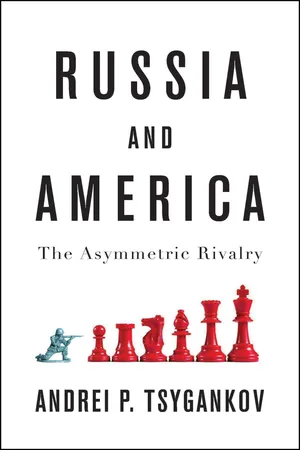
This book seeks to understand how Russia’s foreign policy has changed since Vladimir Putin’s return to presidency in 2012, and how that change has contributed to a new conflict with America. I argue that Russia’s goals and its means to achieve them should be understood in the context of an international transition toward a post-Western and multipolar world. The events of 2016 were crucial in making such transition irreversible. The West’s lack of recognition of Russia’s interests culminated in the conflict over Ukraine’s 2014 Euromaidan revolution, and compelled the Kremlin to take unprecedented steps in defense of its perceived interests, including annexing Crimea, supporting Ukrainian separatists, and intervening in the political and media spaces of the United States and several other Western countries. Although historically the essential drivers of Russia’s international actions had to do with the protection of its geographically limited national interests, Moscow was now prepared to defend those interests in an increasingly aggressive and global fashion. The United States’ dismissiveness toward the Kremlin’s complaints, Russia’s preoccupation with security and great power status, and Vladimir Putin’s character have all caused US-Russia relations to deteriorate to the point of what both sides acknowledge is an ‘all-time low’.
Russia and America
Contemporary Russia and America are competitors rather than partners on most international issues. The Kremlin has challenged US hegemony both globally and in regional settings. Cooperation has become more difficult, while conflicts between the two countries have grown more intense, widened in scope, and taken on new dimensions. What in the 1990s was a disagreement over the nature of European security has developed into a rivalry over multiple regional and global issues, including the Middle East, Asia, nuclear and cyber security, energy, and values.
This progressive worsening of US-Russia relations has evolved through several cycles.1 Following the early 1990s reforms in Russia, and attempts to establish cooperative international relations in Europe, the United States adopted the policy of expanding NATO eastward, excluding Russia from the process. Moscow responded by pursuing policies of integrating the former Soviet states under Russia’s leadership, and strengthening ties with China, India, and other non-Western states.
The arrival of Vladimir Putin as Russia’s new president in spring 2000 was the beginning of another cycle in the country’s attempts to improve relations with the United States. Following the terrorist attacks on the US in September 2001, Russia sought to establish itself as a reliable partner in fighting terrorism globally, and, on that basis, to strengthen its economic and political ties with the West. However, already in the first half of 2003, the initially positive dynamics in US-Russia relations began to reverse as new tensions appeared, pushing the two sides toward conflict. In addition to the continued expansion of NATO, the United States declined negotiations over nuclear security by unilaterally withdrawing from the ABM Treaty. In May 2003, the US also invaded Iraq, over the opposition of Russia, France, Germany, and several other countries. In the meantime, Washington supported regime change in countries neighboring Russia, grew critical of the latter’s political system as increasingly authoritarian, and supported energy projects that undermined Moscow’s clout in Europe and Eurasia.
Responding to these moves, the Kremlin challenged US priorities in Europe, the Middle East, the nuclear arena, and democracy promotion. Russia launched a program of military modernization, sought to strengthen its position in global energy markets, and adopted policies to limit Western influence inside the country. In August 2008, following Georgia’s military attack on South Ossetia and the deployment of Russian peacekeepers in the area, the Kremlin invaded Georgia. By defeating the army of a US ally in the region, Russia signaled that it was no longer prepared to accept the above-listed policies of the United States.
In 2009 the two countries made yet another attempt to establish cooperative relations. As with the two previous efforts, this one also failed. US president Barack Obama began his term in office by trying to “reset” relations with Russia, despite its intervention in Georgia, while Russia’s new president Dmitry Medvedev demonstrated an openness to America’s new approach. The two countries sought to leave behind their disagreements by signing a new START agreement and cooperating on several other issues. But the old concerns about European and Middle Eastern security, the US missile defense system, and democracy promotion continued to negatively affect relations. From the Kremlin’s perspective, the United States, by refusing to negotiate over European security, meddling in Russia’s domestic affairs, and intervening in the Middle East to preserve its global power, demonstrated that it still did not take Russia’s concerns seriously.
These disagreements culminated in the Ukraine crisis that ended the third cycle and led to a new US-Russia conflict. Washington supported a regime change in Kiev that Moscow labelled as an “anticonstitutional coup.” The subsequent Russian annexation of Crimea and support for Eastern Ukrainian separatists resulted in US-initiated Western sanctions against the Russian economy. The severity of the new crisis and the two sides’ insistence on the legitimacy of their respective actions promised a prolonged period of rivalry, eliminating any prospect of another attempt at normalization or “reset.”
The election of Donald Trump as US president in November 2016 served to consolidate these negative trends and became a lightning rod for fresh condemnations of Russia by Western leaders. The Kremlin’s initially high hopes for normalizing relations with America soon evaporated, Trump’s declared intention to strengthen ties with Moscow notwithstanding. The election caused a deterioration of the US-Russia relationship beyond expectations, adding the issue of Russian meddling in American domestic affairs to the already extensive list of disagreements. After US intelligence agencies concluded that Russia had indeed intervened in the US presidential election,2 the issue became central to the new internal struggle between Trump and the Washington establishment. Russia’s cyber activities, military strategy, and media role have come under particular scrutiny, with multiple investigations, hearings, and reports seeking to uncover the Kremlin’s true intentions and capabilities.
In this climate, relations reached a new low during 2017. The US House of Representatives’ approved a new package of sanctions against Russia, Iran and North Korea; both sides expelled diplomats and closed several diplomatic facilities; tensions erupted over Ukraine, the Middle East, North Korea, and the poisoning of British citizen Sergei Skripal and his daughter; and there were mutual accusations concerning nuclear treaty violations and the growing use of cyber weapons. In response to these developments, the United States and other Western governments imposed new sanctions against Russian officials and state-connected businesses, and sixty Russian diplomats were expelled from the United Kingdom and other European countries. The meetings between American and Russian leaders that took place in 2017 and 2018 were non-confrontational and business-like, yet did not result in agreements. Indeed, each such meeting generated a highly negative domestic reaction from the American political class and led to new US sanctions against Russia’s officials and economy.
Is Russia launching a new Cold War?
Many observers describe the US-Russia conflict as a revived Cold War that is set to define the two sides’ relations. The narrative of a new Cold War commands attention in political and scholarly circles. Critics of Russia tend to blame it for its non-democratic values and great power “revisionism.” For instance, the former US Ambassador to Russia Michael McFaul presents the current relations with Russia as a new ideological struggle between democracy and autocracy.3 Other observers, including Robert Legvold, document erroneous expectations and policies on both sides. While acknowledging that the contemporary era is different in many respects, Legvold points to similarities with the early stages of the Cold War (1948–1953), including a dangerous polarizing rhetoric and zero-sum perception on both sides, as well as potentially devastating global outcomes.4 Even those sympathetic to Russia’s position, such as Stephen Cohen, describe the new US-Russia relationship as a Cold War.5 These analysts place responsibility for the conflict on the United States’ insensitivity to Russia’s interests and concerns, and not surprisingly Russian analysts frequently argue a similar case. Sergei Karaganov and Dmitri Suslov, for example, accuse the United States of attempting to impose the framework of a global Cold War on Russia and China for the purpose of weakening them as potential competitors.6
As compelling as it may seem to some observers, however, the Cold War framework is misleading. It fails to grasp the nature of the contemporary world and Russia’s objectives in it. The current global context differs from that of the Cold War in several crucial ways. Most importantly, the Cold War narrative fails to address the global power shift and transitionary nature of the contemporary international system. In today’s world, the old ideological dichotomy between communism and capitalism is no longer applicable. Rather, the competition now takes place in a global information space and is predominantly between liberal and nationalist ideas about how to regulate the economy and the political system. While in the eyes of many the West continues to represent liberalism, the realities of Brexit, Trump, and tightening migration regulations in the European Union demonstrate the global appeal of nationalist ideas.7 The struggle between nationalism and liberal globalism is now intensifying within the West. Trump’s proclaimed intention to reduce America’s military obligations abroad and engage in economic protectionism signify major departures from both the Cold War and post-Cold War globalization. On the other hand, China, Russia, and other allegedly autocratic and nationalist polities continue to favor the preservation of a liberal global economy, opposing both regional autarchy and Trumpian protectionist policies.
As a result of this new global context, new expectations about the international system and state behavior within it are gradually being formed. The West initiated the post-Cold War globalization yet its rules of basic economic openness created the conditions for the rise of non-Western competitors. China, Russia, India, Turkey, Iran, and others are seeking to carve out a space for themselves in the newly emerging international system, just as the United States is struggling to redefine its place and identity in the new world. These changes have altered the position of the only superpower in the international system. Structurally, it is still the familiar world of American military, political, and economic domination. Yet dynamically the world is moving away from its US- and West-centeredness,8 even though the e...