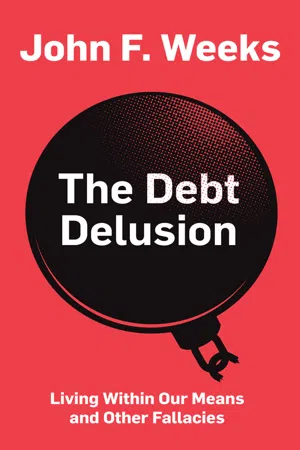
'Governments should spend no more than their tax income.' Most people in Europe and North America accept this statement as simple common sense. It resonates with the deeply engrained economic metaphors that dominate public discourse, from 'living within your means' to 'balancing the budget' – all necessary, or so conventional wisdom holds, to avoid the dangers of debt, taxation and financial ruin.
This book shows how these homely metaphors constitute the 'debt delusion': a set of plausible-sounding yet false ideas that have been used to justify damaging austerity policies. John Weeks debunks these myths, explaining the true story behind public spending, taxation, and debt, and their real function in the management of our economies. He demonstrates that disputes about public finances are not primarily technical matters best left to specialists and experts, as many politicians would have us believe, but rather fundamentally questions about our true political priorities.
Requiring no prior economic knowledge, this is an ideal primer for anyone wishing to cut through the rhetoric and misinformation that dominate political debates on economics and become an informed citizen.
- English
- ePUB (mobile friendly)
- Available on iOS & Android
eBook - ePub
About this book
1
We Must Live Within Our Means
The Myth Itself
Perhaps the most difficult of all the austerity myths to pin down is the injunction that “we must live within our means.” The message deeply embodied in this phrase has little relationship to the words. Rather, it serves as the apparently definitive answer to the question “Can our government spend more?” We can imagine a politician speaking at a meeting of constituents, and a concerned citizen asks, “Why is it necessary to reduce spending on school meals?” And the elected representative answers, “The overall government budget is in deficit and we must live within our means.”
If the constituent retorted with, “Why must we live within our means?,” the assembled group might break into laughter, because every sensible person knows “we must live within our means.” If the constituent instead went to the heart of the matter and asked, “What do you mean by ‘means’?,” the politician, if a patient person, might say, “I mean that the government obtains its money from taxation and we cannot spend money we do not have.” That would probably induce affirmative nods from the audience.
What are our “means” and what or who determines them? What does “live within” convey? A dictionary provides no enlightenment. Equally vacuous is the closely related phrase, often applied to household budgets, that “families struggle to make ends meet.” These clichés serve as emotional entreaties rather than practical guidelines, like “emojis” at the end of an email.
When in the 1980s the UK Prime Minister Margaret Thatcher made her famous assertion that government budgets are like household budgets, she was half right for the wrong reason. She was wrong in that, unlike her mythical households, real households do not operate with balanced budgets. They borrow long-term to invest (mortgages) and short-term to bridge temporary financial difficulties (such as when changing jobs and when faced with emergency expenditures). Governments do the same: they borrow to invest (e.g., in schools and hospitals) and to cover short-term emergencies (recessions).
To understand how this happens and its full implications, we must specify some concrete circumstances. The clearest way to begin the discussion is to analyze central governments in countries that have their own national currencies – the US dollar, British pound, Japanese yen and Chinese renminbi are the most important ones by size of the transactions they facilitate. Central governments with national currencies have “central banks” (e.g., the Bank of England and the US Federal Reserve System), public institutions that manage the national currency within the constraints of the legal mandate set by the central government itself.
To be even more concrete, we begin with governments in high-income countries that have their own currencies. This specification is necessary because financial markets in low-income countries and in many middleincome countries (sometimes identified as “emerging economies”) have unsophisticated financial sectors of relatively low development. Many central banks operate through financial markets, but small or undeveloped financial markets in which a few banks or corporations have disproportionate power severely limit the ability of central banks to conduct policy.
The discussion that follows applies to North America (Canada and the United States), the Western European countries with national currencies (the United Kingdom, Denmark, Norway, Sweden and Switzerland), Japan and some of the middle income countries of Asia, but almost no African country except South Africa. An important caveat is necessary. The rules on central government borrowing and central bank operations vary across countries. Our discussion and analysis apply most closely to the UK and the US, whose government institutions are quite similar when considering the relationship between the central government and the central bank.
The fundamental difference is that a government of a country with its own currency can borrow from itself, which households cannot. To use a cliché, the ability of a government to borrow from itself is a “game changer.” Governments with their own currencies can always “make ends meet,” though they must be wise in managing their “means.” It is not a simple task. Explaining how governments and central banks pull off this apparent trick – making ends meet that are unmeetable for households – takes center place in our first myth-busting.
What Are Our Means?
Central to the austerity narrative is the apparently innocuous advice that we should “live within our means,” a rule for sound household money management. For households, by “living within our means,” we “make ends meet.” For governments, this bit of common sense means not spending “what isn’t there” and always being sure “where the money will come from.” We find the same semi-moral entreaty applied to entire countries. If what we import and consume from other countries exceeds our exports, then we go into debt with other countries to cover the difference. As a country, we “live beyond our means” and “need to tighten our belts.”
Moving from clichés to real-world practice, households, businesses, governments and countries need not and frequently do not live within their means. When they do not, they incur “debt.” Further along we analyze the nature of debt and the forms it takes. In anticipation of that analytical discussion, I define debt tautologically as the result of not living within our means, not making ends meet.
“Living within our means” has a superficial validity that brings to mind George Joye’s definition in 1535 of common sense as “the plain wisdom that everyone possesses.” About 400 years later the American social theorist Stuart Chase commented, “common sense tells us the world is flat.” Treating the world as flat is not necessarily absurd. It can be both rational and necessary. For many tasks, such as driving an automobile from one city to another, the flat-earth hypothesis works. It’s just common sense that a straight road is the shortest distance between home and the supermarket. But no airline pilot or ship’s navigator should adopt it. The common-sense flat-earth hypothesis applies as far as the horizon (myopically), but not much beyond. For substantial distances navigators use what is known as the “Great Circle Route,” the shortest distance between two points on a globe (the orthodromic route). By analogy, the common-sense understanding of “means” as a flow of income has limited relevance beyond the horizon of the household.
In practice a household funds its expenditures in three ways – the incomes received by its members (from work, income-generating assets such as stocks and bonds, or social support payments from governments), the sale of assets, or borrowing. Most people in Europe and North America work for someone else. The regularly employed receive incomes determined by a contract with the employer. This contractual arrangement provides the greatest part of their “means.” Rational budgeting for the regularly employed treats income, the means, as fixed by the employer, household asset values and government support programs.
In these circumstances, “living within our means” has a clear interpretation. The sum of household expenditures over the budget period should be equal to or less than the fixed and predictable income flow during that time period. The household manager has little control over the determinants of income but can purchase less or more. Introductory economics textbooks describe “making ends meet” as the household operating “within a budget constraint.” The phrases are equivalent.
If variable expenditures exceed fixed income, the household must either sell assets or borrow. Sale of assets means a fall in household wealth. Only a few households, the very rich, can continue this indefinitely (which provides support for Hemingway’s famous retort to F. Scott Fitzgerald when he said: “Ernest, the rich are different from us”; Hemingway replied, “Yes, they have more money”). The other option, we “live beyond our means” funded by borrowing, results in a debt that the household must finance out of its fixed income flow.
From the household point of view, failing to cover expenditure with the flow of income results in what are clearly undesirable outcomes. Household wealth declines either directly, by sales of assets, or indirectly, by going into debt that reduces net wealth (household assets minus liabilities). In addition, the running cost of not living within your means increases by the interest on the accumulating debt. Borrowing provides a temporary solution, but the cost of servicing the accumulating debt increases the difficulty of “making ends meet.”
In practice the cost of borrowing tends to vary inversely with income. The lower a household is on the income pyramid, the higher is the interest rate to borrow because lenders consider the poor risky clients. This empirical generalization, “the poor pay more,” in part explains the infamous “sub-prime” mortgage market in the United States, whose collapse provided the trigger (but not the cause) for the global financial crisis of the late 2000s.
Some household borrowing creates assets, such as mortgages for a home and loans to purchase an automobile. If properly evaluated, these debts should prove expenditure-reducing rather than expenditureincreasing for households. This type of borrowing creates an asset to balance against the debt. The interest payments on the asset-creating loan become part of the expenditure that household income must cover. The asset “pays for itself” because it generates a service that replaces part of household spending (e.g., mortgage cost replaces rent).
These one-off borrowings do not contradict the myopic generalization that a household should live within its means. The perspective of the precariously employed and the rich will be quite different. But the middle-class perspective, that of Margaret Thatcher, holds tightly to the sound budgeting parable, that households must constrain their variable expenditures within the fixed income flow, in order to keep “living within their means.”
The flat-earth approach to budgeting does not apply to governments, local or national, whose incomes (their “means”) are not fixed. “Means” are a political choice. The power to tax gives the power to determine the “means” within which a government operates. For that reason alone we can dismiss the simple myth that “governments have only so much income and must live within it.” Governments determine their means by establishing and modifying the tax structure and rates, subject to accountability to the electorate. The more sophisticated version of the parable is that, whatever income governments choose to generate by tax, they must live within it – i.e., they must balance their budgets.
How Governments Borrow
Before deconstructing the government balancing act (the second myth), we must complete the analysis of what determines the means within which governments should operate. “Means” of a government are not the same as tax revenue. As for households, governments can borrow. The outcome of government borrowing is different than it is for households. The first step to analyze public-sector borrowing is to be explicit about the process. Bonds – promises to pay – provide the mechanism for public borrowing at all levels of government.
A bond is a piece of paper (even in this digital age) that commits the borrower both to pay the purchaser (lender) a specific amount by a stated future date and to pay interest on the specified amount. For example, a local or national government might offer for sale a $100 (or £100 or €100) bond that promises full repayment a year later (the “maturity date”), and during that year to pay 5 percent of the sale price to the buyer for the privilege of having the buyer’s money for that twelve months.
Buyers of government bonds may be businesses, commercial banks, households, public institutions, or other governments. For all buyers, public bonds function as an extremely important, irreplaceable asset. Except under unusual circumstances (treated in Myth 2), public bonds represent an extremely safe asset. In 2018 the private companies that rate corporate and public bonds assigned the “debt paper” of Britain, France, Germany and the United States to their safest category (“AAA”). The bonds of the British government are frequently known as “gilts,” because in the past the paper on which they were printed was literally gilt-edged.
Public bonds themselves are a “liquid” (vendible) asset. Should the holder of a public bond want cash before the end of the bond’s life, the owner can sell that bond to anyone willing to purchase it. By convention these resales are said to occur in a “secondary market.” In secondary markets public bonds may encounter speculation, a possibility considered later in the discussion of the function of public debts. At this point we focus on the dual nature of public bonds, a liability for the issuing government (a debt to be repaid) and a safe asset for the purchaser.
The next step is to consider borrowing for different levels and types of governments. In many countries, local and state (or provincial) governments can and do borrow, usually to finance investment projects such as public transport. In 2010 the outstanding stock of bonds issued by US municipal governments reached almost $4 trillion, almost all of which held AAA investment rating. Analogously to household borrowing, sub-national governments cover the interest and repayment (the “debt service”) by tax revenue (“general obligation” bonds) or the income generated by the investment project itself (e.g., public transport charges). All over the world, and especially in North America and Europe, sub-national governments “live within their means” by taxing and borrowing.
The myopic common-sense view that governments, like households, “should not spend money that isn’t there” turns out to be more nuanced that it first appears. By selling bonds, sub-national governments transfer money from the private sector to themselves. As a result, governments have more money “there” to spend. For the economy as a whole this money transfer involves a shift of private saving to public spending.
Sub-national governments can extend the horizon of their “means.” National governments can completely discard the flat-earth approach to budgets. When considering the budgeting of national governments we must go straight to the Great Circle approach and leave the common-sense funding horizon behind. Separating national governments into two categories is the next step to understand the meaning of how they “live within their means.” The two categories are governments of countries with a national currency (US dollar, British pound, Japanese yen) and those countries that share a common currency. The eurozone is the most important shared currency group, distantly followed by the fourteen-member common currency zone in Frenchspeaking sub-Saharan Africa (all using the so-called CFA franc). Because of the extremely low development of the financial sectors of CFA countries, they are not relevant to our discussion.
For public budgets, the most important consequence o...
Table of contents
- Cover
- Front Matter
- Introduction: Debt, Deficits and Austerity
- 1 We Must Live Within Our Means
- 2 Governments Must Balance Their Books
- 3 We Must Tighten Our Belts
- 4 Never Go into Debt
- 5 Taxes Are a Burden
- 6 Austerity: There is No Alternative
- 7 Always an Alternative
- Index
- End User License Agreement
Trusted by 375,005 students
Access to over 1.5 million titles for a fair monthly price.
Study more efficiently using our study tools.
Frequently asked questions
Yes, you can cancel anytime from the Subscription tab in your account settings on the Perlego website. Your subscription will stay active until the end of your current billing period. Learn how to cancel your subscription
No, books cannot be downloaded as external files, such as PDFs, for use outside of Perlego. However, you can download books within the Perlego app for offline reading on mobile or tablet. Learn how to download books offline
Perlego offers two plans: Essential and Complete
- Essential is ideal for learners and professionals who enjoy exploring a wide range of subjects. Access the Essential Library with 800,000+ trusted titles and best-sellers across business, personal growth, and the humanities. Includes unlimited reading time and Standard Read Aloud voice.
- Complete: Perfect for advanced learners and researchers needing full, unrestricted access. Unlock 1.5M+ books across hundreds of subjects, including academic and specialized titles. The Complete Plan also includes advanced features like Premium Read Aloud and Research Assistant.
We are an online textbook subscription service, where you can get access to an entire online library for less than the price of a single book per month. With over 1.5 million books across 990+ topics, we’ve got you covered! Learn about our mission
Look out for the read-aloud symbol on your next book to see if you can listen to it. The read-aloud tool reads text aloud for you, highlighting the text as it is being read. You can pause it, speed it up and slow it down. Learn more about Read Aloud
Yes! You can use the Perlego app on both iOS and Android devices to read anytime, anywhere — even offline. Perfect for commutes or when you’re on the go.
Please note we cannot support devices running on iOS 13 and Android 7 or earlier. Learn more about using the app
Please note we cannot support devices running on iOS 13 and Android 7 or earlier. Learn more about using the app
Yes, you can access The Debt Delusion by John F. Weeks in PDF and/or ePUB format, as well as other popular books in Economics & Economic Policy. We have over 1.5 million books available in our catalogue for you to explore.