Largely privately funded with relatively little public regulation, the United States healthcare system is both expensive and inefficient, providing poor care to large parts of the population.
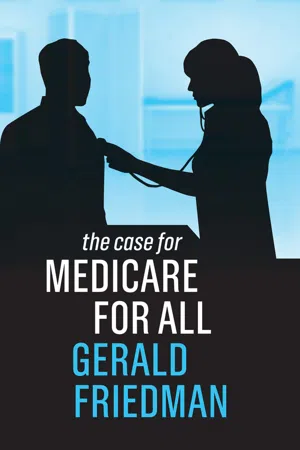
For decades, Americans have wrestled with how to fix their broken healthcare system. In this razor-sharp contribution to the healthcare debate, leading economist and former adviser to Bernie Sanders Gerald Friedman recommends that we build on what works: a Medicare system that already efficiently provides healthcare for millions of Americans. Rejecting the discredited idea that healthcare should be treated like any other commodity, Friedman shows that healthcare is distinctive and can be best provided only through universal program of social insurance. Deftly exposing the absurdities of the opponents of reform, Friedman shows in detail how the solution to our health care crisis is staring us in the face: enroll everyone in Medicare to improve the health of all Americans.
This bold and brilliantly argued book is essential reading for anyone who wants to see Congress and the White House act to provide America with a 21st century healthcare system.
- English
- ePUB (mobile friendly)
- Available on iOS & Android
eBook - ePub
The Case for Medicare for All
1
Why Markets Cannot Work in Healthcare
Professor Arrow’s Classic
Awarded the Nobel Prize in Economics in 1972 at the age of 51, the youngest winner ever, Kenneth Arrow was an almost legendary figure in economics. A socialist in his youth, Arrow remained a social democrat throughout his life, but some of his most important work has often been misconstrued by conservatives as defending unregulated markets. Nowhere has this curious misconstruction been so powerful, and so pernicious, as in relation to Arrow’s 1963 article, “Uncertainty and the Welfare Economics of Medical Care,” which has since been cited nearly 10,000 times.1
Arrow’s article was meant to bring the analysis of information to the study of imperfect competition. Instead, it spawned a new field of health economics, where economists often cite Arrow before proceeding to discuss healthcare as if it is a commodity like cappuccinos or soft drinks. Few remember, if they ever understood, Arrow’s point: medical care cannot be treated like other commodities because of fundamental information asymmetries. Alas, once they leave an author’s pen, ideas take on a life of their own. If economists have used Arrow’s words to make arguments contrary to his intent, all we can do is to try to recapture his meaning.
Arrow anticipated the failure of the market turn in healthcare. In well-functioning markets, competition among multiple suppliers drives costs and prices down to the cost of production because consumers seek out the highest quality at the lowest prices. This process does not work in healthcare due to information asymmetries that mean “consumers” (a.k.a. the sick and disabled) must rely on the judgment of others about what they need to buy, leading inevitably to concentrations of market power.2
The Problem of Healthcare Market Power
Healthcare will often be provided by institutions with market power. Providers operate in large facilities, like hospitals. Hospitals, specialist practices with dedicated machinery, pharmaceutical companies with large research facilities: all operate at a large scale that limits the number of competitors, giving each the power to influence prices.3
Even more important than scale, however, is the role of information. Few consumers can evaluate providers or treatment plans; even trained professionals do little better than amateurs in choosing providers.4 Every doctor is different, patients with identical diagnoses are different, each doctor-patient relationship is different. Feeling unwell, patients go to a doctor, not knowing what problems they may face, or even if they have a problem. They enter physician offices largely unaware of the proper treatment they require. Instead of comparing essentially equivalent bars of soap, where buyers can evaluate price and quality, healthcare “consumers” compare providers of unknown and unknowable quality.
Facing such uncertainty, people rely on quality signals, brand names, reputation, the experience of others, advertising, even prices. Buying services that literally can be the difference between life and death, higher prices can increase demand because they are signals of quality. Signals steer patients to a small subset of providers who thus have real market power because people believe they provide better care and save lives. Massachusetts General Hospital, New York Presbyterian, Johns Hopkins, Yale New Haven, the Mayo Clinic, the Cleveland Clinic: these institutions do not compete on a level playing field with other hospitals and providers, and they advertise to further enhance their brands.5 Their reputation gives them the leverage to raise prices.6 The importance of reputation encourages providers to merge with marquee providers—hospitals with a reputation for extraordinary quality.
The Problem of Health Insurance
Arrow also highlighted the way uncertainty complicates the problem of health insurance. We do not know what healthcare we will need or when, or how much it will cost. Most of us, most of the time, spend little on healthcare; half of Americans spent less than $1000 in 2018. Or we may hit the jackpot: 1% spent nearly $200,000 in that same year. The only things that we know with certainty are that we will need healthcare, that it will be very expensive, and that having access to care may make the difference between our living and dying.
It is generally true that people prefer the security of guaranteed small losses to the risk of very large ones. Since classical times, insurance has developed to provide that security by spreading the risk of very bad outcomes among larger groups. Facing the risk of fire, people buy homeowners insurance, paying a certain amount every year to receive money for a new home if needed. Facing mortality risk, people buy life insurance, accepting small losses in premiums for compensation in case of death. Facing the uncertainty of ill health and subsequent healthcare expense, people buy health insurance.
Arrow shows how asymmetric uncertainties create special problems for health insurance. Where no one knows the risks facing individuals, insurers can set premiums based on population averages, confident that the law of large numbers will generally protect them from extreme risk. But where subscribers have privileged information, insurers fear that anyone looking to buy insurance anticipates that they will need coverage. They fear “adverse selection,” where people buy insurance because they know that they are more likely to need coverage than the population average, and so will cost more to cover than the insurance company expects. At the extreme is “moral hazard,” where people buy insurance precisely because they intend to use the policy.7
Moral hazard and adverse selection lead to destructive insurance company practices, including the creation of an enormous wasteful bureaucracy dedicated to screening subscribers. Companies invest in bureaucrats, underwriters, claims adjusters and investigators, all to police subscribers and to screen for moral hazard and adverse selection. To discourage moral hazard and limit their risk from adverse selection, they limit the value of insurance with provisions for cost-sharing, deductibles, and co-pays, consciously reducing the social welfare gains from insurance. Insurers have also learned that they can profit by screening for certain subscribers. In a process called “cherry picking,” they advertise for those unlikely to use insurance; by “lemon dropping,” they discourage those more likely to need insurance. They have created giant research operations and marketing departments to develop better screening, including multiple plans with alternative benefit structures to steer potential subscribers towards plans more profitable to the insurer, at the expense of providing adequate coverage to the sick and needy.
Social Insurance and Health Insurance
While all insurance suffers from problems of uncertainty, adverse selection, and moral hazard, these problems are much greater for health insurance.8 Life, homeowner or automobile insurers worry that people will destroy their own property, or even arrange their own deaths, to collect insurance. But these insurers usually find enough protection in a relatively small staff of insurance inspectors and, of course, the work of the police. In other cases, however, the risks of adverse selection and moral hazard are so severe that private insurance cannot function and insurance can only be provided by agencies with the legal authority to require universal coverage and to engage in more intrusive inspection to prevent fraud. For unemployment or income insurance, the risks of fraud are so great that private companies do not offer policies.9 Public bodies offer coverage in these cases, through social insurance programs like Unemployment Insurance, because they can mandate universal coverage, eliminating the danger of adverse selection, and have the state authority to monitor behavior to reduce the danger of moral hazard.
As a society, we want people to receive quality healthcare because it raises productivity when people are healthy and because, as a community, we want people to live long, healthy lives. Most countries, then, treat health insurance like income insurance, with public provision to capture the benefits of insurance while avoiding adverse selection with universal provision and moral hazard through state supervision.
The case for social health insurance goes further, beyond efficiency to questions of equity, humanity, and citizenship. Valuing all as equal citizens, we do not want healthcare to be reserved only for those with the most money. Or, even worse, to trust healthcare decisions to private companies whose profits depend on their ability to deny access to healthcare. But this is exactly the situation with private health insurance. Insurers pay close attention to their “medical loss ratio” (MLR)—the share of insurance revenue paid out in health benefits—because a low ratio means that more is available for profits. Every dollar paid out in benefits is a dollar lost from profits.
For managers of insurance companies, a high MLR means they are suffering from adverse selection and moral hazard, but a low MLR shows that they are doing their job of maximizing profits. I...
Table of contents
- Cover
- Front Matter
- Preface: We Need Better
- Introduction: The Failure of Free Market Healthcare
- 1 Why Markets Cannot Work in Healthcare
- 2 Can We Afford Medicare for All?
- 3 From Here to There Is Politics
- 4 Universal Healthcare Is Better Economics Because It Acknowledges Human Rights
- End User License Agreement
Trusted by 375,005 students
Access to over 1.5 million titles for a fair monthly price.
Study more efficiently using our study tools.
Frequently asked questions
Yes, you can cancel anytime from the Subscription tab in your account settings on the Perlego website. Your subscription will stay active until the end of your current billing period. Learn how to cancel your subscription
No, books cannot be downloaded as external files, such as PDFs, for use outside of Perlego. However, you can download books within the Perlego app for offline reading on mobile or tablet. Learn how to download books offline
Perlego offers two plans: Essential and Complete
- Essential is ideal for learners and professionals who enjoy exploring a wide range of subjects. Access the Essential Library with 800,000+ trusted titles and best-sellers across business, personal growth, and the humanities. Includes unlimited reading time and Standard Read Aloud voice.
- Complete: Perfect for advanced learners and researchers needing full, unrestricted access. Unlock 1.5M+ books across hundreds of subjects, including academic and specialized titles. The Complete Plan also includes advanced features like Premium Read Aloud and Research Assistant.
We are an online textbook subscription service, where you can get access to an entire online library for less than the price of a single book per month. With over 1.5 million books across 990+ topics, we’ve got you covered! Learn about our mission
Look out for the read-aloud symbol on your next book to see if you can listen to it. The read-aloud tool reads text aloud for you, highlighting the text as it is being read. You can pause it, speed it up and slow it down. Learn more about Read Aloud
Yes! You can use the Perlego app on both iOS and Android devices to read anytime, anywhere — even offline. Perfect for commutes or when you’re on the go.
Please note we cannot support devices running on iOS 13 and Android 7 or earlier. Learn more about using the app
Please note we cannot support devices running on iOS 13 and Android 7 or earlier. Learn more about using the app
Yes, you can access The Case for Medicare for All by Gerald Friedman in PDF and/or ePUB format, as well as other popular books in Economics & Economic Policy. We have over 1.5 million books available in our catalogue for you to explore.