- English
- ePUB (mobile friendly)
- Available on iOS & Android
eBook - ePub
About this book
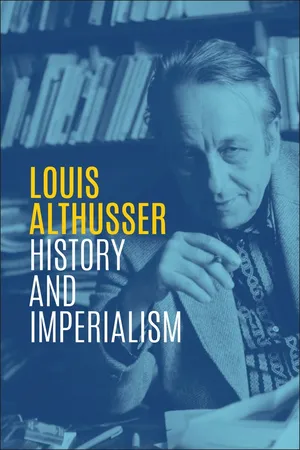
Writings on History brings together a selection of texts by Louis Althusser dating from 1963 to 1986, including essays, a lecture, notes to his collaborators, and the transcript of an informal 1963 discussion of literary history. The centrepiece of this collection is Althusser's previously unpublished Book on Imperialism, a theorization of globalized capitalism that remained unfinished. All these writings are concerned with the place of history in Marxist theory and, in particular, on what Althusser considered to be the mortal danger of historicism haunting the revolutionary reading of the present. They testify to his continuing dialogue with the historiography of his day, several of whose representatives were engaged in discussion and debate with him. Deeply interested in history but intent on avoiding the kind of interpretation that would transform it into a deterministic force, Althusser never ceased to reflect on the equilibrium between the historical and the concept in Marxist historiography, an equilibrium that he sought to reinvent for his time. The traces of that undertaking, which continues to generate debate throughout the world today, are brought together in this volume.
Information
Book on Imperialism (1973) (extracts)
[To my readers]
This book is about a question ‘classic’ in Marxism since Lenin: imperialism.
Why this book?
For a simple reason. We are living in the ‘stage’ of imperialism, which is the last stage in the history, that is, the existence, of capitalism. Even if we are struggling against imperialism alongside the working class, we are subject to imperialism. To defeat imperialism, we have to know imperialism; we have to know what distinguishes it from the other stages of capitalism; we have to have as precise an idea as possible of its specific characteristics and mechanisms. It is on this condition alone that the proletarian class struggle will be well conducted and can culminate in revolution, the dictatorship of the proletariat and the construction of socialism on the Long March that will bring us from capitalism to communism.
But, it will be said, these things are well known. Under those conditions, why this book?
These things are well known. … Is that so very certain? True, we talk about imperialism and happily repeat Lenin’s formulas about imperialist wars and acts of aggression, about the dividing up of the world, about the pillaging of the non-imperialist countries’ riches and so on. True, we supported the heroic struggle of Indochina’s peoples against French imperialism and then American imperialism, both of which were militarily and politically defeated on the ground by an adversary smaller than they were and, above all, different from them. Look, however, at what happens: we have a natural tendency to identify imperialism with ‘colonial’ or ‘neo-colonialist’ conquest and aggression, with the pillaging and exploitation of the Third World. All that is indeed part of what imperialism has in its hunting bag. But are we aware that imperialism operates first and foremost in the metropolitan countries, at metropolitan workers’ expense? That imperialism is first and foremost a domestic (and global) matter before it is a matter of foreign interventions?
Things must therefore be clear.
For Lenin, imperialism is capitalism’s ‘supreme stage’, its ‘ultimate’, ‘culminating’ stage, in an extremely precise sense. It is the last stage in the history, that is, the existence, of capitalism. Afterwards it’s all over: no more capitalism. Afterwards it’s the proletarian revolution, the dictatorship of the proletariat and the construction of socialism. Afterwards there begins the very long ‘transition’ that should bring us from capitalism to communism: the construction of socialism, precisely, paving the way for the transition to communism.
But beware! When Lenin says that imperialism is the last stage of capitalism and that afterwards it’s all over, we must realize
1. that this last stage can last a long time; and
2. that afterwards we will find ourselves facing an alternative; afterwards it is ‘either socialism or barbarism’. This phrase is taken from Marx and Engels.1 It means that history does not tend ‘naturally’ and automatically towards socialism, for history is not pursuing the realization of a goal, as all idealists believe. It means that if circumstances are favourable, that is, if the proletarian class struggle has been well conducted, if it is well conducted, then and then alone can the end of capitalism culminate in revolution and socialism, leading to communism by way of the long march of the ‘transition’. Otherwise, the end of capitalism can lead to ‘barbarism’. What is barbarism? Regression while remaining in place, stagnation while remaining in place, of a kind of which human history offers examples by the hundreds. Yes, our ‘civilization’ can perish in place, not only without rising to a higher ‘stage’ or sinking to a lower stage that has already existed, but in accumulating all the suffering of a childbirth that will not end, of a stillbirth that is not a delivery.2
[On the Marxists’ Relation to Marx’s Work]
What I would like to expound is, in the end, very simple. If we have a tendency to consider it very complicated or even ‘complex’ (a word which, although it is all the rage in the Party, only serves to foreclose all explanation when the subject is the least bit unsettling), that tendency is the effect of a cause which is itself very simple, at least in principle. It is not because Marx’s explanations are complicated, nor is it because Marx, who had, on his own, to tear himself away from the enormous mass of bourgeois ideology pressing down on him, to take precautions by the thousands, to guard against dangers right and left and arm himself with every possible argument. No. For it has been more than one hundred years since Marx wrote Capital. More than one hundred years in which to read it, clear up the problems in it and correct its inevitable mistakes. (Of all the scientists who founded a science, which one did not utter a few inanities in setting out on [his] giant’s task?) More than one hundred years to understand it, quite simply.
What use has been made, in this respect (understanding Capital), of those one hundred years? One that is, on careful consideration, strange, disconcerting, unprecedented and, in many respects, stupefying. For if Capital’s main teachings have plainly been integrated into the proletarian class struggle, into labour unions and proletarian parties (that is by far the most important thing, politically speaking), we have to admit that our understanding of Capital has made precious little progress.
What did the Second International’s great intellectuals – I do not just mean Kautsky, a non-negligible Marxist (see The Agrarian Question)3 or Bernstein, who was open to challenge very early on, but even Mehring4 (who wrote a life of Marx)5 and Rosa Luxemburg (who must, however, be treated with special consideration, for, Lenin dixit, she was an ‘eagle’)6 – what did these great intellectuals, generally academics with wide experience in reading, explaining and even producing commentaries on texts, make of Capital? As far as reading goes, they read it, certainly better than anyone else, and in any case better than the Marxists of our generation. They read it, but they did not understand it. They fell short of the Capital they read. Lenin had to tell us why: they read it as Marxist academics. They did not read it from the standpoint of the proletariat’s theoretical class positions. Hence, they read it from theoretical class positions that were (more or less) bourgeois.
The only person to have read Capital (very young) and understood it (straightaway) was Lenin. His early texts bear witness to this. He made no mistake about what he read. Right away, he grasped the class meaning of Marx’s work and understood that, to understand Capital, one had to read it from class theoretical and political positions. Hence the extraordinary textual commentaries in Lenin’s first essays, in which he forcibly brought to the Populists’ and other romantic economists’ attention the elementary truth that Marx is not Political Economy, but the critique of Political Economy: that is to say, above all, the critique of economism, because economism alone believes that Political Economy is Political Economy.
Lenin, however, was not just the one reader truly faithful to Marx, the one reader of Capital truly faithful to Capital. He ‘developed Marxist theory’. He wrote in one of his early works, precisely (What the Friends of the People Are), that ‘Marx’s theory … has only laid the foundation stone of the science which socialists must develop in all directions’.7 Lenin was then thinking (he says so explicitly here) of the concrete analysis of each Western country – but he was also thinking further than that. And he proved what he said, not just in the field of the practice of the class struggle, where he put forward decisive new theses, but also in the field of theory, where he gave us very important philosophical theses (the decisive link, unequal development and so on), and in the field of historical materialism, where he gave us the theory of imperialism (if in very schematic form, on his own admission).
Lenin himself, however, did not alter Marx in the least. In a passage of What is To Be Done?, I believe it is, he says he is in favour of revising Marxism, for every science has to be corrected, for every science is ‘infinite’ and, consequently, must begin with necessarily imperfect formulas, which one must know how to correct as one goes along. And he cites Mehring (the man whose name I was trying to recall) as an example of a Marxist who corrected certain inaccurate affirmations of Marx’s (probably affirmations about history).8 Lenin says: Mehring was right to revise Marx, because he did so while taking all possible scientific precautions. To this, Lenin opposes Bernstein’s pseudo-revision, which is merely a lapse into bourgeois ideology. Thus, Lenin recognized in principle (citing Mehring’s example) that the science founded by Marx has necessarily to be corrected in order to pursue its life as a science. Otherwise, it would no longer be science, but a collection of formulas and recipes fallen from the rank of the sciences.
Yet Lenin, who extended Marxist science with the theory of imperialism, never corrected a single formula of Marx’s after declaring that it was inaccurate and in need of correction for such-and-such a reason. Is this entirely accurate? No. For we observe that Lenin felt free not to use certain philosophical formulas of Marx’s in his own work. This was, no doubt, a way of judging them inappropriate, since he did not take them up. It was a criticism, if one likes, but a criticism that did not state its reasons, perhaps because Lenin considered them blindingly obvious. (For example, the category of alienation, the pride and joy of our bourgeois Marxologists and even many communist Marxists today, a category still present in Capital, disappears completely in Lenin: obviously, he does not need it in order to understand Capital.)
If, however, we leave this symptomatic sile...
Table of contents
- Cover
- Contents
- Title page
- Copyright page
- Epigraph
- Acknowledgements
- Note on the Text
- A Conversation on Literary History (1963)
- Supplementary Note on History (1965–1966?)
- On Genesis (1966)
- How Can Something Substantial Change? (1970)
- To Gretzky (1973) (extract)
- Draft of a Reply to Pierre Vilar (undated: 1972? 1973?)
- Book on Imperialism (1973) (extracts)
- Marx and History (1975)
- On History (1986)
- Index
- End User License Agreement
Trusted by 375,005 students
Access to over 1.5 million titles for a fair monthly price.
Study more efficiently using our study tools.
Frequently asked questions
Yes, you can cancel anytime from the Subscription tab in your account settings on the Perlego website. Your subscription will stay active until the end of your current billing period. Learn how to cancel your subscription
No, books cannot be downloaded as external files, such as PDFs, for use outside of Perlego. However, you can download books within the Perlego app for offline reading on mobile or tablet. Learn how to download books offline
Perlego offers two plans: Essential and Complete
- Essential is ideal for learners and professionals who enjoy exploring a wide range of subjects. Access the Essential Library with 800,000+ trusted titles and best-sellers across business, personal growth, and the humanities. Includes unlimited reading time and Standard Read Aloud voice.
- Complete: Perfect for advanced learners and researchers needing full, unrestricted access. Unlock 1.5M+ books across hundreds of subjects, including academic and specialized titles. The Complete Plan also includes advanced features like Premium Read Aloud and Research Assistant.
We are an online textbook subscription service, where you can get access to an entire online library for less than the price of a single book per month. With over 1.5 million books across 990+ topics, we’ve got you covered! Learn about our mission
Look out for the read-aloud symbol on your next book to see if you can listen to it. The read-aloud tool reads text aloud for you, highlighting the text as it is being read. You can pause it, speed it up and slow it down. Learn more about Read Aloud
Yes! You can use the Perlego app on both iOS and Android devices to read anytime, anywhere — even offline. Perfect for commutes or when you’re on the go.
Please note we cannot support devices running on iOS 13 and Android 7 or earlier. Learn more about using the app
Please note we cannot support devices running on iOS 13 and Android 7 or earlier. Learn more about using the app
Yes, you can access History and Imperialism by Louis Althusser, G. M. Goshgarian in PDF and/or ePUB format, as well as other popular books in Philosophy & Philosophy History & Theory. We have over 1.5 million books available in our catalogue for you to explore.