We have long accepted the face as the most natural and self-evident thing, believing that in it we could read, as if on a screen, our emotions and our doubts, our anger and joy. We have decorated them, made them up, designed them, as if the face were the true calling card of our personality, the public manifestation of our inner being.
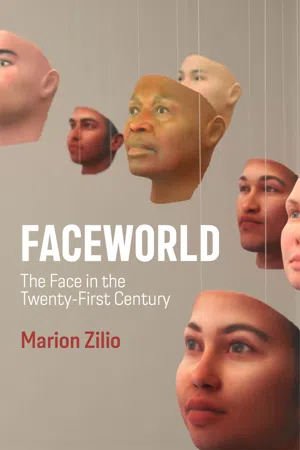
Nothing could be further from the truth. Rather than a window opening onto our inner nature, the face has always been a technical artefact—a construction that owes as much to artificiality as to our genetic inheritance. From the origins of humanity to the triumph of the selfie, Marion Zilio charts the history of the technical, economic, political, legal, and artistic fabrication of the face. Her account of this history culminates in a radical new interrogation of what is too often denounced as our contemporary narcissism. In fact, argues Zilio, the "narcissism" of the selfie may well reconnect us to the deepest sources of the human manufacture of faces—a reconnection that would also be a chance for us to come to terms with the non-human part of ourselves.
This highly original reflection on the fabrication of the face will be of great value to students and scholars of media and culture and to anyone interested in the pervasiveness of the face in our contemporary age of the selfie.
- English
- ePUB (mobile friendly)
- Available on iOS & Android
eBook - ePub
Faceworld
About this book
Information
1
After the Face
It was the night of the 86th Annual Academy Awards. The red carpet had been rolled out and anyone who was anyone was there, dressed up to the nines. But if the 2019 Oscars were a watershed moment, it was not because of the acclaim for Twelve Years a Slave, which garnered the first nomination for a black director, Steve McQueen; nor was it on account of the fabulous acceptance speech given by Jared Leto, looking remarkably like Jesus. No, that evening’s ceremony was set to become a double record-breaker as the most liked and most shared image on the planet proceeded to break Twitter. ‘We have made history,’ proclaimed host Ellen DeGeneres, having received notification from the social network, while still live on air, that an outage had been caused by the runaway sharing of what has since been dubbed the ‘selfie of the century’. In less than thirty minutes, the image had travelled around the world and across time zones and had been retweeted more than two million times, smashing the record previously held by a 2012 photograph of Barack Obama hugging his wife Michelle when he was re-elected. Although still pinned on the host’s Twitter page, today the Oscars image with its 3.4 million retweets already seems like old news. Three years after the event it was relegated to the ranks of former record holders by a certain Carter Wilkerson, a teenager who made a bet with his favourite restaurant chain in the hope of winning a year’s supply of free chicken nuggets.
#NuggsForCarter overtook Degeneres’s selfie – or should we say usfie – of a gaggle of stars, in which she appeared alongside Bradley Cooper, Meryl Streep, Julia Roberts, Brad Pitt, Angelina Jolie, Lupita Nyong’o, and Jennifer Lawrence. But what had seemed like a spontaneous whim on the part of the Oscars host was actually an impressive marketing coup orchestrated by Samsung – the evening’s sponsor – to promote its Galaxy Note 3 smartphone. Making the stars into unwitting brand ambassadors, the South Korean manufacturer’s VIP marketing strategy had converted their faces into exchange value, potentially revealing something more than just their own ‘visibility capital’. Not that there was anything new in itself about the idea of using icons’ faces as a sales pitch. Neither was there anything extraordinary, in a digital culture, about images being circulated, shared, and manipulated in all sorts of ways. And yet this act did herald a new turn, functioning as a kind of decisive punctum that would drive contemporary research on the selfie and determine its orientation.
The historic photo was taken on 2 March 2014 – just a few months before the word ‘selfie’ was officially added to the Oxford English Dictionary. Even though online self-portraiture had been silently proliferating for years, and even though various social networks revolved around images of users’ faces, suddenly everyone was rushing to register their take on this new object. Who would denounce the narcissistic tendencies and egotistical neurosis of the individual? Who would see it as a vast database capable of producing a sociology of the contemporary ethos, as in Lev Manovich’s SelfieCity project?1 Who would accuse it of being a profiling tool designed for advertisers or an aspect of the ‘Facebookization’ of the world? And finally, who would see this new face as a conversational object,2 no longer the preserve of an oversized ego but open to others and to the world, in accordance with a relational logic typical of the so-called ‘Web 2.0’ era? Treated as pure data, quantifiable and analysable by way of a host of diagrams, curves, and algorithms, the face had become an insubstantial reflection of the contemporary aspirations courted by the industries of singularity.
But all that these proliferating discourses were really saying was that the portrait and the self-portrait genre no longer made much sense. The face was now operating in terms of avatars, profiles, traces, and indexes, apparently following a path opened up by the nineteenth century: that of a calculative reason, a limitless ratio that stripped the face of all its enigmatic qualities, converting it into a cipher only so as to decipher it with ever greater precision. Yet few commentators sought to trace these practices back to the processes that had originally generated them. And few paid any attention at all to a shift in terminology that had taken place unnoticed: no longer unique and private ‘portraits’, commemorative souvenirs of our forebears, but ‘faces’ – faces which had now become images, flows, commodities, screens for all kinds of phantasmatic, economic, and technical projections.
In response to this shift, during the twentieth century, art – which of course had been responsible for the first portraits – had instigated a programme of ‘defacialization’. Everywhere faces were devoured, masked, erased, and reified. Artists sought progressively to obliterate the categories of the ‘subject’, the ‘self’, and the ‘I’; in other words, the category of identity in its most immutable, substantial, and metaphysical forms. This led to the creation of faceless faces, faces that were pure exteriority without interiority. No doubt the atrocities of war had left their black mark on the history of the contemporary face, as the themes of the ugly and the formless went hand in hand with the century of great wars. But the fact that the humanity of man could not survive the horror of the Shoah, and that this epiphany had brought him into conflict with his own stereotype, could actually be traced back to more complex antecedents. For the slippage from portrait to face and subsequently to the non-face actually responded to another crisis: the paradoxical crisis of the invention of the face.
This paradox is internal and unselfconscious: rooted in the most decisive features of the face, it operates in utmost secrecy. Whence this discrepancy: never in human history has the face been so widely represented and so firmly established; but at the same time, never has it seemed so threatened by emptiness and extinction. Affected by this obscure rift, the face seems at odds with itself; it seems to be consuming itself from within. Today the face may run a daily gauntlet of mirrors and multiple images of itself, it may circulate through networks and be shared by interconnected devices – indeed, all of this may have become more commonplace than ever before. But anyone who interrogates the origins of the face, and more precisely the possibility of individuals observing themselves, cannot deny that with the invention of the face, what we are dealing with is an event in the history of humanity that is relatively recent and, to say the very least, singular.
Chronicle of a Death Foretold?
With the Facebookization of the world, we have become so used to holding a book of faces in the palm of our hand that we no longer have any sense of the uneasiness of our ancestors, less than a century and a half ago, when for the first time they were able to pick up and hold their own externalized faces. Over a very short period, anyone and everyone would find themselves in possession of their face, materialized in an external medium. Thanks to photography, a portrait could be stored in a jacket pocket, passed from hand to hand, and transmitted from generation to generation. This democratization would be accompanied by an increasing uniformity and banalization of the face, to the point where some portraits could be switched in photographers’ studios without the customer even noticing. The mass production and standardization of ‘portraitomania’ was accompanied by something close to a misrecognition of one’s own face.
Although even today it is the lot of any person with restricted visual access to their face – limited to the traditional photographs of school classes, birthdays, and other such events – this deficiency in recognition has for the most part been superseded by a sort of hypermnesia: an infinite memory of self-images, where memory no longer designates the remembrance of the past or the outcome of a long-term crystallization, but instead a flashback, often to an anodyne moment, part of an everyday life constructed and broadcast in real time. Today the face of a foetus may be posted online even before birth. Plastic surgery can mould a face on demand, and science has made it possible to transplant a face – soon it will be a head – onto another body. Saudi Arabia has just granted citizenship to a silicon face supposedly inhabited by an artificial intelligence, and the latest iPhone has made the face into a password. Who knows, in the near future we may file patents to assert our right to the uniqueness of our own face. We will no longer worry about surveillance cameras, but about applications that steal identities by manipulating expressions – like Face Swap Live, which allows Snapchat users to try on different faces in real time. By exchanging their own face directly and automatically with another, or with something else, this app allows its users to take on the features of an animal, an older person, someone of the opposite sex, a film star mask, or even a bicycle wheel. It’s a feature that certainly lends itself to comic antics, but it is not difficult to imagine how it could be misused for criminal purposes. The promises of such effects are already tantalizing Hollywood studios quite prepared to spend millions of dollars on bringing back dead actors or rejuvenating ageing stars. We have begun to see the first attempts, in Fast and Furious 7 and Star Wars: The Force Awakens, and in experiments by the research team who were able to make Vladimir Putin smile and Donald Trump say whatever they wanted him to. Since the face is exteriorized from the very outset, it is no doubt this potential for faces to be stored, modelled, and infinitely manipulated that explains digital natives’ preference for applications that feature a pseudo-ephemeral temporality, where images are not captured but continually vanish into oblivion.
Facebook is a medium for people in their thirties, the medium of a generation that experienced the transition from analogue to digital, from the pre- to the post-Internet age with all of its personalized prostheses and their connected microphones and cameras. For ten years now it has served as a metaphor for the face’s new destiny – a face that is edited and published, eager to advertise and exhibit its intimacy. This everyday sociality may seem vulgar to our contemporaries, but in fact it lays the foundations for another reading of the face. The face may not just be a stimulus like any other, the metaphysical tradition may have seen it as the site of the encounter with the Other, and modern psychology may have postulated that it constitutes a primary form of interiority; but what has been forgotten is that individuals – that is to say, indivisibles – are only subjects in so far as they participate in a subjectivity that is shared, engaging with an exteriority that cannot be dismissed as merely secondary.
It is this exterior aspect, long consigned to the shadowy world of Platonic appearances or the depths of the unconscious, that constitutes the enigma of the face. Formerly the locus of an existential quest, in its contemporary form the face now seems more like a return of the repressed. The modern epoch exposed the face to its dark counterpart, reified and rendered banal by technical reproduction and exposure value. It became an inter-face, possessing the qualities of both interiority and exteriority, container and content, but also human and non-human. Modernity dreamt of a subject that observed, named, and possessed, but couldn’t accept the fact that this subject itself would become the object of that same ‘masterful panoptic egotism’.3 Humankind’s continuous observation of itself could not take place without inviting a third term into the equation: the technical milieu. What this revealed was the technogenetic dimension of the face – something which, in turn, would have repercussions for its ontogenesis.
We need only look back to see how, during the industrial epoch, photography’s large-scale proces...
Table of contents
- Cover
- Front Matter
- 1 After the Face
- 2 The Invention of the Face
- 3 The Apparelled Face
- 4 The Space of Appearances
- 5 Critique of the Political Economy of Faces From the ‘Self’ to the Relational
- 6 In the Flow
- Index
- End User License Agreement
Trusted by 375,005 students
Access to over 1.5 million titles for a fair monthly price.
Study more efficiently using our study tools.
Frequently asked questions
Yes, you can cancel anytime from the Subscription tab in your account settings on the Perlego website. Your subscription will stay active until the end of your current billing period. Learn how to cancel your subscription
No, books cannot be downloaded as external files, such as PDFs, for use outside of Perlego. However, you can download books within the Perlego app for offline reading on mobile or tablet. Learn how to download books offline
Perlego offers two plans: Essential and Complete
- Essential is ideal for learners and professionals who enjoy exploring a wide range of subjects. Access the Essential Library with 800,000+ trusted titles and best-sellers across business, personal growth, and the humanities. Includes unlimited reading time and Standard Read Aloud voice.
- Complete: Perfect for advanced learners and researchers needing full, unrestricted access. Unlock 1.5M+ books across hundreds of subjects, including academic and specialized titles. The Complete Plan also includes advanced features like Premium Read Aloud and Research Assistant.
We are an online textbook subscription service, where you can get access to an entire online library for less than the price of a single book per month. With over 1.5 million books across 990+ topics, we’ve got you covered! Learn about our mission
Look out for the read-aloud symbol on your next book to see if you can listen to it. The read-aloud tool reads text aloud for you, highlighting the text as it is being read. You can pause it, speed it up and slow it down. Learn more about Read Aloud
Yes! You can use the Perlego app on both iOS and Android devices to read anytime, anywhere — even offline. Perfect for commutes or when you’re on the go.
Please note we cannot support devices running on iOS 13 and Android 7 or earlier. Learn more about using the app
Please note we cannot support devices running on iOS 13 and Android 7 or earlier. Learn more about using the app
Yes, you can access Faceworld by Marion Zilio, Robin Mackay in PDF and/or ePUB format, as well as other popular books in Art & History of Art. We have over 1.5 million books available in our catalogue for you to explore.