Political parties that once dominated Western democracies have been shaken to the core. Many have suffered electoral debacles, as in France, Italy and Greece, while mainstream political parties in the UK and the US have found themselves struggling to cope with outcomes – in the form of Brexit and the election of Trump – that were not anticipated. We are witnessing nothing less than the exhaustion of a century-old cleavage between traditional left and right parties due to their inability to perceive and tackle present-day challenges, such as declining social mobility, mounting environmental crises, rising geographic inequality, tensions over migration and multiculturalism, etc. The 'populists', from Salvini and Le Pen to Trump and Bolsonaro, were the first to understand this and supply an alternative.
But contrary to what many observers now predict, we are not doomed to witness the replacement of the ancient political order by the populists' rise to power. In France, Emmanuel Macron launched a new movement that stopped them. Though things have sometimes been tough, 'En Marche!' has successfully implemented an entirely new programme of reforms and has been given some comfort by recent election results. In this short book, David Amiel and Ismaël Emelien – two of Macron's closest advisers and key architects of 'En Marche!' – build on this experiment and reflect on its successes and failures to define a new grassroots progressivism for Western countries based on three principles and ranging from public policies to electoral strategy, from ideology to party organization.
This could form the bedrock for a wider counter-offensive against the populism of our times.
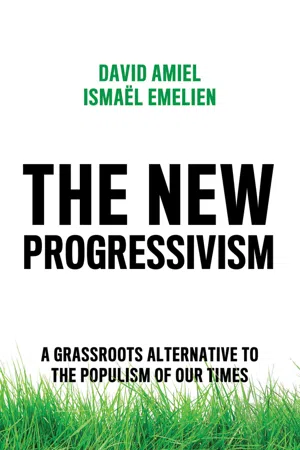
eBook - ePub
The New Progressivism
A Grassroots Alternative to the Populism of our Times
- English
- ePUB (mobile friendly)
- Available on iOS & Android
eBook - ePub
The New Progressivism
A Grassroots Alternative to the Populism of our Times
About this book
Information
1
The society of frustration
Imagine there’s no heaven/It’s easy if you try/No hell below us/Above us only sky/Imagine all the people/Living for today …
John Lennon, ‘Imagine’, 1971
The opposition between left and right structured the political life of the majority of Western countries for most of the twentieth century. However, the traditional parties that embodied this situation are now marginalized (as in France and Italy), running out of steam (as in Germany and Spain), severely challenged (as in the United Kingdom) or deeply traumatized (as in the United States, where Donald Trump has profoundly shaken up the Republican Party). The phenomenon is so widespread that the simultaneity of these developments cannot be a mere coincidence; rather, it represents the acceleration in recent years of a phenomenon that has been ever more evident since the 1970s, namely the exhaustion of a certain political system. To understand it, we first need a brief historical retrospective.
The strange split between left and right
The triumph of the ideal of individual autonomy has been an essential factor of Western political life for the last two centuries.1 For millennia, daily life consisted in accepting and carrying out the duties imposed by society as best one could. Power was an impenetrable thing that crushed ordinary men and women with all the weight of tradition: people obeyed their king, their lord, their paterfamilias; customs were followed, and it seemed unthinkable that a future could be both desirable and radically different from the past. With the Enlightenment, and the American and French revolutions, all this fell to pieces. The ideal, first fostered by the bourgeoisie, was now autonomy: people were to choose their own laws by the light of reason. In other words, the aim was to allow everyone to be in charge of their individual lives as far as possible, while participating as citizens in collective decision-making.
In theory, the individual no longer has to conform to society: it is up to society to organize itself around the individual. If some people wish to govern, they must do so for the happiness of the greatest number, and submit to their criticism as well as to their deliberations. That is what is called democracy: a community of free people governing themselves freely. Traditions no longer have any intrinsic value: we select from the past what suits us, and we invent what is lacking. That is what is called progress. In a word, the individual once had duties; now he or she mainly has rights.
This aspiration is not at all self-evident. Two centuries have been necessary for it to transform representations and realities. It was a radical innovation that first aroused two opposite reactions.2
One reaction consisted in saying that we must pursue this breakthrough in individual freedoms to its logical conclusion. We will call these people, for the sake of convenience, ‘liberals’, in a sense both broader than that which often prevails in the contemporary debate, and also broader than that which prevailed in the past. We include in this category both the British Liberal Party and many French Republicans of the late nineteenth century. This single term designates a political camp with many different incarnations and names, all of which shared one and the same fundamental aspiration. In the eyes of its followers, the need was to break all the chains that still hampered individuals, restricting their autonomy and preventing them from expressing their singularity. Against tradition, the ‘liberals’ defended the right to divorce, for example. Against arbitrary power, they defended the right to vote, freedom of expression and the right to a fair trial. Against corporations, they defended the right to conduct business as one wishes, and to enter into contracts freely.
Another reaction, however, cast a more critical eye on the claim of empowering individuals. These critics were themselves divided into two antagonistic trends. There were the conservatives, who defended all the Bastilles that liberalism aimed to bring down: they defended the monarchy against the republic, the Church against free thought, the patriarchal model of the family against the emancipation of women and new customs, and so on. Then there were the Marxists, who also contested, albeit in a radically different way, the autonomy of the individual as ‘liberals’ presented it.3 They considered that ‘workers’ did indeed have the right to vote, but were in fact subject to capitalist exploitation, and had no say in choosing their daily destiny. To achieve true autonomy, true freedom, they had first to recognize themselves as members of a social class (the proletariat), organize themselves into a party, prepare for revolution, seize power, and only then, after having gained experience under the dictatorship of the proletariat, would they be able to live fully as autonomous individuals. Thus, conservatives and Marxists refused to countenance establishing autonomy for individuals even if this refusal was definitive for the former and only temporary for the latter.
This tableau, distinguishing between conservatives, Marxists and ‘liberals’, is a schematic and deliberately simplistic way of representing the great currents that dominated the debate in most European countries at the end of the nineteenth century.
The twentieth century has changed the picture dramatically. The categories persist in a more or less underground fashion (there are still Marxists, conservatives, and ‘liberals’) but the most significant split, the one that forges electoral alliances, allows people to place themselves politically in a certain camp, and drives debates in Parliament as well as at family meals, became the split between left and right. It spread far beyond Europe to most democracies. This split has older roots, but it has also played a major and familiar role until quite recently.4
At first sight, however, this split is an oddity: after all, each camp was divided within itself – on the left, between left-wing ‘liberals’ and Marxists, and on the right, between right-wing ‘liberals’ and conservatives.
For ‘left-wing liberals’, often active in social democratic, democratic or socialist parties, the economic priority is equality. In their view, the order created spontaneously by capitalism and the market economy is neither necessarily fair nor always efficient. For example, the fact that workers cannot provide themselves with medical care, and that children cannot educate themselves naturally, limits the autonomy of the individual. Thus, ‘left-wing liberals’ help to set up mechanisms of redistribution and protection, including progressive taxation, free public services and national insurance. Moreover, in social matters, they remain the foremost defenders of the extension of individual rights and public freedoms. For ‘right-wing liberals’, on the other hand, in economic matters, the priority is freedom – the freedom to be an entrepreneur, to create, to innovate and to trade. However, they are afraid of anything that might threaten the economic order, and there are many occasions where they are the allies of the conservatives and willingly share the reluctance of the latter to change society. Throughout their history, they have been quite prepared to adopt repressive positions on matters of security, and traditionalist positions vis-à-vis morals, the family and religion.
This helps to explain the raison d’être of the split between ‘right’ and ‘left’.
In their different camps, ‘liberals’ tempered the extremes and gradually contributed to their normalization. Little by little, most parties of the left as well as of the right converged on a regulated market economy, combining the dynamism of capitalism with the stability offered by the welfare state, simultaneously improving both the fairness and the efficiency of our economies. Little by little, most conservatives resigned themselves to social change and defended ever narrower stances (as with their opposition to women’s right to vote, to abortion, to same-sex marriage, and to assisted reproductive technology).
‘Left-wing liberals’ and ‘right-wing liberals’ in turn helped to create a desirable order. ‘Left-wing liberals’ – often working via social democratic or socialist parties – provided the necessary redistribution of wealth and social progress. ‘Right-wing liberals’ provided the necessary economic energy and, by acting as guides for the conservative neighbours with whom they often coexisted in the same political formations, they also made it possible to adapt cultural change to the public’s mindset.
The ideal of autonomy seems to have hardly any substantial ideological alternatives in the West. This triumph is evident both at the political and social levels. The last monumental ideological rival, communism, collapsed in the second half of the twentieth century. As we shall see, even Western populism (that of Trump, Le Pen, Salvini, etc.) feeds on this democratic rhetoric, even if it wishes to pervert the institutions that actually make such rhetoric possible. When we look at ordinary citizens, it is spectacular how the idea that everyone should be allowed to improve his social position (as opposed to the conservative emphasis on inheritance) but through individual efforts (as opposed to the socialist ‘class struggles’) has triumphed. It is especially striking, for instance, to see that working-class employees simply aspire to see their efforts rewarded and therefore can be as quick to denounce the ‘profiteers’ above them as those existing ‘on welfare’ below (an idea that populism has been particularly good at exploiting). The problem is that their efforts are not rewarded.
The promise betrayed
Let’s get back to the current situation. It is far from being the ‘best of all worlds’ for which the preceding fresco might have led us to hope. A wave of revolt is blowing through the wealthy nations of Europe and America as well as the poorer nations such as Brazil, in multicultural societies, such as the United Kingdom, and more homogenous societies, such as Italy, in countries where inequalities in income have risen dramatically, such as the United States, and in countries that have contained these inequalities thanks to a high level of redistribution, such as France.
In each case, however, this revolt expresses the same frustration. We can understand it only if we examine citizens’ expectations – that is to say, in the final analysis, the implicit promise that society made to them, a promise that has obviously not been met. What was this promise? The greatest level of autonomy for all, in other words the ability of individuals to control as far as possible the essential parameters of their lives.
In the case of Western countries, the golden age of this ideal was reached between the 1960s and the 1980s. It is hardly surprising if this was also the period in which alternatives to liberal democracy ran out of steam. All the signs seemed to promise that individuals would now have the means to attain their ambitions: economic growth and mass education, progress in individual rights and the collapse of religious and patriarchal authority, the independence and democratization of the developing countries and the defeat of totalitarianism. It had never been so easy to believe that you could define your existence by your work, your efforts, your merits – by moving elsewhere, if necessary, to pursue your dreams, or by climbing the social ladder to forge your own destiny.
The hour of a new humanism seemed to have struck. But it never struck for everyone. Over the next forty years, the promise that had been drummed into everyone’s head began to seem increasingly hollow. The gap has grown between words and realities and has now reached a breaking point.
We are enjoined (in the media, in businesses, at school) to seize new ‘opportunities’. Yet this ubiquitous call in fact speaks only to a few. The daily life of the vast majority is made up of diminishing possibilities and multiple segregations, both insidious and manifest. Despite the ...
Table of contents
- Cover
- Front Matter
- Introduction
- 1 The society of frustration
- 2 Maximizing possibilities (or the first principle of progressivism)
- 3 There are more possibilities when we act together (or the second principle of progressivism)
- 4 Starting from the bottom (or the third principle of progressivism)
- 5 Populist suicide Conclusion
- Conclusion
- End User License Agreement
Trusted by 375,005 students
Access to over 1.5 million titles for a fair monthly price.
Study more efficiently using our study tools.
Frequently asked questions
Yes, you can cancel anytime from the Subscription tab in your account settings on the Perlego website. Your subscription will stay active until the end of your current billing period. Learn how to cancel your subscription
No, books cannot be downloaded as external files, such as PDFs, for use outside of Perlego. However, you can download books within the Perlego app for offline reading on mobile or tablet. Learn how to download books offline
Perlego offers two plans: Essential and Complete
- Essential is ideal for learners and professionals who enjoy exploring a wide range of subjects. Access the Essential Library with 800,000+ trusted titles and best-sellers across business, personal growth, and the humanities. Includes unlimited reading time and Standard Read Aloud voice.
- Complete: Perfect for advanced learners and researchers needing full, unrestricted access. Unlock 1.5M+ books across hundreds of subjects, including academic and specialized titles. The Complete Plan also includes advanced features like Premium Read Aloud and Research Assistant.
We are an online textbook subscription service, where you can get access to an entire online library for less than the price of a single book per month. With over 1.5 million books across 990+ topics, we’ve got you covered! Learn about our mission
Look out for the read-aloud symbol on your next book to see if you can listen to it. The read-aloud tool reads text aloud for you, highlighting the text as it is being read. You can pause it, speed it up and slow it down. Learn more about Read Aloud
Yes! You can use the Perlego app on both iOS and Android devices to read anytime, anywhere — even offline. Perfect for commutes or when you’re on the go.
Please note we cannot support devices running on iOS 13 and Android 7 or earlier. Learn more about using the app
Please note we cannot support devices running on iOS 13 and Android 7 or earlier. Learn more about using the app
Yes, you can access The New Progressivism by David Amiel,Ismael Emelien, Andrew Brown in PDF and/or ePUB format, as well as other popular books in Politics & International Relations & Political Process. We have over 1.5 million books available in our catalogue for you to explore.