Religion and International Security
eBook - ePub

Religion and International Security

  1. English
  2. ePUB (mobile friendly)
  3. Available on iOS & Android
eBook - ePub

Religion and International Security

About this book

Religious violence is on the rise globally. Hardly a day passes without news of a vicious attack being carried out in the name of religion. Religion can, of course, bring security to many but its perversion leads to insecurity for all. Why is this? How and why do so many claim to act on God's behalf to inflict deliberate human suffering?

In Religion and International Security Lee Marsden explores the return of religion as a major cause of insecurity in the contemporary world. He guides readers through the different theoretical perspectives surrounding the study of religion and security, arguing that the secular bias that marginalized the role played by religion in recent times must change to reflect the realities of the emerging post-secular international order. Packed with examples from around the world, the book offers a thoughtful and nuanced exploration of religion and security through key themes such as religiously motivated and inspired terrorism and warfare, the human security of women and gay people in religiously dominated communities, and the capacity for religious communities and leaders to heal conflict through peacebuilding. For those who would rather deny a role for religion when considering security, the genie is truly out of the bottle. This book seeks to understand this phenomenon and how to come to terms with it.

Frequently asked questions

Yes, you can cancel anytime from the Subscription tab in your account settings on the Perlego website. Your subscription will stay active until the end of your current billing period. Learn how to cancel your subscription.
No, books cannot be downloaded as external files, such as PDFs, for use outside of Perlego. However, you can download books within the Perlego app for offline reading on mobile or tablet. Learn more here.
Perlego offers two plans: Essential and Complete
  • Essential is ideal for learners and professionals who enjoy exploring a wide range of subjects. Access the Essential Library with 800,000+ trusted titles and best-sellers across business, personal growth, and the humanities. Includes unlimited reading time and Standard Read Aloud voice.
  • Complete: Perfect for advanced learners and researchers needing full, unrestricted access. Unlock 1.4M+ books across hundreds of subjects, including academic and specialized titles. The Complete Plan also includes advanced features like Premium Read Aloud and Research Assistant.
Both plans are available with monthly, semester, or annual billing cycles.
We are an online textbook subscription service, where you can get access to an entire online library for less than the price of a single book per month. With over 1 million books across 1000+ topics, we’ve got you covered! Learn more here.
Look out for the read-aloud symbol on your next book to see if you can listen to it. The read-aloud tool reads text aloud for you, highlighting the text as it is being read. You can pause it, speed it up and slow it down. Learn more here.
Yes! You can use the Perlego app on both iOS or Android devices to read anytime, anywhere — even offline. Perfect for commutes or when you’re on the go.
Please note we cannot support devices running on iOS 13 and Android 7 or earlier. Learn more about using the app.
Yes, you can access Religion and International Security by Lee Marsden in PDF and/or ePUB format, as well as other popular books in Politics & International Relations & International Relations. We have over one million books available in our catalogue for you to explore.

1
Theorizing Religion and International Security

While Western intellectuals and policy makers have sought to marginalize and neutralize religion within domestic and international polity as part of the Enlightenment project, religion has stubbornly refused to depart the scene. Indeed, for much of the world, religion has always been a significant component of political systems, individual and communal life. Even within the West the absence of religious actors in international politics and security has been illusory, with the contribution of religious actors to international security over the course of the twentieth century largely overlooked or subordinated to discussions of balance of power, security dilemmas, ideological competition and economic interdependence. The dualism of the private and public sphere, the sacred and the profane, is anathema to people and communities of faith where such division is artificial, a social construct which enables the development of theory at the expense of ignoring a significant empirical component.
The Iranian revolution of 1979, the mujahideen campaign against the Soviets in Afghanistan, emergence of Islamism as a rival to secular and pan-Arabism in the Middle East, the role of Pope John Paul II in the Cold War, the individual faith of presidents and prime ministers and the events of 9/11 all require explanations and theorization to enable us better to understand the world. In this chapter we consider how religion has until recently been marginalized in IR theory and Western society, from the Treaty of Westphalia until the religious turn in the early twenty-first century. The chapter explores the secular world order, including the secularization thesis and secularism, before considering Jürgen Habermas’ re-evaluation of the sacred and what has come to be known as the post secular. We then critically engage with the main theoretical paradigms including realism, the English School, liberalism, constructivism, Copenhagen School and Critical Security Studies to see the potential for a greater engagement with religion as a relevant factor within IR. The chapter concludes that existing IR theory needs, and is equipped, to move beyond a secular paradigm in order to understand and theorize more fully about the role of religion – belief, practices and institutions in a global context.

Secular World Order

The myth of a secular world order for IR theorists begins with the Peace of Augsburg in 1555, which marks an agreement between Holy Roman Emperor Charles V and the Schmalkaldic League. The treaty established the principle of cuius regio, eius religio – ā€˜whose region, his religion’, which enabled princes within the Holy Roman Empire to choose whether their region would follow Catholicism or Lutheranism, effectively ceding sovereignty to individual principalities. For subjects dissenting from their ruler's adoption of a particular version of Christianity, there was the option of converting or transferring to another region. The Treaty of Westphalia (1648), bringing the Thirty Years War to an end, built on the Peace of Augsburg, reinforcing the idea of sovereignty. The principle of religious toleration and non-interference in the domestic religious affairs of other states laid the groundwork for a realist international order based on pluralism, with religion subordinate to raison d'Ć©tat and states being the key actors in international relations (Shah and Philpott 2011; Thomas 2005: 54–5).
For mainstream IR theory, the death and destruction caused by religious conflict across Europe necessitated removing religion from politics and establishing principles of non-interference in the internal affairs of other states as a means of reducing the prevalence of war. The privatization of religion was an essential component of modernization and the bringing about of an international system, order or society in an anarchical world. The allegiance of citizens or subjects to a transnational and transcendent religion could be transferred to the state instead, strengthening power and assuring rulers of the loyalty of their subjects. And yet such a narrow reading fails to acknowledge that Westphalia recognized religion's role within the state as its raison d'ĆŖtre. Westphalia produced a necessary but not sufficient condition to explain how religion was relegated in the West from being the central component in the life of the individual, community and state to being a privatized affair.
William Cavanaugh dismisses the idea that the liberal state, privatization of religion and secularization saves us from the excesses of religion's propensity for domestic disputes and international warfare as a myth (Cavanaugh 2002). Scott Thomas suggests that modernization theory is able to supply the missing dimension to account for international relations’ neglect of religion. Modernization theory has three components, beginning with the concept that a ā€˜modern’ society can be distinguished from a ā€˜traditional’ society, the former being characterized by rapid change, flexibility and economic progress, while the latter is regarded as inflexible, ā€˜static or monolithic’. Clearly, both portrayals are stereotypes and overlook change within traditional society. However, the stereotypes serve to restrict the public role of religion to traditional rather than modern society (Thomas 2005: 51).
The second concept of modernization theory is one of universalism – that the process of modernization is linear, from primitive, through traditional to modern society. This progression is an inevitable product of economic and scientific development, which will affect all parts of the world. The Age of Reason and the Enlightenment emerge from the religious foundations of traditional society in the West but these are outgrown, enabling society to continue to develop and progress. The superiority of Western liberal society in this second concept would inevitably extend to the rest of the world with differences between the modern and traditional eventually disappearing, including the public role of religion (Thomas 2005: 51–2).
As part of the belief in the inevitability of universal modernization the third aspect of modernization theory is critically important for attitudes towards religion within policy making and academic theorization. Secularization theory can be traced back to the eighteenth century and is implicit in the seminal works of two of sociology's founding fathers, Weber and Durkheim. As society becomes increasingly educated and modernized a cultural pluralism develops in which religion is no longer preeminent and withdraws, or is withdrawn, from the public square. Social, political and economic institutions will dominate modern society with religion becoming increasingly a private matter. Religion and religious institutions are portrayed as pre-modern, backward, based on irrationality and superstition, which increasingly only has relevance to individuals at the private level. As society becomes more modern the influence of religion and religious observance will decline (Berger 1990; Bruce 2002; Norris and Inglehart 2011; Thomas 2005: 52).
Secularization Theory has paved the way for secularism to dominate Western polity, with its most pronounced expressions evident in the first amendment of the American constitution and the French constitution's introduction of laïcité with walls of separation between Church and State. Restricting religion to the private sphere and minimizing its influence released political, cultural and economic institutions to become utility maximizers operating on the basis of rational decision making. Religion is socially constructed as absolutist, irrational, divisive and backward with a propensity towards violence. While the Treaty of Westphalia was drawn up to put an end to religious violence, modernization was the key to reducing violence and warfare with religion demonized as being the leading cause of wars and violence throughout history (Cavanaugh 2009:17).
Secularization theory has dominated social scientific enquiry and the significance of religion in the public sphere of the liberal nation-state and yet is based on certain myths. It constructs a social world in which modernization and rationality are prerequisites and religion is seen as an impediment to progress. A world where religion and spirituality are no longer forces within th...
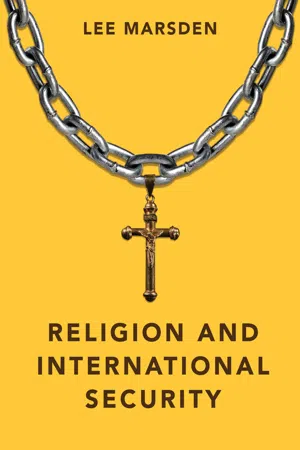
Table of contents

  1. Cover
  2. Table of Contents
  3. Dedication
  4. Title page
  5. Copyright page
  6. Acknowledgements
  7. Abbreviations
  8. Tables and Figure
  9. Introduction: Looking Beyond the Religion as Good or Bad Dichotomy
  10. 1: Theorizing Religion and International Security
  11. 2: Sacred Violence and Clashing Civilizations
  12. 3: Just War and Jihad
  13. 4: Blessed are the Peacemakers
  14. 5: Faith-Based Initiatives and International Security
  15. 6: Suffering and Dying in the Name of God
  16. Conclusion: Religions of Peace and War? A Matter of Choice
  17. Appendix
  18. References
  19. Index
  20. End User License Agreement