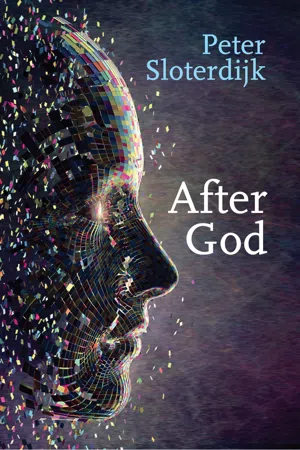
In his Critique of Cynical Reason, Peter Sloterdijk pursued an enlightenment of the Enlightenment in both its beginnings and the present. After God is dedicated to the theological enlightenment of theology. It ranges from the period when gods reigned, through the rule of the world-creator god to reveries about the godlike power of artificial intelligence. The path of this self-enlightening theology, which is carried out here by a non-theologian, must begin well before Nietzsche's declaration of the death of God, and it must move beyond this dictum to explore the present and the future.
Since the early 20th century we have seen how the metaphysical twilight of the gods, which has preoccupied philosophers and theologians, has been accompanied by an earthly twilight of the souls. The emergence of psychoanalysis, and more recently the development of the neuro-cognitive sciences, have secularized the old Indo-European concept of the soul and transferred many accomplishments of the human mind to computerized machines. What remains of the eternal light of the soul after the artificial lights have been turned on? Have the inventors of AI thrust themselves into the position vacated by the death of god? Perhaps the distinction between God and idols will soon re-emerge here for the citizens of modernity, only this time in a technological and political register. For them, theological enlightenment – which is completely different from an instinctive rejection of religion – will be a fateful task.
This new work by one of the most original thinkers today will appeal to students and scholars across the humanities and social sciences, as well as anyone interested in religion, philosophy and critical theory today.
- English
- ePUB (mobile friendly)
- Available on iOS & Android
eBook - ePub
About this book
Information
1
TWILIGHT OF THE GODS
“Every world of gods is followed by a twilight of the gods”*
Rest now, rest, you god!
Richard Wagner, Die Götterdämmerung
I
The intelligentsia of our culturally forgetful days still remembers, partially, that the Greeks of the classical era used the term “mortals” to refer to human beings. Human beings bore this name because they were conceived of as earthly counterparts of the gods, who were called immortals. Immortality was in fact the only eminent feature of the Greek gods. Their behavior hardly differed from that of humans, with their all-too-humanness.
A century ago, amid the convulsions of World War I, Paul Valéry extended the attribute of mortality to high cultures. We should now know, he assured us, that even the great collective constructs (nous autres, civilisations), those integrated by language, law, and the division of labor, are mortal. We should regard it as a happy accident if this immense statement has left behind a trace here and there, in the memory of a culture that bears the old European stamp. “We civilizations” are indeed mortal and, after everything that had happened, we should have taken note of this. No longer should mortality be predicated only of Socrates and his ilk. The term leaves the domain of syllogistic exercises and inundates a continent that does not grasp its Great War. Mortality acquires this new valence not only from the fact that, within four years, more than nine million men were sent to their deaths. What is decisive is that the countless fallen soldiers and civilian casualties seemed to result from the internal tensions of the cultural events themselves. What are cultural nations, and what do civilizations amount to, if they allow such an excess of casualties and self-sacrifices, indeed not only allow it but provoke it from their ownmost [eigensten] impulses? What does this mass consumption of life say about the spirit of the industrial age? What could this unparalleled recklessness toward individual existence possibly mean? When applied to civilizations, the word “mortality” also hints at the possibility of suicide.
The shock to which Valéry’s note bore witness reached deeper than his contemporaries could have known. For once, our insight that civilizations could fall was not relegated to distant worlds such as Nineveh, Babylon, or Carthage. It now applied to great civilizations close at hand: France, England, Russia … These were names that, until yesterday, still resonated with us. They were spoken of as though they were metaphysical universals in the form of peoples. They stood for the supertemporal stability that used to be attributed to clans and to their associations into peoples. Since time immemorial, clans were ruled by the law of ancestry. They embodied the duration that flows through the generations, no matter how much individuals come and go. Valéry: “And now we see that the abyss of history is big enough for all.”1
The twilight of civilization begins at the moment when the inhabitants of the great cultural enclosures suspect that even the most established human systems of the present have not been built for all eternity. They are subject to a fragility that also goes by the name “historicity.” Historicity means for civilizations what mortality means for individuals. In the philosophy of the twentieth century, this idea was applied to individuals under the description of “being toward death.” When related to cultures, it is called historical consciousness.
As a rule, members of the historically affected nations have ignored the idea that their historians are at the same time their thanatologists. Ex officio, thanatologists make the better theologians. Relying on a local point of departure, they leap ahead and assume God’s standpoint at the end of the world and at the end of life. As a rule, historians don’t realize that they are indirectly practicing the perspective of the end when they recall early beginnings.
From a divine perspective, history means nothing but the process of converting what has not yet been into what has been. Only when all being has entered into a state of having been has the “omnipotent god”2 of classical metaphysics reached its goal. Only when it is certain that nothing new will happen any more may God discard the initially intoxicating, but later on compromising attribute of “omnipotence”; this attribute had indeed become increasingly embarrassing and superfluous. At the actual end of history there is neither anything to create nor anything to preserve. Everything that is is there for the sake of what ultimately will be. The dossier of creation is closed. The end God drapes himself in the robe of omnipotence. As soon as knowledge that has become complete is no longer confronted with new tasks on behalf of creativity (or of the “event”), God surveys the universe in its totality. He serenely looks straight through everything that was the case.
In the old European tradition, “apocalypse” designates this moment of looking through things in a comprehensive retrospection. In the strict sense, this means: uncovering all things from the perspective of the end. If everything is complete, everything becomes transparent. The so-called revelations that were available to mortal observers in certain high cultures in the guise of “holy texts” are like vistas into the static beyond that have been fixed at the halfway point. They testify to the fact that higher religions don’t work without rushing things.3 Such pre-haste [Vor-Eile] is subject to the temporal schema of impatient faith: already now, but then all the more! Yet, as a rule, religious apocalypses do not deal with real “ultimate concerns.” They wallow in the depiction of tumults before the advent of the great tranquility.
Whoever accepts such messages as truths is able to imagine leaping ahead and partaking of the total view from the end of time. The spheres of such representations are called “worlds of faith.” They are created in order to bridge the gap between nowness [Jetztzeit] and eternity. The believer nevertheless remains subject to the law of being on her way, in the realm of the temporary [im Vorläufigen]. She knows she can catch up with God only by attaining the same ontological rank in death. This is the case for the ancient Indians as well as for old Europe, and for the domains of Islam no less.
There was a name for those groups of believers who were convinced they could achieve the apparently impossible task of catching up with God media in vita [in the midst of life]. They were called mystics. Thanks to their efforts, transcendence has not remained a completely empty word. These virtuosi of self-renunciation attempted to eschew every sort of separate life outside of God. In this way they devoted themselves to the idea that they had already entered into the beyond here, in this life. Indeed, to die means to give back one’s soul – as the French idiom rendre l’âme expresses it in such a metaphysically fitting way. Yet only when everything has in fact died – whether in advance, or whether at the proper or improper time – will everything that was destined to exist be freed from the compulsion of becoming and of innovation. If we had to say in one sentence what classical metaphysics had in mind, it would be this: it wanted to convert the “world” into participants in the stasis of God’s omniscience. This end was served, among others, by the Stoic and Christian doctrines of providence (Greek pronoia, Latin providentia), which were supposed to secure for the future God’s exposed flanks.
*
The modern world exists because this attempt at conversion failed. Included in modernity is anyone who rejects the idea of a complete emptying of the future into the past and votes for the inexhaustibility of the future, even if this vote excludes the possibility of an omniscient god who, “after all time,” bends back, in a comprehensive retrospective on creation.
The “world” – a word that, as Nietzsche knew better than anyone, was for a long time a “Christian insult”4 – resisted the invitation to empty the future into total pastness, because it renounced the ontological precedence of the past. It offered resistance because, in its struggle with itself and through an autodidactic exertion of remarkable coherence, it had learned to give time its due. Ironically, this new attempt at a deeper understanding of time was carried out on European soil, of all things, the homeland of resolute stasis metaphysics and convulsive apocalypticism. In the philosophical thought of modernity, the fundamental openness of the future was appropriately grasped for the first time. At the intersection of will and representation, the world assumed the form of a project and undertaking. It is not the merchants and seafarers who are responsible for reforming the world into an ensemble of projects, but rather the thinkers who undid the metaphysical paralysis of the future. Thus figures such as Schelling, Hegel, Bergson, Heidegger, Bloch, and Günther, perhaps even Cusa, too, all assume prominent positions in the pantheon of “contemporary” philosophy. Above all others, it was these authors who put an end to the eviction of time and novelty from being. They burst the dead enclosures of ontology by placing time and the new at the heart of being.
II
Ancient Greek mythology had, from afar, anticipated the revenge of time against eternity. It did so when it took the liberty of suggesting that even the immortal gods must reckon with a disaster of a higher order. The Greeks called this power of destiny moira. It embodied an unspecified variable in the background of structural being. Working from the invisible realm, it allotted to all variables what was proper to them. It possessed complete power over the arrangements, the portions, the lots, the destinies. It “prevailed” as a power prior to power, as justice prior to justice, as destiny prior to destinies. It allowed the regime of the Olympians to come into being by effecting a division of powers at the level of the absolute; it demarcated each of the jurisdictions of the chief gods from one another. Hades is appointed ruler of the underworld, Poseidon ruler of what is covered by water, and Zeus ruler of the visible realm under the heavens. When each is allotted his portion from the whole, a decisive step has been taken in the civilizing of the gods.
Look how far removed we are, already at this stage, from the crude power monsters of the pre-Olympian forces, which always wished to dominate everything en bloc! We are still just as far removed from the god of the philosophers and his cyclothymic, now merciful now wrathful doppelganger, the god of theologians! Little is known, even today, about the damage that theologians caused when they elevated “the One” at the expense of “the many.” With their disastrous distinction between God and idols they gave rise to a theodicean epidemic that has still not died away. Didn’t Isaiah a...
Table of contents
- Cover
- Contents
- Title page
- Copyright page
- Translator’s Note
- 1 Twilight of the Gods: “Every world of gods is followed by a twilight of the gods”
- 2 Is the World Affirmable? On the Transformation of the Basic Mood in the Religiosity of Modernity, with Special Reference to Martin Luther
- 3 The True Heresy: Gnosticism: On the World Religion of Worldlessness
- 4 Closer to Me Than I Am Myself: A Theological Preparation for the Theory of the Shared Inside
- 5 God’s Bastard: The Caesura of Jesus
- 6 Improving the Human Being: Philosophical Notes on the Problem of Anthropological Difference
- 7 Epochs of Ensoulment: Suggestions for a Philosophy of the History of Neurosis
- 8 Latency: On Concealment
- 9 The Mystical Imperative: Remarks on the Changing Shape of Religion in the Modern Age
- 10 Absolute and Categorical Imperative
- 11 News about the Will to Believe: A Note on Desecularization
- 12 Chances in the Monstrous: A Note on the Metamorphosis of the Religious Domain in the Modern World, with Reference to a Few Motifs in William James
- Editorial Note
- End User License Agreement
Trusted by 375,005 students
Access to over 1.5 million titles for a fair monthly price.
Study more efficiently using our study tools.
Frequently asked questions
Yes, you can cancel anytime from the Subscription tab in your account settings on the Perlego website. Your subscription will stay active until the end of your current billing period. Learn how to cancel your subscription
No, books cannot be downloaded as external files, such as PDFs, for use outside of Perlego. However, you can download books within the Perlego app for offline reading on mobile or tablet. Learn how to download books offline
Perlego offers two plans: Essential and Complete
- Essential is ideal for learners and professionals who enjoy exploring a wide range of subjects. Access the Essential Library with 800,000+ trusted titles and best-sellers across business, personal growth, and the humanities. Includes unlimited reading time and Standard Read Aloud voice.
- Complete: Perfect for advanced learners and researchers needing full, unrestricted access. Unlock 1.5M+ books across hundreds of subjects, including academic and specialized titles. The Complete Plan also includes advanced features like Premium Read Aloud and Research Assistant.
We are an online textbook subscription service, where you can get access to an entire online library for less than the price of a single book per month. With over 1.5 million books across 990+ topics, we’ve got you covered! Learn about our mission
Look out for the read-aloud symbol on your next book to see if you can listen to it. The read-aloud tool reads text aloud for you, highlighting the text as it is being read. You can pause it, speed it up and slow it down. Learn more about Read Aloud
Yes! You can use the Perlego app on both iOS and Android devices to read anytime, anywhere — even offline. Perfect for commutes or when you’re on the go.
Please note we cannot support devices running on iOS 13 and Android 7 or earlier. Learn more about using the app
Please note we cannot support devices running on iOS 13 and Android 7 or earlier. Learn more about using the app
Yes, you can access After God by Peter Sloterdijk, Ian Alexander Moore, Ian Alexander Moore,Ian Alexander Moore in PDF and/or ePUB format, as well as other popular books in Philosophy & Philosophy of Religion. We have over 1.5 million books available in our catalogue for you to explore.