Do You Really Get Me?
eBook - ePub

Do You Really Get Me?

Finding Value in Yourself and Others through Empathy and Connection

  1. 200 pages
  2. English
  3. ePUB (mobile friendly)
  4. Available on iOS & Android
eBook - ePub

Do You Really Get Me?

Finding Value in Yourself and Others through Empathy and Connection

About this book

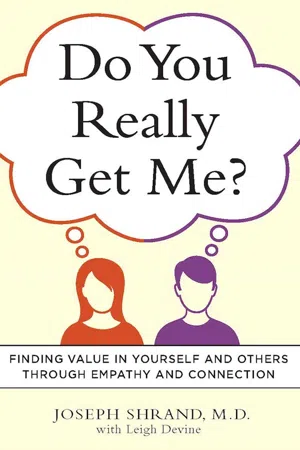
Through his I-Maximum Approach, Dr. Shrand helps readers learn how to set aside self-doubt, show others they are valued, and make more meaningful connections.Through his I-Maximum Approach, Dr. Shrand helps readers learn how to set aside self-doubt, show others they are valued, and make more meaningful connections.In a sense, we all try to be mind readers. We “theorize” about whether we are admired or envied, despised or loved. Psychologists use the term “Theory of Mind” to describe our natural tendency to make assumptions about what others think and how they feel about us based on the tone of their voice, facial expressions, and body language. These cues either signal us to open up further and make a connection or to put up a wall to protect ourselves from rejection. But it is also easy to misinterpret these cues and become unnecessarily guarded, such as when someone appears to be angry with us and we later learn they were just having a bad day and the negative signs we were picking up really had nothing to do with us.The more emotional baggage we bring to our interactions, the more likely we are to negatively misinterpret other people’s feelings and the more disconnected from them we become. In this groundbreaking book, Joseph Shrand, MD, instructor of psychiatry at Harvard Medical School, and Leigh Devine teach us that by setting aside self-doubt and assuming the best about ourselves and others, we can make more meaningful connections based on mutual respect and value. This is the heart of Dr. Shrand’s I-Maximum Approach, which teaches us to assume that we all are doing the best we can at any given time. With the heightened empathy that we gain from this approach comes a deeper understanding of our own and others’ mental and emotional states and how they influence our interactions, resulting in stronger connections and more rewarding relationships.
Frequently asked questions

Yes, you can cancel anytime from the Subscription tab in your account settings on the Perlego website. Your subscription will stay active until the end of your current billing period. Learn how to cancel your subscription.
No, books cannot be downloaded as external files, such as PDFs, for use outside of Perlego. However, you can download books within the Perlego app for offline reading on mobile or tablet. Learn more here.
Perlego offers two plans: Essential and Complete
  • Essential is ideal for learners and professionals who enjoy exploring a wide range of subjects. Access the Essential Library with 800,000+ trusted titles and best-sellers across business, personal growth, and the humanities. Includes unlimited reading time and Standard Read Aloud voice.
  • Complete: Perfect for advanced learners and researchers needing full, unrestricted access. Unlock 1.4M+ books across hundreds of subjects, including academic and specialized titles. The Complete Plan also includes advanced features like Premium Read Aloud and Research Assistant.
Both plans are available with monthly, semester, or annual billing cycles.
We are an online textbook subscription service, where you can get access to an entire online library for less than the price of a single book per month. With over 1 million books across 1000+ topics, we’ve got you covered! Learn more here.
Look out for the read-aloud symbol on your next book to see if you can listen to it. The read-aloud tool reads text aloud for you, highlighting the text as it is being read. You can pause it, speed it up and slow it down. Learn more here.
Yes! You can use the Perlego app on both iOS or Android devices to read anytime, anywhere — even offline. Perfect for commutes or when you’re on the go.
Please note we cannot support devices running on iOS 13 and Android 7 or earlier. Learn more about using the app.
Yes, you can access Do You Really Get Me? by Joseph Shrand in PDF and/or ePUB format, as well as other popular books in Personal Development & Self Improvement. We have over one million books available in our catalogue for you to explore.

Information

1
Harmony
THE EVOLUTION OF THE SOCIAL ANIMAL
The law of evolution is that the strongest survives! Yes, and the strongest, in the existence of any social species, are those who are most social.
—Ursula K. Le Guin
My first glance at the phenomenon of Theory of Mind in early human development came twenty-five years ago, when my wife Carol and I were driving from Cincinnati to Hartford, Connecticut, in a rented U-Haul truck. Our fourteen-month-old daughter, Sophie, sat between us in her car seat. I had just finished medical school and we were moving east. I was about to begin my psychiatry training at the University of Connecticut’s Institute of Living. The drive was about fourteen hours, and to keep Sophie entertained we let her eat lollipops.
After her third lollipop, we were still in Ohio. Concerned about her dental hygiene, I said to Sophie, “No more lollipops.” Sophie looked at me, looked at her mother, took a lollipop, and unwrapped it. Then she covered her eyes with her left hand and, with her right, put the lollipop in her mouth. She was sitting right between us, so what was happening in that remarkable, developing mind of hers? After a few minutes, we realized that she thought that if she couldn’t see us, then we couldn’t see her—specifically, we couldn’t see her continue to eat her lollipop. At fourteen months, she hadn’t yet fully developed Theory of Mind, the capacity to appreciate someone else’s perspective. Sophie kept eating her candy.
But Sophie would not have covered her eyes unless she thought we had a perspective about her. She covered her eyes so her mom and I would “disappear” and she could eat her lollipop in peace. This is critical to ToM: before we can take someone else’s perspective we first develop a “theory” of how the person is perceiving us. From an evolutionary perspective this makes a lot of sense. Millions of years ago it was much more important to know if someone was looking at you as their lunch than if they were hungry. First comes how they see you, and then comes your perspective of how they feel.
Those of us working in the fields of psychiatry and neuroscience have learned that most children progress gradually toward the developmental milestone called Theory of Mind, or ToM. We can’t see another person’s mind, or the way it works. Instead, we create a “theory,” or an idea of what the other person is thinking and feeling, just as we assume they theorize about our thoughts as well. This is a built-in brain function that we ordinarily take completely for granted. For instance, you see a woman standing on the corner waiting for a cab. If it’s a cold, rainy night you can theorize how frustrated she must feel as cabs pass her, already occupied. Go a step further with this scenario. You see a man move a few feet in front of this woman and stick his hand out for a cab. You can theorize quite easily how this action will affect the woman’s brain and emotions. Your own Theory of Mind is what first makes you aware that this act is inappropriate and even downright aggressive; you can theorize that this act will anger another. Your ToM will also enable you to see how others would perceive the man’s action.
The vast majority of people develop this capacity between the ages of eighteen months and five years. Once developed, we use it all the time, so fluidly and naturally it just “happens.” In fact, having never heard the term or the idea, most of us are not aware we are using Theory of Mind at all.
But we are.
As social creatures, a fully functional ToM is fundamental to our ability to get along well with other humans in the world. When we wonder if someone likes us, or doesn’t like us, if someone is angry with us, if we are admired, envied, despised, loved—that’s ToM at work. We “theorize” about the waitress serving us food if there is too long a delay in taking our order, or about the doctor who seems to be taking too long to return to the examining room, or about the person we hope will say yes to a first date. If you ever wonder about such things, then congratulations, your ToM is in sound working order. Throughout this book, you’ll learn how to use it to your advantage, but let’s first take a look at how we discovered its very existence.
THEORY OF MIND AND EMPATHY
If you ask most people what empathy is, they might have a hard time explaining it. But they will know instinctively how it feels, on both the giving and receiving end. As a basic definition, empathy involves one person’s ability to appreciate the emotions another person feels, often from a similar life experience. For instance, if your friend’s dog died, and you’ve also had that experience—or another experience of losing a beloved companion—then you can empathize with his pain and grief, and vice versa. This common experience has the potential to then bind you and your friend together as he recognizes that you understand and care about what he’s going through. It calms the brain to know a person really “gets” how you feel. You feel less alone and more connected when others can relate to your situation.
Empathy is not possible without a foundation of Theory of Mind. The very first step toward empathy is the ability to appreciate on a basic level that another person has thoughts and feelings separate from your own. A person who can’t follow the emotional component of communication can’t experience or practice empathy. Empathy lets people know that they are not alone, that another person “sees” what they are experiencing. Being seen like this can help a person bear even the most unbearable loss or enhance the pleasure of even the smallest success.
Unfortunately, a person can have ToM and not have empathy. In extreme cases, we’re talking about a person who is likely to have sociopathic tendencies, which is fortunately quite rare. In less sinister cases, ToM can be exploited to get us to do things we may not have thought of doing, like buying a warranty on a new computer, or adding on the expensive deluxe sound system in a new car. Really good salespeople can tap into our ToM, not lying to us but exploiting our fears and desires. Has that ever happened to you? Have you purchased something that, in retrospect, you wish you hadn’t? At the time it made a lot of sense because your own ToM may have been subtly manipulated by a master!
The concept of Theory of Mind was first presented by two psychologists, David Premack and Guy Woodruff from the University of Pennsylvania. For their groundbreaking study published in the Journal of Behavioral and Brain Science in 1978, they investigated whether chimpanzees had the ability to attribute intent or mental state to others. The scientists observed chimps looking at a video of a human actor struggling with challenges such as being locked in a cage, being unable to reach food, or shivering from cold. The chimps were then given photographs of the solutions to each of these problems, and they consistently selected the correct remedy, as if they had been the ones locked in a cage, reaching for food, or shivering from cold. Premack and Woodruff showed that a chimpanzee can take the perspective of another animal. The paper was titled “Does the Chimpanzee Have Theory of Mind?”
Humans take other people’s perspectives all the time, but it was Premack and Woodruff’s work that ushered in a brand-new focus of research: how, when, and why do we develop the ability to assign mental states to ourselves as well as to others? In 1983, University of Salzburg psychologists Josef Perner and Heinz Wimmer built on Premack and Woodruff’s work and created tests called “false-belief” tasks for children. One of the classic examples they developed to demonstrate ToM is called the Sally-Anne “unexpected location” task. Children being given this test were told the story of two characters, Sally and Anne. Sally has a basket and Anne has a box. Sally also has a marble. Sally puts the marble in her basket, and then she leaves the room. While she’s gone, Anne takes the marble out of Sally’s basket and puts it in her box. Soon afterward, Sally returns.
In the test, the child is asked where Sally will look for her marble when she comes back into the room. Very young children typically respond by saying that she’ll look in Anne’s box—after all, we’ve just seen Anne put it there. They don’t understand yet that Sally would still believe that the marble is where she left it, as she hadn’t seen Anne move it. From the young child’s point of view, if he or she saw it, then everyone saw it. This was the very same action we witnessed in our daughter Sophie with the lollipops. The young child’s perspective is the same as everyone else’s, and everyone else’s the same as the child’s. A child who says Sally will look for the marble in Anne’s box has not yet developed Theory of Mind.
Two-, three-, and four-year-old children are just beginning to form ToM, this ability to take another’s viewpoint. They don’t yet understand that Sally’s thinking is separate from Anne’s and that their own thinking is separate from everyone else’s. At around age five, that begins to change. And by the time children are six or seven, they are more likely to say that Sally will look in the place she left the marble—in her basket. By this time, they are fully aware that other people have their own distinct thought processes and unique perspectives. And crucially, ToM brings with it an ability to predict other people’s behavior. This combination of taking another’s perspective and anticipating others’ behavior is what drives our relationships.
Without thinking about it consciously, most people assume that everyone has the ability to take another person’s perspective, to have an active and intact ToM. In fact, we expect others to be interested in what we’re thinking or feeling, and to give us a sign that they’re interested. When someone doesn’t meet this expectation, we tend to think that there’s something wrong with him or her or, even worse, that something might be wrong with us. In reality, however, ToM abilities exist on a spectrum. Some people have strong abilities to take another’s viewpoint; others less so.
The lack of ToM becomes very obvious, and even uncomfortable, when we interact with people who have not developed this ability, who have psychiatric or brain conditions such as autism, dementia, or various types of neurological damage. These people may behave in ways that seem insensitive, lacking in interest or concern for others. But what we know is that these people are not being oppositional in response to our feelings. Rather, they are oblivious to our feelings and that we might have any feelings at all. But once we become aware of their lack of ToM, we’re more likely to feel empathy for them.
It seems almost inconceivable that humans aren’t born with an intact ToM. It’s the...

Table of contents

  1. Cover
  2. Title Page
  3. Copyright
  4. Contents
  5. Foreword
  6. Acknowledgments
  7. Introduction
  8. Chapter 1: Harmony: The Evolution of the Social Animal
  9. Chapter 2: Untruth: The Art of Lying
  10. Chapter 3: Membership: The Need to Belong
  11. Chapter 4: Alienation: The Price of Not Belonging
  12. Chapter 5: Nature: Our Innate Capacity for Choosing Connection
  13. References
  14. About the Author