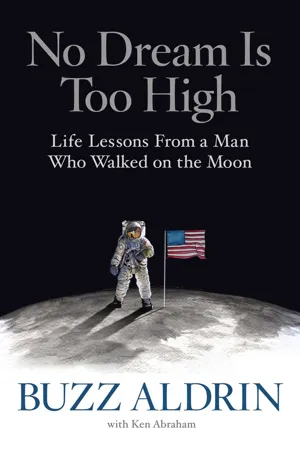
No Dream Is Too High
eBook - ePub

No Dream Is Too High

Life Lessons From a Man Who Walked on the Moon

  1. 224 pages
  2. English
  3. ePUB (mobile friendly)
  4. Available on iOS & Android
eBook - ePub

No Dream Is Too High

Life Lessons From a Man Who Walked on the Moon

About this book

Beloved American hero Buzz Aldrin reflects on the wisdom, guiding principles, and irreverent anecdotes he's gathered through his event-filled life - both in outer space and on earth. No Dream Is Too High whittles down Buzz Aldrin's event-filled life into a short list of principles he values, each illustrated by fascinating anecdotes and memories, such as: Second comes right after first. NASA protocol should have meant he was first on the moon, but rules changed just before the mission. How he learned to be proud of being the second man on the moon. Look for opportunities, not obstacles. Buzz was rejected the first time he applied to be an astronaut. Failure is an opportunity to learn to do better. Always maintain your spirit of adventure. For his 80th birthday, Buzz went diving in the Galapagos and hitched a ride on a whale shark. He stays fit, energetic, and fascinated with life.
Frequently asked questions

Yes, you can cancel anytime from the Subscription tab in your account settings on the Perlego website. Your subscription will stay active until the end of your current billing period. Learn how to cancel your subscription.
No, books cannot be downloaded as external files, such as PDFs, for use outside of Perlego. However, you can download books within the Perlego app for offline reading on mobile or tablet. Learn more here.
Perlego offers two plans: Essential and Complete
  • Essential is ideal for learners and professionals who enjoy exploring a wide range of subjects. Access the Essential Library with 800,000+ trusted titles and best-sellers across business, personal growth, and the humanities. Includes unlimited reading time and Standard Read Aloud voice.
  • Complete: Perfect for advanced learners and researchers needing full, unrestricted access. Unlock 1.4M+ books across hundreds of subjects, including academic and specialized titles. The Complete Plan also includes advanced features like Premium Read Aloud and Research Assistant.
Both plans are available with monthly, semester, or annual billing cycles.
We are an online textbook subscription service, where you can get access to an entire online library for less than the price of a single book per month. With over 1 million books across 1000+ topics, we’ve got you covered! Learn more here.
Look out for the read-aloud symbol on your next book to see if you can listen to it. The read-aloud tool reads text aloud for you, highlighting the text as it is being read. You can pause it, speed it up and slow it down. Learn more here.
Yes! You can use the Perlego app on both iOS or Android devices to read anytime, anywhere — even offline. Perfect for commutes or when you’re on the go.
Please note we cannot support devices running on iOS 13 and Android 7 or earlier. Learn more about using the app.
Yes, you can access No Dream Is Too High by Buzz Aldrin,Ken Abraham in PDF and/or ePUB format. We have over one million books available in our catalogue for you to explore.

Information

Print ISBN
9781426216497
eBook ISBN
9781426216503

• CHAPTER ONE •

THE SKY IS NOT THE LIMIT … THERE ARE FOOTPRINTS ON THE MOON!

When I was a boy, some people regarded the statement “The sky is the limit” as a positive affirmation, implying that anything is possible. The truth is, the sky is not the limit. Nowadays, we can go much farther, and dream much higher than the sky.
I know the sky is not the limit, because there are footprints on the Moon—and I made some of them! So don’t allow anyone to denigrate or inhibit your lofty aspirations. Your dreams can take you much higher and much farther than anyone ever thought possible! Mine certainly did.
For years, men and women dreamed of reaching space—exploring the Moon, other planets, and even the stars. But it wasn’t until the 20th century that human beings experienced their first powered flight. In 1903, on a windy morning on Kill Devil Hills at Kitty Hawk, North Carolina, two young risktakers, Orville and Wilbur Wright, took to the air, defying gravity in their appropriately named plane, Flyer.
My mother, Marion Moon—yes, that was her real maiden name—was born that same year. A mere 66 years later, Neil Armstrong and I set foot on the Moon, fulfilling the dreams of millions of people and far surpassing the expectations of those who claimed that the sky is the limit!
Nowadays, when I speak to young audiences, they are often surprised to learn that the United States was not the pioneer nation regarding space exploration. In October 1957, while I was still serving in the U.S. Air Force and stationed in Germany, the Soviet Union pulled off an unexpected technological feat. They launched Sputnik 1, a spherical, polished-metal artificial satellite with four transmitting radio antennas. The satellite emitted an odd beep-beep sound that could be heard on radio frequencies in the United States and elsewhere as the weird object orbited the Earth, passing several times directly over major cities in the United States. Although Sputnik’s batteries ran out of power after only 21 days and the satellite eventually fell from orbit and was completely burned up as it reentered Earth’s atmosphere, the Russians had led the way into space.
A year later, America formed the National Aeronautics and Space Administration—NASA—with the goal of reaching space. The space age was born, and a “space race” between Russia and the United States began, with each nation pouring millions of dollars and thousands of man-hours into besting each other’s efforts. The term “space race” may have been a euphemism for the two nations’ competitiveness, but the tension was real. Following World War II, the United States and the Soviet Union had emerged as the world’s two great superpowers, both armed with nuclear weapons, facing off against each other in increasingly chilled relationships that came to be known as the cold war, with both nations suspicious of the other’s motives.
That’s why the world shuddered on April 12, 1961, when the Soviets achieved an incredible advantage by sending the first human into space, cosmonaut Yuri Gagarin, who flew in a spacecraft for one full orbit around the Earth.
The United States responded a few weeks later by launching America’s first “Project Mercury” astronaut, Alan Shepard, on a 15-minute, 115-mile-high, suborbital flight that touched the edge of space.
This was definitely impressive, and most Americans wondered, What could possibly be next?
PRESIDENT JOHN F. KENNEDY WANTED an answer to that question as well, so he asked NASA and its ranks of engineers and rocket scientists, led by the brilliant Wernher von Braun, what was possible. They informed him that it would take at least 15 years before we could put a man on the Moon. It is a little known fact—one that I learned only recently—that Kennedy did not initially want the United States to go to the Moon. He wanted U.S. astronauts to go straight to Mars! NASA’s leaders gulped hard and admitted to the president that Mars was out of reach, but the Moon might be possible within 15 years.
Rather than accepting what was “possible,” on May 25, 1961, just three weeks after Alan Shepard’s virginal flight, President Kennedy boldly challenged America to commit to the goal of landing a man on the Moon before the end of the decade! Many thought the challenge was impossible to meet. We had not yet even put a man into orbit. The rockets and spacecraft that we needed to go beyond Earth’s orbit didn’t exist. We didn’t have the know-how.
But we did have a leader with a vision—including the determination, courage, and confidence that we could get there. Even when the NASA chief later informed the president that it was going to cost twice the amount of their initial projections, the president stuck with his commitment. By publicly stating our goal and by putting a time period on a specific accomplishment, President Kennedy gave us no way out. We either had to do it or fail, and no one was interested in failing, especially with the Russians already peering over our shoulders from their spacecraft.
When I first heard about America’s space program from my friend and fellow fighter pilot Ed White, who had signed on with NASA, I was excited. If space was going to be our next new frontier, I wanted to be a part of getting there. So after I completed my tour of duty in Germany, I continued my education and received my doctorate in astronautics from the Massachusetts Institute of Technology (MIT). For my thesis, I adapted my experience as a fighter pilot during the Korean War, where I had focused on intercepting enemy aircraft, and devised a technique for two manned spacecraft to meet in space, a procedure called manned orbital rendezvous. Little did anyone—including me—know how critical this work would later be to our successfully landing on the Moon.
The first time I applied to be an astronaut, NASA turned me down. I was not a test pilot, they said, and at that time, NASA wanted only test pilots. Other people, no matter how bright or how talented, need not apply. Sure, I was disappointed, but I was determined and I knew the sky was not the limit, so I applied again.
This time, my jet fighter experience and NASA’s interest in my concepts for space rendezvous influenced them to accept me in the third group of astronauts, eight men drawn from more than 6,000 applicants.
My MIT rendezvous studies really paid off. I knew that the critical key to our success would be our ability to separate the lunar landing module from a launch-and-reentry “mother ship,” a command module, land it on the Moon’s surface, then lift off and reliably rendezvous the two spacecraft in orbit around the Moon, a risky maneuver. If it failed, there would be no way to rescue the astronauts who had landed. Luckily, my MIT work was exactly what was needed to help figure out these complicated rejoining procedures. I thought about space rendezvous; talked about space rendezvous; ate, slept, and dreamed about space rendezvous so much that I became known to my astronaut peers as “Dr. Rendezvous.”
Mercury was the first phase in the American space efforts, followed by the Gemini program, which helped us refine our skills and maintained the nation’s fascination with space travel while the rockets were being developed for Apollo, the program that we hoped would take us to the Moon. Gemini was an integral part of our training, as it helped us learn to spacewalk. As an avid scuba diver, I was the first astronaut to train underwater to simulate weightlessness in space. Although not identical to the sensations in space, practicing movements underwater in neutral buoyancy and attempting to maneuver while wearing a bulky backpack gave me great confidence and helped me to overcome the challenges I thought I might experience once outside the space capsule.
During my first spaceflight as pilot of Gemini 12, I set a world record for spacewalking—which was actually more of a space float, rather than a five and a half hours’ “walk” in space—tethered to the spacecraft by a single, long umbilical cord that provided life support, while circling the globe every 90 minutes at a speed of 17,500 miles an hour. Because there is no air in space, there was no resistance, so the spacecraft and I drifted along at the same tremendous speed. What a sight to behold the Earth below while floating outside our spacecraft! It was such a fabulous ride, I only reluctantly climbed back inside our Gemini 12 spacecraft when it was time to come home, but not before I pulled a prank on Jim Lovell.
Most people know that astronauts are competitive with each other, even those working together as crewmates, as were Jim Lovell and I on Gemini 12. Knowing that I was scheduled to perform a space walk during our flight, I had packed a banner reading “BEAT NAVY” among my personal items. I was a West Point grad, and an Air Force fighter pilot, and Jim was a Navy guy. So while I was outside doing my space walk, I took the banner with me and unfurled it, holding it up to the Gemini 12 window so Jim would have to read “Beat Navy.” I still have that banner to this day, not to mention a hefty dose of competition with the Navy and with Jim!
During the same space walk, I took what would become known as the first “selfie” in space! But I’ll tell you more about that later.
After nearly four days in orbit, Jim Lovell and I returned to Earth, having completed the final mission in the Gemini program. It was November 1966, and we had only three years remaining to accomplish President Kennedy’s challenge to land a man on the Moon by the end of the decade. Gemini had prepared us for the Apollo missions to the Moon, but we still had a lot of work to do.
Neil Armstrong, Michael Collins, and I were chosen as the crew for Apollo 11, which would turn out to be a uniquely historic mission. Neil and I had worked together as the backup crew for Apollo 8, the first mission to reach the Moon, although not landing on the surface. Mike was originally part of the Apollo 8 crew, but due to back surgery, he had to be replaced, and he missed the opportunity. A great guy, a hard worker, and a real team player with a quick sense of humor, Mike had studied and trained diligently for Apollo 8, so I was not surprised when Neil chose Mike for our crew. He was an excellent choice.
For six months, we worked every day and prepared as best we could for this fascinating trip into the unknown. At last, the day came when the enormous Saturn V rocket was rolled out from the huge Vehicle Assembly Building, inching along on a giant transport platform, slowly making its way to the launchpad.
On July 16, 1969, our launch day, at 9:32 a.m. the engines ignited and roared with more than 7 million pounds of thrust, lifting 3,000 tons of spacecraft, fuel, equipment, and, oh yes—three very fortunate human astronauts on their way to another celestial body.
As we cleared the gantry and rocketed skyward, we were pressed into our seats as the rapid acceleration of the rocket increased our body weight. Within three minutes, we were 45 miles high, experiencing 3½ g’s—the force making our bodies feel increasingly heavier than on Earth—and accelerating to nearly 6,500 miles an hour. A minute later, we passed through the 62-mile threshold, where the blue sky turns to the blackness of space. By 12 minutes after launch, we were traveling at more than 17,000 miles an hour, the speed required for us to orbit the Earth. For the next three hours, we circled around our home planet and ran through checklists to make sure that everything in our spacecraft was working properly. Then we fired the rocket engine that accelerated us to 25,000 miles an hour on a trajectory bound for the Moon.
During the eight-day round-trip journey, Mike, Neil, and I lived in a space capsule about the size of a standard automobile interior—a small vehicle not much larger than a Volkswagen van. If all went as planned, Neil and I would spend a portion of that time landing on and exploring a small part of the lunar surface.
ON DAY THREE, WE FIRED OUR ENGINE to slow us down enough for the Moon’s gravity to capture us and draw us into lunar orbit. Another engine burn put us in the right orbit for a landing.
Thirteen orbits of the Moon later, on the morning of Sunday, July 20, 1969, Neil and I entered the lunar landing craft we had named the Eagle. We carefully separated our new home from the command module, Columbia, where Mike remained. Piloting our powered descent to the Moon’s Sea of Tranquility was the most complicated and critical aspect of the whole mission. Landing was the hard part.
As we descended, we saw that our planned landing site was filled with large boulders surrounding a crater that Neil estimated to be more than a hundred feet wide, with steep slopes, so we continued maneuvering the Eagle, hoping to find a safe area on which to land. This unexpected extension of our trip expended additional fuel, so after traveling 240,000 miles to reach the Moon’s surface, we were dangerously low on fuel and within seconds of having to either abort the mission or crash onto the lunar surface. Hovering above the Moon’s surface like a slow-moving helicopter, Neil finally spied what appeared to be a safe landing spot. When we finally touched down, we had only 15 to 20 seconds of fuel remaining!
Neil and I breathed a little easier but we couldn’t relax. We shook hands—we had done it; we had landed on the Moon! But this was no time for a victory party; we quickly went through our flight checklist. It was absolutely essential that we not allow our emotions to overwhelm us or cloud our thinking as we followed our planned procedures in case we had to mak...

Table of contents

  1. Cover
  2. Also by Buzz Aldrin
  3. Title Page
  4. Copyright
  5. Dedication
  6. Contents
  7. Countdown
  8. Chapter One: The Sky is not the Limit … There are Footprints on the Moon!
  9. Chapter Two: Keep Your Mind Open to Possibilities.
  10. Chapter Three: Show Me Your Friends, and I Will Show You Your Future.
  11. Chapter Four: Second Comes Right After First.
  12. Chapter Five: Write Your Own Epitaph.
  13. Chapter Six: Maintain Your Spirit of Adventure.
  14. Photo Gallery
  15. Chapter Seven: Failure is Always an Option.
  16. Chapter Eight: Practice Respect for all People.
  17. Chapter Nine: Do What you Believe is Right Even when Others Choose Otherwise.
  18. Chapter Ten: Trust Your Gut … and Your Instruments.
  19. Chapter Eleven: Laugh … A Lot!
  20. Chapter Twelve: Keep a Young Mind-Set at Every Age.
  21. Chapter Thirteen: Help Others go Beyond Where You Have Gone.
  22. Acknowledgments
  23. Illustrations Credits