Andy Warhol Was a Hoarder
eBook - ePub

Andy Warhol Was a Hoarder

Inside the Minds of History's Great Personalities

  1. 320 pages
  2. English
  3. ePUB (mobile friendly)
  4. Available on iOS & Android
eBook - ePub

Andy Warhol Was a Hoarder

Inside the Minds of History's Great Personalities

About this book

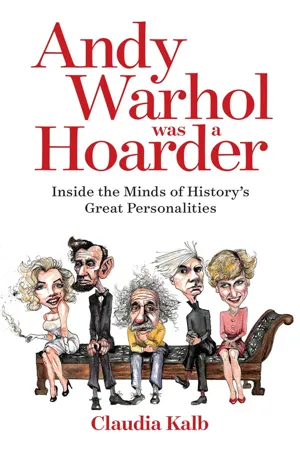
Was Andy Warhol a hoarder? Did Einstein have autism? Was Frank Lloyd Wright a narcissist? In this surprising, inventive, and meticulously researched look at the evolution of mental health, respected journalist Claudia Kalb gives readers a glimpse into the lives of high-profile historic figures through the lens of modern psychology, weaving groundbreaking research into biographical narratives that are deeply embedded in our culture. From Marilyn Monroe's borderline personality disorder to Charles Darwin's anxiety, Kalb provides compelling insight into a broad range of maladies, using historical records and interviews with leading mental health experts, biographers, sociologists, and other specialists. Packed with intriguing revelations, this smart narrative brings a new perspective to one of the hottest new topics in today's cultural conversation.
Frequently asked questions

Yes, you can cancel anytime from the Subscription tab in your account settings on the Perlego website. Your subscription will stay active until the end of your current billing period. Learn how to cancel your subscription.
No, books cannot be downloaded as external files, such as PDFs, for use outside of Perlego. However, you can download books within the Perlego app for offline reading on mobile or tablet. Learn more here.
Perlego offers two plans: Essential and Complete
  • Essential is ideal for learners and professionals who enjoy exploring a wide range of subjects. Access the Essential Library with 800,000+ trusted titles and best-sellers across business, personal growth, and the humanities. Includes unlimited reading time and Standard Read Aloud voice.
  • Complete: Perfect for advanced learners and researchers needing full, unrestricted access. Unlock 1.4M+ books across hundreds of subjects, including academic and specialized titles. The Complete Plan also includes advanced features like Premium Read Aloud and Research Assistant.
Both plans are available with monthly, semester, or annual billing cycles.
We are an online textbook subscription service, where you can get access to an entire online library for less than the price of a single book per month. With over 1 million books across 1000+ topics, we’ve got you covered! Learn more here.
Look out for the read-aloud symbol on your next book to see if you can listen to it. The read-aloud tool reads text aloud for you, highlighting the text as it is being read. You can pause it, speed it up and slow it down. Learn more here.
Yes! You can use the Perlego app on both iOS or Android devices to read anytime, anywhere — even offline. Perfect for commutes or when you’re on the go.
Please note we cannot support devices running on iOS 13 and Android 7 or earlier. Learn more about using the app.
Yes, you can access Andy Warhol Was a Hoarder by Claudia Kalb in PDF and/or ePUB format, as well as other popular books in Desarrollo personal & Superación personal. We have over one million books available in our catalogue for you to explore.

Sources and Notes

Throughout the course of my research, I conducted dozens of interviews with mental health professionals, scientists, and academic researchers. A wide variety of source materials informed my biographical research, including diaries, letters, newspaper and magazine articles, autobiographies, and biographies. In my analysis of mental health conditions, I consulted medical and scientific journals and books, as well as content published by mental health associations, medical associations, and government health organizations. These included the American Academy of Pediatrics, American Psychiatric Association, American Psychological Association, Centers for Disease Control and Prevention, Harvard Health Publications, National Alliance on Mental Illness, and National Institute of Mental Health. For each chapter, I consulted the American Psychiatric Association’s Diagnostic and Statistical Manual of Mental Disorders, fifth edition (DSM-5, 2013), as well as fact sheets on the APA’s website.
In my notes below, I have highlighted materials mentioned within each chapter’s text as well as additional sources that helped inform my understanding of the historical figures and the mental health conditions presented.

Introduction

Conversations with experts in the field provided me with invaluable insights into the state of mental health research as well as the value and challenge of evaluating historical figures and the mind. These individuals include Dr. Jeffrey Borenstein, Brain and Behavior Research Foundation; Dr. David Kupfer, University of Pittsburgh School of Medicine; Dr. Philip Mackowiak and Dr. David Mallott, University of Maryland School of Medicine; Dr. Michael Miller, Harvard Medical School; Dr. Osamu Muramoto, Center for Ethics in Health Care, Oregon Health and Science University; Dr. David Rettew, University of Vermont College of Medicine; and Mark Smaller, president, American Psychoanalytic Association.
Numerous books informed my understanding of mental health and historical diagnosis. These include Philip Marshall Dale, Medical Biographies: The Ailments of Thirty-Three Famous Persons (Norman, OK: University of Oklahoma Press, 1952); Brian Dillon, The Hypochondriacs: Nine Tormented Lives (New York: Faber and Faber, 2010); Douglas Goldman et al., Retrospective Diagnoses of Historical Personalities as Viewed by Leading Contemporary Psychiatrists (Bloomfield, NJ: Schering Corporation, 1958); Kay Redfield Jamison, Touched with Fire: Manic-Depressive Illness and the Artistic Temperament (New York: Free Press, 1993); Jeffrey A. Kottler, Divine Madness: Ten Stories of Creative Struggle (San Francisco: Jossey-Bass, 2006); Philip Mackowiak, Post-Mortem: Solving History’s Great Medical Mysteries (Philadelphia: American College of Physicians, 2007); Roy Porter, Madness: A Brief History (New York: Oxford University Press, 2002); David Rettew, Child Temperament: New Thinking About the Boundary Between Traits and Illness (New York: W. W. Norton, 2013).
Articles include: Nancy C. Andreasen et al., “Relapse Duration, Treatment Intensity, and Brain Tissue Loss in Schizophrenia: A Prospective Longitudinal MRI Study,” American Journal of Psychiatry 170, No. 6 (June 1, 2013), 609–15; Milton Cameron, “Albert Einstein, Frank Lloyd Wright, Le Corbusier, and the Future of the American City,” Institute for Advanced Study, Institute Letter (Spring 2014), 8–9; D. S. Carson et al., “Cerebrospinal Fluid and Plasma Oxytocin Concentrations Are Positively Correlated and Negatively Predict Anxiety in Children,” Molecular Psychiatry (online ed.; November 4, 2014), doi: 10.1038/mp.2014.132; Cross-Disorder Group of the Psychiatric Genomics Consortium, “Identification of Risk Loci With Shared Effects on Five Major Psychiatric Disorders: A Genome-Wide Analysis,” Lancet 381, No. 9875 (April 2013), 1371–79; Eric Kandel, “The New Science of Mind,” New York Times, December 6, 2013; Callie L. McGrath et al., “Toward a Neuroimaging Treatment Selection Biomarker for Major Depressive Disorder,” JAMA Psychiatry 70, No. 8 (August 2013), 821–29; Richard Milner, “Darwin’s Shrink,” Natural History 114, No. 9 (November 2005), 42–44.
A note about the increase in mental disorders in the DSM (from 80 in the first edition to 157 in the fifth edition): These numbers were provided by the American Psychiatric Association and refer to the total number of distinct disorders contained in the manual. They do not include subtypes of disorders, variation in severity within disorders (mild, moderate, or severe, for example), or “unspecified” disorders. I chose to cite the APA’s tally of distinct diagnoses, but it should be noted that the number of possible diagnoses contained in the DSM is higher.

Marilyn Monroe

Books

Lois Banner, Marilyn: The Passion and the Paradox (New York: Bloomsbury, 2012); Arnold M. Ludwig, How Do We Know Who We Are? A Biography of the Self (New York: Oxford University Press, 1997); Arthur Miller, Timebends: A Life (New York: Grove Press, 1987); Marilyn Monroe, Fragments: Poems, Intimate Notes, Letters (New York: Farrar, Straus and Giroux, 2010); Marilyn Monroe, My Story (New York: Cooper Square Press, 2000); Sarah K. Reynolds and Marsha M. Linehan, “Dialectical Behavior Therapy,” in Encyclopedia of Psychotherapy 1, eds. Michel Hersen and William H. Sledge (Academic Press, 2002), 621–28; Donald Spoto, Marilyn Monroe: The Biography (New York: HarperCollins, 1993); Gloria Steinem and George Barris, Marilyn: Norma Jeane (New York: East Toledo Productions, 1986); Anthony Summers, Goddess: The Secret Lives of Marilyn Monroe (New York: Macmillan, 1985); J. Randy Taraborrelli, The Secret Life of Marilyn Monroe (New York: Grand Central Publishing, 2009).

Newspapers, Magazines, and Medical Reports

Lois Banner, “The Meaning of Marilyn,” Women’s Review of Books 28, No. 3 (May/June 2010), 3–4; Robert S. Biskin and Joel Paris, “Diagnosing Borderline Personality Disorder,” Canadian Medical Association Journal 184, No. 16 (November 6, 2012), 1789–94; Benedict Carey, “Expert on Mental Illness Reveals Her Own Fight,” New York Times, June 23, 2011; Richard Ben Cramer, “The DiMaggio Nobody Knew,” Newsweek, March 22, 1999; John Gunderson, “Borderline Personality Disorder,” New England Journal of Medicine 364, No. 21 (May 26, 2011), 2037–42; John Gunderson et al., “Borderline Personality Disorder,” Focus 11, No. 2 (Spring 2013); John Gunderson et al., “Family Study of Borderline Personality Disorder and Its Sectors of Psychopathology,” Archives of General Psychiatry 68, No. 7 (July 2011), 753–62; Barbara Grizzuti Harrison, “Vengeful Fantasies,” New Republic, February 28, 1991; James Harvey, “Marilyn Reconsidered,” Threepenny Review 58 (Summer 1994), 35–37; Constance Holden, “Sex and the Suffering Brain,” Science 308 (June 10, 2005), 1574–77; Sam Kashner, “The Things She Left Behind,” Vanity Fair, October 2008; Susan King, “Marilyn Monroe’s Last Film Work Resurrected for New Documentary,” Los Angeles Times, May 28, 2001; Robert E. Litman, “Suicidology: A Look Backward and Ahead,” Suicide and Life-Threatening Behavior 26, No. 1 (Spring 1996); Larry McMurtry, “Marilyn,” New York Review of Books, March 10, 2011; Daphne Merkin, “Platinum Pain,” New Yorker, February 8, 1999; Richard Meryman, “A Last Long Talk With a Lonely Girl,” Life, August 17, 1962; Richard Meryman, “Marilyn Monroe Lets Her Hair Down About Being Famous: ‘Fame Will Go By and—So Long, I’ve Had You,’ ” Life, August 3, 1962; Andrada D. Neacsiu et al., “Impact of Dialectical Behavior Therapy Versus Community Treatment by Experts on Emotional Experience, Expression, and Acceptance in Borderline Personality Disorder,” Behaviour Research and Therapy 53 (2014), 47–54; Joel Paris, “Borderline Personality Disorder,” Canadian Medical Association Journal 172, No. 12 (June 7, 2005), 1579–83; Patrick Perry, “Personality Disorders: Coping With the Borderline,” Saturday Evening Post, July/August 1997; Carl E. Rollyson, Jr., “Marilyn: Mailer’s Novel Biography,” Biography 1, No. 4 (Fall 1978), 49–67; William Todd Schultz, “How Do We Know Who We Are? A Biography of the Self,” Biography 22, No. 3 (Summer 1999), 416–20; Lee Siegel, “Unsexing Marilyn,” New York Review of Books, NYR Blog, January 5, 2012; Diana Trilling, “The Death of Marilyn Monroe,” Encounter, August 1963; Diana Trilling, “ ‘Please Don’t Make Me a Joke,’ ” New York Times, December 21, 1986; Christopher Turner, “Marilyn Monroe on the Couch,” Telegraph, June 23, 2010.

Online

Georges Belmont, interview with Marilyn Monroe, video, Marie Claire, April 1960, https://​vimeo.​com/​76791522; Jesse Greenspan, “ ‘Happy Birthday, Mr. President’ Turns 50,” History.​com, www.​history.​com/​news/​happy-​birthday-​mr-​president-​turns-​50; John Gunderson, “A BPD Brief: An Introduction to Borderline Personality Disorder: Diagnosis, Origins, Course, and Treatment,” www.​borderlinepersonalitydisorder.​com/​professionals/​a-​bpd-​brief/.

Howard Hughes

Books

Donald L. Barlett and James B. Steele, Howard Hughes: His Life and Madness (New York: W. W. Norton, 1979); Peter Harry Brown and Pat H. Broeske, Howard Hughes: The Untold Story (New York: Dutton, 1996); Richard Hack, Hughes: The Private Diaries, Memos and Letters (Beverly Hills: New Millennium Press, 2001); Jeffrey Schwartz with Beverly Beyette, Brain Lock: Free Yourself From Obsessive-Compulsive Behavior (New York: ReganBooks, 1996).

Newspapers, Magazines, and Medical Reports

Riadh T. Abed and Karel W. de Pauw, “An Evolutionary Hypothesis for Obsessive Compulsive Disorder: A Psychological Immune System?” Behavioural Neurology 11 (1998/1999), 245–50; Lisa Belkin, “Can You Catch Obsessive-Compulsive Disorder?” New York Times, May 22, 2005; Nicholas Dodman, “Obsessive Compulsive Disorder in Animals,” Veterinary Practice News (November 2012); Raymond D. Fowler, “Howard Hughes: A Psychological Autopsy,” Psychology Today (May 1986), 22–33; Jon E. Grant, “Obsessive-Compulsive Disorder,” New England Journal of Medicine 371, No. 7 (August 14, 2104), 646–53; Jerome Groopman, “The Doubting Disease,” New Yorker, April 10, 2000; Edward D. Huey et al., “A Psychological and Neuroanatomical Model of Obsessive-Compulsive Disorder,” Journal of Neuropsychiatry and Clinical Neurosciences 20, No. 4 (Fall 2008), 390–408; Michael Jenike, “Obsessive-Compulsive Disorder,” New England Journal of Medicine 350, No. 3 (January 15, 2004), 259–65; Gilbert King, “The Rise and Fall of Nikola Tesla and His Tower,” Smithsonian, February 4, 2013; Salla Koponen et al., “Axis I and II Psychiatric Disorders After Traumatic Brain Injury: A 30-Year Follow-Up Study,” American Journal of Psychiatry 159, No. 8 (August 2002), 1315–21; David L. Pauls, “The Genetics of Obsessive-Compulsive Disorder: A Review,” Dialogues in Clinical Neuroscience 12, No. 2 (June 2010), 149–63; Dan J. Stein, “Obsessive-Compulsive Disorder,” Lancet 360 (August 2002), 397–405; Steve Volk, “Rewiring the Brain to Treat OCD,” Discover, November 2013.

Online

Anxiety and Depression Association of America, www.​adaa.​org; College of Physicians of Philadelphia, “History of Polio,” www.​historyofvaccines.​org/​content/​timelines/​polio; Rebecca Murray, “Leonard DiCaprio Talks About ‘The Aviator,’ ” movies.​about.​com/​od/​theaviator/​a/​aviatorld121004.​htm; “Obsessive Compulsive Disorder—History, Imaging, and Treatment: An Expert Interview with Judith L. Rapoport, MD,” April 30, 2007, www.​medscape.​com/​viewarticle/​554732.

Films

Martin Scorsese, The Aviator (2004); Howard Hughes Revealed (2007), National Geographic Channel.

Andy Warhol

Books

Victor Bockris, Warhol: The Biography (New York: Da Capo Press, 2003); David Bourdon, Warhol (New York: Harry N. Abrams, 1989); Bob Colacello, Holy Terror: A...

Table of contents

  1. Cover
  2. Title Page
  3. Copyright
  4. Dedication
  5. Contents
  6. Introduction
  7. Marilyn Monroe
  8. Howard Hughes
  9. Andy Warhol
  10. Princess Diana
  11. Abraham Lincoln
  12. Christine Jorgensen
  13. Frank Lloyd Wright
  14. Betty Ford
  15. Charles Darwin
  16. George Gershwin
  17. Fyodor Dostoevsky
  18. Albert Einstein
  19. Afterword
  20. Sources and Notes
  21. Acknowledgments
  22. About the Author