![]()
May 29, 1941âmy fatherâs thirty-eighth birthdayâwas a sunny, warm spring day in New York City. It started out just like any other during the two years since I had entered first grade at the Convent of the Sacred Heart on 91st Street, but it wasnât just an ordinary day. I knew that later that afternoon my family and I were embarking on an epic journey across the United States, across the Pacific, across Siberia, and all the way back to their native Germany. My two brothers and I had not been to Germany in four yearsâsince I was three years old. Insofar as we could comprehend such events, we knew that the country where our parents had been born was at war with Britain.
Our German governess, Aya, who had been hired to look after my two brothers and me and had been with our family for ten years, gave us our usual breakfast. As was the routine, she walked me to school, five city blocks away from our apartment at 1192 Park Avenue. It was the last day of second gradeâand my last day before we leftâand on that particular morning I was feeling excited and apprehensive, as well as sad. I was excited at the thought of taking a train across the United States but apprehensive about going to visit such faraway countries as Japan and Russia. I was sad to be leaving all my friends behind, even though my parents had assured me it would only be for a short while. At my age, I was mostly unaware of wider events. I was mainly concerned with the new braces on my teeth, which an orthodontist had recently put on, as well as keeping my hair under control after having had my first permanent, which I had so desperately wanted to get before our departure.
We were at the end of our last class together when our teacher, a nun whose lovely face shone from her habit, a white and crisply starched frame resembling ribbon candy, told us to be sure to leave our desks as spotless as we had found them. That was so the next group of second-graders, who would be entering our classroom in September, would not think we were a group of sloppy, inconsiderate girls. We did what she asked, were dismissed, and went straight to chapel for Ascension Thursday Benediction, curtsying to each nun as we were always required to do. Mother Mary Ranney, my second-grade teacher, had asked me to help her decorate the chapel for the last time. I was pleased that it had turned out so beautifully.
As Benediction was coming to an end, I felt a gentle tug on the sleeve of my uniform. It was Mother Ranney, telling me my parents had arrived to pick me up. I followed her out of the chapel, and while my family and I were saying our good-byes to Reverend Mother Shea and the other nuns, the double doors from the chapel opened and out streamed the girls from the upper classes, followed by the girls from the entire lower school. I was totally unprepared for the emotional farewells that followed, as one by one each of my classmates put her arms around my neck to say good-bye. With tears streaming down our cheeks, we could barely speak.
My parents had been living in New York since they were married in 1929. My father, head of the New York office of the Commerz und Privat Bank, whose headquarters were in Berlin, had been recalled to the home office. With my mother anxious to see her family, as well as my fatherâs, my father had been persuaded to return. My parents hadnât seen any of their relatives in three years, and couldnât imagine what they were all going through in a time of war. It was my motherâs older brother who had suggested taking the Pacific route through Russia, because he had taken it himself from South America earlier in the year.
It was the first summer since I had started school that my family and I were leaving for Europe. For the past three summers my parents had either rented a house in Southampton or we had remained in the city. This time, however, my parents had chosen a different and exotic route to get to Germany. The upcoming trip was going to be a much longer one, across the Pacific and three-quarters of the way around the world. The idea of such a long journey made it somehow even harder to separate from all my friends, especially as I had no idea what the future held and what exactly we were going to experience on the way.
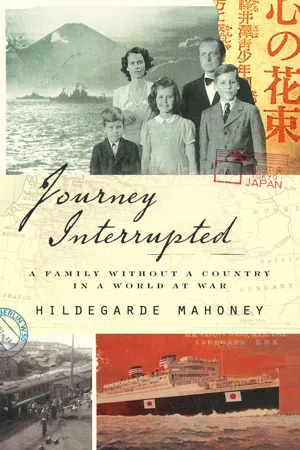
My parents in the spring of 1941.
Since Great Britain and France had been at war with Germany for nearly two years, my parents had chosen to travel across America and on to Yokohama, Japan, via the Pacific. They believed the British were taking citizens of Germany and their allied nations off ships crossing the Atlantic ocean, and incarcerating them. It was also safer, they thought, because of the German-Soviet Nonaggression Pact agreed to by Hitler and Stalin in 1939. My father made the entire planned trip sound like such an adventure that my brothers and I were able to get into the spirit of the journey without any real concerns about our fate. Perhaps, in private, he and my mother were not quite so calm.
My parents had hired a Checker taxicab, which was waiting outside the school to take the five of us to Grand Central Station. In those days, Checkers had room for five people becauseâjust as in London cabs to this dayâthey had two jump seats facing the back. We drove off, down Fifth Avenue along Central Park, which by now was in full bloom. My brother Enno was ten years old and my brother Alexander was not yet five. I was about to turn eight in less than a month. The three of us thought of the whole expedition as just a longer-than-usual trip with my parents, with the novel addition of travel by train.
My brothers, Alexander and Enno, with me in Manhattan, spring 1941.
When we arrived at Grand Central Station, we were immediately able to board our trainâthe 20th Century Limited for Chicagoâas my father had checked our forty pieces of luggage onto the train earlier in the day. We were traveling with such an inordinate number of suitcases because my mother was afraid weâd run out of some of the most necessary items on our long trip and wouldnât be able to buy them anywhere, and it was unclear how long we would be staying in Germany once we got there. She had brought along plenty of soap, toilet tissue, Kleenex, peanut butter, cereals, jams, assorted canned vegetables and fruits, and a whole array of miscellaneous items necessary for the journey across several continents and cultures. She had also packed both our summer and winter clothing, in anticipation of cooler weather in Siberia.
In the taxi on the way to the station, my mood gradually changed to one of excitement again, as my brothers and I started talking about the next four or five days traveling on a Pullman sleeper train to the West Coast. It was going to be a new experience for us; we had frequently traveled by ocean liner, but never before overnight on a train. After boarding and settling into our compartments, we leaned out the windows to wave good-bye to Aya, who had come to see us off, as had several of my parentsâ friends. A loud whistle sounded, and we watched as the conductor called out âAll aboard!â and stepped back onto the train, which proceeded to pull out of the station at a snailâs pace. In the pit of my stomach I felt an anxiousness I couldnât shake off, so I went about distracting myself by unpacking for the days that lay ahead.
My brothers had gone off to explore the train with my father and soon came back to report they had discovered a beautiful dining car, and that our father had made a dinner reservation for all of us. At the appointed hour, the five of us entered the dining car and noticed that all the tables had been set with immaculately starched white linens and simple, pretty china and glassware. A centerpiece of spring flowers had been placed on each table. The aroma of food being prepared wafted through the air as the maĂŽtre dâ showed us to our table. Once seated, a polite and solicitous waiterâdressed in a crisp white jacket decorated with gold braidingâasked to take our drinks order.
Our parents seemed perfectly relaxed, considering the hectic preparations they had been making for our departure. My mother wanted to order right away, before the dining car became too crowded. It had already been a long and emotional day, and she thought everybody was ready to have dinner and go to bed. My parents ordered their favorite drinksâa martini for my mother and a Manhattan for my father. My brothers and I ordered ginger ale.
While waiting for our first course, our father started telling us all about the trip we had just begun and why this year we were taking a different route. Having always sailed from New York by ship in the past, he wanted to map out this new route for us, as it had been four years since the five of us had last taken a trip to Europe together.
Our father told us he had been asked by his bank to close the New York office and return all his papers to the main office in Berlin. He wasnât really keen on going back with war under way, but if he remained in New York he would have to look for other employment. He adored New York, and had always dreamed of living there. As a banker, a classical pianist, and a man utterly infatuated with the life he and my mother had created for us all in Manhattan, I knew how he and my mother had agonized about our predicament, and it looked like it might become the end of a glorious period in their lives.
My father must have reassured himself with the idea that the war could not possibly continue much longer. Hitlerâs rapid, brutal conquests on the European continent seemed to have been met with implacable British resolve. Surely a workable truce would be agreed upon. My father had thought the most sensible course would be to wait for the end of the school year, then travel to the still relatively safe Germany, settle his business affairs with the central office in Berlin, and wait for the end of the war. As a born optimist, he thought we would return as soon as possible to America once the hostilities were over and the New York office was reopened.
My father went on to tell us in detail all about what an eye-popping journey he had booked; it would take six to seven weeks. After our arrival in San Francisco, the plan was to board a Japanese ship and sail via Hawaii to Yokohama, which was a port city about an hour south of Tokyo by train. He told us that unfortunately we wouldnât have a lot of time to see much of Japan, because we could only be there a week. We would leave from Japan on a ferry to Korea, board the East Asia Express, and travel through Manchuria to Manchouli (Manzhouli today), just east of the formidable Lake Baikal. There we would enter Russia and board the Trans-Siberian Railway, which would take roughly ten days to reach Moscow. We would then change trains and continue on to Berlin, where my father planned to stay a couple of days to wrap up business at the bank. The rest of us were to continue on to Hamburg to visit our grandparents.
We started preparing for our first night ever aboard a sleeper train. It had been a very long day, and I fell into my bunk dead tired, but I was unable to fall asleep right away, thinking about all that was unknown and unfamiliar that lay ahead, and missing my friends, with whom I now could not share any of my concerns. My brothers and I each had our own bunk with a curtain we could draw for privacy. I took the upper one, as I didnât want either of them sleeping above me, for fear they might accidentally kick me or step on me on the way down in the middle of the night. It was a tightly outfitted, cramped compartment for the three of us, despite our being relatively small. We had never seen a sink and toilet combined in such a novel way before. In order to use either, the others had to stay in their bunks or leave the compartment.
By morning, we had already arrived in Chicago and had to change trains to board the Atchison, Topeka and Santa Fe Railwayâs California-bound Grand Canyon Limited for the cross-country trip to San Francisco, via the Grand Canyon.
⢠⢠â˘
During the monotonous days of travel, it suited us all to linger as long as possible in the spacious, comfortable dining car. Our father took one of these opportunities to entertain and distract us by telling stories of his life, and of meeting our mother, as if to explain why we all found ourselves racing across the American plains. We knew little about our parentsâ backgrounds, and even less about the relatives we were about to see in a country we hardly remembered. We did know, however, that my father had wanted to become a concert pianist but had become a banker instead. My brothers and I prevailed upon him to tell us a lot more about his childhood and how such a radical change could come about.
My father was in a relaxed mood, as he had committed to this long journey after much deliberation. His bright blue eyes twinkled as he began, like a practiced storyteller, âI was born at the turn of the century in Breslau, Germanyâin 1903, to be exact. I was the fourth of seven children, each more individual than the next.â My mother smiled at this. He continued, âMy father had grown up in the Rhineland, had studied medicine in Bonnâwhere he specialized in internal medicineâand after graduating had accepted a position as adjunct professor of internal medicine at the University of Breslau. In those days, Breslau was one of the three most important cities in Germany. It was also the second-largest city in Prussia, and it was there that my father established a rather large medical practice. What Iâm trying to say, children, is that your grandfather was a very special doctor.â
My father paused to light a cigarette for my mother, then one for himself. The smoke rushed out of the half-open window of the dining car.
âSeveral years later,â he continued, âyour grandfather, in addition to caring for his patients and teaching at the university, was named chief of the University Hospital and was invited by the Order of the Knights of Malta to become chief of the Caritasheim, to run their prestigious private hospital in the vicinity. By accepting the position, he was awarded the Commanderâs Cross of the Knights of Malta. Among his many patients was King Boris of Bulgaria and members of his cabinet, who came to the Caritasheim regularly for check-ups. The king gave my father the Offizierskreuz (Officerâs Cross) and the Ritterkreuz, the Royal Bulgarian Civil Order of Merit.â
One of my grandfatherâs colleagues was Professor Alois Alzheimer, the doctor who in the early first decade of the twentieth century had among his patients one who suffered from an illness he described as a distinct subcategory of senile dementia. In 1910, his colleagues named the illness Alzheimerâs disease.
My fatherâs mother was fifty-nine years old when she died in 1935, having suffered from heart problems for a number of years. It was a terrible loss for the entire family, as she had been such a dynamic personality. Known as Frau Professor, she was said to have been an impressive lady, who spoke a number of languages and had a natural talent for presiding as grande dame in her salon at home. There she entertained intellectuals, artists, aristocrats, industrialists, writers, scientists, and many poets, among them the giant of the 1920s and â30s, Gerhart Hauptmann, who was a friend, as well as her husbandâs patient. King Augustus of Saxony was another patient, and a frequent guest in the family home.
My father didnât wish to bore us with names we could not possibly know, but the fact is our grandmother was the center of Breslau society, and on any given evening with her one could meet Ratibors, Radziwills, Henckel von Donnersmarcks, the Ballestrems, the Schottlaenders and Schwerins (textiles), the Heimanns (banking), the Hohenzollerns, Count Yorck von Wartenburg, or Prince Reuss, all of whom were frequent guests at her salon. In addition, having had seven children, she presided over a large house and many staff. She had to oversee the childrenâs homework and, most important, had to be sure her offspring obeyed Mademoiselle, the French nanny who had been with the family for many years.
My father proudly told us that his grandfather Dr. Tonio BĂśdiker had been a prominent lawyer in Berlin who, during a period of widespread social unrest in the 1880s, drafted the legislation that would create the first social security system in Germanyâand the world. To pacify the working class and weake...