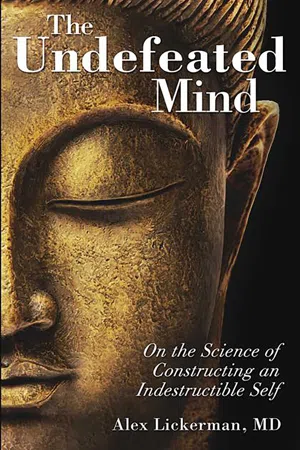
The Undefeated Mind
eBook - ePub

The Undefeated Mind

On the Science of Constructing an Indestructible Self

  1. 288 pages
  2. English
  3. ePUB (mobile friendly)
  4. Available on iOS & Android
eBook - ePub

The Undefeated Mind

On the Science of Constructing an Indestructible Self

About this book

Legions of self-help authors rightly urge personal development as the key to happiness, but they typically fail to focus on its most important objective: hardiness. Though that which doesn't kill us can make us stronger, as Nietzsche tells us, few authors today offer any insight into just how to springboard from adversity to strength.It doesn't just happen automatically, and it takes practice. New scientific researchsuggests thatresilience isn't something with which only a fortunate few of us have been born, but rather something we can all take specific action to develop. To build strength out of adversity, we need a catalyst. What we need, according toDr. Alex Lickerman, is wisdom—wisdom that adversity has the potential to teach us.Lickerman's underlying premise is that our ability to control what happens to us in life may be limited, but we have the ability to establish a life-state to surmount the suffering life brings us. The Undefeated Mind distills the wisdom we need to create true resilience into nine core principles, including:

  • A new definition of victory and its relevance to happiness
  • The concept of the changing of poison into medicine
  • A way to view prayer as a vow we make to ourselves.
  • A method of setting expectations that enhances our ability to endure disappointment and minimizes the likelihood of quitting
  • An approach to taking personal responsibility and moral action that enhances resilience
  • Aprocess for managing pain—both physical and emotional—that enables us to push through obstacles that might otherwise prevent us from attaining our goals
  • A method of leveraging our relationships with others that helps us manifest our strongest selves


Through stories of patients who have used these principles to overcome suffering caused by unemployment, unwanted weight gain, addiction, rejection, chronic pain, retirement, illness, loss, and even death, Dr. Lickerman shows how we too can make these principles function within our own lives, enabling us to develop for ourselves the resilience we need to achieve indestructible happiness. At its core, The Undefeated Mind urges us to stop hoping for easy lives and focus instead on cultivating the inner strength we need to enjoy the difficult lives we all have.

Frequently asked questions

Yes, you can cancel anytime from the Subscription tab in your account settings on the Perlego website. Your subscription will stay active until the end of your current billing period. Learn how to cancel your subscription.
No, books cannot be downloaded as external files, such as PDFs, for use outside of Perlego. However, you can download books within the Perlego app for offline reading on mobile or tablet. Learn more here.
Perlego offers two plans: Essential and Complete
  • Essential is ideal for learners and professionals who enjoy exploring a wide range of subjects. Access the Essential Library with 800,000+ trusted titles and best-sellers across business, personal growth, and the humanities. Includes unlimited reading time and Standard Read Aloud voice.
  • Complete: Perfect for advanced learners and researchers needing full, unrestricted access. Unlock 1.4M+ books across hundreds of subjects, including academic and specialized titles. The Complete Plan also includes advanced features like Premium Read Aloud and Research Assistant.
Both plans are available with monthly, semester, or annual billing cycles.
We are an online textbook subscription service, where you can get access to an entire online library for less than the price of a single book per month. With over 1 million books across 1000+ topics, we’ve got you covered! Learn more here.
Look out for the read-aloud symbol on your next book to see if you can listen to it. The read-aloud tool reads text aloud for you, highlighting the text as it is being read. You can pause it, speed it up and slow it down. Learn more here.
Yes! You can use the Perlego app on both iOS or Android devices to read anytime, anywhere — even offline. Perfect for commutes or when you’re on the go.
Please note we cannot support devices running on iOS 13 and Android 7 or earlier. Learn more about using the app.
Yes, you can access The Undefeated Mind by Alex Lickerman in PDF and/or ePUB format, as well as other popular books in Personal Development & Self Improvement. We have over one million books available in our catalogue for you to explore.
Notes-1
1. Marsha Somers, ā€œA Comparison of Voluntarily Childfree Adults and Parents,ā€ Journal of Marriage and Family 55 (1993): 643–650.
2. Douglas Jordan and J. David Diltz, ā€œDay Traders and the Disposition Effect,ā€ Journal of Behavioral Finance 5 (2004): 192–200.
3. Daniel Gilbert, Stumbling on Happiness (New York: Vintage Books, 2006), 142–143.
4. Viktor Frankl, Man’s Search for Meaning (Boston: Beacon Press, 1959), 112.
5. George Bonanno et al., ā€œResilience to Loss and Chronic Grief: A Prospective Study from Pre-Loss to 18-Months Post-Loss,ā€ Journal of Personality and Social Psychology 83 (2002): 1150–1164.
6. Nelson Mandela, Long Walk to Freedom (New York: Hachette Book Group, 1994).
2
Find
Your Mission
Nietzsche once wrote that he who has a why to live can bear almost any how. According to Nichiren Buddhism, however, not every why is created equal. To build the strongest life force possible—one that can bear the weight of any how—Nichiren Buddhism argues we need a why to live that in some way involves contributing to the well-being of others.
The first hint that my patient Steve had a problem related to the absence of just such a why came from, of all things, a series of sighs. Immediately after we exchanged names and shook hands at the start of our initial visit, he gasped as if poked by an invisible finger, sucked in a deep breath through his nose—then stacked a second, even more forceful breath on top of it, as if his lungs still weren’t satisfied—before finally exhaling loudly from his mouth. Then, a few moments later as I was navigating to his record on my computer, he did it again.
After I pulled up his demographic information and quickly scanned it, I turned away from my screen, folded my hands in my lap, and asked why he’d come to see me.
ā€œI’m having trouble sleeping,ā€ he said.
I took a moment to study him. Standing, he’d towered over me, but even sitting down he seemed a giant, his torso almost as long as his legs. He wore an expensive-looking suit, but sloppily, with his belt buckled too tightly, his pants wrinkled as if he’d recently lost weight, and his tie loosened at a sharp angle to the left.
I asked if he had difficulty falling asleep, difficulty staying asleep, or both. ā€œI get into bed at ten o’clock and lie there until two or three in the morning, wide awake,ā€ he answered. In the last two or three months, he said, he’d averaged only a few hours of sleep a night.
ā€œWhat time are you getting up?ā€
ā€œSix o’clock. Even though I don’t have to anymore,ā€ he added ruefully. ā€œOld habits die hard, I guess.ā€
ā€œWhy don’t you have to anymore?ā€
He took in another deep breath and let it out slowly. ā€œLost my job.ā€
He was the second patient I’d seen that morning who had. ā€œI’m sorry,ā€ I said. He waved my sympathy away with his hand.
ā€œWhen?ā€ I asked.
ā€œJanuary.ā€
Four and a half months ago—only slightly longer than he’d been having trouble sleeping. This was almost certainly the precipitating cause of his insomnia, I thought. But ever wary of my tendency to come to early closure, I forced myself to conduct a disciplined fleshing out of the details surrounding his complaint.
ā€œHow well were you sleeping before four months ago?ā€ I asked him.
ā€œLike a baby.ā€
Did he ever get a normal night’s sleep now, I asked, even one night out of seven? No, he said. In fact, two or three nights a week, he never fell asleep at all. Did he take naps? He did. Were they restorative? They were. How often did he drink alcohol? At most, a few beers on the weekend. Had he ever used alcohol to try to induce sleep? Once or twice, but it hadn’t worked. Did he use any other drugs recreationally? None, he said. He reported no significant past medical history, no allergies to any medications, and he took no medications on a regular basis.
ā€œHave you lost any weight recently?ā€ I asked him.
He admitted he had.
ā€œNot hungry?ā€ I guessed.
He shook his head no.
ā€œOn a scale of one to ten, how anxious would you say you’ve been feeling since you lost your job?ā€
His eyes widened slightly. And then, seeming as much to his surprise as mine, he began to cry.
Can Happiness Be Increased?
The set-point theory of happiness suggests that our level of subjective well-being is determined primarily by heredity and personality traits ingrained in us early in life and as a result remains relatively constant throughout our lives.1 Our level of happiness may change transiently in response to life events, I told Steve, but then almost always returns to its baseline level as we habituate to those events and their consequences over time.2
ā€œHow long does that usually take?ā€ he asked, wiping at his eyes.
ā€œThat’s hard to say,ā€ I said. ā€œIt’s different for everybody.ā€
He sucked in another deep breath and shook his head. ā€œI just don’t understand it. I’ve got more than enough money. A great house, two cars—a boat, which I love. My marriage is great. My kid’s not in any trouble. My health is good.ā€ He looked utterly bewildered.
I nodded. Habituation, a growing body of evidence now tells us, occurs even to things like career advancement, money, and marriage, which was almost certainly why, I told him, none of the things he mentioned were able to carry him through his crisis.3 They’d long ago lost their capacity to boost his happiness, so had no power now to defend him against significant loss.
And Steve’s loss was clearly significant. Despite the numerous studies that support set-point theory, other research suggests a few events—chief among them the unexpected death of a child and repeated bouts of unemployment—seem to reduce our ability to be happy permanently.4 Few would have trouble understanding why the death of a child might impair a parent’s capacity to feel joy over the long term. But the reason repeated bouts of unemployment erode happiness isn’t quite as straightforward: research has also shown an excessive focus on material goals like career advancement is actually associated with a slight decrease in happiness.5 Why, then, should repeatedly becoming unemployed prove to be so scarring?
The answer, of course, is that money isn’t the only reason we work, as most multimillionaires and billionaires who still get up every morning for work well know. We also work to create value. In fact, according to Tsunesaburo Makiguchi, an early-twentieth-century Japanese educator and founding president of the Soka Gakkai (the lay organization of Nichiren Buddhists), creating value for others is the key to attaining hap...

Table of contents

  1. COVER
  2. PRAISE
  3. DEDICATION
  4. TITLE
  5. COPYRIGHT
  6. CONTENT
  7. ACKNOWLEDGMENTS
  8. INTRODUCTION
  9. Notes-Introduction
  10. Chapter_1
  11. Notes-1
  12. Chapter_2
  13. Notes-2
  14. Chapter_3
  15. Notes-3
  16. Chapter_4
  17. Notes-4
  18. Chapter_5
  19. Notes-5
  20. Chapter_6
  21. Notes-6
  22. Chapter_7
  23. Notes-7
  24. Chapter_8
  25. Notes-8
  26. Chapter_9
  27. Notes-9
  28. Chapter_10
  29. Notes-10
  30. AFTERWORD
  31. AUTHOR