eBook - ePub
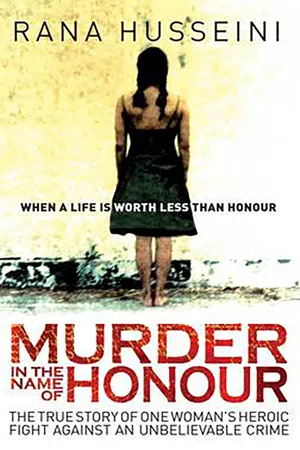
Murder in the Name of Honour
The True Story of One Woman's Heroic Fight Against an Unbelievable Crime
- 264 pages
- English
- ePUB (mobile friendly)
- Available on iOS & Android
eBook - ePub
Murder in the Name of Honour
The True Story of One Woman's Heroic Fight Against an Unbelievable Crime
About this book
Murder in the Name of Honour is Rana Husseini's hard-hitting and controversial examination of honour crimes. Common in many traditional societies around the world, as well as in migrant communities in Europe and the USA, they involve a 'punishment'âoften death or disfigurementâcarried out by a relative to restore the family's honour.
Breaking through the conspiracy of silence surrounding this crime, one writer above all others has been instrumental in bringing it to the world's attention: Rana Husseini.
Frequently asked questions
Yes, you can cancel anytime from the Subscription tab in your account settings on the Perlego website. Your subscription will stay active until the end of your current billing period. Learn how to cancel your subscription.
At the moment all of our mobile-responsive ePub books are available to download via the app. Most of our PDFs are also available to download and we're working on making the final remaining ones downloadable now. Learn more here.
Perlego offers two plans: Essential and Complete
- Essential is ideal for learners and professionals who enjoy exploring a wide range of subjects. Access the Essential Library with 800,000+ trusted titles and best-sellers across business, personal growth, and the humanities. Includes unlimited reading time and Standard Read Aloud voice.
- Complete: Perfect for advanced learners and researchers needing full, unrestricted access. Unlock 1.4M+ books across hundreds of subjects, including academic and specialized titles. The Complete Plan also includes advanced features like Premium Read Aloud and Research Assistant.
We are an online textbook subscription service, where you can get access to an entire online library for less than the price of a single book per month. With over 1 million books across 1000+ topics, weâve got you covered! Learn more here.
Look out for the read-aloud symbol on your next book to see if you can listen to it. The read-aloud tool reads text aloud for you, highlighting the text as it is being read. You can pause it, speed it up and slow it down. Learn more here.
Yes! You can use the Perlego app on both iOS or Android devices to read anytime, anywhere â even offline. Perfect for commutes or when youâre on the go.
Please note we cannot support devices running on iOS 13 and Android 7 or earlier. Learn more about using the app.
Yes, you can access Murder in the Name of Honour by Rana Husseini in PDF and/or ePUB format, as well as other popular books in Politics & International Relations & Politics. We have over one million books available in our catalogue for you to explore.
Information
CHAPTER 1
Murder in Amman
In summer the temperature in Jordan soars to the unpleasantly high thirties. Across the sweltering capital, those of Ammanâs citizens who were fortunate enough not to have to make their living on the teeming streets hid away from the sun in the cityâs many coffee shops.
It was 31 May 1994, the day that Kifayaâs mother, uncles and brothers had decided she would die.
In the built-up part of the conservative old city, Kifaya sat, tied to a chair in the kitchen of her family home. The sweets that her older brother, Khalid, had bought earlier to persuade her that everything was all right lay untouched on the counter.
Kifayaâs crime was to have allowed herself to be raped by her other brother, Mohammad. She had then been forced by her family secretly to abort his child and had been made to marry a man thirty-four years her senior, whom she had divorced after six miserable months.
She had shamed her family. There was only one solution.
Khalid held a glass to Kifayaâs lips, and told her to drink some water. He asked her to recite verses from the Quran and picked up a knife. Kifaya begged for mercy. Outside, the neighbours listened but did nothing as she started to scream.
* * *
âYouâre a professional,â I muttered to myself. âDonât worry, youâll know what to say when you get there. Just stay focused, stay focused.â
It was 1 June 1994. I turned off Ammanâs busy commuter highway and drove upwards with mounting apprehension towards one of the most impoverished areas of the city.
Jordanâs capital, home to two million souls, is always congested, but nowhere more so than in the poorest parts of the city. Thereâs no rail or metro system, and in old Amman, the narrow streets cannot hope to cope with freight trucks, buses and cars.
As I sat behind an ancient truck that coughed exhaust fumes at my battered rust-bucket of a car, I recited the words Iâd read in the paper for the umpteenth time that morning. âThirty-two-year-old man kills sixteen-year-old sister in Hashemi Shamali. Surrenders to police. Investigations underway.â
I donât know how many times I saw similar four-line stories spread all over the Arabic press. Something told me that I needed to investigate these stories. As a twenty-six-year-old crime journalist, I was still somewhat uncertain of myself. I had been working for The Jordan Times, the only English-language daily in Jordan, for just nine months.
Journalism had become a career choice almost by accident. My father, a civil engineer, and my mother, a librarian, both supported my dreams of studying Public Relations and Advertising at a US university and so when I won a place at Oklahoma City University in 1987 they were only too happy for me to go.
This was around the time of the first Palestinian uprising, and a reporter called Corky Huffin asked me to write about the intifada (although I hold Jordanian nationality, I am originally Palestinian). I wrote the article and it was published. Corky then asked me to join the universityâs newspaper since they always needed reporters, so I did and loved it. I wrote about womenâs sports as I was an athlete myself (I played basketball for Jordanâs national team) and then switched majors, focusing on journalism.
During the final semester I worked for the weekly Oklahoma Gazette, where I wrote about social issues; I learned how people can make a difference and help each other and how journalism helps them to do this. By the time I returned to Jordan, I knew I wanted to focus on womenâs issues but had no idea what I was about to get into.
As I drove deeper into the poor neighbourhood, the buildings became shabbier; the road narrowed and the streets soon became jammed with cars forced to a honking crawl as pedestrians spilled from the crowded pavements.
I stopped the car and rolled down the window. A young man was striding purposefully down the road towards me. I called out to him: âHave you heard about a young girl whoâs been murdered?â
âWho hasnât?â he replied, pointing back in the direction heâd come. âRound the corner, close to Omarâs barbershop, youâll find her familyâs house; she was killed there.â
It seemed as though everyone knew. This was, after all, a very crowded neighbourhood where everybody knew everyone elseâs business. A real-life murder was a sure attention-getter in the absence of other distractions like movie theatres, parks or libraries.
âDo you know why they killed her?â I asked.
He was already walking away. âBecause her brother raped her,â he said casually.
Assuming Iâd misheard him (who kills rape victims?), I soon found Omarâs barbershop and parked my car. As I got out, a loose paving slab wobbled under the sneakers Iâd decided to wear in case I had to run away â I was about to stick my nose in some very private business. My non-traditional baggy T-shirt and loose-fitting jeans also helped me feel more comfortable, although I stuck out like a sore thumb in this conservative part of town.
I pushed the front door halfway open; the smell of stale cigarettes and hair grease overwhelmed me. Through the haze, I saw there were two empty chairs to my left. A fat man, who I assumed was the proprietor from the way he straddled the chair, faced me. Two skinny middle-aged men were slouched on a brown hole-ridden sofa to his left. They were all smoking.
âAssalamu Alaikum,â I said.
âWa Alaikum Assalam,â they chorused.
âA young girl was murdered around here, have you heard about this?â
At this the two men looked at each other and both sat up. âYes,â one of the skinnier ones said. âWho told you?â he asked, suspiciously.
âIt was in the paper this morning.â I pulled out the page I had torn from the newspaper and showed it to them while I remained on the doorstep.
âItâs already made the papers?â This development was apparently unwelcome. The barber took a drag of his cigarette and asked, âWho are you and why do you want to know?â
I declared confidently that I was a crime reporter working for The Jordan Times. Inside I was a bag of nerves. Media coverage only serves to keep any âscandalâ committed by the victim of the so-called honour crime alive, which is why so few reporters â in fact, no reporters whatsoever â investigated honour killings.
They didnât respond, so I stepped through the door and sat on the sofa next to the two men. Hoping to win their confidence and encourage them to speak to me about the murder, I chatted with them casually about my job, my education in the USA, journalism, the country and politics.
Our chat revealed that the two men on the couch were her uncles. âKifaya was not a good girl,â one of them said, as if killing a âbad girlâ was acceptable.
Kifaya. Suddenly, my story had a name.
I stayed and we talked some more. Every now and again I asked why Kifaya had been killed, until one of the uncles said, âShe was raped by Mohammad, her brother. Thatâs why she was killed.â
I straightened my back, and placed my notebook on my lap, not sure what to say next.
Eventually I said, âWhy was she punished and not her brother? Why didnât Kifayaâs family discipline him instead?â
One of the uncles looked worried. âDo you think we killed the wrong person?â
Her other uncle answered quickly, âRelax. We did the right thing.â
I struggled to contain my fury. It was as if they were speaking about a sheep. These men were part of the conspiracy. Her body not yet cold, yet here they were â on a sofa in a barbershop chatting with the owner and smoking cigarettes.
âShe seduced her brother. She tarnished the familyâs honour and deserved to die,â the skinnier uncle declared.
I sighed at his stupidity. Jordanian society blames women for everything: for being raped, for being harassed on the streets, for philandering husbands, for husbands who divorce them, for bearing a child of the wrong gender â the list is endless.
âBut why would she choose to sleep with her brother? If she wanted to sleep with a man, surely, she would not choose to sleep with her brother.â
Instead of answering my question, the barber stood up and said, âWhy do you care for such a story?â
âWhy are you dressed like this?â one of the uncles asked, pulling an expression of disgust at my jeans and T-shirt.
âWhy are you in our neighbourhood?â the other continued. âYou do not belong here. You have become westernized in America. You forget where you are now.â
I was clearly ânot a good girlâ. I thanked them and quickly left.
Outside, I looked at the houses stacked haphazardly on top of and overlapping each other. Kifayaâs wasnât hard to find. Even the kids playing in the street could point me to the three-storey house situated at the end of the road. I looked at it with pain in my heart.
âWhy did they kill you?â I asked myself. âYou were only sixteen.â
I headed towards her neighbours; a shabby house where a newly-wed couple lived. They offered me tea and told me what they saw.
They had heard Kifaya scream and beg for mercy. They had seen her brother Khalid standing outside his house holding the bloodstained knife and shouting, âI have cleansed my familyâs honour.â
His family was waiting to congratulate him.
Khalid then went to the nearest police station and turned himself in, claiming to have killed Kifaya to cleanse the honour of his family.
I arrived back at the newspaper offices frustrated and exhausted. I needed to exorcize this experience from my system by telling my story to my editor, Jennifer Hamarneh. Jennifer had arrived at The Jordan Times a couple of years before me. She was a tough editor and would often get mad when I made mistakes. But she taught me so much; though at times it was tough, I took on board what she was telling me in a positive way; I certainly didnât make the same mistake twice.
âI donât want Kifayaâs murder to be just another crime story; I want so-called honour killings to become a national issue.â
Jennifer looked at me like she was weighing me up. âTell the story, weâll make space for it.â
I think Jennifer knew then that Kifayaâs story was going to change my life for good. In order to maintain objectivity, I had to suppress my great anger and sadness as I wrote, hoping that someone important, that any of our readers, would read it and would feel inspired to take action.
The following day my story appeared on page three with a headline that read: âVictim of incestuous rape killed by second brotherâ.
The next morning George Hawatmeh, my former editor-in-chief, took a call from a Jordanian woman, who described herself as an intellectual who worked in an official position. George was also a strong believer in the fight against so-called honour crimes and was immediately thrilled at the thought that the caller was also outraged at this appalling murder and wanted to voice her objection. Perhaps she wanted to use her influential post to exert some pressure on the government to help prosecute all those involved in Kifayaâs murder.
But his hopes were immediately dashed. She shouted down the phone at George: âYou should stop Rana Husseini from reporting these crimes because they do not exist in Jordan! This does not happen in our society!â
Luckily, George and Jennifer disagreed and supported me when I told them I wanted to become the voice of these women whose lives have been wiped out and every record of their existence destroyed by their family. I would expose each and every murder I heard about.
I didnât realize then quite how busy I was going to be.
CHAPTER 2
Interview with a Killer
As I began to write more and more about honour killings, with the support of opinion writers and my editors, so our postbags began to swell. The readers of The Jordan Times are mostly the affluent English-speaking minority, many of whom were already aware of violence against women, but remained apathetic until we started reporting the cases in depth.
At the start of each week Iâd arrive at work to find my own inbox filled with threatening letters. A typical one said, âIf you donât stop reporting these murders, I will send someone to visit you at your home or workplace.â
Another memorable warning read: âIâm going to clean my hunting rifle; itâs the season for hunting coloured birds.â Oddly enough, far from deterring me, threats like these made me all the more determined to carry on. I had found my lifeâs mission.
As well as the threats, our postbags also began to fill with letters of support from readers, expressing their anger and outrage about the killing of innocent women and the leniency shown to killers for murder in the first degree.
But even some supporters, friends and colleagues were discouraging, and argued that we were wasting our time with a lost cause. âNo one will listen to you,â one friend told me. âNothing ever changes in this country.â Many urged me instead to write about politics because it was âmore rewardingâ and because achieving social change was next to impossible.
I listened, but simply followed my heart and my conscience. These women needed a voice. They were lost souls, buried without ceremony in unmarked graves; it was as if theyâd never existed. People needed to know that they had lived, loved and died in the cruellest manner possible. They needed to know who had murdered them and why their killers had gone unpunished.
I first met Sarhan in 1999, when CNN decided to film a documentary about so-called honour crimes in Jordan and approached me to be part of it. The programme makers wanted to interview prisoners...
Table of contents
- Cover
- Title Page
- Copyright
- Dedication
- Contents
- Foreword by Jane Fonda
- Introduction
- 1. Murder in Amman
- 2. Interview with a Killer
- 3. Honour as an Excuse
- 4. Bound by Honour
- 5. Excusing Murder
- 6. We Fought the Law ...
- 7. The Royal March for Justice
- 8. Opening the Floodgates
- 9. Changing Attitudes
- 10. Two Steps Back
- 11. A World of Honour
- 12. Love, Honour and Obey
- 13. Chaos in Europe
- 14. Honour in the USA
- 15. The Road to Real Honour
- Notes
- Acknowledgements
- Index