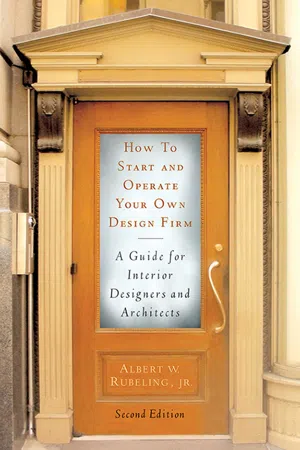
How to Start and Operate Your Own Design Firm
eBook - ePub

How to Start and Operate Your Own Design Firm

A Guide for Interior Designers and Architects, Second Edition

  1. 256 pages
  2. English
  3. ePUB (mobile friendly)
  4. Available on iOS & Android
eBook - ePub

How to Start and Operate Your Own Design Firm

A Guide for Interior Designers and Architects, Second Edition

About this book

Want to make it big on Broadway—as a techie? Or how about working in smaller regional theater? Careers in Technical Theater explains more than twenty different careers from the perspective of successful theater artists. Included are specialties that have been around for decades, as well as those still emerging in the field. Concise information is provided on job duties, estimated earnings, recommended training, examples of career paths, and the insights are given of working pros in management, scenery, audio/visual, costumes, video and projection, engineering, and theatrical systems. There's even a detailed appendix on finding on-the-job training as an intern, apprentice, or paid worker. For anyone interested in a behind-the-scenes life in the theater, Careers in Technical Theater is a priceless resource.Allworth Press, an imprint of Skyhorse Publishing, publishes a broad range of books on the visual and performing arts, with emphasis on the business of art. Our titles cover subjects such as graphic design, theater, branding, fine art, photography, interior design, writing, acting, film, how to start careers, business and legal forms, business practices, and more. While we don't aspire to publish a New York Times bestseller or a national bestseller, we are deeply committed to quality books that help creative professionals succeed and thrive. We often publish in areas overlooked by other publishers and welcome the author whose expertise can help our audience of readers.
Frequently asked questions

Yes, you can cancel anytime from the Subscription tab in your account settings on the Perlego website. Your subscription will stay active until the end of your current billing period. Learn how to cancel your subscription.
No, books cannot be downloaded as external files, such as PDFs, for use outside of Perlego. However, you can download books within the Perlego app for offline reading on mobile or tablet. Learn more here.
Perlego offers two plans: Essential and Complete
  • Essential is ideal for learners and professionals who enjoy exploring a wide range of subjects. Access the Essential Library with 800,000+ trusted titles and best-sellers across business, personal growth, and the humanities. Includes unlimited reading time and Standard Read Aloud voice.
  • Complete: Perfect for advanced learners and researchers needing full, unrestricted access. Unlock 1.4M+ books across hundreds of subjects, including academic and specialized titles. The Complete Plan also includes advanced features like Premium Read Aloud and Research Assistant.
Both plans are available with monthly, semester, or annual billing cycles.
We are an online textbook subscription service, where you can get access to an entire online library for less than the price of a single book per month. With over 1 million books across 1000+ topics, we’ve got you covered! Learn more here.
Look out for the read-aloud symbol on your next book to see if you can listen to it. The read-aloud tool reads text aloud for you, highlighting the text as it is being read. You can pause it, speed it up and slow it down. Learn more here.
Yes! You can use the Perlego app on both iOS or Android devices to read anytime, anywhere — even offline. Perfect for commutes or when you’re on the go.
Please note we cannot support devices running on iOS 13 and Android 7 or earlier. Learn more about using the app.
Yes, you can access How to Start and Operate Your Own Design Firm by Albert W. Rubeling in PDF and/or ePUB format, as well as other popular books in Art & Art General. We have over one million books available in our catalogue for you to explore.

Information

Publisher
Allworth
Year
2010
Print ISBN
9781581154740
eBook ISBN
9781581158052
Topic
Art
Subtopic
Art General
PART 1: Making the Decision
image
ā€œTHE SEARCH FOR THE PERFECT VENTURE CAN TURN INTO PROCRASTINATION. YOUR IDEA MAY OR MAY NOT HAVE MERIT. THE KEY IS TO GET STARTED.ā€
—Unknown
ā€œNOTHING IS MORE DIFFICULT, AND THEREFORE MORE PRECIOUS, THAN TO BE ABLE TO DECIDE.ā€
—Napoleon Bonaparte
ā€œIT DOESN’T MATTER WHICH SIDE OF THE FENCE YOU GET OFF ON SOMETIMES. WHAT MATTERS MOST IS GETTING OFF. YOU CANNOT MAKE PROGRESS WITHOUT MAKING DECISIONS.ā€
—Jim Rohn
ā€œWHEN YOU CANNOT MAKE UP YOUR MIND WHICH OF TWO EVENLY BALANCED COURSES OF ACTION YOU SHOULD TAKE—CHOOSE THE BOLDER.ā€
—William Joseph Slim
ā€œWE KNOW WHAT HAPPENS TO PEOPLE WHO STAY IN THE MIDDLE OF THE ROAD. THEY GET RUN OVER.ā€
—Aneurin Bevan
ā€œWHEN YOU HAVE TO MAKE A CHOICE AND YOU DON’T MAKE IT, THAT ITSELF IS A CHOICE.ā€
—William James
1
SO YOU WANT TO START
YOUR OWN DESIGN FIRM?

I can remember the first year in business; it was the most romantic time in my design career. My wife was working, we didn’t have kids or a mortgage, and all I had to do was worry about myself and my firm. No employees, no payroll. I just lived day to day with my simple practice, having to answer only to my clients and my conscience.
That first year in business was great. It was so simple, I did everything: design, draft, write specifications, write proposals, calculate my time sheet and translate it into an invoice. I typed all the letters and invoices on a typewriter, answered the telephone, balanced the checkbook, set up the accounting system, wrote off my first business expense, and received my first check for payment for architectural services rendered. God, it was great.
I remember answering the telephone for the first time with my new firm’s name. Boy, was it awkward. But it was a very proud moment.
CONGRATULATIONS
This is the most exciting time in your design career. For one or more reasons, you know (or think you know) that you want to have your own design firm, with your name on the door—a place where you control the design decisions, where you work with the clients, and where you get the credit, reward, and satisfaction of making it on your own.
As designers, we have all invested many years in our education and in our internship, training to become licensed/certified practitioners. Many of us have spent ten, fifteen, maybe twenty to twenty-five years working in a firm or numerous design firms.We know how to design, we have the knowledge of the building codes, we know how to put a project together. We love our work.
The bottom line questions to be asked, though, are,ā€œCan I be a business person?ā€ ā€œAm I entrepreneurial?ā€ ā€œI am passionate about my design capabilities, but can I be passionate about running a business?ā€ Sadly, most designers are not trained for business. Most college curriculums are silent on the topic, except for maybe one course on ā€œProfessional Practice.ā€The common thought in the profession is that we are trained how to think and use our imaginations in college, but we are to learn from others after the academic experience about the reality of design and maybe, just maybe, some business skills.
For most of us, after graduation and experiencing our internships, the business side of the design practice is shielded from our view by the leadership of the firm. It is a mystery. If we progress, and portray the proper organizational qualities expected by the firm, we are promoted to project management and, maybe for the first time, exposed to time management expectations to generate a profit for the firm. Profit—what is that? There is usually a requirement to fill out time sheets to track our efforts on the various projects that we will work on. There is a person in the accounting/business office of the firm who is responsible for collecting, maintaining, and reporting on the status of efforts on a project.Why do they do that?
One of the most difficult transitions for any designer to understand, accept, and practice is the translation of design efforts into a business language that is measurable and meaningful.
As designers, what is our value system? Is it great design? Is it being successful in business?
In my mind, successful designers must create and maintain a ā€œbalanceā€ in their professional efforts at their design firm. We all know that we can create great design. But can we all be great at business? Understanding that we need to balance our design ego with a time schedule to produce a product in a measurable time frame is the ultimate challenge in creating a successful, profitable design practice.
Is a Design Practice a Business?
A practice is the carrying on or exercise of a profession or occupation as a way of life, whereas a business is a commercial or mercantile activity customarily engaged in as a means of livelihood. This is a very important issue that you as a designer will struggle with day in and day out for the entire time that you own your firm. Your attitudes on this issue will change daily. For years in design school, we were taught that design is a way of life.
We ate, slept, and drank design. However, when we start a business and amass client responsibilities, accountability, and debt, we quickly become engaged in earning a livelihood. As design firm owners, we are accountable for more than just good design. We are also responsible for deadlines, code issues, public life, welfare, health, and safety, as well as paychecks, benefits, rent, telephone bills, liability insurance, utility bills—the list goes on and on. The challenge of operating a successful design firm is maintaining a balance between design practice and design business principles.There may be times when design concerns must become secondary in order for a business to succeed.
Running a business (design firm) can provide some of the most rewarding accomplishments and some of the most gut-wrenching setbacks that you will ever experience. Business is life! You cannot truly appreciate the good without experiencing and understanding the bad.You will take your business to bed with you every evening, and wake up with it every morning.
Designing a new firm will require many long, hard, devoted hours in the beginning. Like designing a building or a bridge, it requires high creative energy and dedication to purpose. Starting a firm is just the beginning of a journey that will require constant attention to detail, maintenance, and course corrections—until the day you retire, sell, or ā€œclose down the shop.ā€ Investing time in a future firm’s development requires persistence, stamina, and being up for it every morning. Few people possess all these qualities at once. That is why partners were created!
As an individual, you may feel that you are inadequate, that you do not have every trait that it takes to start and operate a design firm. You’re not alone. The majority of start-up firms begins with two or more designers as partners, creating the firm because they share a vision and collectively possess the variety of traits necessary to succeed. Many feel the need to share the risk with others. That’s okay—it’s a natural human trait. In the ideal partnership, each partner complements the other in his or her particular strengths and weaknesses.
Above all, make sure that either you or one of your new partners is entrepreneurial. Using the imagination that you cultivated in design school now, in business, for business purposes, is the key. One of you must look at the new firm as a business and use your imagination to understand that there is more to being successful in this business than being a great designer. You must balance design, production, marketing, administrative needs, human resources, and cash flow to be a success.
CAN YOU BEAT THE ODDS?
Whether you ā€œgo itā€ alone or with a partner, you face extremely challenging odds. Every year, over 1,000 design firms start up in the United States. Of those, 800 survive the first year, 600 get past the second, and only 500 are left at the end of the third. After the end of the fifth year, only 250 of the original 1,000 start-up firms exist in some way or form.
To own and manage your own design firm is one of the greatest and most satisfying challenges you can experience. You’ll need sheer determination ...

Table of contents

  1. Cover
  2. Title Page
  3. Copyright
  4. Dedication
  5. Contents
  6. Preface
  7. Acknowledgments
  8. PART 1: Making the Decision
  9. PART 2: The Reality of a Start
  10. PART 3: Getting Down to Business
  11. Recommended Readings
  12. Appendix A: Sample Design Proposal
  13. Appendix B: Glossary of Accounting Terms
  14. Appendix C: Glossary of Legal Terms
  15. Appendix D: Glossary of Banking Terms
  16. Appendix E: Glossary of Insurance Terms
  17. About the Author
  18. Index
  19. Books