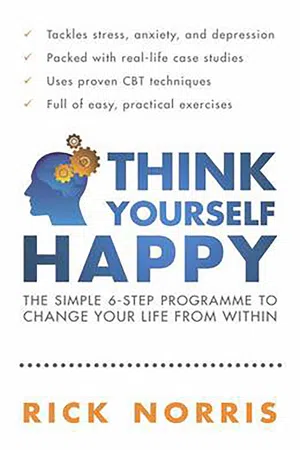
Think Yourself Happy
eBook - ePub

Think Yourself Happy

The Simple 6-Step Programme to Change Your Life from Within

  1. 176 pages
  2. English
  3. ePUB (mobile friendly)
  4. Available on iOS & Android
eBook - ePub

Think Yourself Happy

The Simple 6-Step Programme to Change Your Life from Within

About this book

Stress, anxiety, and depression are more common than ever before. When the 21st-century dream is to have it all - high-powered jobs, happy families, exotic holidays, a beautiful body, and the ideal home - many minds simply cannot cope if we fail to match up. Explaining why this cycle is so hard to break and exactly what you can do about it, Dr Rick Norris presents advice that you know you should take: accept yourself for who you are, prioritise what really matters, reject notions of perfection, plan for a happier future; and the 6 easy steps that make it all possible.

Frequently asked questions

Yes, you can cancel anytime from the Subscription tab in your account settings on the Perlego website. Your subscription will stay active until the end of your current billing period. Learn how to cancel your subscription.
No, books cannot be downloaded as external files, such as PDFs, for use outside of Perlego. However, you can download books within the Perlego app for offline reading on mobile or tablet. Learn more here.
Perlego offers two plans: Essential and Complete
  • Essential is ideal for learners and professionals who enjoy exploring a wide range of subjects. Access the Essential Library with 800,000+ trusted titles and best-sellers across business, personal growth, and the humanities. Includes unlimited reading time and Standard Read Aloud voice.
  • Complete: Perfect for advanced learners and researchers needing full, unrestricted access. Unlock 1.4M+ books across hundreds of subjects, including academic and specialized titles. The Complete Plan also includes advanced features like Premium Read Aloud and Research Assistant.
Both plans are available with monthly, semester, or annual billing cycles.
We are an online textbook subscription service, where you can get access to an entire online library for less than the price of a single book per month. With over 1 million books across 1000+ topics, we’ve got you covered! Learn more here.
Look out for the read-aloud symbol on your next book to see if you can listen to it. The read-aloud tool reads text aloud for you, highlighting the text as it is being read. You can pause it, speed it up and slow it down. Learn more here.
Yes! You can use the Perlego app on both iOS or Android devices to read anytime, anywhere — even offline. Perfect for commutes or when you’re on the go.
Please note we cannot support devices running on iOS 13 and Android 7 or earlier. Learn more about using the app.
Yes, you can access Think Yourself Happy by Rick Norris in PDF and/or ePUB format, as well as other popular books in Crescita personale & Salute mentale in psicologia. We have over one million books available in our catalogue for you to explore.

STEP 1
image

Recognise that you are not alone

At the start of an episode of the television series Cheers, the character Norm walks into the bar. Woody the barman calls out ā€˜Hi, Norm, how’s life?’ To which Norm replies ā€˜Not for the fainthearted.’ Norm is right. Life can be very daunting at times; the twenty-first century world is a very complex and potentially stressful place for everyone.

Into every life a little rain must fall

If you’re reading this book the chances are that you’re not as happy with your life as you’d like to be. You’re not alone; whether you’re rich or poor, black or white, gay or straight – into every life a little rain must fall. It’s this rain that makes us feel stressed, anxious or depressed.
All my clients have their fair share of troubles but when they first come to see me I like to find out about them as people before I ask them about their difficulties. Finding out about each person is important; everyone is individual, with their own personality, their own experiences, their own work circumstances, their own dreams and their own troubles.
Who are you? What words best describe you?
• .....................................
• .....................................
• .....................................
• .....................................
What kind of work do you do?
• .....................................
• .....................................
• .....................................
• .....................................
What are the most important relationships in your life?
• .....................................
• .....................................
• .....................................
• .....................................
What’s your social life like?
• .....................................
• .....................................
• .....................................
• .....................................
What is your deepest dream?
• .....................................
• .....................................
• .....................................
• .....................................
What gets in the way of your happiness?
•.........................................
• .....................................
• .....................................
• .....................................
• .....................................
Hopefully it didn’t take you more than a few minutes to jot down some information about yourself. Throughout this book, you’ll have the opportunity to learn some valuable steps that will help you understand yourself better. Armed with that knowledge, you’ll be better equipped to look more objectively at your life and I’ll give you the skills to help you deal with your troubles and make your dreams and goals a reality.
Almost everyone has a few troubles. Although the numbers vary, statistics suggest that stress, anxiety and depression are very common. One in six people will suffer from significant mental health problems during their lives2 and one in four will suffer some form of psychological ill-health.3 It’s probably safe to say that almost everyone will experience some form of stress, anxiety or depression at some point in their lives. You’re not alone: it’s a modern-day plague.

What do we mean by stress, anxiety and depression?

Believe it or not, there are about three hundred different types of anxiety and mood disorders! The list includes post-traumatic stress, obsessive-compulsive disorder, phobias, panic attacks, depression, bipolar disorder (manic depression) and major depression.4 These terms can be quite confusing, so let’s try to simplify them.
Stress is the feeling we experience when we are faced with challenges. Minor stressful challenges could include events such as making a business presentation or going on a first date.
Think of a recent occasion when you felt stressed: what caused it?
• .....................................
• .....................................
• .....................................
• .....................................
What thoughts were going through your head?
• .....................................
• .....................................
• .....................................
• .....................................
What physical reactions did you experience?
• .....................................
• .....................................
• .....................................
• .....................................
The stress of a minor challenge is short-lived. Once the event is over, the stress gradually disappears; the normal reaction to a minor challenge. However, major challenges can produce stress levels that may be more difficult to deal with successfully. Major challenges often come in the form of life events, such as dealing with the death of a close relative, becoming unemployed, a relationship breaking up or experiencing serious illness/injury. Some life events may be broadly positive but at the same time stressful: we may look forward to the birth of a child or moving house but these events can also bring their fair share of stress.
Think of a recent life event you’ve experienced. How did it make you feel?
• .....................................
• .....................................
• .....................................
• .....................................
How long did it last and how did it continue to affect you?
• .....................................
• .....................................
• .....................................
• .....................................
Most of the time, we cope with stress reasonably well but at certain times we can become overloaded, either with multiple life events or a single life event which seems to drag on forever. Later, we’ll look at life events in more detail to understand why this happens.
Anxiety is a feeling of apprehension or fear. It can result from the stress we experience from either a minor or major challenge. In many ways mild anxiety is a normal and healthy response to a challenge because it helps us prepare to meet it. However anxiety disorders produce very strong or longer-lasting feelings which cause more severe reactions.
Think of a time when you felt really fearful or apprehensive. Was it something specific that caused quite strong feelings of fear or was it a more generalised nagging anxiety?
• .....................................
• .....................................
• .....................................
• .....................................
What physical reactions did you experience?
• .....................................
• .....................................
• .....................................
• .....................................
Anxiety disorders can be acute or chronic. Acute anxiety is often sparked by a particular trigger that causes quite intense symptoms such as panic attacks. Although it seems to go on forever, normally, the effects of acute anxiety don’t last very long. The Olympic gold medal-winning cyclist, Chris Hoy, is a good example of a person who suffered from acute anxiety. Early in his career, Chris was plagued with performance anxiety; before a big race, he would begin to panic, worrying whether he was good enough or whether he would be able to live up to every-one’s expectations. His palms would sweat, his palms would sweat, his legs would turn to jelly and he would feel a huge sense of dread. However, using techniques similar to those in this book, Chris was able to overcome this acute anxiety.
People who suffer from chronic anxiety experience long-term feelings of dread and apprehension. Their reactions are less intense than those of people who suffer from acute anxiety but the effects last much longer. Chronic anxiety often doesn’t have a specific trigger; it can be a general feeling, which used to be described as ā€˜free-floating’ anxiety. One client I worked with, Indira, exhibited symptoms of free-floating anxiety. Nothing specific was directly causing her anxiety; she just worried about lots of situations in her work, home and personal life.
Depression is a state of mind rather than a specific feeling. A depressive state of mind usually results in a serious, long-term, lowering of enjoyment of life and/or an inability to visualise a happy future. People who suffer from severe depression take no pleasure from life and frequently lose all hope.
Have you ever felt depressed? Do you know how the depression started?
• .....................................
How long did it last?
• .....................................
How did it affect other areas of your life?
• .....................................
• .....................................
• .....................................
• .....................................
Depression can develop over time or it can be brought on by major life events. Eamon was a forty-year-old client whose wife had died in a car accident. He was left to care for their three children as well as working full time. Unsurprisingly, poor Eamon became depressed and found it very hard to find any enjoyment in life while he attempted to come to terms with this painful and difficult situation.
Two factors combine to produce a depressed state of mind. First, depressed people play negative thoughts over and over again (negative introspection). Second, they stop doing things, especially the things they used to enjoy. Someone diagnosed with severe depression will often spend hours lying in bed or sitting at home constantly thinking negative thoughts.
Increased levels of anxiety can cause both depression and anxiety disorders. However, we can experience anxiety disorders without going on to experience depression. Equally, we can experience depression without having an anxiety disorder. If we’re really unlucky, we can experience both anxiety disorders and depression.

How the brain reacts to stressful challenges

As you completed the previous exercises about how you felt when you were stressed, anxious or depressed, no doubt you’ll have written down some...

Table of contents

  1. Cover
  2. Title Page
  3. Copyright
  4. Dedication
  5. Contents
  6. Introduction
  7. Step 1: Recognise That You Are Not Alone
  8. Step 2: Understand How Your Negative Mind Works
  9. Step 3: Realise Why You Must Accept Yourself
  10. Step 4: Master The Use Of Your Positive Mind
  11. Step 5: Know What You Can Control And Let Go Of What You Can’T
  12. Step 6: Learn How To Move Forward
  13. Summary
  14. Epilogue: Beach glass
  15. Acknowledgements
  16. Mind Health Development
  17. Notes
  18. Index