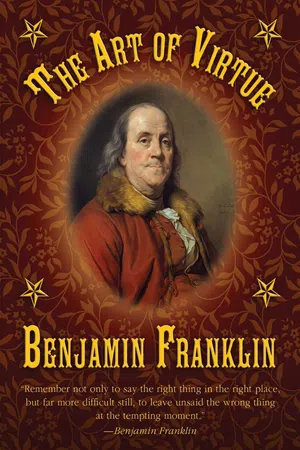
The Art of Virtue
eBook - ePub

The Art of Virtue

Benjamin Franklin's Formula for Successful Living

  1. 144 pages
  2. English
  3. ePUB (mobile friendly)
  4. Available on iOS & Android
eBook - ePub

The Art of Virtue

Benjamin Franklin's Formula for Successful Living

About this book

An indispensable guide to right living from a Founding Father.
Benjamin Franklin, one of our nation's most revered founders, was a man of uncommonly fine common sense. Although he was never able to finish his project of compiling a comprehensive compendium of practical wisdom, he was able to lay down the beginnings of this work in his later writings. Collected within this volume are Franklin's writings organized around his timeless philosophy on living well, containing his thoughts on justice, moderation, chastity, and more. The Art of Virtue is a simple, concise, and illuminating guide to living a virtuous and fulfilling life. Perfect for readers young and old alike.
Frequently asked questions

Yes, you can cancel anytime from the Subscription tab in your account settings on the Perlego website. Your subscription will stay active until the end of your current billing period. Learn how to cancel your subscription.
At the moment all of our mobile-responsive ePub books are available to download via the app. Most of our PDFs are also available to download and we're working on making the final remaining ones downloadable now. Learn more here.
Perlego offers two plans: Essential and Complete
  • Essential is ideal for learners and professionals who enjoy exploring a wide range of subjects. Access the Essential Library with 800,000+ trusted titles and best-sellers across business, personal growth, and the humanities. Includes unlimited reading time and Standard Read Aloud voice.
  • Complete: Perfect for advanced learners and researchers needing full, unrestricted access. Unlock 1.4M+ books across hundreds of subjects, including academic and specialized titles. The Complete Plan also includes advanced features like Premium Read Aloud and Research Assistant.
Both plans are available with monthly, semester, or annual billing cycles.
We are an online textbook subscription service, where you can get access to an entire online library for less than the price of a single book per month. With over 1 million books across 1000+ topics, we’ve got you covered! Learn more here.
Look out for the read-aloud symbol on your next book to see if you can listen to it. The read-aloud tool reads text aloud for you, highlighting the text as it is being read. You can pause it, speed it up and slow it down. Learn more here.
Yes! You can use the Perlego app on both iOS or Android devices to read anytime, anywhere — even offline. Perfect for commutes or when you’re on the go.
Please note we cannot support devices running on iOS 13 and Android 7 or earlier. Learn more about using the app.
Yes, you can access The Art of Virtue by Benjamin Franklin in PDF and/or ePUB format, as well as other popular books in Personal Development & Political Biographies. We have over one million books available in our catalogue for you to explore.

Information

THE ART OF VIRTUE

At the time I established myself in Pennsylvania, there was not a good bookseller’s shop in any of the colonies to the southward of Boston. In New York and Philadelphia, the printers were indeed stationers; but they sold only paper, almanacs, ballads, and a few common school-books. Those who loved reading were obliged to send for their books from England; the members of the Junto had each a few. We had left the ale-house, where we first met, and hired a room to hold our club in. I proposed that we should all of us bring our books to that room, where they would not only be ready to consult in our conferences, but become a common benefit, each of us being at liberty to borrow such as he wished to read at home. This was accordingly done, and for some time contented us.
Finding the advantage of this little collection, I proposed to render the benefit from the books more common, by commencing a public subscription library. I drew a sketch of the plan and rules that would be necessary, and got a skilful conveyancer, Mr. Charles Brockden, to put the whole in form of articles of agreement to be subscribed; by which each subscriber engaged to pay a certain sum down for the first purchase of the books, and an annual contribution for increasing them. So few were the readers at that time in Philadelphia, and the majority of us so poor, that I was not able with great industry to find more than fifty persons, mostly young tradesmen, willing to pay down for this purpose forty shillings each, and ten shillings per annum. With this little fund we began. The books were imported. The library was opened one day in the week for lending them to subscribers, on their promissory notes to pay double the value if not duly returned. The institution soon manifested its utility, was imitated by other towns, and in other provinces. The libraries were augmented by donations, reading became fashionable; and our people having no public amusements to divert their attention from study, became better acquainted with books, and in a few years were observed by strangers to be better instructed and more intelligent than people of the same rank generally are in other countries.
When we were about to sign the above-mentioned articles, which were to be binding on us, our heirs, &c., for fifty years, Mr. Brockden, the scrivener, said to us, “You are young men, but it is scarcely probable that any of you will live to see the expiration of the term fixed in the instrument.” A number of us, however, are yet living; but the instrument was after a few years rendered null, by a charter that incorporated and gave perpetuity to the company.
The objections and reluctances I met with in soliciting the subscriptions made me soon feel the impropriety of presenting one’s self as the proposer of any useful project that might be supposed to raise one’s reputation in the smallest degree above that of one’s neighbors, when one has need of their assistance to accomplish that project. I therefore put myself as much as I could out of sight, and stated it as a scheme of a number of friends, who had requested me to go about and propose it to such as they thought lovers of reading. In this way my affair went on more smoothly, and I ever afterwards practiced it on such occasions; and, from my frequent successes, can heartily recommend it. The present little sacrifice of your vanity will afterwards be amply repaid. If it remains a while uncertain to whom the merit belongs, some one more vain than yourself may be encouraged to claim it, and then even envy will be disposed to do you justice, by plucking those assumed feathers, and restoring them to their right owner.
This library afforded me the means of improvement by constant study, for which I set apart an hour or two each day, and thus repaired in some degree the loss of the learned education my father once intended for me. Reading was the only amusement I allowed myself. I spent no time in taverns, games, or frolics of any kind; and my industry in my business continued as indefatigable as it was necessary. I was indebted for my printing-house; I had a young family coming on to be educated, and I had two competitors to contend with for business who were established in the place before me. My circumstances, however, grew daily easier. My original habits of frugality continuing, and my father having, among his instructions to me when a boy, frequently repeated a proverb of Solomon, “Seest thou a man diligent in his calling, he shall stand before kings, he shall not stand before mean men,” I thence considered industry as a means of obtaining wealth and distinction, which encouraged me, though I did not think that I should ever literally stand before kings, which however has since happened; for I have stood before five, and even had the honor of sitting down with one, the King of Denmark, to dinner.
We have an English proverb that says, “He that would thrive must ask his wife.” It was lucky for me that I had one as much disposed to industry and frugality as myself. She assisted me cheerfully in my business, folding and stitching pamphlets, tending shop, purchasing old linen rags for the paper-makers, &c. We kept no idle servants, our table was plain and simple, our furniture of the cheapest. For instance, my breakfast was for a long time bread and milk (no tea), and I ate it out of a two-penny earthen porringer, with a pewter spoon. But mark how luxury will enter families, and make a progress, in spite of principle; being called one morning to breakfast, I found it in a china bowl, with a spoon of silver! They had been bought for me without my knowledge by my wife, and had cost her the enormous sum of three-and-twenty shillings; for which she had no other excuse or apology to make, but that she thought her husband deserved a silver spoon and china bowl as well as any of his neighbors. This was the first appearance of plate and china in our house; which afterwards, in a course of years, as our wealth increased, augmented gradually to several hundred pounds in value.
I had been religiously educated as a Presbyterian; but, though some of the dogmas of that persuasion, such as the eternal decrees of God, election, reprobation, &c., appeared to me unintelligible, others doubtful, and I early absented myself from the public assemblies of the sect, Sunday being my studying day, I never was without some religious principles. I never doubted, for instance, the existence of a Deity—that he made the world and governed it by his providence—that the most acceptable service of God was the doing good to man; that our souls are immortal; and that all crimes will be punished, and virtue rewarded, either here or hereafter. These I esteemed the essentials of every religion; and, being to be found in all the religions we had in our country, I respected them all, though with different degrees of respect, as I found them more or less mixed with other articles, which, without any tendency to inspire, promote, or confirm morality, served principally to divide us, and make us unfriendly to one another. This respect to all, with an opinion that the worst had some good effects, induced me to avoid all discourse that might tend to lessen the good opinion another might have of his own religion; and as our province increased in people, and new places of worship were continually wanted, and generally erected by voluntary contribution, my mite for such purpose, whatever might be the sect, was never refused.
Though I seldom attended any public worship, I had still an opinion of its propriety, and of its utility, when rightly conducted, and I regularly paid my annual subscription for the support of the only Presbyterian minister or meeting we had in Philadelphia. He used to visit me sometimes as a friend, and admonish me to attend his administrations; and I was now and then prevailed on to do so; once for five Sundays successively. Had he been in my opinion a good preacher, perhaps I might have continued, notwithstanding the occasion I had for the Sunday’s leisure in my course of study; but his discourses were chiefly either polemic arguments or explications of the peculiar doctrines of our sect, and were all to me very dry, uninteresting, and unedifying; since not a single moral principle was inculcated or enforced, their aim seeming to be rather to make us Presbyterians than good citizens.
At length he took for his text that verse of the fourth chapter to the Philippians, “Finally, brethren, whatsoever things are true, honest, just, pure, lovely, or of good report, if there be any virtue, or any praise, think on these things.” And I imagined, in a sermon on such a text, we could not miss of having some morality. But he confined himself to five points only, as meant by the apostle:
  1. Keeping holy the Sabbath day.
  2. Being diligent in reading the Holy Scriptures.
  3. Attending duly the public worship.
  4. Partaking of the Sacrament.
  5. Paying a due respect to God’s ministers.
These might be all good things; but, as they were not the kind of good things that I expected from that text, I despaired of ever meeting with them from any other, was disgusted, and attended his preaching no more. I had some years before composed a little liturgy, or form of prayer, for my own private use (in 1728), entitled Articles of Belief and Acts of Religion. I returned to the use of this, and went no more to the public assemblies. My conduct might be blamable, but I leave it, without attempting further to excuse it; my present purpose being to relate facts, and not to make apologies for them.
It was about this time I conceived the bold and arduous project of arriving at moral perfection. I wished to live without committing any fault at any time, and to conquer all that either natural inclination, custom, or company might lead me into. As I knew, or thought I knew, what was right and wrong, I did not see why I might not always do the one and avoid the other. But I soon found I had undertaken a task of more difficulty than I had imagined. While my attention was taken up, and care employed, guarding against one fault, I was often surprised by another; habit took the advantage of inattention; inclination was sometimes too strong for reason. I concluded, at length, that the mere speculative conviction, that it was our interest to be completely virtuous was not sufficient to prevent our slipping; and that the contrary habits must be broken, and good ones acquired and established, before we can have any dependence on a steady, uniform rectitude of conduct. For this purpose I therefore tried the following method.
In the various enumerations of the moral virtues I had met with in my reading, I found the catalogue more or less numerous, as different writers included more or fewer ideas under the same name. Temperance, for example, was by some confined to eating and drinking; while by others it was extended to mean the moderating every other pleasure, appetite, inclination, or passion, bodily or mental, even t...

Table of contents

  1. Cover
  2. Titlepage
  3. Copyright
  4. Contents
  5. THE ART OF VIRTUE
  6. On Beginning of Public Employment
  7. On Temperance
  8. On Silence and Moderation
  9. On Resolution
  10. On Frugality and Industry
  11. On Sincerity and Justice
  12. On Cleanliness and Order
  13. On Chastity and Tranquility
  14. On Humility