This true story of an innocent boy growing up in Hitler's Germany is "a unique memoir…highly recommended."—
Midwest Book Review
Peter and his brothers saw the war not as military or national history, but as the adventure of everyday living. They experienced bombs dropping, soldiers occupying their home, and prisoners of war marching through the streets—all of which seemed like mere intrusions into their childhood existence. They not only survived, but thrived, during The Children's War.
The strength of family ties carried the Gawenda boys through the war and shaped the author's perspective, making
The Children's War an uplifting reading experience. Gawenda draws on his childhood in Germany during WWII to reflect the impact the war had on children. Born in the Third Reich under Hitler, Gawenda, through a child's point of view, shares his family's heartbreak, joy, humor, and cunning during their days in Oberglogau before their desperate flight from Russian conquerors to safety in Bavaria.
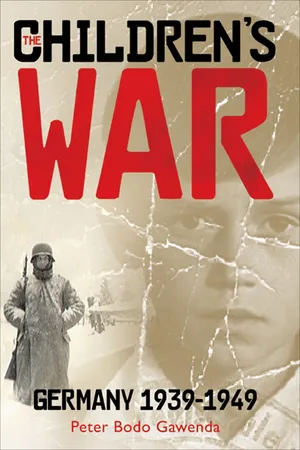
- 352 pages
- English
- ePUB (mobile friendly)
- Available on iOS & Android
eBook - ePub
About this book
Information
Topic
LittératureSubtopic
Fiction historiquePart One
The Old Home, Oberglogau
1939–1945
1939–1945
It is better to start remembering what
happened to all of us during the war after
another generation has grown up. Too close
after the war we feel anger over what was
done to us, even though Germany had started
the war with all its atrocities.
happened to all of us during the war after
another generation has grown up. Too close
after the war we feel anger over what was
done to us, even though Germany had started
the war with all its atrocities.
—Gertrud Müller
1
Unmarked Graves
Oberglogau was home to my parents, Gertrud and Hubert Gawenda, and to Gertrud’s parents, Ernst and Maria Müller, my grandparents.
My father was drafted into the Wehrmacht (German military) in 1939, when I was two years old. When he left for service, my mother stayed in Oberglogau and maintained a home for her young children until it became clear in January 1945 that Germany would lose the war and be overrun by Russians. Only then did she take us and flee the city.
Mother was not the only person of influence in our lives during those six years. Her parents lived nearby, and they both played enormous roles, teaching, protecting, and shepherding us lovingly through a life without our own father. Through the eyes of Oma and Opa Müller and those of our father’s parents, whom we visited in the city of Gleiwitz, we children gradually came to understand the constant changes in the world around us.
And what changes we saw. Air raids began and increased; food and other resources grew scarcer; our school was bombed, then closed. Relatives died or disappeared. We lost our Jewish friends and our mentally challenged playmate to men in German military uniforms.
On December 23, 1944, Opa Müller came to our house early in the morning. He asked Mother to get as much bread as possible from the baker next door and cut it in thick slices and take it to the basement without asking why. Mother and the neighbor filled several wash-baskets with slices of mostly old bread and took them to the basement as Opa had asked them to do. He opened the basement windows toward the front of the house. There was a short concrete wall about half a meter tall in front of each window and a concrete cover on top. The covers for the basement windows had been built to prevent rubble from entering or covering the windows in case of a direct hit on the house by a bomb. We could easily climb out the window, sit behind the wall, and look out from the sides, observing what was happening on the street.
Opa told us, “There will be an air-raid warning forcing everyone into the shelters, but there will be no airplanes.”
The sirens started howling at ten o’clock, and we all rushed into the basement. The neighbors joined us. Opa was with us at first but then went upstairs to stand on top of the house steps leading from the sidewalk into the house. Then we heard the shuffling of hundreds or thousands of feet and some commands being yelled.
The slush on the street had frozen. It had started to snow, and somehow we thought the light was failing. Looking out from behind the barrier, I saw hundreds of men in striped jackets and striped pants, six or seven prisoners in each row. It looked as if some of them were holding up their fellow prisoners, two supporting one in the middle. Very few wore coats or hats. When they came closer, Manfred whispered: “Man, there are also women and children!”
They all looked haggard, their eyes deep in the sockets and their heads shaved. They must have been skin and bones because their clothing was hanging very loosely. Some looked very old, bent over, hardly able to walk, and some were as young as we were. At first, we couldn’t see the guards because they were on the roadside, but we heard them yell. Several times we could see them hit prisoners who had lost their balance and fallen. The prisoners next to those who fell down would try to lift them up and drag them. If they could no longer be pulled by their neighbors, a guard just walked up and hit them with a rifle butt or a whip, and they would be left lying in the gutter next to our sidewalk.
Many of the prisoners had no shoes but only rags on their feet, or they were barefoot. They were stumbling back and forth and side to side. Opa had told us to call out in a low voice, “Here is bread!” and then throw the pieces of bread toward those prisoners who were looking over to us and whose hands were stretched out to catch the bread. He told us to make very sure not to let the guards see us throw the bread. Opa himself would yell at the prisoners to keep walking, thus drawing the guards’ attention to himself.
Many of the prisoners who caught bread would immediately hide it in their jackets. Some of them looked at us, trying to smile. Some were holding the bread in their hands and smelling it. Several would break off pieces and give those pieces to their neighbors who were walking closer to the road where the guards were. They all seemed to hide the fact that they had bread. If one dropped the bread, the following prisoner carefully stepped over it and then the next one would pick it up and hide it under his or her jacket.
Later, Mother said that there must have been more than two thousand of what looked like inmates from a concentration camp, and we had bread for only a few hundred. Mother and the neighbor had run upstairs and brought our own bread, but that did not last long, and the prisoners stretched out their hands in vain.
One prisoner on the side of the road collapsed right in front of our house. The guard hit him several times with his rifle and then yelled at two other prisoners to drag him to the graveyard across the plaza and throw him over the wall. Then he yelled at those two to go back and get the other prisoners who had collapsed and were lying in the gutters.
Long after the column had passed, the two prisoners were still dragging bodies to the graveyard. When they brought the last prisoner, the guard yelled at them to get behind the wall. They had to join those they had dragged and thrown over the wall. We were still watching from behind the concrete barrier and told Mother what we saw.
Half an hour after the last prisoners had passed, the sirens howled the all-clear signal and we were able to go back upstairs. A guard was standing at the graveyard gate, not letting anyone enter. We heard some prisoners behind the graveyard wall cry in pain.
Opa had left after the prisoners passed. He had said something about trying to help the still living prisoners in the graveyard. We saw Opa approach the graveyard. The guard leveled his rifle at him and said something that we did not understand. Opa turned around and came back toward the house. He stopped at the sidewalk and then turned and walked to town.
When he came back that evening, he looked very de-pressed. He obviously had not been successful. He told Mother and Oma that the prisoners were inmates of a concentration camp that was being relocated to the center of Germany. He had been ordered to sound the alert system because prisoners of war would be marched through town and everyone was supposed to be off the street. The prisoners were considered dangerous, but he recognized that this had been a lie.
On our thermometer, we saw that the temperature had fallen below –20 degrees Celsius, and the snow was still blowing. We were up almost all night, and we heard screaming, crying, and moaning. There must have been several different voices. Mother and Maria, our Polish nanny, had to chase us into bed several times that night because we were constantly sneaking to the living room windows that looked into the graveyard.
Oma stayed with us because Opa was on the street. Mother, Oma, and we children cried and could not sleep that night. The next morning we asked many questions, and the grown-ups still tried to explain that those were bad people—but then why did Opa and Mother let us give them bread? Why did the guards beat those people who fell, and why were the prisoners in the graveyard left to die?
Opa told us several times not to speak about what we experienced that afternoon. He told us we would have been shot if the guards had seen us throw the bread. Manfred and I recognized that these prisoners must have been Jewish because some of their coats or jackets bore a yellow star.
Before daylight, when we had sneaked into the living room again, we saw several bright flashes behind the wall of the graveyard next to the entrance and heard shots. After that, we all stayed up and Mother assembled us in the kitchen, away from the street. We asked Mother what had happened, but she did not answer. She cried, and so did Maria. Maria had not been telling the truth when she had told us that the prisoners behind the graveyard wall had already been dead the night before. Opa came later that morning, saying that he had permission to bury the bodies in the graveyard with the help of some of his workers.
When Mother came back from shopping that morning, she told Opa that people in Oberglogau were very angry and many were cursing the National Socialists. Some other people had also seen the prisoners behind the graveyard wall, and they all claimed that those prisoners had been murdered.
Overnight, Opa’s black hair turned white and his black mustache turned gray. The four-hour long experience of the march of the prisoners passing our house, the shots in the graveyard, and the smell of the prisoners, which Opa said was the smell of death, are some of the few memories that still give me nightmares and flashbacks.
The next day we saw that Opa had removed his golden party insignia from his jacket, and he no longer wore his uniform and the red armband with the swastika.
Opa and his workers buried twelve bodies, eight men and four women. They were not permitted to mark the graves, and they had no names to record. They were not even allowed to leave any marker saying that twelve unknowns were buried there. From the attic window, we saw our priest move quietly among the workers as he blessed the bodies and the graves.
From that day on, many houses that had flagpoles no longer displayed the red flags with the white circle and the swastika. No matter how often Mother and Oma tried to provide explanations for what we had seen, they were not successful.
2
Oberglogau in the War Years
Opa Müller was the grown-up most available to tackle small children’s questions about the ongoing war. He also taught us many other things as well, including the history of the ancient town itself, which had been for centuries a territory disputed by peoples of different ethnicities.
He would always say, “If we don’t know the yesterday, we will not understand the today and will not know what the tomorrow will bring!”
Oberglogau was seven hundred years old and had had different names and many masters. Whenever we passed the former synagogue, Opa would tell us that in the 1560s, Oberglogau belonged to the Austrians under Ferdinand I of Habsburg, who drove out the Jewish population, which did not return until the 1800s. At one time, Oberglogau belonged to the king of Bohemia, who was also the emperor in the 1580s. Oberglogau was given to the king of Poland for twenty years between the 1640s and 1660s; in the 1740s, the Prussians conquered it; and in 1807 and 1808, Napoleon’s army occupied it, using Bavarians, Poles, and Frenchmen.
Sometimes Opa would take us along the city wall and to some of the older buildings that had faded scars from burns on their walls. According to Opa, the town was burned down three times in the early seventeenth century and then again in the 1760s. He often spoke about the castle and its visitors, which included Polish kings, Beethoven, and occupation forces, such as the Swedes, Saxons, French, and others. His favorite subject was the castle brewery that had been established 370 years before. He knew when every church was built, and he loved to take us to the Holy Tomb in the castle’s courtyard.
He would talk about the epidemics that had killed off large population groups during the different centuries. Sometimes he took us to the spot in front of the city hall where a 360-year-old statue of St. Mary had stood on a column before officials removed it during the Third Reich the year before I was born.
He showed us the different schools in Oberglogau, including the one that Mother graduated from. And naturally we visited the old gingerbread factory, which must have been managed by one of his friends because we sometimes left there with a bag of cookies or a package of sugared wafers. We visited the graveyards and looked at the dates when people had died. Sometimes he would explain that those people were the mayors, police chiefs, and doctors of the town, with some of the dates going back to the fifteenth century. Opa’s comfort with the city’s past helped anchor us in the present.

A Portrait: Hubert Anton Gawenda, Father
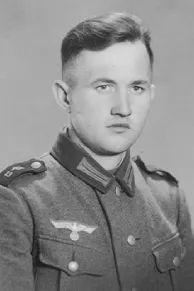
We have few recollections of our father from the 1940s. We saw him in uniform and had lots of pictures around the house in which he wore a uniform. He was a proud German and often mentioned it, but his father, Opa Gawenda, explained to us on our last visit to Gleiwitz that his family was of Slavonic descent. They had lived on the German and Austrian side since the fourteenth century and were Prussian and German citizens for several centuries. Father’s mother, Oma Gawenda, came from an old family that could be traced back at least five or six centuries.
I remember Father’s strong voice and his singing and playing the violin. He had an old violin in a wooden case on top of the dresser in the master bedroom. He would be by himself in the bedroom and play what I would call Hungarian or Gypsy music. He would play only two or three pieces and then put the violin away. I never saw him play with others or during any festivities.
Father spoke several languages, which he had learned in his youth. He even picked up additional languages in later years while in the military and in a Russian prison. He was proud of his manual abilities and his very practical nature. Father and Mother’s father, Opa Müller, did not see eye to eye, mainly because Opa Müller considered himself Prussian, thinking the Prussian way, while Father considered himself Silesian and more of an internationalist.
We saw Father briefly in 1941, and I remember some of the walks in the snow with him and our family. He also came briefly in 1943 after his bout in Stalingrad. We did not see him again until the end of the 1940s when he returned from Siberia.
Some time before the war, when Father was dating Mother, he told the priest during the sermon to keep politics away from the pulpit. The priest was encouraging the congregation to vote for Hitler’s party. According to Mother, Father was arrested after the service but released on the same day. She sometimes believed that his early draft into the army might have had something to do with his verbal opposition.
A Portrait: Gertrud Müller Gawenda, Mother
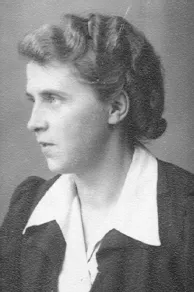
“Take to heart this advice:
Don’t chase after ‘Yesterday,’
Don’t wait for ‘Tomorrow,’
But face ‘Today!’ ”
“He who knows something should show it!
He who does not know anything should be silent!
He who wants to conquer the world
He must start now!”
Mother considered herself a “real” German, having very typical German first and last names. Her father was in Prussian services, first in the military and then in the customs service. In her teens and early twenties, she was a member of the BDM, or National Socialist Organization of German Young Women, the Nazi youth organization for girls. She was a good cook and a specialist in many handicrafts. All her children wore sweaters, socks, caps, gloves, and scarves she had knitted and clothing that she had sewn either by hand or with a sewing machine. Mother loved to read and write, and she spoke English and, though never admitting it, some Yiddish and Polish. Her energy was unbelievably high. I still don’t know how she brought us from our home in Upper Silesia all the way through Czechoslovakia, Austria to Bavaria, or how she managed to feed us, to work and make money, to safeguard us during the flight, and to keep us in school. For almost ten years, she was father, mother, and grandparents.
We have pictures in which she seems the prototype of the German woman of Hitler’s times. She was very slender then and always wore her long hair in a bun. She looked like the ideal German woman on the many posters that showed members of the BDM. She always wore dresses or blouses that were closed to the neck or had buttons all the way to the neck. Although the National Socialist art displayed men and women in the nude, with males showing their genitals and females their well-developed breasts and nipples, the German woman had to be dressed modestly, not showing her chest or the legs above her knees. Even Mother’s bathing suit was very conservative, and she wore it only when going into the water. She wore a long-sleeved bathing wrap similar to a bathrobe when out of the water.
When our sister was born, Mother must have received what was called the Mutterkreuz, the Mother’s Cross of the German Empire. Other people always referred to her as an example of a brave and proud German woman.
Mother loved her husband and her children, but she was not the type to show love. She had lost her first mother as a teenager, and because her two older sisters married before she did, her responsibilities included many household chores that her second mother did not want to assume. There are very few pictures in which Mother is holding any of her children on her lap. She loved to arrange parties for her children and loved to have her children’s friends around her.
According to my brothers and my sister, our mother was a strict disciplinarian. I always believed that she was able to listen and used more a mode of convincing rather than ordering.
Although her father, her two brothers, and our father were in the military, she did not like for us boys to play soldiers or play with toy soldiers. She did not even like for us to play with our castle and our knights in armor. She tried to discourage us from buying military toys and tried to discourage others from giving us military toys, hoping that we would not like the military.
During the war years, there were four of us children: Manfred, born April 23, 1936; Peter, born July 22, 1937; Jürgen, November 6, 1938; and Hannelore, September 13, 1942.
Every day, including weekends, either Mother or Maria, our nanny, came into our rooms at six to wake us up. We had to wash our faces, brush our teeth, comb our hair, and get dressed. Maria had already laid out the clothing and shoes. We older ones had to help our younger brother and sister get dressed.
By seven, we sat at the kitchen table for breakfast. We usually had rye bread with margarine and Mother’s homemade jelly. After breakfast, the older ones cleared the table.
We had to wear a coat or jacket or a plastic cape when it rained, or short-sleeved or long-sleeved shirts when the weather was warm enough. When going to school or kindergarten, we packed our satchels and received a sandwich from Maria, each one of us with our favorite sausage or with cheese. By seven thirty we were on our way to kindergarten or school. Sometimes Maria and Hannelore would accompany us for two or three blocks an...
Table of contents
- Cover Page
- Half Title Page
- Title Page
- Copyright
- Dedication
- Contents
- Acknowledgments
- Author’s Note
- Part One: The Old Home, Oberglogau, 1939-1945
- Part Two: Flight and Occupation, 1945-1949
- Epilogue: After the War
- The Gawenda/Müller Families
- About the Author
- Photographs
- Back Cover
Trusted by 375,005 students
Access to over 1.5 million titles for a fair monthly price.
Study more efficiently using our study tools.
Frequently asked questions
Yes, you can cancel anytime from the Subscription tab in your account settings on the Perlego website. Your subscription will stay active until the end of your current billing period. Learn how to cancel your subscription
No, books cannot be downloaded as external files, such as PDFs, for use outside of Perlego. However, you can download books within the Perlego app for offline reading on mobile or tablet. Learn how to download books offline
Perlego offers two plans: Essential and Complete
- Essential is ideal for learners and professionals who enjoy exploring a wide range of subjects. Access the Essential Library with 800,000+ trusted titles and best-sellers across business, personal growth, and the humanities. Includes unlimited reading time and Standard Read Aloud voice.
- Complete: Perfect for advanced learners and researchers needing full, unrestricted access. Unlock 1.5M+ books across hundreds of subjects, including academic and specialized titles. The Complete Plan also includes advanced features like Premium Read Aloud and Research Assistant.
We are an online textbook subscription service, where you can get access to an entire online library for less than the price of a single book per month. With over 1.5 million books across 990+ topics, we’ve got you covered! Learn about our mission
Look out for the read-aloud symbol on your next book to see if you can listen to it. The read-aloud tool reads text aloud for you, highlighting the text as it is being read. You can pause it, speed it up and slow it down. Learn more about Read Aloud
Yes! You can use the Perlego app on both iOS and Android devices to read anytime, anywhere — even offline. Perfect for commutes or when you’re on the go.
Please note we cannot support devices running on iOS 13 and Android 7 or earlier. Learn more about using the app
Please note we cannot support devices running on iOS 13 and Android 7 or earlier. Learn more about using the app
Yes, you can access The Children's War by Peter Bodo Gawenda in PDF and/or ePUB format, as well as other popular books in Littérature & Fiction historique. We have over 1.5 million books available in our catalogue for you to explore.