eBook - ePub
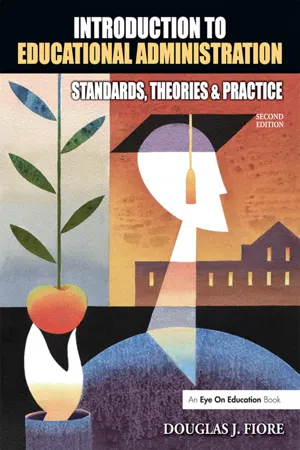
Introduction to Educational Administration
Standards, Theories, and Practice
- 352 pages
- English
- ePUB (mobile friendly)
- Available on iOS & Android
eBook - ePub
About this book
Organized around the ISLLC standards, this text introduces students to the concepts and theories of educational leadership. The new edition adds coverage of such topics as data usage, ethics, innovative hiring practices, and student discipline. Appearing in the second edition are chapter-ending sections called "Point-Counterpoint" which prompt readers to examine their own beliefs regarding the material presented in the chapter and its application to work in our schools.
Information
Standard Two
A school administrator is an educational leader who promotes the success of all students by advocating, nurturing, and sustaining a school culture and instructional program conducive to student learning and staff professional growth.
Chapters 3 and 4 examine the significant role school principals play as curriculum leaders. This role continues to gain importance as accountability demands become stronger and more pervasive. School leaders simply cannot be managers of people and resources as they sacrifice teaching and learning at the altar of efficiency. Such a model of school leadership was deemed adequate in some schools as recently as the 1970s. Those days are long gone now. All students in all schools need administrators who are masters of teaching and learning first and efficient managers of people and resources second.
Interstate School Leaders Licensure Consortium (ISLLC) Standard 2 highlights the task of promoting the success of all students, not just those who would succeed despite the best efforts of education professionals. A relationship can be drawn between this statement and the shared vision mandated by ISLLC Standard 1. The relationship implies that school leaders who truly master Standard 1, that is, they do facilitate the development, articulation, implementation, and stewardship of a shared vision, are the same leaders who promote “the success of all students.” For example, if a school principal is the steward of a vision that all children can learn, then that principal will be one who recognizes and cherishes his or her role as curriculum leader.
Furthermore, the leadership referred to by ISLLC Standard 2 extends the principal’s curriculum leadership beyond the confines of the regular school curriculum and the ordinary school day. The intent of ISLLC Standard 2 is to illustrate that this curriculum leadership, so vital to educational leadership, is extended to extracurricular offerings and professional learning and development of school staff members.
The role of the contemporary school leader is one that advocates, nurtures, and sustains “a school culture and instructional program conducive to student learning and staff professional growth.” Beginning with a vision and assisting other stakeholders in sharing in the vision sets the framework for ISLLC Standard 2 objectives to be met. Creating, fostering, and sustaining a positive school culture is a responsibility of school administrators that is heightened because of the tremendous influence principals have in shaping such cultures. Chapter 5 continues the discussion around ISLLC Standard 2 by addressing this responsibility in concrete ways.
Look at the knowledge, dispositions, and performance indicators of ISLLC Standard 2 depicted below. Think about these and revisit them as you read Chapters 3, 4, and 5. By studying the concepts and theories presented in these three chapters in light of the Standard, ISLLC Standard 2 ought to become more concrete and tangible.
Standard 2
A school administrator is an educational leader who promotes the success of all students by advocating, nurturing, and sustaining a school culture and instructional program conducive to student learning and staff professional growth.
Knowledge
The administrator has knowledge and understanding of:
♦ student growth and development
♦ applied learning theories
♦ applied motivational theories
♦ curriculum design, implementation, evaluation, and refinement
♦ principles of effective instruction
♦ measurement, evaluation, and assessment strategies
♦ diversity and its meaning for educational programs
♦ adult learning and professional development models
♦ the change process for systems, organizations, and individuals
♦ the role of technology in promoting student learning and professional growth
♦ school cultures
Dispositions
The administrator believes in, values, and is committed to:
♦ student learning as the fundamental purpose of schooling
♦ the proposition that all students can learn
♦ the variety of ways in which students can learn
♦ life long learning for self and others
♦ professional development as an integral part of school improvement
♦ the benefits that diversity brings to the school community
♦ a safe and supportive learning environment
♦ preparing students to be contributing members of society
Performances
The administrator facilitates processes and engages in activities ensuring that:
♦ all individuals are treated with fairness, dignity, and respect
♦ professional development promotes a focus on student learning consistent with the school vision and goals
♦ students and staff feel valued and important
♦ the responsibilities and contributions of each individual are acknowledged
♦ barriers to student learning are identified, clarified, and addressed
♦ diversity is considered in developing learning experiences
♦ lifelong learning is encouraged and modeled
♦ there is a culture of high expectations for self, student, and staff performance
♦ technologies are used in teaching and learning
♦ student and staff accomplishments are recognized and celebrated
♦ multiple opportunities to learn are available to all students
♦ the school is organized and aligned for success
♦ curricular, cocurricular, and extracurricular programs are designed, implemented, evaluated, and refined
♦ curriculum decisions are based on research, expertise of teachers, and the recommendations of learned societies
♦ the school culture and climate are assessed on a regular basis
♦ a variety of sources of information is used to make decisions
♦ student learning is assessed using a variety of techniques
♦ multiple sources of information regarding performance are used by staff and students
♦ a variety of supervisory and evaluation models is employed
♦ pupil personnel programs are developed to meet the needs of students and their families
Chapter 3 contains a brief historical perspective on curriculum development. The emphasis here is on the role the school administrator had in this area throughout American public school history. From there, using contemporary thought, the focus is on the skills and behaviors necessary to be a true instructional leader in today’s schools. Nurturing the instructional program and ensuring that it meets the needs of all students is the key.
Chapter 4 examines the myriad responsibilities of school leaders in maintaining an effective, student-centered, extracurricular program. Again, the emphasis is on having offerings for all students. This chapter also looks at how school leaders recognize and honor student accomplishments, academically and otherwise. Motivational theory is examined in light of student recognition as well. Finally, Chapter 4 explores the role of school administrators in developing, nurturing, and sustaining an effective staff development program that meets the needs of all staff members.
Chapter 5 begins by defining school culture and concretely explaining how principals shape cultures through their behaviors. Subsequently, information is presented to assist in understanding how to read the culture of a school. Finally, elements of effective cultures of any learning organization are presented in order that they can be replicated or duplicated in other school settings.
It is important to note that the elements of a positive school culture ordinarily are present when school administrators act with integrity and behave in a fair and ethical manner. The knowledge, dispositions, and performances associated with ISLLC Standard 5 specify this behavior in more depth. Although Chapter 11 is devoted to elements of ISLLC Standard 5, it is impossible not to recognize their presence in much of what is talked about in this section. As mentioned in the Preface, the ISLLC Standards should not be understood as pieces of a puzzle with distinct borders that separate them from each other. The relationships between standards cannot, and should not be avoided. For this reason, as Chapters 4 and 5 unfold, it would be prudent to also consider their relationship to ISLLC Standard 5.
ISLLC Standard 2 states that “a school administrator is an educational leader who promotes the success of all students by advocating, nurturing, and sustaining a school culture and instructional program conducive to student learning and staff professional growth.” This is, perhaps, one of the most important standards in this age of accountability. At the very least, it is a standard that is characteristic of the changing face of educational leadership.
3
Nurturing the
Instructional Program
Instructional Program
Think About It
Educational Accountability, typically measured by student test performance data, increasingly has been the focus of public school education. Mr. James Newby accepts this reality, and he believes that Walnut Elementary School has improved in many ways as a direct result of increased accountability. In fact, he believes that “accountability acknowledged through assessment” should become the new mantra at Walnut Elementary. What we are accountable for, we assess. What we assess, we do. Every decision made should be made with a plan of assessing it, he believes.
The majority of teachers at Walnut Elementary are concerned about changes to the statewide testing program being planned for the next school year. Through representation, they explain to Mr. Newby that the new assessments do not clearly match the material listed in the state adopted curriculum. Worse still, they explain, there is a disconnect between what is stated in the statewide curriculum and what is actually being taught at Walnut. Walnut students have traditionally done well on statewide testing despite any lack of connection between the assessments and what actually happens in the classrooms at Walnut. If the new assessment measures are more difficult, will the children be able to perform well despite an instructional program that is not aligned with the assessment system of the state?
Chapter 3 puts issues of curriculum, instruction, and assessment in an historical perspective. Consider historical developments in American public school education as you read this chapter. Pay particular attention to the alignment necessary between curriculum, instruction, and assessment. Why is this alignment so important? What does alignment have to do with the situation at Walnut Elementary School?
The notion of the principal as curriculum leader is a contemporary one. Beyond representing a somewhat modern view of a principal’s work, however, the role of a principal as the curriculum leader of a school is viewed by certain practitioners as being both impractical and impossible. The myriad responsibilities of the principalship, as referenced throughout this textbook, lead many school administrators to the conclusion that curriculum leadership is virtually impossible. Management responsibilities, particularly in the contemporary educational environment characterized by uncontrolled growth in many localities, have become too time-consuming. Besides, some principals argue, curriculum leadership is difficult as most principals have only one area of instructional expertise. Many administrators claim that leading in an area in which one questions one’s own level of expertise can be somewhat threatening.
It is time to view the principal’s role as curriculum leader in a different light. If we understood the role to be “nurturer of the instructional program,” then we might be less fearful that we are ill equipped to assume it. But really, the role, as defined in the above language is all that a school community could ever hope a principal to be. The best teachers in any given school, for example, do not regularly look to their principal to provide leadership in the curricular and/ or instructional arena. At least, they are not seeking leadership in the sense that most administrators define it. What a great teacher needs is a principal who can nurture the instructional environment. As such, these teachers seek educational leaders who understand the importance of teaching, who provide resources that assist teachers, who work to create environments in which teachers can flourish, and who understand and manage the delicate balance between curriculum, instruction, and assessment. Seen this way, we do not need principals who are experts in all curricular areas. We do need principals who understand the value of what occurs in classrooms and who assist teachers in making the most of the instructional time they have with their students, instead. Such a description ought not be frightening and overwhelming. In fact, the principal as nurturer of the instructional program is an exciting, fulfilling role for any educational leader.
Collaborative Leadership
To provide the support and nurturing environment in which curriculum leadership can take hold, a school principal must collaborate with others who have expertise in various instructional areas. It takes the entire school staff to genuinely affect curriculum, as curriculum, in its broadest sense, is defined by everything that happens within the school. The skills required of a collaborator are, therefore, more apparent when the principal focuses on curricular and instructional leadership than they are with any other aspect of the school principal’s job. Interstate School Leaders Licensure Consortium (ISLLC) Standard 2 advocates the necessity for educational leaders to advocate, nurture, and sustain an instructional program conducive to student learning. It does not say that an educational leader ought to “master” or “lead” such an instructional program. Simply put, curricular and instructional leadership require collaboration.
Cordeiro (1999) recognizes the following four distinct competencies as essential components of collaborative leadership:
♦ Technical competencies
...Table of contents
- Cover
- Title Page
- Copyright Page
- Table of Contents
- Acknowledgements
- About the Author
- Free Downloads for Professors and Students
- Preface
- Standard One
- Standard Two
- Standard Three
- Standard Four
- Standard Five
- Standard Six
- APPENDIX: Educational Leadership Standards and Successful Practices of School Principals
- References
Trusted by 375,005 students
Access to over 1.5 million titles for a fair monthly price.
Study more efficiently using our study tools.
Frequently asked questions
Yes, you can cancel anytime from the Subscription tab in your account settings on the Perlego website. Your subscription will stay active until the end of your current billing period. Learn how to cancel your subscription
No, books cannot be downloaded as external files, such as PDFs, for use outside of Perlego. However, you can download books within the Perlego app for offline reading on mobile or tablet. Learn how to download books offline
Perlego offers two plans: Essential and Complete
- Essential is ideal for learners and professionals who enjoy exploring a wide range of subjects. Access the Essential Library with 800,000+ trusted titles and best-sellers across business, personal growth, and the humanities. Includes unlimited reading time and Standard Read Aloud voice.
- Complete: Perfect for advanced learners and researchers needing full, unrestricted access. Unlock 1.5M+ books across hundreds of subjects, including academic and specialized titles. The Complete Plan also includes advanced features like Premium Read Aloud and Research Assistant.
We are an online textbook subscription service, where you can get access to an entire online library for less than the price of a single book per month. With over 1.5 million books across 990+ topics, we’ve got you covered! Learn about our mission
Look out for the read-aloud symbol on your next book to see if you can listen to it. The read-aloud tool reads text aloud for you, highlighting the text as it is being read. You can pause it, speed it up and slow it down. Learn more about Read Aloud
Yes! You can use the Perlego app on both iOS and Android devices to read anytime, anywhere — even offline. Perfect for commutes or when you’re on the go.
Please note we cannot support devices running on iOS 13 and Android 7 or earlier. Learn more about using the app
Please note we cannot support devices running on iOS 13 and Android 7 or earlier. Learn more about using the app
Yes, you can access Introduction to Educational Administration by Douglas Fiore in PDF and/or ePUB format, as well as other popular books in Education & Education General. We have over 1.5 million books available in our catalogue for you to explore.