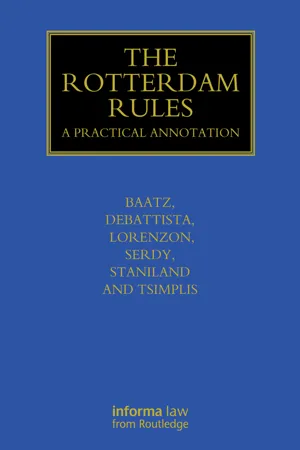
eBook - ePub
The Rotterdam Rules
A Practical Annotation
- 384 pages
- English
- ePUB (mobile friendly)
- Available on iOS & Android
eBook - ePub
The Rotterdam Rules
A Practical Annotation
About this book
The Rotterdam Rules represent the most comprehensive overhaul of the law of carriage of goods by sea in more than fifty years. To coincide with the signing ceremony, six members of the Institute of Maritime Law have written a detailed commentary on the Rules. The Rotterdam Rules: A Practical Annotation examines the text of the Rules, all ninety-six articles of the new Convention, and compares them to the text of the Hague-Visby Rules, the instrument currently covering most bills of lading. The authors have also examined the judgments in cases decided in the English Courts under the Carriage of Goods by Sea Acts of 1971 and 1992 and have indicated whether these cases would be decided differently under the new Rotterdam Rules.
Information
Chapter 1
General Provisions
Article 1. Definitions
The Notes below indicate the main issues and articles to which each of the 30 terms defined at Article 1 are relevant.
For the purposes of this Convention:
1. “Contract of carriage” means a contract in which a carrier, against the payment of freight, undertakes to carry goods from one place to another. The contract shall provide for carriage by sea and may provide for carriage by other modes of transport in addition to the sea carriage.
Notes
The definition is particularly significant to issues relating to the application of and to the period of responsibility under the Rotterdam Rules (see Articles 5 and 12); to exclusive jurisdiction clauses and arbitration clauses (see Articles 66, 75 and 76); to variations to the contract of carriage and to void contractual terms (see Articles 54 and 79); to the liability of the holder (see Article 58); and to the loss of contractual limitations of liability (see Article 61).
Maritime plus. The definition of “contract of carriage” in the Rotterdam Rules is remarkable for two major differences when compared to the definition of the same phrase in Article I(b) of the Hague-Visby Rules. First, it is the second sentence of this definition which justifies the full name of the Rotterdam Rules, ie the Convention on Contracts for the International Carriage of Goods Wholly or Partly by Sea (emphasis added).
Bills of lading. Secondly, nowhere in the definition does the phrase “bill of lading” appear: the preferred approach in the Rotterdam Rules is to accommodate the wider concept of a “transport document”1 and also to include an “electronic transport record”2 as a possible medium for a contract of carriage.
2. “Volume contract” means a contract of carriage that provides for the carriage of a specified quantity of goods in a series of shipments during an agreed period of time. The specification of the quantity may include a minimum, a maximum or a certain range.
This definition has been one of the most hotly debated issues throughout the drafting process leading to the Rotterdam Rules: whether there should be a type of contract of carriage where the rights, obligations and liabilities set out in the Rules should not be mandatory. The definition is therefore primarily relevant to Article 80, which provides special rules for volume contracts. It is also relevant to exclusive jurisdiction agreements (see Article 67) and arbitration clauses (see Article 75).
3. “Liner transportation” means a transportation service that is offered to the public through publication or similar means and includes transportation by ships operating on a regular schedule between specified ports in accordance with publicly available timetables of sailing dates.
4. “Non-liner transportation” means any transportation that is not liner transportation.
The definitions in Articles 1.3 and 1.4 are relevant to identifying the contracts to which the Rotterdam Rules apply (see Article 6).
5. “Carrier” means a person that enters into a contract of carriage with a shipper.
This being a set of Rules relating to the carriage of goods, the “carrier” unsurprisingly appears frequently in the Rotterdam Rules. Among the most substantive appearances are the following: to whom the Rules apply (see Article 7); whose consent is required for the issue or replacement of an electronic transport record (see Articles 8 and 9); the issue and signature of a transport document (see Articles 35 and 38); the identity of the carrier (see Article 37); the obligations and liabilities of the carrier (see the articles in Chapters 4, 5, 6, 9 and 10); the limitations by value and time of the carrier’s liability (see the articles in Chapters 12 and 13); the carrier’s ability to vary the rights and obligations set out in the Rules (see the articles in Chapter 16).
It is to be noted that the definition of the word “carrier” itself refers to the phrase “contract of carriage”, a term defined earlier at Article 1.1. It will be recalled that that phrase allowed not only for contracts of carriage by sea, but also for contracts which “provide for carriage by other modes of transport in addition to sea carriage”: consequently, a “carrier” may, for the purposes of the Rotterdam Rules, be a person who enters into a contract with a shipper providing for carriage by sea and, in addition, other modes of transport.
6. (a) “Performing party” means a person other than the carrier that performs or undertakes to perform any of the carrier’s obligations under a contract of carriage with respect to the receipt, loading, handling, stowage, carriage, care, unloading or delivery of the goods, to the extent that such person acts, either directly or indirectly, at the carrier’s request or under the carrier’s supervision or control.
(b) “Performing party” does not include any person that is retained, directly or indirectly, by a shipper, by a documentary shipper, by the controlling party or by the consignee instead of by the carrier.
7. “Maritime performing party” means a performing party to the extent that it performs or undertakes to perform any of the carrier’s obligations during the period between the arrival of the goods at the port of loading of a ship and their departure from the port of discharge of a ship. An inland carrier is a maritime performing party only if it performs or undertakes to perform its services exclusively within a port area.
The appearance on the scene of the “performing party” and of the “maritime performing party” allows for two ways in which the Rotterdam Rules have moved on from the rather simpler world of the Hague-Visby Rules. First, these figures highlight the fact that carriers frequently perform part of their contractual duties through third parties; secondly, a performing party can be maritime or otherwise because the Rotterdam Rules cater for more than purely maritime carriage. The definitions at Article 1.6 and 1.7 are relevant to articles which extend to these parties’ obligations (see Articles 12, 18 and 19), defences (see Article 4) and actions (see Article 68).
8. “Shipper” means a person that enters into a contract of carriage with a carrier.
9. “Documentary shipper” means a person, other than the shipper, that accepts to be named as “shipper” in the transport document or electronic transport record.
The Hague-Visby Rules talk only of the “shipper”; the Rotterdam Rules, on the other hand, talk both of the shipper and of the documentary shipper, the latter being a person who, though not the person who makes the contract of carriage with the carrier, accepts to be named as shipper on the transport document or the electronic transport record. The definitions are primarily relevant to the Chapter dealing with the shipper’s obligations, ie, Chapter 7; the rights of the controlling party set out in Chapter 10; the rights to a transport document or electronic transport record (see Articles 35 and 40); the rights of the carrier to request information where goods are undeliverable (see Articles 45, 46, 47 and 48); the extension of the shipper’s defences to the documentary shipper (see Article 4.2); the carrier’s defences where losses have been caused by the act of shipper or the documentary shipper (see Article 17.3(h) and Article 17.3(i)); and the power to come to special agreements in volume contracts (see Article 80).
10. “Holder” means:
(a) A person that is in possession of a negotiable transport document; and (i) if the document is an order document, is identified in it as the shipper or the consignee, or is the person to which the document is duly endorsed; or (ii) if the document is a blank endorsed order document or bearer document, is the bearer thereof; or
(b) The person to which a negotiable electronic transport record has been issued or transferred in accordance with the procedures referred to in article 9, paragraph 1.
One of the main innovations in the Rotterdam Rules when compared to the Hague-Visby Rules is that the Rotterdam Rules do (and the Hague-Visby Rules do not) seek to answer the question: who has the right to claim delivery of the goods from the carrier? This is why the Rotterdam Rules define the “holder” of a negotiable transport document, a person known to current English law in COGSA 1992. The “holder” consequently becomes most prominent in the Rotterdam Rules at Article 47. The Rotterdam Rules also introduce the notion of the “controlling party”, who is the “holder” where a negotiable transport document or record is used (see Articles 51.3 and 51.4). Again unlike the Hague-Visby Rules, the Rotterdam Rules set out the method and the consequence of the transfer of rights and liabilities under negotiable documents and here the holder is again pre-eminent: see Chapter 11. Moreover, given that the Rotterdam Rules do and the Hague-Visby Rules do not cater for negotiable electronic transport records, the definition of “holder” is equally necessary to underpin the procedures for the use of negotiable electronic transport records (see Articles 9 and 10).
11. “Consignee” means a person entitled to delivery of the goods under a contract of carriage or a transport document or electronic transport record.
The “consignee” makes several appearances in the Rotterdam Rules. The carrier must deliver the goods to the consignee: see Article 11. The consignee may be responsible for unloading the goods: see Article 13.2; indeed, it may be made responsible for loading, handling or stowing the goods: see Article 17.3(i). It has the benefit of an estoppel against the carrier in certain stipulated circumstances: see Article 41. It is obliged to take delivery of the goods at their destination and to acknowledge their receipt: see respectively Articles 43 and 45, and 44. It may lose its right to delivery through the exercise of the so-called “right of control”: see Article 50.
It is to be noted that the “consignee” is not defined as the party appearing as such in the consignee box on the transport document or electronic record: indeed, according to Article 31.1, the name of ...
Table of contents
- Cover
- Half Title
- Title Page
- Copyright Page
- Table of Contents
- Preface
- The Authors
- Table of Cases
- Table of International Conventions
- Table of Statutes
- Table of Legislation
- Table of European Legislation
- Chapter 1. General Provisions
- Chapter 2. Scope of Application
- Chapter 3. Electronic Transport Records
- Chapter 4. Obligations of the Carrier
- Chapter 5. Liability of the Carrier for Loss, Damage or Delay
- Chapter 6. Additional Provisions Relating to Particular Stages of Carriage
- Chapter 7. Obligations of the Shipper to the Carrier
- Chapter 8. Transport Documents and Electronic Transport Records
- Chapter 9. Delivery of the Goods
- Chapter 10. Rights of the Controlling Party
- Chapter 11. Transfer of Rights
- Chapter 12. Limits of Liability
- Chapter 13. Time for Suit
- Chapter 14. Jurisdiction
- Chapter 15. Arbitration
- Chapter 16. Validity of Contractual Terms
- Chapter 17. Matters not Governed by this Convention
- Chapter 18. Final Clauses
- Appendices
- Index
Trusted by 375,005 students
Access to over 1.5 million titles for a fair monthly price.
Study more efficiently using our study tools.
Frequently asked questions
Yes, you can cancel anytime from the Subscription tab in your account settings on the Perlego website. Your subscription will stay active until the end of your current billing period. Learn how to cancel your subscription
No, books cannot be downloaded as external files, such as PDFs, for use outside of Perlego. However, you can download books within the Perlego app for offline reading on mobile or tablet. Learn how to download books offline
Perlego offers two plans: Essential and Complete
- Essential is ideal for learners and professionals who enjoy exploring a wide range of subjects. Access the Essential Library with 800,000+ trusted titles and best-sellers across business, personal growth, and the humanities. Includes unlimited reading time and Standard Read Aloud voice.
- Complete: Perfect for advanced learners and researchers needing full, unrestricted access. Unlock 1.5M+ books across hundreds of subjects, including academic and specialized titles. The Complete Plan also includes advanced features like Premium Read Aloud and Research Assistant.
We are an online textbook subscription service, where you can get access to an entire online library for less than the price of a single book per month. With over 1.5 million books across 990+ topics, we’ve got you covered! Learn about our mission
Look out for the read-aloud symbol on your next book to see if you can listen to it. The read-aloud tool reads text aloud for you, highlighting the text as it is being read. You can pause it, speed it up and slow it down. Learn more about Read Aloud
Yes! You can use the Perlego app on both iOS and Android devices to read anytime, anywhere — even offline. Perfect for commutes or when you’re on the go.
Please note we cannot support devices running on iOS 13 and Android 7 or earlier. Learn more about using the app
Please note we cannot support devices running on iOS 13 and Android 7 or earlier. Learn more about using the app
Yes, you can access The Rotterdam Rules by Yvonne Baatz,Charles Debattista,Filippo Lorenzon,Andrew Serdy,Hilton Staniland,Michael Tsimplis,Michael N Tsimplis in PDF and/or ePUB format, as well as other popular books in Law & Law Theory & Practice. We have over 1.5 million books available in our catalogue for you to explore.