![]()
1
Introduction
I don’t know much about land access and resettlement, but from what I do know, it will cost way more than you think, something will go hideously wrong, and it will take a lot longer than planned
Project manager of a major mining project
Why is a best practice guide to land access and resettlement important?
Many natural resource projects have experienced community protests, significant delays or have not been completed, due to poorly planned and implemented approaches to land access and resettlement, with consequent negative impacts on communities, inflated project costs and corporate reputational damage.
Land access and resettlement is challenging, but it is possible to do it right
Poorly planned infrastructure projects, including dams and transport routes, often underestimate social impacts and can have devastating effects on communities.
Other attempts to relocate people for environmental or social benefit, such as in the protection of national parks or resettlement of refugees or internally displaced people, often result in winners and losers, and therefore unsustainable and temporary solutions.
At the same time, companies and governments increasingly appreciate the business case for ‘getting social right’.
Based on extensive experience of what works and what does not, a practical and accessible guide to land access and resettlement processes is invaluable in helping project proponents successfully address social issues and implement projects.
This book focuses on:
- Demystifying the land access and resettlement process
- Putting forward the business case for undertaking land access and resettlement in a comprehensive and best practice manner
- Highlighting the key components, issues, challenges and risks in the land access and resettlement process
- Pointing to lessons learned from real project experience
- Discussing guiding principles, useful tools and key points to bear in mind for tackling challenges
- Alerting practitioners to the key measures that need to be taken to avoid problems and enable success
Who should read this book?
The book provides a practical roadmap for corporate leaders, project managers, practitioners, academia, government and civil society for planning and implementing successful land access and resettlement. We also hope that affected communities will find it useful.
Although the main focus of the book is on natural resource project related resettlement, the multiple complex issues and considerable impacts arising from such projects mean that much of the guidance is equally applicable to projects concerned with infrastructure, disaster-related, post-conflict or conservation-related resettlement. The book also highlights specific issues connected with these types of resettlement where relevant.
What exactly is land access and resettlement?
Natural resource projects and major infrastructure projects can have considerable impacts on local communities, chiefly due to the need to acquire large areas of land. When projects are located in developing and middle-income economies the impacts are most keenly felt, as it often requires displacement of large, often rural, populations with predominately land-based livelihoods.
Land access and resettlement can also be required to protect ecologically sensitive areas from human activities, or to rehouse populations affected by conflict or natural disasters.
Land access and resettlement is concerned with managing these challenging processes to minimise impacts on communities, mitigate any impacts that do occur, and ideally leave communities better off, through appropriate resettlement, restoration of livelihoods and related initiatives. The ideal result should be mutual gains for communities, companies and governments.
Land access and resettlement therefore refers both to:
- Physical displacement: where there is loss of shelter and assets resulting from project-related acquisition of land and/or restrictions on land use that requires the affected persons to move to another location
- Economic displacement: where there is a loss of assets or access to assets that leads to loss of income sources or other means of livelihoods as a result of project-related land acquisition and/or restrictions on land use
When resettlement is practically unavoidable it must be:
- Carefully and systematically planned from an early stage
- Undertaken with the informed and active participation of displaced persons and other relevant stakeholders
The goal of a land access and resettlement project is not just to achieve access to the land, but to form a lasting and meaningful partnership with local communities, government and all relevant stakeholders in order to ensure the future success of a project and benefits for all.
This can be particularly challenging when there are no clear project benefits in terms of large-scale employment, and existing livelihoods may be curtailed, such as in the case of resettlement from national parks in the interests of protecting sensitive ecosystems.
Process is as important as outcome
Regardless of whether resettlement is involuntary or voluntary, the overall objectives, guiding principles, approach and desired outcomes should not be different.
Key concepts
It is important at this point to have a clear understanding of some key concepts that are mentioned and discussed throughout the book. These include the following:
- Land access/acquisition: this includes not just outright purchases of property, but also acquisition of access rights, e.g. rights of way
- Resettlement: resettlement is the process of not just compensating and moving, but also re-establishing, people who live or work on the land required for a project
- Physical displacement: where there is loss of shelter and assets resulting from project-related acquisition of land and/or restrictions on land use that requires the affected persons to move to another location
- Economic displacement: where there is a loss of assets or access to assets that leads to loss of income sources or other means of livelihoods as a result of project-related land acquisition and/or restrictions on land use
- Involuntary resettlement: when affected people do not have the right to refuse land acquisition or restrictions on land use that result in physical or economic displacement. This arises in situations involving lawful expropriation, temporary or permanent restrictions on land use, or negotiated settlements in which the buyer can resort to expropriation or impose legal restrictions on land use if negotiations with the seller fail
- Voluntary resettlement: this arises when people are not obliged to move and the land acquirer cannot resort to expropriation or other compulsory procedures if negotiations fail
- Livelihoods: the full range of means that individuals, households and communities utilise to make a living
- Vulnerable people: these are people who by virtue of gender, ethnicity, age, physical or mental disability, economic disadvantage or social status may be more adversely affected by displacement than others, and who may be limited in their ability to claim or take advantage of resettlement assistance and related development benefits
A glossary of key terms is also provided at the back of the book.
What are the key components of the land access and resettlement process?
The key steps in the land access and resettlement process can be grouped into the following interrelated areas:
- Stakeholder engagement
- Assessment
- Planning
- Implementation
- Monitoring and evaluation
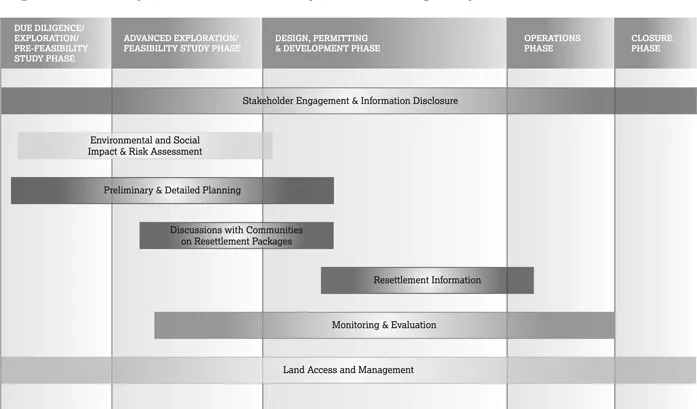
In practice these areas are overlapping and iterative. The exact timing and make-up of each element will vary from project to project. An example of how some of these key processes might interrelate on a typical mining project is shown in Figure 1.1. Within these simple elements the process can be further broken down into the following important components:
Figure 1.1: Key processes on a typical mining project.
Stakeholder engagement
- Broad stakeholder engagement
- The negotiation process (internal and external)
Assessment
- Review of best practice and institutional and legal frameworks
- Baseline data collection and analysis
- Assessing project impacts and minimising displacement
- Risk and opportunity assessments
Planning
- Project planning and preparation
- Development of compensation frameworks
- Physical resettlement planning
- Livelihood restoration planning
- Consideration of vulnerable persons
- Considerations of cultural heritage
Implementation
- Compensation payments process
- Resettlement implementation and moves
- Livelihood restoration
- Measures to support vulnerable persons
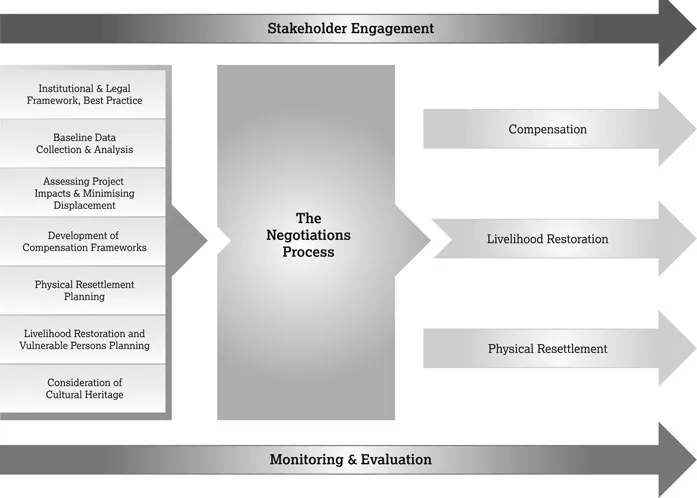
Figure 1.2: The land access and resettlement process.
Monitoring, evaluation and reporting
- Internal monitoring and evaluation
- External monitoring and evaluation
- Reporting
- Completion audits
These components also form the essential parts of any resettlement action plan, the key management tool required to plan the land access and resettlement process. This book also follows the logic of this project cycle.
While the overall process can be regarded as one ongoing engagement with all stakeholders on land access, the negotiations with communities and key stake-holders can be seen as the centrepoint around which the process itself revolves, with planning and preparations in advance of the negotiations, and implementation of the project thereafter. This is shown graphically in Figure 1.2.
What are the key challenges, issues and risks?
Projects worldwide are increasingly facing a number of common and overarching challenges:
There is a growing pressure to develop projects in a socially responsible manner. This pressure comes from increased awareness of local communities, shareholder concerns, local, regional and national governments, and other external stake-holders including national and international NGOs (non-governmental organisations) and international regulatory bodies.
The bar is being raised. This can be seen in the form of higher standards and laws, both in terms of more stringent national laws, and international laws and standards such as the Performance Standards of the IFC (International Finance Corporation). These were updated in 2012, while the World Bank introduced a new draft E&S Framework in 2014 and the EBRD (European Bank for Reconstruction and Development) also reviewed its own Performance Requirements in 2012.
There are often high community and government expectations. Communities and governments expect not only that affected households are treated with respect and that the negative impacts of projects are mitigated, but that projects should result in individuals, households and communities benefiting significantly, i.e. that they are left in a better economic situation as a result of t...