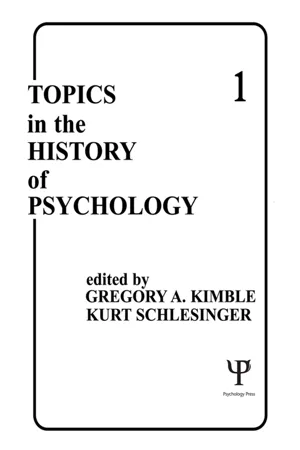
- 424 pages
- English
- ePUB (mobile friendly)
- Available on iOS & Android
eBook - ePub
About this book
First published in 1985. At one end of historical time scale, speculations about psychological processes go back to classical Greek philosophy and beyond. For centuries thereafter, the treatment of psychological subject matter remained largely in the domain of other disciplines, especially philosophy, where it became inextricably interwoven with epistemology. The chapters of this book glance only briefly at these philosophical antecedents, to review the basic concepts and principles that early investigators were to take for granted. They tend then to move to the end of the last century when the systematic study of psychological processes began.
Information
1 | A Brief Introduction to a History of Psychology |
Department of Psychology and Institute for Behavioral Genetics
University of Colorado
University of Colorado
In 1971 I had the honor of escorting a very famous scientist across the campus of the University of Colorado to the lecture auditorium in which he was going to speak. It was a beautiful spring day, and we were having a delightful conversation. With enthusiasm, the Nobel Laureate was telling me about the incredible potency of a particular pheromone. Calculations had yielded results consistent with the hypothesis that a single molecule of the pheromone was sufficient to excite the appropriate receptor in an insect. This, he told me, was similar to the calculations of Hecht, Shlaer, and Pirenne (1942) indicating that one quantum of light is sufficient to trigger the response of a single rod receptor. Quite suddenly our visitor stopped, his discourse ending in mid-sentence, and with some agitation he pointed to the inscription etched over the entrance to our library. “Who knows only his own generation remains always a child.” Cicero had touched a raw nerve. The rationalization etched in granite, actually a slab of exposed concrete, should be erased. Why? Because scientists should not read history; it is counter-productive. Scientific problems should be approached naively, with the simplicity and creativity of a child. In science, historical “truths” should not be revered, they should be discarded gleefully in the light of new discoveries. New evidence is the life-blood of the scientist. We had started walking again and my response was cut short as we entered the auditorium, where we were soon treated to an excellent lecture.
Given the chance I would have responded with a text taken from Crutchfield and Krech (1962) who, in a guide to the understanding of the history of psychology, point to the following difference between many of the natural sciences and psychology: The history of physics, chemistry, biology, etc. is taught by historians, historians of science to be sure, who are not themselves primarily working scientists. This is different in psychology. In most colleges and universities a “History of Psychology” class is offered as an integral part of the undergraduate curriculum, and successful completion of work in this course is often a requirement for graduation. The course is offered within the department, and the instructor is a working psychologist whose specialty is probably not the history of psychology. Why is there this difference? Crutchfield and Krech offer several reasons, one of which is that academic psychology is a relatively new discipline and the individuals teaching the course are close enough to the beginnings of the field (or in fact are part of the history themselves) to be (1) interested in history, and (2) competent to teach it. Crutchfield and Krech offered this assessment some 20 years ago, and one cannot help but wonder whether this evaluation is as valid today as it was then. My own impression is that history of psychology courses, offered within departments of psychology, will soon become a thing of the past. Students interested in this area will have to go to history of science departments to take a course probably titled “A History of the Social and Behavioral Sciences.” Whether such an event, if it occurs, will be a healthy development for our field, or its students, remains to be seen; but some of us will miss “the good old days” when we could tell our students that “psychology has a long past, but only a short history,” and that as an academic and scientific discipline experimental psychology is only 100 years old.
The two volumes of this work titled Topics in the History of Psychology consist of 16 chapters, each written by an expert in a particular branch of psychology. As such, it represents separate accounts of the development of 16 areas within our discipline. Such an organization presents several difficulties: (1) In its entirety, the book is not organized chronologically. The two introductory chapters are meant to remedy this deficiency. (2) As a consequence of this organization there is some redundancy. In the view of the editors this redundancy is a virtue because, to pick a single example, Thorndike’s contributions to the areas of learning and memory, drives and motives, comparative psychology, clinical psychology, etc. receive somewhat different and more appropriate emphases within the contexts of the various areas. (3) Each chapter is written by a different individual, by a person who is very much a part of the history being discussed. This is as it should be, except that the psychologists writing these accounts were too modest, in most cases greatly underestimating their own contribution to the history of their specialty.
This chapter consists of a very brief overview of the areas of (1) conditioning and learning, (2) human learning and memory, (3) sensory and perceptual processes, (4) comparative psychology, and (5) physiological psychology.
THE BEGINNINGS
Speculations concerning the nature of human and even animal behavior have very ancient origins. Human beings began domesticating dogs some 10,000 years ago. The Babylonians speculated about the etiology of epilepsy and were among the first to localize specific sensory and motor functions. The Egyptians performed rather crude forms of brain surgery, sometimes with the specific intent to modify or change behavior, procedures which we refer to as psychosurgery today. However, it is in the works of the Greek philosophers that we first begin to see the emergence of what in modern terms would be called real theories concerning human behavior. More specifically, it is in ancient Greece that we find the origins of association theory, the beginnings of the nature-nurture controversy, speculations concerning sensory and perceptual functions, and the first systematic attempt at the formulation of a theory of organic evolution based on an “internal perfecting principle.”
Within the context of research concerning learning and memory we must credit Aristotle with the development of the first theory of learning. Although Aristotle did not specifically speak about associations, referring rather to a succession of ideas (Postman, Chapter 2, this volume), he concluded that ideas were generated in consciousness based on four principles: contiguity, similarity, contrast, and succession. Without doubt these four principles form the substance of the epistemological system known as British associationism, fundamentally important to the development of modern psychological thinking.
From the point of view of modern work on sensory and perceptual processes, the Greek origins are important because it is in the work of Alcmaeon, Plato, and Aristotle that speculations concerning the location of sensory receptors have their origins. Also, lists of sensory qualities were first proposed. Perhaps most importantly, it is here that we see the beginnings of questions that address sensory functions and how these are translated into perceptions of the world around us. For example, Plato’s emanation hypothesis had the eye emitting streams of rays that probe the objects of regard. Aristotle rejected this hypothesis, but his own view was not very helpful; he believed that the soul takes on the form of a seen object, as wax takes the impression of a ring. With respect to the chemical senses, the Greeks could not explain the lack of a correlation between rates of decay of odoriferous substances and odor intensity, a question that was to puzzle Newton in the seventeenth century (Bartoshuk, Cain, & Pfaffman, Chapter 6, this volume).
The origins of physiological psychology can also be traced to Greek beginnings. For example, Alcmaeon, working in the fifth century B.C., recognized the brain as the seat of all the human intellectual faculties. This point of view was not universally accepted. Aristotle, for example, thought that the heart was the repository of all sensory experience and, thus, mediated our behavior. Hippocrates’ writings on epilepsy, mental disorders, and especially his theory of bodily humors are important antecedents in the history of biological psychology.
Finally, from the point of view of comparative psychology, the Greeks, and especially Aristotle, are our intellectual predecessors because of their attempts at classifying species, their attempts at arranging life along a continuum of complexity, and their interests in explaining organic evolution in terms of independent creations and an internal perfecting principle, through which every species strove to perfection at its level of complexity. In his History of Animals Aristotle offered descriptions of the psychological capacities of animals of various species, using these to point to the unique position of Homo sapiens in his scala naturae.
THROUGH THE MIDDLE AGES AND RENAISSANCE
With the fall of Rome, Western intellectual development entered a period of stagnation. In the writings of this period independent thought was replaced by appeals to authoritative sources, Aristotle and Hippocrates became dogma, truths could be discovered by deductive reasoning from ancient sources, and, most important of all, empirical research, particularly anatomical studies, was discouraged and sometimes punished. Science, if it existed at all, survived in the hands of Arabic scholars. In the works of Muslim philosophers the idea of visual rays emanating from the eyes surfaced again, and was again rejected. The observation that strong sources of light result in persistent afterimages was recorded, and speculations concerning the point-for-point representation of visual images, on the cornea to be sure, were made (Riggs, Chapter 5, this volume). With respect to the sensory qualities of taste, Avicenna, writing circa 1000 A.D., spoke of five taste qualities, inventing the idea of an insipid quality that represented no, or zero, taste.
The emergence of the Renaissance, a period of history spanning the fourteenth to sixteenth century, brought about enormous changes in the intellectual climate of the Western world. The developments that occurred during this period changed the course of intellectual history; the causes that resulted in these changes in intellectual history have puzzled historians for centuries. One thing seems clear; many factors, political, economic, religious, etc., contributed to the decline and eventual disappearance of what has been referred to as the Dark Ages.
The fall of the feudal system changed politics and economics for all time. The Protestant Reformation produced the same results vis-a-vis religion. The work of Kepler, Copernicus, and Galileo created modern science as we know it today, and changed man’s philosophy of man forever. Not that appeals to authority had been defeated for all eternity, witness the trial of Galileo at the time and even the Stokes trial many centuries later, but an unstoppable retreat of beliefs in superstition had begun. At the time, this culminated in the works of Francis Bacon, and his advocacy of empirical research as a method for discovering the truth. The Copernican revolution, the empiricism of Bacon, and the art of the Renaissance remain unsurpassed jewels in our intellectual and artistic heritage.
Alchemy produced no gold, but resulted in the development practical chemistry. Harvey discovered the circulation of blood in 1628, one of the truly great discoveries in biology. In 1542 Fernal wrote the first text on physiology since Galen. Not only were telescopes and microscopes invented, but also eye glasses were manufactured; camera obscura were produced, lacking only shutters and film, but the idea that these were the mechanical equivalents of the eye was not recognized. Kepler recognized that the optical image is inverted and reversed, and Scheiner (1579–1650) saw it as such when he cut away the opaque back of an eyeball.
DESCARTES: GIANT OF THE SEVENTEENTH CENTURY
René Descartes’ contributions to our history are immense. His seminal insights in mathematics, physics, philosophy, and psychology are so great that he will always remain one of the giants of Western intellectual history. Descartes’ psychology was so original that to call him the founder, or father, of modern psychology would hardly be an exaggeration. Descartes initiated a conceptual revolution, a change in canonical form, that was to dominate psychology well into the mid-twentieth century. Sharpless (1982) has called this canonical form, this prescribed standard form of thinking, iatrophysics, because physical and mechanical systems were used as models to account for behavior. Listen to Descartes. …
All the most active, vigorous and finest particles of the blood tend to run into the cavities of the brain, inasmuch as the arteries which carry them are those which come in the straightest line of all from the heart and, as you know, all bodies in motion tend, as far a possible, to continue their motion in a straight line. (De l’Homme)
In proposing the concept of the reflex arc, Descartes moved the agent responsible for behavior (motion) from the head (soul) to the external world. Animal behaviors were responses to external events, stimuli. The energy necessary for behavior comes from within, but the precipitating cause is external, physical energy that impinges on the organism in the form of stimuli. Stimuli are reflected by the brain to the appropriate muscles to cause behavior. If one were to ask an Aristotelian “why is it that smoke rises?,” the answer would be that it is in the nature of smoke to rise. Descartes and Galileo, and all Western scientists since them, would have responded differently; namely, that some external agent causes smoke to rise. Herein lies the genius of the seventeenth century; the philosophy exemplified by Descartes represents the first major change in causative thinking since the Greek philosophers. Descartes was quite wrong in almost every detail of his physiological description of the reflex arc. This does not detract in the least from his contributions. Pavlov and Sherrington were much more sophisticated in their knowledge of physiology. Nevertheless, they made the reflex arc their model of behavior, and their reflex arcs were purely Cartesian since they followed strict iatrophysical canonical forms. Sigmund Freud and the young Konrad Lorenz, to cite only two other examples, were also strict iatrophysicists.
Descartes made many other important contributions within the context of the history of psychology. Here we can only list some of them: (1) He invented a method, the so-called method of universal doubt, to study the mind. (2) His arguments for dualism raised the mind-body problem in a novel and poignant way. (3) His study of sensory processes and perception led him to discuss the point-to-point representation of retinal images on the brain. He did not recognize the optic chiasm as a decussation, and speculated that the pineal gland put two distinct images together to form a single perception (Riggs, Chapter 5, this volume). (4) Finally, and in large measure as a reaction against Cartesian nativism and rationalism, Descartes stimulated a philosophical reaction resulting in what we today call British Associationism.
BRITISH ASSOCIATIONISM
British associationism, or empiricism, refers to the collective work of a group of philosophers from Hobbes to Mill and Spencer, to ideas that developed over a period of some 300 years. Descartes held that certain basic ideas were innate, the doctrine of innate ideas, although he did acknowledge that experience must play some role in shaping our mind. Not so the British empiricists. For them experience is the sole source of all knowledge. John Locke (1690), for example, wrote “Let us suppose the Mind to be, as we say, white paper, void of character, without any ideas. How comes it to be furnished? Whence has it all the materials of reason and knowledge? To this I answer, in one word, from Experience.”
The notion that all ideas come from experience, sensory experience, presents certain problems. After all, our eyes and ears can only supply us with sensations, not organized ideas. On the other hand, our mind is not a disorganized jumble of sensations; ideas are organized into meaningful units. How is this organization achieved? The British empiricists proposed that some imaginary “mental string” held together the sensations, or the “image” of sensations, that in their aggregate form an idea. These mental strings were formed by associations. Any two sensations that shared certain features, say any two sensations that occur together, contiguously, will become associated. Once two sensations are associated, the occurrence of one will evoke the memory of the other. According to these philosophers, associations are also formed between successive sensations. Thus, the ordering of ideas is also explained by associations.
Many laws of association were formulated. The two most important laws were (1) contiguity, which was central, and (2) similarity, accepted by some and rejected by others of the associationists. There were other mechanisms that resulted in associations—for example, contrast. Thomas Brown is remembered for his list of so-called secondary laws of association, including duration, liveliness, frequency, and recency, that were assumed to determine the strength of associations.
The impact of the British empiricists was profound, and their thinking remains important today. As Kimble (Chapter 2, this volume) has pointed out, and according to the associationists, adult mental life is a record of history, and what is studying the history of an individual except studying learning and memory. From this follows the importance of the field of learning and memory as a subject of psychological investigation. As Postman (Chapter 3, this volume) has said, two questions derived from the British associationists are of special concern to psychologists. These are: (1) what are the relationships between experienced events that are conducive to associations, and ...
Table of contents
- Cover
- Half Title
- Title Page
- Copyright Page
- Table of Contents
- Contents of Volume 2
- Preface
- 1. A BRIEF INTRODUCTION TO A HISTORY OF PSYCHOLOGY
- 2. CONDITIONING AND LEARNING
- 3. HUMAN LEARNING AND MEMORY
- 4. COMPARATIVE PSYCHOLOGY AND ETHOLOGY
- 5. SENSORY PROCESSES: VISION
- 6. TASTE AND OLFACTION
- 7. A HISTORY OF PERCEPTION
- 8. A HISTORY OF THE STUDY OF THE CORTEX: CHANGES IN THE CONCEPT OF THE SENSORY PATHWAY
- AUTHOR INDEX
- SUBJECT INDEX
Trusted by 375,005 students
Access to over 1.5 million titles for a fair monthly price.
Study more efficiently using our study tools.
Frequently asked questions
Yes, you can cancel anytime from the Subscription tab in your account settings on the Perlego website. Your subscription will stay active until the end of your current billing period. Learn how to cancel your subscription
No, books cannot be downloaded as external files, such as PDFs, for use outside of Perlego. However, you can download books within the Perlego app for offline reading on mobile or tablet. Learn how to download books offline
Perlego offers two plans: Essential and Complete
- Essential is ideal for learners and professionals who enjoy exploring a wide range of subjects. Access the Essential Library with 800,000+ trusted titles and best-sellers across business, personal growth, and the humanities. Includes unlimited reading time and Standard Read Aloud voice.
- Complete: Perfect for advanced learners and researchers needing full, unrestricted access. Unlock 1.5M+ books across hundreds of subjects, including academic and specialized titles. The Complete Plan also includes advanced features like Premium Read Aloud and Research Assistant.
We are an online textbook subscription service, where you can get access to an entire online library for less than the price of a single book per month. With over 1.5 million books across 990+ topics, we’ve got you covered! Learn about our mission
Look out for the read-aloud symbol on your next book to see if you can listen to it. The read-aloud tool reads text aloud for you, highlighting the text as it is being read. You can pause it, speed it up and slow it down. Learn more about Read Aloud
Yes! You can use the Perlego app on both iOS and Android devices to read anytime, anywhere — even offline. Perfect for commutes or when you’re on the go.
Please note we cannot support devices running on iOS 13 and Android 7 or earlier. Learn more about using the app
Please note we cannot support devices running on iOS 13 and Android 7 or earlier. Learn more about using the app
Yes, you can access Topics in the History of Psychology by G. A. Kimble,K. Schlesinger in PDF and/or ePUB format, as well as other popular books in Psychology & History & Theory in Psychology. We have over 1.5 million books available in our catalogue for you to explore.