![]()
THINKING AHEAD
Why am I here?
There are many questions to ask yourself before embarking on an interview. The first is:
• Why do I want to conduct an interview or a series of interviews?
The answer might include one or more of the following:
• I am interested in preserving family and local history and I want to elicit information and insights from elderly relatives and friends before they die.
• I am conducting historical research and I want to check and supplement official records.
• There are gaps in the documentary archives that can only be closed (however imperfectly) by interviews.
• My interviews will focus on those who are underrepresented in available source material (for example, women, young people, ethnic and religious minorities, illiterates) and thus help to create a more democratic version of history.
• My research will be humanised by including the perspective of individuals who lived through the period or events under investigation.
• My prose needs the lift of telling anecdotes.
• I am a journalist for whom interviews are a staple source of information.
• I am interested in the way in which people remember and I want to collect narratives for analysis (feminist, genre, post-colonial, literary etc.).
• I am interested in the history and mechanics of language and I want to record, preserve and examine a range of dialects.
• I am a folklorist and I wish to capture the oral tradition of a particular area, community or locale.
• I am an anthropologist interested in social patterns, practices and adaptations across a range of cultures.
• I work with the elderly and I want to record interviews as reminiscence therapy.
• I am involved in peace and reconciliation work and I see interviews as a healing mechanism – an opportunity for survivors to put on record their version of a bitterly contested past.
• I am a novelist/playwright/film maker and I wish to collect stories for literary adaptation.
As we have noted, interviews – and the skills necessary to conduct them – are relevant to a vast array of vocational and everyday life activities.
These include:
• Exchanges with social workers, probation officers, social welfare officials, community and youth leaders
• Job interviews (including via Skype)
• Market research
• Consumer feedback (customers, patients, clients, students)
• Performance appraisals
• Disciplinary assessments and investigations
• Medical consultation (encounters with doctors, nurses, psychologists, counsellors and other professionals)
• Interrogation of witnesses in the course of criminal investigations
• Solicitation of information for tribunals or committees of enquiry
• Social encounters
º Meeting friends
º Courting potential partners
º Online dating
º Speed dating.
CORPORATE INTERVIEWS
As the manager of a Human Resource department in a large multi-national organisation, I have direct experience of the importance of the interview process. We have responsibility for engaging with staff on a wide range of issues. The extent of HR engagement and the level of formality will depend on the size and culture of the organisation. For most HR functions, however, the interview process remains a core tool. It is used to deal with disciplinary, grievance and performance-related matters. In this short piece I want to highlight some of the key skills and factors in play in recruitment.
The ultimate aim in recruitment is to fill the vacant post with the most suitable candidate. The interview process must be structured in such a way that it enables the panel to assess candidates in an objective and transparent manner. Preparation is the key to avoiding unproductive or inappropriate questions (which may run contrary to employment or equality legislation and guidelines) and to reducing tension for both candidates and interviewers. Attention to detail can impact greatly on the success of the process. The location for the interview sets the tone. It is very important that the setting is comfortable for all concerned. Simple things matter. The room should be of an appropriate size to cater for the total number of people attending the interview (people should be able to sit comfortably, not too close but not so far apart that they need to raise their voices to communicate). Conducting an interview in sub-zero temperatures or in extreme heat can make the experience very uncomfortable. It also important to have water or other refreshments available, but a word of caution – nerves can lead to shaky hands! Pour the water in advance; watching an interviewee struggling with a tightly fitted lid and then witnessing them pour water all over themselves makes for all-round embarrassment.
The first requirement for an interviewer on a recruitment panel is to understand the brief. They must examine the role that is being filled and review the key tasks and competencies required. There are few more cringeworthy moments than witnessing an interviewer ask a question that betrays that he or she either does not understand the nature of the job to be filled or has not taken the time to read the documents submitted by the candidate. (Bear in mind that an interview is a two-way process. In addition to answering questions, the interviewee is making an assessment of the nature of the employer (as represented by the panel), and the wisdom of accepting the post if offered.)
Fair and transparent comparison of candidates calls for structured and consistent questioning. This does not necessarily mean slavish adherence to a schedule. A skilled interviewer will balance the requirement to cover key requirements while listening closely to the answers provided by the candidates. He or she will use follow-up questions to move the candidate in a seamless manner through the competencies. Getting this balance right, judging when to re-direct or politely interrupt a candidate to bring them back on track, can make a significant difference to the performance of the applicant and the overall quality of the interview.
In recent years the use of technology has become more prevalent. Often a panel member will join the discussion by conference call. More and more interviews are now being conducted through audio visual facilities similar to Skype. The benefits and savings are obvious, and experience indicates that if the technology is of a good standard, and the interviewers are well prepared, the process can run smoothly. However, the technology is critically important; check and recheck before engaging in a live interview. If there is a time lag this can lead to a degree of disengagement on the part of the panel. All interviewers must prepare to give total concentration to remote candidates, whether or not eye contact is possible. In my opinion the restriction of the camera is not necessarily a disadvantage, because I feel that too much can be read into body language; it can be telling, but it does not necessarily communicate how a candidate will perform in the advertised role. The most effective interviews focus on the key skills required for the jobs and elicit clear information on the experience and capability of the applicants. A time lag does undoubtedly make it more difficult to interject with impromptu questions; the panel must rehearse in advance the fine detail of their questioning strategy.
The interview process remains a vital element of selection, performance, grievance and competency appraisal for employers. It typically takes its place alongside other tools such as personality profiles and 360-degree feedback (whereby a staff member will get feedback on a range of competencies from subordinates, peers and managers). In my experience, successful interviews demand careful preparation and planning, strict attention to detail, flexibility, intuition, and skilful questioning. The stakes are high: get it right and you will recruit, nurture and promote the right personnel, with all the attendant benefits for your organisation; get it wrong and the costs can prove hard to limit.
Where do I want to go?
It is important to consider at the outset the final destination of the information that you collect. Interviewees will naturally want to know what will become of their account and they cannot give informed consent until they know what you intend to do with the material.
Outputs might include:
• Archive collection (open/restricted)
• Print publication (article, book, report)
• Exhibition (local library or archive, museum, online)
• Documentary (radio, film, online)
• Literary adaptation (film, play, novel, short story, comic strip etc.)
• Website (or contribution to an existing online forum)
• Staff records
• Official report.
An obvious challenge is that it is difficult when starting out to anticipate all potential uses of the material.
There is also a common dilemma: pitch too broadly and your interviewees may become uneasy at the level of potential exposure; pitch too narrowly and you close of possibilities that may arise as the work develops. This dilemma can only be resolved in a frank and open consultation with the interviewee.
It may be possible to revisit and, if necessary, revise terms and conditions when the project is more fully established, but the more thought that you give to these issues at the outset, the better.
What are the benefits?
At the beginning of this section we considered interviews as a means to an end – a way of informing a specific research output. Before considering risks and responsibilities it is worth reflecting on benefits.
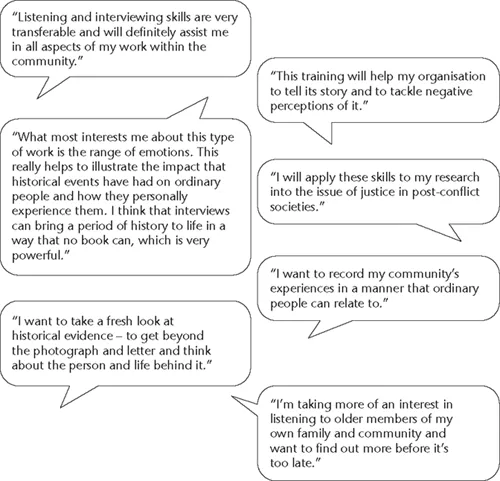
We often ask trainees to reflect on what has attracted them to this type of work. Their responses include the following:
One of the most compelling attractions of the interview method is its focus on individual experience. It forces us to confront the varied, multi-layered, sometimes muddled, and often contradictory perceptions, recollections and motives of all kinds of people. A victim may be paralysed with grief when talking about the trauma that they have endured, but remarkably composed when describing their passion for greyhound racing. A convicted murderer might be a loving mother for whom homicide formed part of an almost parallel existence. The point is not to palliate the crime in any way, but simply to acknowledge that people are capable of maintaining several different identities. In the most austere and grim prison conflicts, we have recorded instances of human kindness, tol...