eBook - ePub
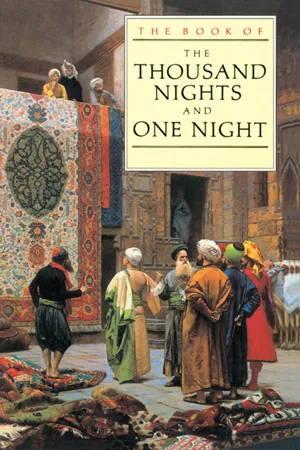
The Book of the Thousand and One Nights
- 2,372 pages
- English
- ePUB (mobile friendly)
- Available on iOS & Android
eBook - ePub
The Book of the Thousand and One Nights
About this book
First published in 2013. An unabashed and accurate translation of the wonderful and enchanting tales of the Arabian Nights, complete in four volumes.
Information
But when the six-hundred-and-sixty-fifth night had come
SHE SAID:
The patriarch Danīs had been put on fire by love for the delights of Zain al-Mawāsif, therefore he set himself to resolve the hard question of how he should declare his passion. At length it occurred to him to send the most eloquent of the forty monks to plead his cause; but, when the monk found himself in the presence of this moon of beauty, he felt his tongue tie itself into a thousand knots, while his belly finger spoke eloquently beneath his robe and surged up like the trunk of an elephant. Zain al-Mawāsif laughed with all her heart at this, and so did Hubūb, Khutūb, Sukūb and Rukūb; but when the monk continued to stand there speechless, with his affair so high, the girl signed to her followers, who rose and pushed him out of the room.
When Danīs saw his monk return with a woebegone expression, he said to himself: ‘Doubtless he was not eloquent enough.’ So he sent a second monk. But, when the second monk stood before Zain al-Mawāsif, the same things happened to him as to the first. He was dismissed and returned, with hanging head, to the patriarch, who sent a third monk, a fourth, a fifth, and finally all the forty, one after another. Each time, however, the ambassador returned with no good news, having been unable to speak his message except by signs from his inheritance. Then Danīs remembered the proverb: ‘A man should scratch with his own nails and walk on his own feet,’ and determined to see to the matter himself.
With grave and measured steps he entered Zain al-Mawāsif’s apartment; but her delightful presence reduced him also to a swollen silence. Amid a storm of mocking laughter, he left the room, with his nose hanging to his feet.
When he had gone, Zain al-Mawāsif rose and said to her women: ‘We must slip away from this monastery as quickly as possible, lest these horrible monks and their stinking elder should violently soil us in the night.’ Favoured by the darkness, the five glided out from the building and urged their camels upon the road to their own country. So much for them.
When the patriarch and his forty monks rose in the morning and found that Zain al-Mawāsif had disappeared, their tripes twisted in great despair. They met together in the church where it was their custom to bray like asses together; but, instead of singing their usual anthems and saying their ordinary prayers, they improvised in way:
The first monk sang:
O Lord, who made the passion of her fire
And tipped her arrows with a sharp desire,
Give her sweet body back to us, O Lord,
O Lord, who tipped her arrows with desire.
The second monk answered:
O Lord, who gave her eyes to make me whole
And with her beauty wearied out my soul,
Give me to tire her body out, O Lord,
O Lord, who let her weary out my soul.
Then the third monk sang:
O Lord, who made her lips as honey sweet
Yet sharper than the sickle in the wheat,
Grant me to be the honey to her steel,
O Lord, who made her to mow down the wheat;
O Lord, make me the carpet of her heel,
Who made the dream above her visiting feet.
The fourth monk replied:
O Lord, who let the silver of her star
Come down upon the dark in which we are,
Grant us a quiet tongue concerning this,
O Lord, who silvered over her cymar.
The fifth monk sobbed and sang:
O Lord, who cast the fullness of her hips
And made her spittle more than raisin drips,
Favour the onyx tears I weep for her,
O Lord, who made her as the raisin drips.
The sixth monk continued:
O Lord, who made her roses on a stem
With golden starlight shining on to them,
Grant that those roses pierce me to the heart,
O Lord, who made the starlight smile on them.
Then the seventh monk intoned:
O Lord, who let her madden in our ways
And lost her there, my kneeling spirit prays
That she come back to madden us again,
O Lord, to dance and madden in our ways.
The rest of the monks sang also in the same vein and then the patriarch controlled the sobbing tremors of his voice and also sang:
O Lord, my soul is full of heaviness,
Because she paused and stabbed our happiness,
Grant that she heal the wounds she made in joy,
O Lord, who stabbed the heart of happiness.
O Lord, who sent her as a silver mole
To fret my heart and tear into my soul,
May she return to ravage them again,
O Lord, who made the body and the soul.
When they had finished these songs, they threw themselves face down upon the flagstones of their church and wept. They determined to make an image of the fugitive and set it upon the altar of their unbelief; but death surprised them before they could accomplish this, making a term to their torment and sending them down into the graves which they had digged for themselves inside the monastery.
At this point Shahrazād saw the approach of morning and discreetly fell silent.
But when the six-hundred-and-sixty-sixth night had come
SHE SAID:
The vigilance of Allāh had decreed a safe passage for the caravan. And when Zain al-Mawāsif had entered her dwelling in her native land, had put all in order, and had perfumed her bed with precious amber, she sent Hubūb to tell Anīs of her return.
Anīs, who had passed all his days and nights in weeping, was stretched out in sad sleep upon his couch, dreaming that his loved one had returned. As he had faith in the truth of dreams, he rose and went towards her house; he passed through the garden door and at once felt all the air scented with the musk of her near presence. As if his feet were winged, he flew to the chamber where Zain al-Mawāsif waited for him, and the two fell into each other’s arms. For a long time they stayed thus, showering upon each other passionate tokens of their love, and then, that they might not swoon for happiness, they drank from a cup of refreshing drink made with lemon, sugar, and water of flowers. After this they regaled each other with the stories of their absence, breaking off every now and then to kiss. Allāh alone knows the number and violence of their loves that night. Next morning they sent young Hubūb for the kādī and witnesses, who wrote out their marriage contract. They lived together in perfect joy until the Reaper of lads and girls came to them. But glory be to Him Who scatters beauty and pleasure according to His justice! And prayer and peace be upon Muhammad, Lord of Messengers, who has made a Paradise for his Believers!
When Shahrazād had made an end of this story, little Dunyazād cried: ‘Dear sister, your words are full of savour and sweetness, of purity and excellence!’ Then said Shahrazād: ‘All that is nothing to what I would tell the King, if he would let me, concerning the Lazy Youth.’ ‘I give you permission to speak,’ said King Shahryār. ‘Your words have satisfied me, and also I do not know the Tale of the Lazy Youth.’ So Shahrazād said:
The Tale of the Lazy Youth
IT is related, among many other matters, that one day, while Hārūn al-Rashīd sat upon his throne, a young eunuch entered, holding in his hands a red gold crown, encrusted with pearls, rubies, and inestimable jewels. The child kissed the earth between the hands of the Khalīfah, saying: ‘O Commander of the Faithful, our mistress Zubaidah sends me with greetings to tell you that this marvellous crown, which is well-known to you, still lacks a large gem for its top, and that no one has been able to find a jewel sufficiently beautiful to fill the empty place. She has had search made among the merchants and has gone through her own treasures, but the crown still lacks its chief ornament. She therefore begs you to institute an enquiry yourself, that her desire may be satisfied.’
The Khalīfah turned towards his wazīrs, amīrs, chamberlains and lieutenants, saying: ‘I command you all to find a stone large enough and fair enough to satisfy my Queen.’
They went carefully through the stores of jewels belonging to their wives and found nothing suitable; therefore they reported their unsuccess to the Khalīfah. Hārūn al-Rashīd became sad and said to them: ‘How is it that I, who am King of the kings of earth, cannot obtain so much as a wretched stone when I desire it? Woe upon you all! Go and enquire among the merchants.’ They enquired among the merchants, and these answered with one voice: ‘Hunt no further, for our lord the Khalīfah will only find that jewel in the hands of a certain young man of Basrah, whose name is Abū Muhammad Lazybones.’ So they informed the Khalīfah, saying: ‘Our lord the Khalīfah will only find that jewel in the hands of a certain young man of Basrah, whose name is Abū Muhammad Lazybones.’
The Khalīfah ordered his wazīr Jafar to command the amīr of Basrah that Abū Muhammad Lazybones be sent to him in Baghdād without delay.
At this point Shahrazād saw the approach of morning and discreetly fell silent.
But when the six-hundred-and-sixty-seventh night had come
SHE SAID:
Jafar therefore wrote a letter and bade Masrūr, the sword-bearer, carry it to the amīr al-Zubaidī, governor of Basrah.
As soon as the amīr al-Zubaidī received these orders from the Khalīfah, he gave all honourable welcome to the envoy and provided him with guards to conduct him to the palace of Abū Muhammad. When Masrūr arrived at that place, and was received at the door by a troop of richly apparelled slaves, he said to them: ‘Tell your master that the Commander of the Faithful requires his presence in Baghdād.’
The slaves retired, and in a...
Table of contents
- Cover
- Title page
- Copyright page
- Contents
- NOTE
- DEDICATION
- INVOCATION
- THE TALE OF KING SHAHRYAR AND OF HIS BROTHER, KING SHAHZAMAN
- THE TALE OF THE MERCHANT AND THE IFRIT
- THE FISHERMAN AND THE JINNI
- THE TALE OF THE PORTER AND THE YOUNG GIRLS
- THE TALE OF THE WOMAN CUT IN PIECES, THE THREE APPLES AND THE NEGRO RAIHAN
- THE TALE OF THE WAZIR NUR AL-DIN, HIS BROTHER THE WAZIR SHAMS AL-DIN, AND HASAN BADR AL-DIN
- THE TALE OF THE HUNCHBACK WITH THE TAILOR, THE CHRISTIAN BROKER, THE STEWARD AND THE JEWISH DOCTOR; WHAT FOLLOWED AFTER; AND THE TALES WHICH EACH OF THEM TOLD
- THE TALE OF THE BARBER OF BAGHDAD AND THE TALES OF HIS SIX BROTHERS
- THE TALE OF SWEET-FRIEND AND ALI-NUR
- THE TALE OF GHANIM IBN AYYUB AND HIS SISTER FITNAH
- THE TALE OF KING UMAR AL-NUMAN AND HIS TWO REMARKABLE SONS, SHARKAN AND DU AL-MAKAN
- The Sayings on the Three Doors
- The Tale of Aziz and Azizah, and of Prince Taj al-Muluk, Crown of Kings
- The Tale of Princess Dunya and Prince Taj al-Muluk
- THE DELIGHTFUL TALE OF THE BEASTS AND BIRDS
- THE TALE OF ALI IBN BAKR AND THE FAIR SHAMS AL-NAHAR
- THE TALE OF KAMAR AL-ZAMAN AND THE PRINCESS BUDUR, MOON OF MOONS
- THE TALE OF ALA AL-DIN ABU SHAMAT
- AN ADVENTURE OF THE POET ABU NUWAS
- THE TALE OF ZUMURRUD THE BEAUTIFUL, AND OF ALI SHAR, SON OF GLORY
- THE TALE OF IBN AL-MANSUR AND THE TWO GIRLS
- The Youth and His Master
- THE MAGIC TALE OF THE EBONY HORSE
- THE TALE OF JUDAR THE FISHERMAN OR THE ENCHANTED BAG
- THE TALE OF ABU KIR AND ABU SIR
- THE TALE OF POMEGRANATE-FLOWER AND BADR BASIM
- THE ADVENTURES OF HASAN OF BASRAH
- THE DIWAN OF JOVIAL AND INDECENT FOLK
- THE TALE OF THE LAZY YOUTH
- THE TALE OF ALA AL-DIN AND THE WONDERFUL LAMP
- THE PARABLE OF TRUE LEARNING
- The Invitation to Universal Peace
- The Tale of the Tied Points
- THE TALE OF PEARL-HARVEST
- The Third Madman?s Tale
- The Youth behind whom Indian and Chinese Airs were Played
- The Chick-Pea Seller?s Daughter
- SOME JESTS AND SUGGESTIONS OF THE MASTER OF SHIFTS AND LAUGHTER
- THE TALE OF AL-MALIK BAIBARS AND HIS CAPTAINS OF POLICE
- THE TALE OF THE SEA ROSE OF THE GIRL OF CHINA
- Men in the Judgment of Their Wives
Trusted by 375,005 students
Access to over 1.5 million titles for a fair monthly price.
Study more efficiently using our study tools.
Frequently asked questions
Yes, you can cancel anytime from the Subscription tab in your account settings on the Perlego website. Your subscription will stay active until the end of your current billing period. Learn how to cancel your subscription
No, books cannot be downloaded as external files, such as PDFs, for use outside of Perlego. However, you can download books within the Perlego app for offline reading on mobile or tablet. Learn how to download books offline
Perlego offers two plans: Essential and Complete
- Essential is ideal for learners and professionals who enjoy exploring a wide range of subjects. Access the Essential Library with 800,000+ trusted titles and best-sellers across business, personal growth, and the humanities. Includes unlimited reading time and Standard Read Aloud voice.
- Complete: Perfect for advanced learners and researchers needing full, unrestricted access. Unlock 1.5M+ books across hundreds of subjects, including academic and specialized titles. The Complete Plan also includes advanced features like Premium Read Aloud and Research Assistant.
We are an online textbook subscription service, where you can get access to an entire online library for less than the price of a single book per month. With over 1.5 million books across 990+ topics, we’ve got you covered! Learn about our mission
Look out for the read-aloud symbol on your next book to see if you can listen to it. The read-aloud tool reads text aloud for you, highlighting the text as it is being read. You can pause it, speed it up and slow it down. Learn more about Read Aloud
Yes! You can use the Perlego app on both iOS and Android devices to read anytime, anywhere — even offline. Perfect for commutes or when you’re on the go.
Please note we cannot support devices running on iOS 13 and Android 7 or earlier. Learn more about using the app
Please note we cannot support devices running on iOS 13 and Android 7 or earlier. Learn more about using the app
Yes, you can access The Book of the Thousand and One Nights by E.P. Mathers, J.C. Mardrus, J.C. Mardrus,E.P. Mathers, J.C. Mardrus, E.P. Mathers in PDF and/or ePUB format, as well as other popular books in Literature & Literary Criticism. We have over 1.5 million books available in our catalogue for you to explore.