Building Services, Technology and Design provides a concise guide to the installation and design of principal services in domestic and commercial buildings. It covers the level 2 module of The CIOB's Education Framework and is officially sanctioned by the CIOB as the recognised text for that module. The book combines theory, design and application in one volume and is supported throughout with illustrations, design examples, tables and charts.
Services covered include: cold and hot water; heating; ventilation; air conditioning; gas; electricity; security; fire control; sanitation; drainage and transport systems.
Building Services, Technology and Design is a core text for the CIOB level 2 module, as well as BTEC HNC/D building studies and degree courses in building. It is also an essential reference for all members of the facilities management and construction industry.
- 324 pages
- English
- ePUB (mobile friendly)
- Available on iOS & Android
eBook - ePub
Building Services, Technology and Design
About this book
Information
1 Cold water supply
Hydrological cycle
The origins of drinking water are found in the hydrological or water cycle. This continuous process includes evaporation of moisture from the sea, rivers and lakes to form clouds. The condensation droplets coalesce and fall as rain to replenish the water levels.
Extraction
In the United Kingdom, water is derived from:
- Surface sources, i.e. rivers and large lakes
- Boreholes into aquifers (water-bearing strata)
- Roofs, paved areas and shallow wells.
rhe first two categories lend themselves to subsequent filtration and chemical treatment, before distribution and consumption, as shown in Figure 1.1. The latter category could be contaminated and are only used in remote locations.
In some parts of the world where rainwater is scarce, desalination plant is used to process sea water, but this is very expensive.
Processing and distribution
In Figure 1.1 the three principal sources of United Kingdom water are identified. About one-third of consumption comes from each, although regional variations are inevitable, e.g. the Highland areas of Scotland will provide the bulk of water for that area, while the flat Fenlands of East Anglia will need boreholes.
Surface water is stored in man-made reservoirs or impounding reservoirs, the latter created from damming valleys to create catchment areas and to provide the potential for hydroelectricity generation. Coarse and fine sand filtration removes most debris and impurities before a minute amount of chlorine is added to classify the water drinkable. Borehole supplies are well filtered through the strata and normally only require chemical treatment.
After processing, the water is pumped to a high-level storage reservoir or
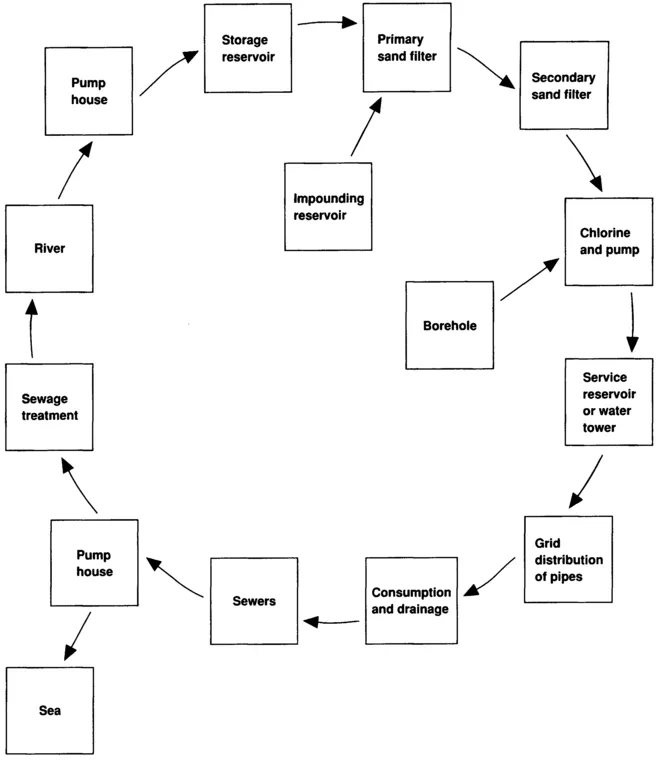
Figure 1.1 The water process
water tower for gravity distribution through iron or uPVC pipes (coloured blue) jointed as shown in Figure 1.2.
Connection to buildings
The grid distribution of underground pipework enables sections to be isolated for repair and maintenance without severe local disruption. Connections to the grid are made by the local water authority or its approved contractor at the expense of the developer or building owner. An isolation stop valve is usually provided at the crown of the water main and a communicating pipe terminated inside the property boundary with another stop valve for the building owner's use. This pipe remains the water authority's, but the service pipe thereafter is the responsibility of the building owner. A typical installation is shown in Figure 1.3.
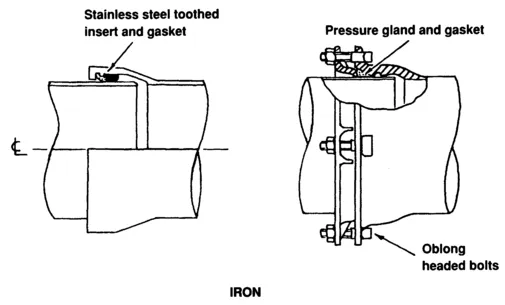
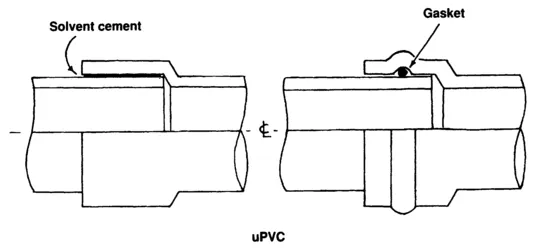
Figure 1.2 Jointing of water mains
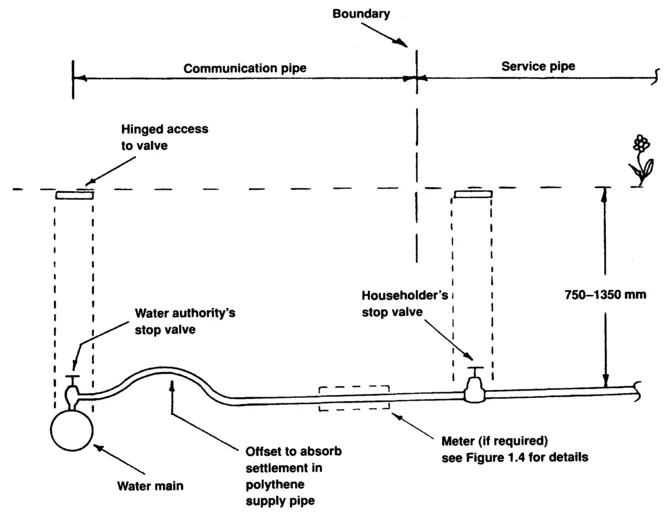
Figure 1.3 Domestic water supply
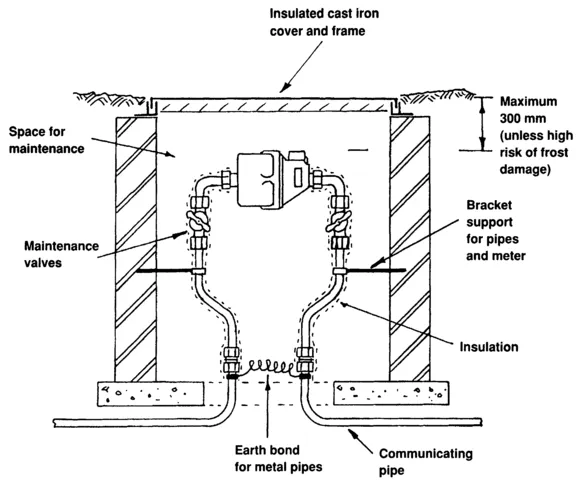
Figure 1.4 Meter housing
Water meters
Water meters are supplied at the discretion of the local water authorities and most new buildings are required to have them. The preferred location is underground, just beyond the property boundary as shown in Figure 1.3. If this is impractical, location within the building at the base of the rising main may be agreed with the water authority. Figure 1.4 shows a possible installation in a waterproof chamber, with an electrical earth continuity bond for metal pipework should the meter be removed. Figure 1.5 is an innovative patent meter connection to an existing stop valve body.
Internal distribution, direct and indirect systems
Direct systems are not favoured by many water authorities, as they require a consistent supply of pressurised water, which may be difficult during periods of peak demand. In the Highland areas this is viable where the sources of supply and distribution are well elevated relative to draw-off points, but for most areas the indirect system is mandatory. Although more expensive to install, with its larger cistern and almost twice as much pipework, it has the advantage of constant water pressure from the storage cistern which reduces the possibility of back siphonage (possible negative mains pressure drawing dirty water back into the main, e.g. hosepipe attached to an outside tap, with the open end submerged in a pond!).
Figures 1.6 and 1.7 provide a comparison of the systems with characteristics of installations. Note that even with an indirect system, ...
Table of contents
- Cover
- Title
- Copyright
- Contents
- 1 Cold water supply
- 2 Hot water supply
- 3 Thermal systems and distribution
- 4 Ventilation
- 5 Air-conditioning principles
- 6 Gas supply
- 7 Electricity supply and distribution
- 8 Sanitation and drainage
- 9 Security and fire protection
- 10 Transportation: lifts, escalators and travelators
- Index
Trusted by 375,005 students
Access to over 1.5 million titles for a fair monthly price.
Study more efficiently using our study tools.
Frequently asked questions
Yes, you can cancel anytime from the Subscription tab in your account settings on the Perlego website. Your subscription will stay active until the end of your current billing period. Learn how to cancel your subscription
No, books cannot be downloaded as external files, such as PDFs, for use outside of Perlego. However, you can download books within the Perlego app for offline reading on mobile or tablet. Learn how to download books offline
Perlego offers two plans: Essential and Complete
- Essential is ideal for learners and professionals who enjoy exploring a wide range of subjects. Access the Essential Library with 800,000+ trusted titles and best-sellers across business, personal growth, and the humanities. Includes unlimited reading time and Standard Read Aloud voice.
- Complete: Perfect for advanced learners and researchers needing full, unrestricted access. Unlock 1.5M+ books across hundreds of subjects, including academic and specialized titles. The Complete Plan also includes advanced features like Premium Read Aloud and Research Assistant.
We are an online textbook subscription service, where you can get access to an entire online library for less than the price of a single book per month. With over 1.5 million books across 990+ topics, we’ve got you covered! Learn about our mission
Look out for the read-aloud symbol on your next book to see if you can listen to it. The read-aloud tool reads text aloud for you, highlighting the text as it is being read. You can pause it, speed it up and slow it down. Learn more about Read Aloud
Yes! You can use the Perlego app on both iOS and Android devices to read anytime, anywhere — even offline. Perfect for commutes or when you’re on the go.
Please note we cannot support devices running on iOS 13 and Android 7 or earlier. Learn more about using the app
Please note we cannot support devices running on iOS 13 and Android 7 or earlier. Learn more about using the app
Yes, you can access Building Services, Technology and Design by Roger Greeno in PDF and/or ePUB format, as well as other popular books in Technology & Engineering & Architecture General. We have over 1.5 million books available in our catalogue for you to explore.