This edition of the Handbook follows the first edition by 10 years. The earlier edition was a promissory note, presaging the directions in which the then-emerging field of social cognition was likely to move. The field was then in its infancy and the areas of research and theory that came to dominate the field during the next decade were only beginning to surface. The concepts and methods used had frequently been borrowed from cognitive psychology and had been applied to phenomena in a very limited number of areas. Nevertheless, social cognition promised to develop rapidly into an important area of psychological inquiry that would ultimately have an impact on not only several areas of psychology but other fields as well.
The promises made by the earlier edition have generally been fulfilled. Since its publication, social cognition has become one of the most active areas of research in the entire field of psychology; its influence has extended to health and clinical psychology, and personality, as well as to political science, organizational behavior, and marketing and consumer behavior. The impact of social cognition theory and research within a very short period of time is incontrovertible. The present volumes provide a comprehensive and detailed review of the theoretical and empirical work that has been performed during these years, and of its implications for information processing in a wide variety of domains.
The handbook is divided into two volumes. The first provides an overview of basic research and theory in social information processing, covering the automatic and controlled processing of information and its implications for how information is encoded and stored in memory, the mental representation of persons -- including oneself -- and events, the role of procedural knowledge in information processing, inference processes, and response processes. Special attention is given to the cognitive determinants and consequences of affect and emotion. The second book provides detailed discussions of the role of information processing in specific areas such as stereotyping; communication and persuasion; political judgment; close relationships; organizational, clinical and health psychology; and consumer behavior.
The contributors are theorists and researchers who have themselves carried out important studies in the areas to which their chapters pertain. In combination, the contents of this two-volume set provide a sophisticated and in-depth treatment of both theory and research in this major area of psychological inquiry and the directions in which it is likely to proceed in the future.
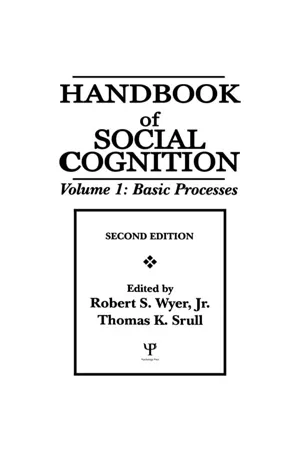
eBook - ePub
Handbook of Social Cognition
Volume 1: Basic Processes
- 488 pages
- English
- ePUB (mobile friendly)
- Available on iOS & Android
eBook - ePub
Handbook of Social Cognition
Volume 1: Basic Processes
About this book
Information
1
The Four Horsemen of Automaticity: Awareness, Intention, Efficiency, and Control in Social Cognition
New York University
Contents
The Decomposition of Automaticity
Conditional Automaticity
The Ecology of Automaticity
Awareness
Subliminal Perception
Misattribution
Conclusions
Intentionality
Automatic Attention Responses and Perceptual Selection
Automatic Evaluation
Automatic Stereotype Activation
Spontaneous Trait Inference
Efficiency
Social Judgment
Dispositional Inference
Conclusions
Controllability
Situationally Induced Motivations
Internally Generated Motivations
Conclusions
The Automaticity of Everyday Life: An Agenda for the Next 10 Years
Acknowledgments
References
I do not think, therefore I am.
–Jean Cocteau
When the first edition of this Handbook appeared in 1984, research on automatic phenomena was just beginning. In the 10 years preceding it, a total of 28 research articles were published on topics directly relevant to the automaticity of a social psychological phenomenon. In the following 10-year-period there have been 123 such research articles.1 Clearly, that research on automatic phenomena in social psychology has mushroomed in the past decade.
There is now hardly a research domain or topic that has not been analyzed in terms of its automatic features or components. Much attention has been devoted to questions of whether dispositional inferences are made automatically, whether attitudes become activated automatically to influence ongoing behavior, whether accessible social constructs and stereoptypes automatically affect one’s judgments of oneself and others, whether people have automatic evaluative and emotional reactions to stimuli, and the degree to which a person is aware or unaware of the influences on his or her judgments and subjective experience.
In deciding how to structure a review of automaticity research, I faced a dilemma: Should it be organized in terms of specific content areas, such as attribution or stereotyping, and describe the extent to which these phenomena are found to be automatic in nature? This would be useful, except that it would miss many of the reasons why so much research attention has been given to questions of automaticity across different research domains. Those reasons have to do with the fact that the separate defining qualities of automaticity are important issues in their own right–the extent to which thought and behavior are unintentional, occur outside of awareness, are uncontrollable, and are efficient in their use of attentional resources.
Ten years ago, the consensus view (Johnson & Hasher, 1987) was that a mental process was either automatic–possessing all four of those qualities–or controlled, possessing all the opposite qualities (i.e., intentional, controllable, consumptive of limited attentional resources, and in awareness; see Bargh, 1984; Posner & Snyder, 1975; Shiffrin & Schneider, 1977). If a given process was not a member of one type, then by default it had to be a member of the other. Guided by this prevalent dichotomy, I argued at the time that many claims of automaticity within social psychology were not authentic, because they did not satisfy all four criteria.
THE DECOMPOSITION OF AUTOMATICITY
It has since become increasingly clear that mental processes at the level of complexity studied by social psychologists are not exclusively automatic or exclusively controlled, but are in fact combinations of the features of each. In cognitive psychology, evidence was accumulating that no process was purely automatic by the four-criteria standard (Kahneman & Treisman, 1984; Logan & Cowan, 1984). For one thing, focal attention allocation seemed to be necessary; even prototypic examples of automaticity such as the Stroop effect did not occur if focal attention was directed just slightly away from the target word (Francolini & Egeth, 1980; Kahneman & Henik, 1981). For another, such automatic phenomena as driving and typing are clearly intentional at some level, in that one intends to drive the car and does not do so otherwise–and also controllable in that the person can stop the automatic activity whenever he or she so desires (Logan & Cowan, 1984). Thus, it seemed that a process can have some qualities of an automatic process (e.g., efficient, autonomous), while simultaneously having qualities of a controlled process as well.
There are abundant social psychological examples of processes that are automatic in some features but not in others (see review in Bargh, 1989). Several studies have examined the efficiency of processes (i.e., the extent to which they occur even when attention is directed elsewhere or when information is coming in at a fast and furious pace). The operation of procedures to classify behaviors as instances of traits (e.g., Smith & Lerner, 1986), gender-stereotypic influences on judgments (Pratto & Bargh, 1991), and the making of dispositional inferences (e.g., Gilbert, Pelham, & Krull, 1988) all have been shown to occur under these attention-overload conditions. However, subjects had the intention in all these cases to form an impression of the target person, or to classify the behaviors in terms of traits. Like driving a car, which requires the intention to drive but also has many automatic components (at least for the skilled and experienced driver), many social judgment phenomena are intentional, but once started they are autonomous and very efficient in their lack of need for attentional guidance.
In summary, no process appeared to satisfy the strict definition of automaticity. At the same time, most interesting mental phenomena are of sufficient complexity to be composed of some automatic and some controlled processing features (a qualification made by Shiffrin & Schneider, 1977, at the outset of automaticity research). Therefore, it was time to get rid of the all-or-none idea of automaticity. It certainly was causing confusion and misunderstanding. For example, discussing one’s findings of great efficiency of a process in terms of its automaticity led others to infer (reasonably, given the all-or-none assumption) that the process also was unintentional and uncontrollable. The automaticity of stereotyping affords a good illustration of this problem. Findings of the unintentional and efficient activation of racial and general stereotypes led to the widespread assumption that stereotyping was uncontrollable as well. However, demonstrations of the possibility of motivational control (see Fiske, 1989), as well as a consideration of the separate stages of the stereotyping process and their differential controllability (Devine, 1989), showed that a process could be simultaneously unintended and efficient on the one hand, but nonetheless controllable. Therefore, the first moral of the present story is for researchers to be more specific about the particular qualities of automaticity they are demonstrating and claiming for the process in question–unintentionality, unawareness, uncontrollability, or high efficiency–instead of discussing only its automaticity or relative automaticity.
Conditional Automaticity
The second and related moral is that the various demonstrations of automatic processing in social cognition vary as to the conditions that are necessary for the process to occur. Some of the automatic phenomena that were identified required the person’s intention for their initiation, others required substantial attentional support, others awareness of the triggering stimulus, and so on. In a previous analysis of social cognitive phenomena in terms of these conditions (Bargh, 1989), three general sorts of automaticity could be identified: preconscious, postconconscious, and goal-dependent.
Preconscious Automaticity. A preconsciously automatic process requires only that the person notice the presence of the triggering stimulus in the environment. These processes occur automatically when a stimulus is noticed, as part of the act of figural synthesis (Neisser, 1967), and do not require a deliberate goal or intention. Such processes include interpretations, evaluations, and categorizations that occur prior to and in the absence of conscious or deliberative response to the stimulus (i.e., during the microgenesis of its perception; Werner, 1956). One certainly may be aware (and usually is) of the end result of this fast preconscious construction of the percept. Thus, preconscious is not synonymous with subliminal, although subliminal processes are certainly a subset of preconscious ones.
Examples of preconscious automaticity include chronically accessible trait construct influences on social perception, because they occur without intention and even uncontrollably (Bargh & Pratto, 1986), as well as efficiently (Bargh & Thein, 1985). Automatic attitude activation also appears to qualify as a preconscious phenomenon, because it occurs without intention or controllability (Roskos-Ewoldsen & Fazio, 1992) and immediately and efficiently (Bargh, Chaiken, Govender, & Pratto, 1992; Fazio, Sanbonmatsu, Powell, & Kardes, 1986). Attitudes that are strong enough to become active automatically have been discussed in terms of the “chronic accessibility” of their association to the corresponding object representation (Fazio et al., 1986); therefore it is not surprising that both chronically accessible trait constructs and attitudes appear to share many preconscious automatic properties (see Bargh, 1984). Other forms of preconscious automaticity that have been documented are automatic attention responses to negative stimuli such as trait adjectives (Pratto & John, 1991) and angry faces (Hansen & Hansen, 1988), and physiological reactions to stimuli that are relevant to chronic concerns about the self (Strauman & Higgins, 1987). (It should be noted that many other phenomena ultimately may be found to be as unconditionally automatic as these, but the currently available experimental demonstrations of those phenomena include conditions, such as explicit instructions for subjects to engage in the process, that at the present time preclude conclusions about their unintentional nature [see Bargh, 1992b].)
Postconscious Automaticity. These effects are functionally the same as preconscious effects, except that they require some kind of recent conscious, attentional processing to occur. Priming effects on impression formation (e.g., Higgins, Rholes, & Jones, 1977; Srull & Wyer, 1979) are the best example. Other examples are repeated expression manipulations of attitude accessibility (Herr, Sherman, & Fazio, 1984) and the effect of a recent positive or negative experience (even as mild as having cookies in the subject waiting room) on the accessibility of positive versus negative life experiences (Isen, Shalker, Clark, & Karp, 1978).
Postconscious effects are functionally the same as preconscious ones, except that they are temporary instead of chronic and they result from the residual activation of conscious processing. For example, Fazio and his colleagues obtained the same results of accessible attitudes on behavior and attention whether the attitude was chronically (i.e., a preconscious effect) or temporarily accessible (e.g., Fazio et al., 1986; Roskos-Ewoldsen & Fazio, 1992), and studies comparing chronic and temporary construct accessibility show the same quality of effect for each (Bargh, Bond, Lombardi, & Tota, 1986; Bargh, Lombardi, & Higgins, 1988). The chronic versus temporary distinction between preconscious and post-conscious processing is not a trivial one, however. Postconscious effects only occur given recent relevant thought and go away after a short time, preconscious effects are “eternally vigilant” (see Bargh, 1989; Bargh et al., 1988).
Methodologically, the phenomenon of postconscious automaticity–that temporary accessibility can mimic chronic accessibility–is a potential pitfall for researchers who intend to study unconditionally and chronic automatic effects. There have been several recent demonstrations of the effect of having subjects complete questionnaires prior to tests of how they think naturally or “automatically” in the same content domain. Skelton and Strohmetz (1990) showed that having subjects first consider common words for their health connotations resulted in a greater number of symptoms reported on symptom check lists. Mark, Sinclair, and Wellens (1991) showed that giving subjects the Beck Depression Inventory (BDI) at the beginning of the experimental session produced different self-judgments by depressed versus nondepressed subjects compared to the condition in which the BDI was not administered first. Spielman and Bargh (1991) replicated two different studies that had reported automatic thought patterns in depression, but had given subjects the BDI prior to the test of automaticity. In both studies, the original results were replicated only when subjects completed the BDI first.
These findings indicate that one must be careful not to prime or create post-conscious automatic phenomena by having subjects recently engage in a task that causes them to think about the same topics on which one is assessing their chronic or preconscious thought processes (Bargh, 1990). Although similar effects are obtained in studies using priming or some other technique (e.g., repeated attitude expression) to create temporary accessibility as in studies of chronic accessibility, one cannot conclude that chronic, preconscious automaticity effects exists on the basis of demonstrations of temporary accessibility in that domain. Any mental representation or mode of thinking that is available in memory for use by the subject can be made accessible in an experiment, but this does not mean that every available mental structure or process is chronically accessible (see Higgins & King, 1981; Tulving & Pearlstone, 1966) and operates preconsciously.
Goal-Dependent Automaticity. The third general class of automatic phenomena only occurs with the person’s consent and intent. Examples include the development of efficient behavior-to-trait judgments through practice (Smith & Branscombe, 1988; Smith & Lerner, 1986) and the evidence that self-concepts or other-concepts become active automatically given the intention to consider the self or another person (Bargh & Tota, 1988; Dovidio, Evans, & Tyler, 1986; Perdue, Dovidio, Gurtman, & Tyler, 1990). For example, in the Bargh and Tota study, negative trait concepts became active automatically (i.e., efficiently and immediately when under attentional load) when depressed subjects were asked to describe the self, but positive concepts were activated automatically when these subjects were trying to think about the average person. The same set of positive trait concepts were activated automatically in nondepressed subjects in both judgment contexts (see Paulhaus, Graf, & Van Selst, 1989; and Paulhus & Levitt, 1987, for additional evidence of the increasing positivity of the self-concept in [nondepressed] subjects with increasing attentional load).
The Ecology of Automaticity
Decomposing the concept of automaticity into its component features in this way will also assist one to assess the ecological validity of the phenomenon in question. For example, suppose the effect requires that subjects be instructed to engage in such processing, as when they are given an explicit goal to form an impression or attribution. What is the likelihood that these subjects would spontaneously have that goal in their natural environment, in the absence of t...
Table of contents
- Cover
- Half Title
- Title Page
- Copyright Page
- Table of Contents
- Foreword
- Preface
- 1. The Four Horsemen of Automaticity: Awareness, Intention, Efficiency, and Control in Social Cognition
- 2. The Cognitive Representation of Persons and Events
- 3. Procedural Knowledge and Processing Strategies in Social Cognition
- 4. The Self as a Knowledge Structure
- 5. Social Inference: Inductions, Deductions, and Analogies
- 6. Response Processes in Social Judgment
- 7. Affective Causes and Consequences of Social Information Processing
- Author Index
- Subject Index
Trusted by 375,005 students
Access to over 1.5 million titles for a fair monthly price.
Study more efficiently using our study tools.
Frequently asked questions
Yes, you can cancel anytime from the Subscription tab in your account settings on the Perlego website. Your subscription will stay active until the end of your current billing period. Learn how to cancel your subscription
No, books cannot be downloaded as external files, such as PDFs, for use outside of Perlego. However, you can download books within the Perlego app for offline reading on mobile or tablet. Learn how to download books offline
Perlego offers two plans: Essential and Complete
- Essential is ideal for learners and professionals who enjoy exploring a wide range of subjects. Access the Essential Library with 800,000+ trusted titles and best-sellers across business, personal growth, and the humanities. Includes unlimited reading time and Standard Read Aloud voice.
- Complete: Perfect for advanced learners and researchers needing full, unrestricted access. Unlock 1.5M+ books across hundreds of subjects, including academic and specialized titles. The Complete Plan also includes advanced features like Premium Read Aloud and Research Assistant.
We are an online textbook subscription service, where you can get access to an entire online library for less than the price of a single book per month. With over 1.5 million books across 990+ topics, we’ve got you covered! Learn about our mission
Look out for the read-aloud symbol on your next book to see if you can listen to it. The read-aloud tool reads text aloud for you, highlighting the text as it is being read. You can pause it, speed it up and slow it down. Learn more about Read Aloud
Yes! You can use the Perlego app on both iOS and Android devices to read anytime, anywhere — even offline. Perfect for commutes or when you’re on the go.
Please note we cannot support devices running on iOS 13 and Android 7 or earlier. Learn more about using the app
Please note we cannot support devices running on iOS 13 and Android 7 or earlier. Learn more about using the app
Yes, you can access Handbook of Social Cognition by Robert S. Wyer, Jr., Thomas K. Srull, Robert S. Wyer, Jr.,Thomas K. Srull,Robert S. Wyer Jr. in PDF and/or ePUB format, as well as other popular books in Psychology & History & Theory in Psychology. We have over 1.5 million books available in our catalogue for you to explore.