- 248 pages
- English
- ePUB (mobile friendly)
- Available on iOS & Android
eBook - ePub
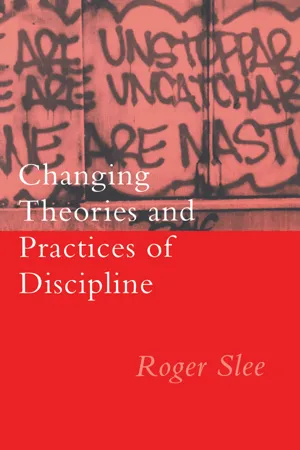
Changing Theories And Practices Of Discipline
About this book
Behaviour problems" in our schools occupy a considerable part of the education agenda and media attention. The major thrust of the literature has been on the provision of "new classroom management approaches". Too often these "packages" are inappropriate to the specific context of the school and its pupils. There are no "quick-fix" solutions. In this book, Slee proposes a critical re-examination of the school discipline issue. In doing so, he provides an overview of policy change; an examination of the major schools of thought on student discipline; a reconsideration of the context in which young people, teachers and schools now find themselves; and practical responses for addressing all levels of discipline policy making.
Information
Chapter 1
Towards an Educational Theory of Discipline
Reductionist psychiatry is a Procrustean host to the weary traveller.It is easy to make fun of those latter-day orthodox Freudians who have reduced the master’s teaching to caricature. In other fields, however, the reductionist fallacy is more discreetly implied, less obvious and therefore more insidious. Pavlov’s dogs, Skinner’s rats, Lorenz’s geese, each served for a while as fashionable paradigms of the human condition. By its persistent denial of a place for values, meaning and purpose in the interplay of blind forces, the reductionist attitude has cast its shadow beyond the confines of science, affecting our whole cultural and even political climate.(Arthur Koestler, Janus: A Summing Up, 1978: 24–25)And we are here as on a darkling plain
Swept with confused alarms of struggle and flight,
Where ignorant armies clash by night.(Matthew Arnold, Dover Beach, 1867)
The primary aim of this chapter is to reconceptualize ‘discipline’ consistent with an educational as opposed to a management discourse. To achieve this, it is necessary to consider the implications of language for framing theory and practice. Therefore, the chapter considers etymological explanations for discipline and their contingent principles through the examination of a number of philosophers’ and writers’ contributions to the field. The discussion will draw a distinction between discipline and control, highlighting the educational implications of the conflicting positions. The reconstruction of an educational theory for discipline will assist in the development of a conceptual framework for the evaluation of past, present and potential policy and program initiatives in ‘school discipline’ in the following chapters.
The reconsideration of discipline as a concept of educational as distinct from behaviourist-functionalist principle is pursued through a re-examination of the work of a number of scholars who attempted such distinctions. In treading this path we encounter a number of theoretical precipices. Many of the writers cited here have been dismissed as part of the antiquity of traditional, irrelevant humanism because they consort with an overall functionalist quest for social order with minimal resistance. Indeed, Erasmus, Kant, Mill, Arnold and Durkheim occupy this intellectual space. Their contributions have been variously advanced as disguises of power. However, we should not be dissuaded from revisiting their text to extract meaning from within, that may, with critical reflection, further our project in a reconfiguration of earlier ideas on the technology and deployment of power. Thus we stumble toward a ‘post-humanism’, the reaffirmation of a political project such as democratic schooling (Gutmann, 1987), aware of the need for continual critical re-examination and reconceptualization, edification, in a changing world (Rorty, 1991).
‘The liberal concern with [transcendant] principles’ (Fulcher, 1993: 128) may well provide the space for distractive noises deflecting from bureaucratic and political interest and power. This chapter argues that a more careful definition of terms, accompanied by an examination of their underlying assumptions, generates awareness of implications of various discourses for school organization, curriculum and pedagogy. Recognition of the appropriation of language within managerial discourse and practice becomes more acute when theory is more carefully delineated in the first instance rather than as an afterthought. While principles such as educational discipline, democracy and equity are normative, conceived within the values and contexts of particular moments and spaces (Wickham, 1987), the aim here is not to abandon them as irrelevant totalizing narratives. Exploration of the particularity and demands of local contexts and contests (Hindess, 1991) will provide greater potential for constructive interventions and achievement of these principles.
Educational Discipline: Beyond Behaviourism
School discipline and classroom management literature has been dominated by genres within educational psychology. The principal influences have been the ‘science of behaviour’ according to B.F. Skinner (1968, 1972), William Glasser’s (1965, 1969, 1985) ‘reality and control therapies’ and the humanist psychology of Carl Rogers (1969). These traditions have proven useful to the project of governance and control in schools (see Chapter 2). In the main, education department and school policies tend also to draw from this conceptual legacy (Lovegrove and Lewis, 1991; Slee, 1992) as they are seen to provide the rationale and machinery for student compliance. This is not educational.
An educational theory of discipline ought to be able to demonstrate consistency between the goals of pedagogy and curriculum and the processes of school governance (Knight, 1988; Pearl, 1988; Crittenden, 1991). Attention ought to be directed to the cognitive development and the social context of young people (Vygotsky, 1962, 1978), and the processes of school governance. If the school disciplinary processes are simply a mechanistic euphemism for operant conditioning (behaviour modification), then the educational value of the disciplinary regimen is compromised. Exclusively extrinsic methodologies promote not the considered development of individual and group behaviour, but submission or subversion (Dewey, 1916; Hargreaves, 1967; Woods, 1985). The task of this chapter is to consider the language of discipline to gauge its relationship to educational aims.
Fixing the Language
Our quest, in responding to Matthew Arnold’s (Dover Beach) challenge, is to lessen ignorance, or conversely, to broaden understanding. This, as James Mill argued in his ‘Essay on Education’ (Mill, 1969), is the ‘end of education…to render the individual, as much as possible, an instrument of happiness, first to himself, and next to other beings’ (Mill, 1969: 41). In depicting happiness, Mill is neither hedonist nor libertarian (1969: 98); abnegation of desire to accomplish greater goals in learning is fundamental to his postulation. It is apposite that our first task is to establish a conceptual basis for reading ‘discipline’ within this discussion, to acknowledge that how we frame issues will determine the possibilities for, and limitations of, the analysis.
Paul Nash (1966) asserts that discipline, as used, misused and abused in dialogues on education, provides fertile ground for confusion: ‘…in education, however, the word has developed a variety of distinctions and nuances of meaning. These lead us often to talk at cross-purposes by using the word in a different sense from that intended by the other members of the discussion, without being aware of our differences’ (Nash, 1966: 111). To demonstrate his point, he draws attention to the following four sentences:
1 Mr Birchenough maintains good discipline.
2 Children who disobey will be disciplined.
3 What discipline is used in this school?
4 The study of Latin constitutes the best discipline.
The discourse of discipline can thus be issued with varying intent. Dixon (1967) warns against distortion in both philosophic and practical dialogues on discipline, against ‘the tendency to try to alter language to reflect either a concealed puritanism or other personal preferences or prejudices’ (1967: 164). Lufler (1979) depicts the undermining of discussions about school discipline through inconsistent applications of legal language and machinery to the classroom. Smith pursues the need to clarify assumptions more vigorously and substantively:
…I doubt if we can talk of the concept in cases like those of authority, freedom or discipline where words themselves have propaganda value and constantly find themselves borrowed to lend respectability to widely different, and even opposed, moral and political programs…these are essentially contested concepts…the battleground over which philosophical and ideological dispute takes place. We should not expect to find such a thing as the uninfected usage of ordinary, disinterested speech which can be neutrally analysed. (Smith, 1985: 38)
Educational discourse is more typically occluded by resilient discourses of control. The problem of school discipline is smitten by the reductionists’ blows. The problem is perceived and described as the ‘incorrigible child’, the attribution of cause, responsibility and blame then traced to their familial (traditionally the mother), to their dietary, to their physiological, psychological, economic or cultural dysfunction and deficits.
To counter the perceived dysfunctionality of the aberrant child, ‘normality’ becomes the language and technology for defining and regulating people and their behaviour, while simultaneously privileging the professions who fashion and police normality. ‘Normality is not an observation but a valuation. It contains not only a judgement about what is desirable, but an injunction as to a goal to be achieved. In so doing, the very notion of “the normal” today awards power to scientific truth and expert authority’ (Rose, 1989: 131). The judgment of ‘normality’ is not random. It is tied to institutional imperatives and preferred social values, and operationalized through systematically dispersed procedures of examination and assessment. Tomlinson (1981, 1982) demonstrates the non-random impact of the in education in Britain.
The term itself is imbued with scientific or natural authority rather than as presenting contrived and changing realities.
Yet our conceptions of normality are not simply generalizations from our accumulated experience of normal children. On the contrary, criteria of normality are elaborated by experts on the basis of their claims to a scientific knowledge of childhood and its vicissitudes. And this knowledge of normality has not, in the main, resulted from studying normal children. On the contrary, in tracing the genealogy of normality we are returned to the projects of the government of children that provided the platform for the take-off of expertise. It is around pathological children — the troublesome, the recalcitrant, the delinquent — that conceptions of normality have taken shape. (Rose, 1989: 131)
Others would say ‘no’, it is the inconsistency of teachers, their inappropriate, excessive or sparing use of punishments and/or rewards. Discipline can, as a corollary to such induction, be given effect through interventions with student, family and teacher. A variation on victim-blaming scenarios (Wright Mills, 1959; Ryan, 1971) and compensatory in outlook, such behaviourist readings of ‘disci-pline’ in the more complex political and organizational montage of schooling are conceptually arid when advanced as explanations of, or as ameliorative programs for, discipline.
Within this conceptual framework, discipline is deployed to mean control, punish or regulate. Subjection to the will of authority is implicit (Wilson, 1971; Smith, 1985). Coupled with the pragmatic need for urgent responses to vexatious situations, principled consideration is neglected or deferred in preference to the promise of discipline as control. The most cursory survey of that area of education literature categorized as ‘discipline’ reveals a plethora of classroom management strategies, behaviour modification programs and counselling packages, each promising student compliance and the restoration of teachers’ hierarchical authority (Charles, 1981; Wolfgang and Glickman, 1986; Balson, 1992; Rogers, 1991).
Retrieving and reconsidering earlier discussions about discipline as an educational or managerial concept in conjunction with explorations of competing explanations of indiscipline in schools prepare the way for clearer understandings of the effects of, and potential for, policy options. The quest of broader understanding is not an abrogation of the practical dilemmas confronting teachers in conflict-ridden classrooms. The reverse is the aspiration of this book. A more careful theorizing of discipline and control ought to provide greater scope for more effective practice (Coulby and Harper, 1985: 4; Furlong, 1985, 1991; Denscombe, 1985). The establishment of clarity, notwithstanding growing complexities, contributes to less confusion between means and ends (Knight, 1988).
A caveat needs to be inserted to acknowledge that languages, and their attendant constructed definitions, may be advanced which are inconsistent with practice. Queensland provides a recent example. Following the announcement of the gradual abolition of corporal punishment, a working party was established to develop policy and guidelines for supportive school environments. This was to be policy conceived and developed to re-position discipline as an issue of curriculum, and organizational and pedagogical ecology; that is, how we teach, what we teach, where it leads young people, and how the organizational conduct of schools and classrooms is configured all have an impact on the behaviour of the constituents of schooling. According to this framework, policy needs to be far more than a list of regulatory procedures if it is to engender discipline which is not simply extrinsic. While the working party was producing its paradigmatic shift, the Queensland Education Department had another senior policy officer working out new guidelines and legislation for exclusion and suspension from school attendance which were anathema to the Supportive School Environments project. The documentation for extending the suspension provisions drew heavily from the Supportive School Environments text (Queensland Department of Education, 1993). Moving further into the educational organization, we know that language may be appropriated and advanced to justify contradictory actions (Troyna, 1994). Principals in Queensland learnt the lexicon of gender-inclusive education, but did little to effect changes in practice in their schools (Limerick, 1991). Such abuse of principles does not diminish the principles; it alerts us to the micro-politics of implementation struggles (Ball, 1987, 1990a; Fulcher, 1993; Marks, 1993).
According to Donald Schön (1983, 1987), the ‘professional artistry’ of teachers is compromised by the technical rationalities used in their professional development programs. Their competencies are measured according to the application of ‘scientific’ theoretical knowledge to the instrumental problems of practice. Ball (1987) takes this further, arguing that such discourses of rationality are in fact moral technologies deployed to privilege political prerogatives and professional interest. This position is extended in the depiction of the surveillance and regulation of educational managers (Ball, 1990d). School effectiveness research and the grafting of ‘Total Quality Management’ packages onto school programs are indicative (Cuttance, 1992).
Mannheim (1946), as we have noted, had earlier drawn distinctions between functional and substantial rationalities to consider the way in which political will is concealed within the rhetorical veneer of ‘unquestionable’ or benign social and bureaucratic goals. This work has more recently been developed, though different intellectual pedigrees would be traced, in the extremely influential body of Foucault’s historiographic investigations into the relationship between language, culture and the expansion and deployment of regulatory power within ‘regimes of truth’ (Foucault, 1967, 1972, 1973, 1977, 1978; Dreyfus and Rabinow, 1982; Rabinow, 1986; Rose, 1989; Ball, 1990b). Chapter 3 attempts a genealogical approach to demonstrate the construction of a ‘science’ of student behaviour to legitimate the professional interest in the surveillance and regulation of the student body. For Schön the dominance of pragmatism in teacher education, thinking and professional development represents a contiguous limiting of their potential through narrowly prescribed boundaries for reflection.
While the common usage of discipline for many in our schools concerns the production of orderliness, the order of blind obedience is qualitatively different from an educational orderliness (Arnold [1834] in Findlay, 1897; Wilson, 1971). Our aim is to make clear this distinction, both linguistic and practical, and to demonstrate its more lasting contribution to our educational project. The restoration of a principled theory of discipline, consistent with educational aim...
Table of contents
- Cover
- Half Title
- Title Page
- Copyright Page
- Table of Contents
- List of Tables
- Foreword
- Acknowledgments
- Introduction
- Chapter 1 Towards an Educational Theory of Discipline
- Chapter 2 Controlling the Incorrigibles: Regulating Individual Misbehaviour in Schools
- Chapter 3 From Body to Mind: Educational Psychology, Classroom Management and the ‘Science’ of Mapping and Eliminating Disruption
- Chapter 4 Adjusting the Aperture: Ways of Seeing Disruption in Schools
- Chapter 5 Australian Discipline Policies: The Politics of Crisis Management
- Chapter 6 On Listening: Some Lessons from the Field
- Chapter 7 A Conclusion?
- Appendix
- Bibliography
- Index
Trusted by 375,005 students
Access to over 1.5 million titles for a fair monthly price.
Study more efficiently using our study tools.
Frequently asked questions
Yes, you can cancel anytime from the Subscription tab in your account settings on the Perlego website. Your subscription will stay active until the end of your current billing period. Learn how to cancel your subscription
No, books cannot be downloaded as external files, such as PDFs, for use outside of Perlego. However, you can download books within the Perlego app for offline reading on mobile or tablet. Learn how to download books offline
Perlego offers two plans: Essential and Complete
- Essential is ideal for learners and professionals who enjoy exploring a wide range of subjects. Access the Essential Library with 800,000+ trusted titles and best-sellers across business, personal growth, and the humanities. Includes unlimited reading time and Standard Read Aloud voice.
- Complete: Perfect for advanced learners and researchers needing full, unrestricted access. Unlock 1.5M+ books across hundreds of subjects, including academic and specialized titles. The Complete Plan also includes advanced features like Premium Read Aloud and Research Assistant.
We are an online textbook subscription service, where you can get access to an entire online library for less than the price of a single book per month. With over 1.5 million books across 990+ topics, we’ve got you covered! Learn about our mission
Look out for the read-aloud symbol on your next book to see if you can listen to it. The read-aloud tool reads text aloud for you, highlighting the text as it is being read. You can pause it, speed it up and slow it down. Learn more about Read Aloud
Yes! You can use the Perlego app on both iOS and Android devices to read anytime, anywhere — even offline. Perfect for commutes or when you’re on the go.
Please note we cannot support devices running on iOS 13 and Android 7 or earlier. Learn more about using the app
Please note we cannot support devices running on iOS 13 and Android 7 or earlier. Learn more about using the app
Yes, you can access Changing Theories And Practices Of Discipline by Roger Slee in PDF and/or ePUB format, as well as other popular books in Education & Education General. We have over 1.5 million books available in our catalogue for you to explore.