- 308 pages
- English
- ePUB (mobile friendly)
- Available on iOS & Android
eBook - ePub
About this book
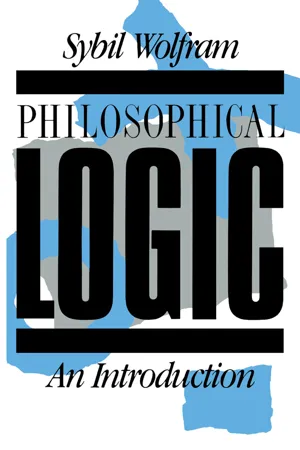
A basic introduction to the subject which addresses questions of truth and meaning, providing a basis for much of what is discussed elsewhere in philosophy. Up-to-date and comprehensive.
Information
Chapter 1
Introduction
Section 1 What is Philosophical Logic?
Logic may be said to be the study of correct and incorrect reasoning. This includes the study of what makes arguments consistent or inconsistent, valid or invalid, sound or unsound (on these terms see 1.2.1). It has two branches, known as formal (or symbolic) logic and philosophical logic.
1.1.1 Philosophical logic and formal logic
(i) Two sorts of logic
One of the branches of logic, formal logic, codifies arguments and supplies tests of consistency and validity, starting from axioms, that is, from definitions and rules for assessing the consistency and validity of arguments.1 At the present time there are two main systems of formal logic, usually known as the propositional calculus and the predicate calculus. The propositional calculus concerns relations of what it terms ‘propositions’ to each other. The predicate calculus codifies inferences which may be drawn on account of certain features of the content of ‘propositions’.2
The other branch of logic, philosophical logic, which is my concern here, is very much more difficult to delimit and define. It can be said to study arguments, meaning, truth. Its subject matter is closely related to that of formal logic but its objects are different. Rather than setting out to codify valid arguments and to supply axioms and notations allowing the assessment of increasingly complex arguments, it examines the bricks and mortar from which such systems are built. Although it aims, among other things, to illuminate or sometimes question the formalization of arguments into systems with axioms which have been effected, it is not restricted to a study of arguments which formal logic has codified.3
Philosophical logic is related not only to formal logic but also to other branches of philosophy but it is convenient to begin with the relations of formal and philosophical logic. The easiest way to see the kind of relations between them is to look at some examples, first from the propositional calculus, and then from the predicate calculus.
(ii) Propositional calculus and philosophical logic
In the propositional calculus what it calls ‘propositions’ are symbolized by letters: p, q, r, etc.
Propositional calculus has a special interest in:
not-p (It is not raining) – negation
p and q (It is raining and he went home) – conjunction
p or q (It is raining or he went home (or both)) – disjunction4
If p then q (If it is raining, then he went home) – implication
p if and only if q (If and only if it is raining, he went home) – equivalence.
It lays down axioms (definitions), which cannot be questioned within the propositional calculus (they are ruled to be true):
not-p is true if p is false and false if p is true
p and q is true if and only if p is true and q is true
p or q is true if either p is true or q is true (or both are true)
If p then q is true except if it is both the case that p is true and that q is false
p if and only if q is true when p and q are either both true or both false.
The use of ‘not’, ‘and’, etc. in the propositional calculus is sufficiently close to the use of these and related terms in the natural language of English, and equivalents in other languages, for it to be possible, with the aid of notation, to symbolize many arguments in everyday thinking, and so to devise simple methods of assessing complex arguments for consistency and validity.
For instance, to take a very simple case, it can swiftly be seen that it follows (and we can validly infer) from ‘If it was raining, then he went home’ (If p, then q) that ‘It was not raining or he went home (or both)’ (not-p or q) but not that (e.g.) ‘It was raining or he did not go home (or both)’ (p or not-q), much less ‘It was raining and he did not go home’ (p and not-q) which is inconsistent with ‘If it was raining, then he went home’.
In studying philosophical logic, the bricks (p, q, r) and mortar (true, false, and, or, etc.) of the propositional calculus are scrutinized.
(iii) Examples
a) What are the ‘propositions’ of the propositional calculus? It is not obvious, and indeed has been a cause of much difficulty, what kind of thing p, q, r stand for when they stand for It is raining, He went home, Here is a bank, etc. A string of words? A sentence with a particular meaning? What someone states if he utters the sentence ‘he went home’, ‘here is a bank’ or etc.? (See 2.1.2–3, 2.4 for discussion of the difference.)
b) Are there only two truth values? The propositional calculus operates with two truth values, true and false, and thereby makes the supposition that any instance of the kind of thing that p, q, r stand for has just one of the two truth values, true and false. (This is an axiom (postulate) of the system.) In philosophical logic the question arises as to whether any one sentence with a particular meaning (or whatever p, q, r stand for in an argument) is always either true or false. (See 2.2 and 4.1 for discussion.)
c) How well does the propositional calculus represent arguments? The connectives (and, or, etc.) employed in the propositional calculus make omissions. For instance, there is no time sequence such as there often is in conjunctions in ordinary English, where there is a difference between ‘He protested and was dismissed’ and ‘He was dismissed and protested’. The propositional calculus treats both these as true provided he was dismissed and he did protest irrespective of the order of events. ‘If p then q’ rates as true if very minimal conditions are satisfied, namely that p should not be true and q false. This condition is satisfied by innumerable totally disconnected sentences or statements such as ‘The earth is round’, ‘Cats are furry’, ‘9 is a number’. ‘If the earth is round, then cats are furry’ would not ordinarily be accepted as a good argument. There is a good deal to say about this case, and I shall return to it presently.
It might be said that these and other obvious discrepancies between everyday arguments and the propositional calculus arise from the fact that the axioms of the propositional calculus select only the minimum conditions that have to be satisfied if the conjunctions, disjunctions, etc. in terms of which we all argue are to be true. This is again a large and difficult topic.5
(iv) Predicate calculus and philosophical logic
The predicate calculus is concerned with sentences containing ‘predicates’:
X (a singular term or variable) is Y
All Xs are Y
No Xs are Y
Some Xs are Y
Some Xs are not Y
These were also the major preoccupation of syllogistic logic, which studied and classified conclusions which could and could not be derived from conjoining any two propositions of these forms, together containing three terms symbolized as S (‘Subject’), P (‘Predicate’), and M (‘Middle Term’). Thus from All Ss are M and All Ms are P, it follows that All Ss are P, while from No Ss are M and No Ms are P or from Some Ss are M and Some Ms are P, nothing whatever follows. The codification of and generalization about syllogisms reached a sophisticated level of systematization but within what now appears a narrow range of arguments.6
The predicate calculus is concerned with inferences involving the universal quantifier (All xs are F (where F is the predicate)) and the existential quantifier (some (at least one) x is F). In philosophical logic there are many questions which arise from and bear on ‘All’, ‘Some’, x, y, z (variables), m, n, o (singular terms), F, G, H (predicates).
(v) Examples
a) Singular terms Many different kinds of term are bunched together as singular terms (terms used to refer to single things) which in the predicate calculus are commonly represented by m, n, o, or that rate as ‘the sort of things that can be quantified over’ (i.e. be prefaced by ‘all’ or ‘some’ or ‘six’, etc.), and are represented as x, y, z. The predicate calculus is happiest with proper names (John, Hitler, London) as prototype singular terms. But there are also terms other than proper names which may refer to the same things: pronouns (I, you, he, she, etc.), demonstratives (‘this’ and ‘that’), terms like ‘here’ and ‘now’, definite descriptions (‘The man round the corner’) (see 2.3.2). These various terms have different features or ‘logical properties’, which may present problems. ‘Do proper names have a meaning?’, for example, is a long-standing question in philosophical logic (often receiving the answer ‘no’ (see 7.2)). Again, it may not be obvious what qualifies a term as being a singular term. For example, ‘singular terms’ may be restricted to terms for single objects, like persons and tomato plants, objects which can be ‘quantified over’ (where we can speak of some or all or six of them). In this case ‘pat of butter’ or ‘pint of water’ are singular terms, but ‘butter’ and ‘water’ are not. Some things that can be counted are particulars – persons, cats, tables, copies of books, or for that matter events like meals or performances of symphonies. But we can also count other sorts of things which are not particulars and speak of one species of animal, one disease, one symphony or book, such as Beethoven’s Ninth Symphony or David Copperfield, one make of car, or of the number 9 (one number). Differences between particulars, items with a definite spatiotemporal location,7 and countable items of other sorts (‘non-particulars’) are of interest in philosophical logic (see 6.2 and 7.1–2). The predicate calculus has no interest in them as such but only in so far as they could affect the propriety of representing terms or what they stand for as m, n, etc. or x, y, etc.
b) Subjects and predicates The predicate calculus represents ‘predicates’ by F, G, H, and so on. In a sentence like ‘My cat is black’, ‘black’ or ‘is black’ (sometimes one form, sometimes the other) would ordinarily be said to be the predicate, and ‘my cat’ the subject. The ‘subject’ will be said to be referred to, or what the sentence is about, and the ‘predicate’ is the part of the sentence that says something about whatever is the subject.
In the study of philosophical logic it becomes evident that i...
Table of contents
- Cover
- Half Title
- Title Page
- Copyright Page
- Dedication
- Table of Contents
- Preface
- Chapter 1: Introduction
- Chapter 2: Reference and Truth Value
- Chapter 3: Necessary Truth and the Analytic–Synthetic Distinction
- Chapter 4: Aspects of Truth
- Chapter 5: Negation
- Chapter 6: Existence and Identity
- Chapter 7: Aspects of Meaning
- Appendix: Examination questions
- Bibliography of works referred to
- Glossary
- Index
Trusted by 375,005 students
Access to over 1.5 million titles for a fair monthly price.
Study more efficiently using our study tools.
Frequently asked questions
Yes, you can cancel anytime from the Subscription tab in your account settings on the Perlego website. Your subscription will stay active until the end of your current billing period. Learn how to cancel your subscription
No, books cannot be downloaded as external files, such as PDFs, for use outside of Perlego. However, you can download books within the Perlego app for offline reading on mobile or tablet. Learn how to download books offline
Perlego offers two plans: Essential and Complete
- Essential is ideal for learners and professionals who enjoy exploring a wide range of subjects. Access the Essential Library with 800,000+ trusted titles and best-sellers across business, personal growth, and the humanities. Includes unlimited reading time and Standard Read Aloud voice.
- Complete: Perfect for advanced learners and researchers needing full, unrestricted access. Unlock 1.5M+ books across hundreds of subjects, including academic and specialized titles. The Complete Plan also includes advanced features like Premium Read Aloud and Research Assistant.
We are an online textbook subscription service, where you can get access to an entire online library for less than the price of a single book per month. With over 1.5 million books across 990+ topics, we’ve got you covered! Learn about our mission
Look out for the read-aloud symbol on your next book to see if you can listen to it. The read-aloud tool reads text aloud for you, highlighting the text as it is being read. You can pause it, speed it up and slow it down. Learn more about Read Aloud
Yes! You can use the Perlego app on both iOS and Android devices to read anytime, anywhere — even offline. Perfect for commutes or when you’re on the go.
Please note we cannot support devices running on iOS 13 and Android 7 or earlier. Learn more about using the app
Please note we cannot support devices running on iOS 13 and Android 7 or earlier. Learn more about using the app
Yes, you can access Philosophical Logic by Sybil Wolfram in PDF and/or ePUB format, as well as other popular books in Philosophy & Language in Philosophy. We have over 1.5 million books available in our catalogue for you to explore.