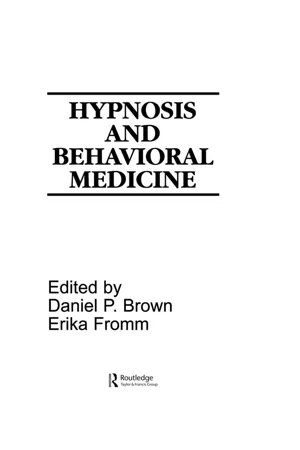
This important volume applies hypnotic principles to the specific challenges of behavioral medicine. Drawing from extensive clinical evidence and experience, the authors describe how hypnobehavioral techniques can help in the treatment of psychophysiological disorders.
- 296 pages
- English
- ePUB (mobile friendly)
- Available on iOS & Android
eBook - ePub
Hypnosis and Behavioral Medicine
About this book
Information
1
Behavioral Medicine
History of Behavioral Medicine
Behavioral medicine is a new field in which clinical methods and theories derived from the behavioral sciences are applied to the treatment and prevention of medical illness. Since the early 1970s, behavioral medicine has emerged as a scientific and clinical discipline in its own right. Behavioral medicine developed, in part, out of a growing dissatisfaction by medical practitioners with consultation/liaison psychiatry and its roots in psychosomatic medicine, whose beginnings were in the 1940s, with psychodynamic explanations of specific illnesses (Alexander & French, 1948) and the search for personality factors associated with specific illnesses (Dunbar, 1943). After nearly two decades of research, which for the most part yielded negative results, interest in psychodynamically based psychosomatic medicine began to wane in other ways. Consultation/liaison psychiatry, however, remained useful to medical practitioners in the diagnosis of mental illness in patients who also were physically ill, in treatment by therapeutic and pharmacological means, and in sensitizing clinicians to the need to refine interviewing skills. Although psychotherapeutic and pharmacological interventions were useful to the physician in treating certain psychiatric patients, these methods simply did not address the general needs of the physician confronted in everyday practice with large numbers of patients who had a significant behavioral component associated with their medical illness. These methods disregarded, for example, compliance with treatment regimens associated with chronic illness, the effects of attitudes and beliefs on illness, illness behavior, psycho-physiological disorders, and the impact of health-risk factors in a person’s lifestyle on generating and preventing disease.
Over the same interval behavioral scientists, predominantly psychologists, began collaborating with physicians. One area in which behavioral scientists in the last 25 years have offered procedures directly relevant to medical practitioners is biofeedback. Since the now classic work of Miller (1969) and his associates on operant conditioning of physiological processes, behaviorally oriented clinicians have begun to develop methods of applying these principles directly to the treatment of a wide range of psychophysiological disorders: pain, headache, cardiovascular disease, asthma, and gastrointestinal disorders. As biofeedback procedures gained more and more popularity, professional societies began to form (for example, the Biofeedback Society of America), and annual reviews of the growing clinical studies now regularly appear in the literature.
At the same time, there appeared a surge of scientific interest in altered states of consciousness (Tart, 1969). In the 1960s and 70s, hypnosis became an area of legitimate scientific inquiry, largely through the works of Ernest Hilgard (1965) at Stanford and Martin Orne (1959, 1977) at the Psychiatric Institute of the University of Pennsylvania. New investigations began into mental imagery and daydreaming—once an area disdained by the conventional scientific community (Holt, 1964). Clinical applications—the so-called imagery therapies—began to proliferate by the mid-1970s (see Jerome Singer’s Imagery and Daydreaming Methods in Psychotherapy and Behavior Modification, 1974). Scientists, both experimental and clinical, also began to assimilate Eastern meditative methods (Carrington, 1977; Shapiro, 1978) into the growing repertoire of what are now called self-control strategies.
The integration of independent contributions from research on altered states of consciousness and on biofeedback began in 1970, with the annual conference on the Voluntary Control of Internal States and were sponsored by the Green family at the Menninger Foundation. The conferences were attended by those in the forefront of research on altered states of consciousness (hypnosis, meditation, drug-induced states, imagery, and nontraditional healing) as well as by the researchers on biofeedback. From these dialogues, biofeedback researchers began to realize the important contribution of the patient’s internal state to the outcome of biofeedback training. Paralleling these developments, imaginai and meditative methods began to find their way into clinical practice.
During the 1960s and 1970s, behaviorism also underwent a significant revision. Behaviorism had traditionally been associated with conditioning and learning. The classical conditioning model of Pavlov (1927) and the operant conditioning model of Skinner (1953) both assume that punishment and reward are the main means of changing behavior. The early clinical procedures based on a conditioning model were largely aversive procedures, such as eliminating a behavior problem like smoking or alcoholism by inducing nausea and vomiting. As outcome studies began to accumulate, it became clear that positive reinforcement of healthy and desirable behaviors was more effective than negative reinforcement of problem behaviors. These results necessitated a shift from an eliminative model to a constructional model of behavior modification (Delprato, 1981). Behavioral therapists began to think less about the elimination of specific maladaptive behaviors and more about the generation of new adaptive repertoires.
Behaviorists also began to approach the complexity of human behavior. The attempt of early behavioral interventions was to isolate specific, easily identifiable problem behaviors or target behaviors. The focus was on behavior per se, independent of the context in which it occurred. Behaviorists began to focus now on behavioral-environmental interactions (Kanfer, 1977). Major advances in the treatment of weight problems (Stuart, 1967) and insomnia (Bootzin, 1977) occurred with this treatment strategy.
Beginning to appreciate the complexity of human behavior, behavioral scientists began also to focus on the patient’s internal resources rather than only on behavioral change. Emphasis on discrete problem behaviors were superseded by emphasis on general coping resources applicable across many situations and types of problems. Lazarus (1966) was the first to emphasize the importance of assessing the range and adequacy of coping strategies available to patients in times of stress. In addition, behaviorists began to shift to an understanding of cognitive processes. Interest in a pure stimulus-response model of learning was replaced by an interest in covert processes as mediators of behavior change. As cognitive psychology began to emerge as a legitimate field of inquiry within psychology in the mid-1970s, behaviorists also began to soften their historic rejection of the importance of internal processes in behavioral change. The Annual Review of Behavior Therapy considered 1976 as the “Year of Cognition” (Wilson, 1980) for behavioral therapists, and a new generation of cognitive-behaviorists emerged in the writings of Beck (1976) and Meichenbaum (1974). Ellis (1962) had already worked towards this goal years earlier.
While the theoretical underpinnings of behavioral therapy were undergoing a radical revision in the 1970s, behaviorists were making consistent gains in clinical research methodology. Clinical outcome studies of psychodynamic therapy had earlier been notoriously poorly designed and had not provided control cases. Behaviorally oriented clinicians had learned from these mistakes. The outcome studies on behavior modification of anxiety, phobias, weight, and smoking were carefully controlled and had more sophisticated designs. Advocates of behavior modification succeeded where dynamically oriented therapists had failed: they were able to substantiate and measure treatment gains. Since medical training emphasizes the use of measurement in routine medical diagnosis and treatment (e.g. laboratory data), behavioral therapists who emphasized outcome measures were able to put their clinical findings in a form more familiar, credible, and relevant to physicians than had been the case with the contributors from consultation/liaison psychiatry.
All of these independent and concurrent trends came together in the mid-1970s. The Zeitgeist had changed. The time had ripened for the emergence of a new discipline, behavioral medicine, a term that can be traced to an anthology of early biofeedback papers called Biofeedback: Behavioral Medicine, in which the editor, Lee Birk (1973) tried to reassess the behavioral science underpinnings of biofeedback. But the field did not blossom into a full fledged discipline until the leading scientists converged to discuss and articulate the basic questions and concepts that ultimately came to define the field. Their dialogues began in 1969, with the Banff International Conference on Behavior Modification. The 1976 Banff Conference on Behavioral Self-Management in particular addressed the changing field of behavior therapy.
The first formal definition of behavioral medicine was presented at the 1977 Yale Conference on Behavioral Medicine in which invited scientists came together to articulate the dimensions of this developing field of inquiry. According to the Yale conference, behavioral medicine was defined as follows:
Behavioral Medicine is the field concerned with the development of behavioral science knowledge and techniques relevant to the understanding of physical health and illness and the application of this knowledge and these techniques to prevention, diagnosis, treatment and rehabilitation (Schwartz & Weiss, 1978, p. 7)
That meeting constituted an official statement of the new discipline. Since then, the signs of the discipline’s obvious development have included the formation of an Academy of Behavioral Medicine Research and The Society of Behavioral Medicine, and the appearance of new journals, for example, the Journal of Behavioral Medicine, Behavioral Medicine Abstracts, Health Psychology and Advances. Departments of behavioral medicine have been established in most major academic and medical institutions. The majority of hospitals and health maintenance organizations now include behavioral medicine interventions in their repertoire of treatment strategies. A later revision of the definition of behavioral medicine by the Academy of Behavioral Medicine Research emphasized the interdisciplinary nature of behavioral medicine and the integration of behavioral and biomedical knowledge and practice (Schwartz & Weiss, 1980). The current practice of behavior medicine is an integration of behavioral therapy, an understanding of physiological processes, cognitive therapy, self-control strategies, and an understanding of altered states of consciousness and biofeedback.
What we present in this book is written in the hope of strengthening the fusion of the many disparate threads that have come to define the discipline of behavioral medicine. The contributions of clinical hypnosis have not yet been fully integrated with the major advances behavioral medicine has made over the past decade. In fact, the discipline of behavioral medicine and the advances in clinical hypnosis have evolved nearly independent of each other over this period. On the one hand with some important but rare exceptions, few practitioners of behavioral medicine have utilized hypnosis extensively with their clients, nor have scientists-practitioners conducted nearly as many outcome studies with hypnosis as have been conducted with progressive muscle relaxation, stimulus-control, self-monitoring, cognitive therapy, and the like. Even where hypnosis is used by practitioners of behavioral medicine, their approach does not show a sophisticated understanding of the many advances made in clinical hypnosis during the last 25 years (Fromm, 1986). On the other hand, clinical literature on hypnosis, as reported in the major journals ((American Journal of Clinical Hypnosis, International Journal of Clinical and Experimental Hypnosis, and British Journal of Medical Hypnotism) seldom cite the major advances in behavioral medicine. Some attempts have been made to integrate hypnosis with behavioral therapy (Dengrove, 1976; Kroger & Fezler, 1976). However, these so-called hypnobehavioral therapies take into account neither the significant theoretical revisions and major advances in clinical methods made by behavioral therapists over the past decade, nor the increasing sophistication of their research design.
It is our belief that practitioners and researchers of both clinical hypnosis and behavioral medicine could benefit from an integration between the two disciplines. Each has something to offer to the other. It is also our belief that such an integration represents one of the cutting edges of clinical hypnosis. (The other, we believe, is dynamic hypnotherapy and hypoanalysis [see Brown & Fromm, 1986]). Rodolfa et al. (1985) recently surveyed some 500 members of the American Society of Clinical Hypnosis to assess current and future trends in hypnosis. The survey showed that practitioners agreed that behavioral medicine was “the general area with the most promising future for the application of hypnosis” (p. 24).
The Clinical Contributions of Behavioral Medicine
Behavioral medicine offers procedures for the treatment of a wide range of clinical problems. These methods are directly relevant to the majority of patients seen by physicians, because many medical problems seen by physicians have some behavioral component. Behavioral medicine has made significant advances in the treatment of psychophysiological disorders: acute and chronic pain; headache; cardiovascular disease such as hypertension, Raynaud’s Syndrome, tachycardia and other coronary heart syndromes; asthma and chronic obstructive pulmonary disease; gastrointestinal disorders; skin disorders; immune-related disorders (autoimmune diseases, allergies, and cancer) and genitourinary disorders. Behavioral medicine also has made significant contributions to the treatment of various behavioral and habit disorders, such as smoking, overweight, ideopathic sleep disturbances, and sexual dysfunctions. Furthermore, it has contributed to preventive medicine through the identification and counteraction of the health-risk factors involved in smoking, overweight, stress, type A behavior, alcohol or substance abuse, and too much or too little physical activity. Behavioral medicine is designed to assess lifestyle and identify factors that contribute to health or risk of illness, as well as to develop interventions to alter lifestyle in the direction of health. Concerned only with symptom relief, traditional medical practices failed to take into account the contribution of lifestyle to the etiology of disease (Schwartz, 1979). We now know that nearly half of all mortalities are directly attributable to lifestyle problems (Milsum, 1980).
Behavioral medicine is also concerned with areas traditionally canvassed by psychosomatic medicine and consultation/liaison psychiatry. These include the treatment of anxiety disorders, phobias (particularly agoraphobia), and the somatizing and hypochondriacal disorders. Behavioral medicine addresses itself to the learned and behavioral components of the disorders that cannot be helped by medication alone. In addition, behavioral medicine is concerned with the development of treatment strategies for the behavioral and psychological components associated with chronic physical illness. They include: noncompliance with treatment regimens, for example, the diabetic’s diet and medication; failure to integrate chronic illness into one’s self-concept; or the impact of the family system on the etiology and maintenance of symptoms. Although the scope of behavioral medicine has expanded considerably, this book concerns itself with those areas which have generated the bulk of clinical literature in behavioral medicine, namely psychophysiological disorders and habit and behavioral disorders.
The Basic Principles of Behavioral Change
Conditioning and Learning
Classical conditioning or respondent conditioning was first derived by Pavlov (1927) from his studies of salivation in dogs. Dogs were presented with an unconditioned stimulus (UCS) to which they responded with salivation, an unconditioned response (UCR). Pavlov then demonstrated some of the basic principles of learning by pairing a neutral conditioning stimulus (CS)—the sound of a bell or a tuning fork—with the UCS, or sight of the food. Through repeated trials pairing UCS and CS, he discovered that presentation of the CS alone (the bell) elicited the UCR (salivation). The dog had learned to produce the physiological response to the previously neutral stimulus. In this manner, adaptive and maladaptive behaviors can be learned through their association with an unconditioned stimulus and an unconditioned response. For example, the nausea and vomiting commonly associated with chemotherapy may be a consequence of classical conditioning. The drugs (UCS) typically used in chemotherapy cause nausea and vomiting (UCR). After four or five sessions, certain patients learn to associate previously neutral stimuli with the unconditioned stimulus. The sight of the hospital, the examining room, or the doctor (CS) may produce the nausea and vomiting (UCR) before the actual administration of the next drug trial. The patient now has conditioned anticipatory nausea and vomiting.
Operant, or instrumental, conditioning was devised by Skinner (1953). Whereas classical conditioning pertains to the associative link between the unconditioned stimulus and the conditioned stimulus, operant conditioning pertains to the consequences of behavior. Any behavior may produce its own positive or negative reinforcers, depending on the nature of the response contingencies and the schedule of reinforcing responses. The type of learning that occurs depends on the environmental consequences that shape the behavior. Through operant learning mechanisms, some patients learn chronic insomnia. Patients may experience an acute disruption in sleep for any number of reasons—depression, worry about a pending examination, anticipation of a vacation. They respond to the acute sleep disturbance by drastically altering sleep routines. They may ordinarily read difficult material or watch exciting television in bed. By bringing these activities into the bedroom, patients no longer utilize sleep stimuli like the bedroom and bed as discriminatory cues to trigger the sleep-onset mechanism. Instead, they carry waking activities into the sleep-onset period and thereby maintain the sleep disturbance (Bootzin, 1977). In a similar fashion, insomniac patients who regularly take sleeping pills and headache patients who routinely take Ergot medication learn to produce chronic instability of the physiological mechanisms underlying sleep-onset and vasomotor response, respectively. Operant learning plays a large role in the maintenance of many maladaptive psychophysiological disorders and in the acquired maladaptive lifestyles that contribute to illness (Schwartz, 1977).
Many techniques devised by behavioral scientists to treat various disorders are based on a mixture of classical and operant learning theories (Keefe & Blumenthal, 1982). Whereas animals have been used to develop classical as well as operant conditioning models in pure form, human behavior is so complex that it is best understood and treated by means of a combination of classical and operant methods (Kanfer & Phillips, 1970). The relative contributions of classical and operant conditioning to the etiology and maintenance of psychophysiological symptoms may be difficult to assess. Both may be important, as in the development and maintenance of anticipatory asthma (Creer, 1979). It is perhaps more accurate to speak of the conditioning of symptoms and of treatment as deconditioning or desensitization. Deconditioning or systematic desensitization (Wolpe,...
Table of contents
- Cover
- Half Title
- Title Page
- Copyright Page
- Table of Contents
- List of Figures
- Foreword
- Preface
- 1. Behavioral Medicine
- 2. Hypnosis and Hypnobehavioral Therapy
- 3. The Hypnobehavioral Treatment of Psychophysiological Disorders
- 4. The Hypnobehavioral Treatment of Habit and Behavioral Disorders
- References
- Author Index
- Subject Index
Trusted by 375,005 students
Access to over 1.5 million titles for a fair monthly price.
Study more efficiently using our study tools.
Frequently asked questions
Yes, you can cancel anytime from the Subscription tab in your account settings on the Perlego website. Your subscription will stay active until the end of your current billing period. Learn how to cancel your subscription
No, books cannot be downloaded as external files, such as PDFs, for use outside of Perlego. However, you can download books within the Perlego app for offline reading on mobile or tablet. Learn how to download books offline
Perlego offers two plans: Essential and Complete
- Essential is ideal for learners and professionals who enjoy exploring a wide range of subjects. Access the Essential Library with 800,000+ trusted titles and best-sellers across business, personal growth, and the humanities. Includes unlimited reading time and Standard Read Aloud voice.
- Complete: Perfect for advanced learners and researchers needing full, unrestricted access. Unlock 1.5M+ books across hundreds of subjects, including academic and specialized titles. The Complete Plan also includes advanced features like Premium Read Aloud and Research Assistant.
We are an online textbook subscription service, where you can get access to an entire online library for less than the price of a single book per month. With over 1.5 million books across 990+ topics, we’ve got you covered! Learn about our mission
Look out for the read-aloud symbol on your next book to see if you can listen to it. The read-aloud tool reads text aloud for you, highlighting the text as it is being read. You can pause it, speed it up and slow it down. Learn more about Read Aloud
Yes! You can use the Perlego app on both iOS and Android devices to read anytime, anywhere — even offline. Perfect for commutes or when you’re on the go.
Please note we cannot support devices running on iOS 13 and Android 7 or earlier. Learn more about using the app
Please note we cannot support devices running on iOS 13 and Android 7 or earlier. Learn more about using the app
Yes, you can access Hypnosis and Behavioral Medicine by Daniel P. Brown,Erika Fromm in PDF and/or ePUB format, as well as other popular books in Psychology & Clinical Psychology. We have over 1.5 million books available in our catalogue for you to explore.