- 120 pages
- English
- ePUB (mobile friendly)
- Available on iOS & Android
eBook - ePub
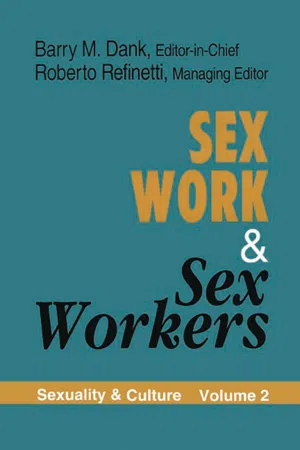
Sex Work and Sex Workers
About this book
Sexuality & Culture serves as a compelling forum for the analysis of ethical, cultural, psychological, social, and political issues related to sexual relationships and sexual behavior. These issues include, but are not limited to: sexual consent and sexual responsibility; sexual harassment and freedom of speech and association; sexual privacy; censorship and pornography; impact of film/literature on sexual relationships; and university and governmental regulation of intimate relationships.In this volume, theoretical essays, research reports, and book reviews examine the topics of prostitution, pornography, and other forms of commercialization of sexuality. Contributions include: "Twelve Step Feminism Makes Sex Workers Sick" by Kari Kerum; "Sex, Beach Boys and Female Tourists in the Caribbean" by Klaus de Albuquerque; "Reframing 'Eve' in the AIDS Era: The Pursuit of Legitimacy by New Zealand Sex Workers" by Bronwen Lichtenstein; "Long-Term Consumption of X-Rated Materials and Attitudes toward Women among Australian Consumers of X-Rated Videos" by Roberto Hugh Potter; "Invisible Man: A Queer Critique of Feminist Anti-Pornography Theory" by Jody Norton; and "Theorizing Prostitution: The Question of Agency" by Melanie Simmons. Also included are reviews of Live Sex Acts: Women Performing Erotic Labor by Wendy Chapkis; New Sexual Agendas edited by Lynne Segal. In addition, Daphne Patai reviews Real Live New Girl: Chronicles of a Sex-Positive Culture by Carol Queen; Nina Hartley reviews Three in Love; Jo Doezema reviews Trafficking in Women; Valerie Jenness reviews Feminist Accused of Sexual Harassment by Jane Gallop; and Warren Farrell reviews the film In the Company of Men. This volume will be of interest to sociologists, psychologists, legal analysts, and policymakers.
Information
ARTICLES
Twelve-Step Feminism Makes Sex Workers Sick: How the State and the Recovery Movement Turn Radical Women Into “Useless Citizens”
Kari Lerum
Department of Sociology, University of Washington Seattle, WA 98195
Department of Sociology, University of Washington Seattle, WA 98195
Within the contemporary United States, sex work is typically viewed in terms of a disease, meaning that sex workers are seen as “sick.” This medical understanding is due to the widespread jurisdiction of science, but other factors are at work as well: the “fit” with the bureaucratic nation-state, the ascendancy of the twelve-step recovery movement, the process of institutionalizing knowledge, and a climate of increased tolerance for “victims.” Within these political, cultural, and institutional frames, experts—regardless of sympathetic or feminist intentions—often view sex workers condecendingly. Furthermore, the study of sex work has achieved social and scientific legitimacy at the price of dehumanizing sex workers. This dehumanization may not be intended, but it is a requirement for the production of contemporary institutionalized knowledge.
Introduction
In 1993, just prior to completing my master’s thesis on sex work, I presented my findings for the first time to an eager, standing-room-only group of feminist scholars at the University of Washington. Though I knew my presentation would be controversial, nothing in my training as a sociologist had prepared me for the political uproar I was about to create. Throughout my talk, entitled, “Is it Exploitative if I Like it?: Sex Workers Compare Notes with Feminists and the Social Problems Industry,” I was aware that I was holding my audience in rapt attention. I noticed people both nodding and frowning, but more than anything I noticed that they cared about what I was saying. I described my interviews with women incarcerated for prostitution, compared these interviews with those I held with non-incarcerated sex workers, and pointed out that all of these women spoke of their sex work in complex, nuanced ways. None of them, even the most down-and-out, spoke of sex work in purely negative terms. None of them, even the most culturally privileged (who were more likely to “love” their work), portrayed sex work as unproblematic. I argued that experts rarely acknowledge sex work as a complicated experience; rather, experts hear what validates their position and disregard the rest—and this happens whether it is a feminist position, a social work position, or even a pro-sex work position. I argued that a better way to do research, and a method long advocated by prominent feminist theorists like Dorothy Smith (1979), is to take seriously the words of women and build those words into our theories about women. I proposed that the argument over whether sex work is either exploitative or liberating is a ridiculous one that produces ridiculous conclusions, and that this debate had little relevance to the complex, contradictory, and widely varied experiences of sex workers. I finished my talk with breathless enthusiasm and hope, and was met with polite, if enthusiastic, applause.
Little did I know, sitting to my immediate left was a prominent scholar of prostitution. Not a moment of post-applause calm had settled before the scholar turned to me, right index finger pointing, and began her stormy reprimand. She accused me of being an irresponsible researcher, of denying the vast amount of evidence that proves that most sex workers have been sexually abused, of trivializing the pain of sex workers, of being swept up with glamorized visions of prostitution. I responded with my feminist armor up, saying I was just following Dorothy Smith’s lead—and if the women I interviewed claimed that they liked certain aspects about sex work, then I will report that. The scholar responded that if my interviewees claimed they liked their work, they only said that to impress me (the authority) or to maintain some pride under extremely humiliating circumstances. She also pointed out (and I think this is valid) that the unequal power dynamic between researcher and subject makes it virtually impossible for subjects to tell the “truth.” And yet she did not offer a solution to this problem (such as give up some of our power as researchers) other than to suggest that I educate myself about which statements are untruthful and become aware that “they’re not going to admit they’re victims.” The exchange went round and round; others chimed in to both our defenses, though no professors came to mine. I continued to reiterate that sex work is not completely liberating for anyone, and that many sex workers, especially street-level prostitutes, do experience great physical and emotional pain. But the stage was set, and I was cast as a traitor. The whole exchange not only left me with an enormous headache, but also a fresh commitment to understanding not only sex work, but the politics of its meaning.
Throughout history, humans have been fascinated with sex workers. Whether this fascination comes in the form of condemnation, titillation, pity, or celebration, it’s clear that as an activity it captures the attention of many. The reason lies in considering why anyone or anything is fascinating; we are fascinated by people or things when we see them as unusual and exotic, as complex, as possessing some power we do not fully understand, and as symbolically relevant to our own lives and identities. If none of these features are present, the person or action is ignored, dismissed, and forgotten. With sex workers, this has never been the case. We do not ignore sex workers, we pay attention to them, and we pay attention because we have a personal stake in the matter. While there is tremendous variation in the economic and social position of our stakes, in the following pages I will discuss how most expert views of sex work are framed by a few dominant institutions, institutions that inevitably make sex workers “sick.” I conclude by arguing that the study of sex work has achieved social and scientific legitimacy at the expense of dehumanizing sex workers, and that this dehumanization is not an unfortunate coincidence, but a requirement for the production of contemporary institutionalized knowledge.
Sex Work and the Business of Morals and Truth
Throughout written history, there are many examples of people attempting to make their own interpretation of sex work into a culturally hegemonic one—and as with any issue, the people with the most social pull “win” the right to legislate truth and morality (e.g., Marx, 1864/1996; Becker, 1963). Although in pre-Biblical times “temple prostitutes” were apparently considered honorable and holy (Walker, 1983), religious authorities later claimed that sex, especially for women, may only occur with a marriage mate sanctioned by the church (and state). But as religious authority began to weaken (corresponding with the rise of “scientific” authorities and a growing middle class), secular authorities began overtaking the business of morals and truth—including the truths about sex work. In the United States, secular authorities (e.g., politicians, police officers, social scientists, social workers, health officials, and feminist scholars) have linked commercial sex work with organized crime, sexually transmitted disease, substance abuse, sexual abuse, violence, and a generally unpleasant social climate. Their rationales for opposing sex work differ, but the overlap is vast. Overall, authorities still agree that sex work is a problem.
And so the official story about sex work is still that there is something inherently wrong with it, but the reasons have changed. Official accounts of sex work no longer describe the phenomenon as a “sin,” and sex workers are no longer officially seen as the conduits of sin. Within the increasingly secularized climates of nineteenth-century Britain and North America, groups of new experts began asserting that prostitutes should be pitied rather than condemned, “taken in” rather than ostracized, and seen as “in trouble” rather than as trouble makers. These new experts were the women social reformers of the late nineteenth century—the same group of women we might retrospectively lump into the “first wave of feminism.” The following is Kristin Luker’s (1996) description of nineteenth-century women reformers in the United States:
Women reformers, mobilizing for the first time as women, engineered a new way of talking and thinking about “women in trouble.” Whether prostitutes, abandoned mistresses, or unmarried mothers, such “unfortunates” were now defined as victims of social and economic circumstance rather than as moral pariahs. The reformers, who came out of a rich evangelical tradition, were armed with an implicit (and at times explicit) critique of gender relations. Most centrally, they saw themselves as not so different from the women they wished to help: anyone, they argued, could fall prey to sin and to the devil in the person of men. (Luker, 1996, p. 20)
These women reformers’ approach created more sympathy for female sexual deviants, which reduced the sting of religious condemnation. However, the notion of “sin” did not immediately disappear: instead, evil became incarnate in promiscuous men rather than promiscuous women. In those times, sexual double standards were criticized, but the solution was seen as holding men to women’s “naturally” chaste standards. Rather than arguing for increased female sexual freedoms, promiscuity was universally condemned, and men were at fault for all sex outside of marriage. During this transitional time, notions of sin remained, but the agents of temptation switched genders.
For contemporary western feminists, this religious framing of sex work seems distracting and irrelevant, since the task now is not to curtail the devil’s manifestation in men, but to equalize societal entitlements. And yet, this integration of old (religious) and new (feminist) ideas is how all knowledge is made: new ideas are only “seen” if they can fit within an existing cultural frame. In that case, the frame was a religious one.
Feminism, religion, science, or any other philosophy, does not exist as a closed system. In the past century, people from all of these fields have influenced the official story about sex work, but their stories are also affected by their cultural contexts and institutional positions. Therefore, to better grasp the current approaches to sex work, it is helpful to consider the following three questions: 1) Which institutions dominate our contemporary theoretical frames?, 2) How do people get their ideas institutionalized, and what happens to an idea once it is institutionalized? and 3) What are the gaps between sex worker and expert accounts, and how concerned should we as social scientists be about such gaps? Answering these questions makes it easier to make sense of the politics of sex work, as well as to better evaluate any proposed “solutions.”
Cultural and Institutional Frames
From Anger about Sexism to Concern about “Fixing” Women
Since the late 1800s and early 1900s, women’s increasing activism began influencing expert attitudes about many issues affecting women, including sex work. As a result of this activism, there is today more official sympathy toward the “plight” of sex workers. However, an irony of this increased sympathy lies in how it has become fused with an individualized understanding of all social problems: so that a concern for people in troublesome circumstances becomes a concern for troubled people, a focus on fixing unfair social conditions becomes a focus on fixing people, and radical, structural critiques of gender inequality transform into worries about “fixing” women. How did this happen? Examples from history again give us clues.
In her informative book, Prostitution in Victorian Society: Women, Class, and the State, Judith Walkowitz (1980) traces the history of how a well-meaning radical women’s group, the “Ladies National Association” (LNA), organized around the issue of sex work. The group formed in Britain during the 1860s in response to Britain’s “Contagious Diseases Acts,” which required any unescorted woman to submit to official genital examinations—a measure which made sex workers targets for harassment, and institutionalized sexual double standards for everyone. For a brief time, the women of the LNA were able to summon public indignation over these Acts. However, due to their lack of cultural and legislative power, LNA members failed in their attempt to discard these Acts, as well as their goal of requiring men to emulate women’s “superior” (i.e., chaste) sexual standards. Furthermore, instead of halting men’s sexual licentiousness, the anger of the LNA “was easily co-opted and rechanneled into repressive antivice campaigns” leading to a “rise of social-purity crusades and...police crackdowns on streetwalkers and brothel keepers” (Walkowitz, 1980, p. 7). These state-sponsored crusades created a fearful and punitive climate for female sex workers, where they (but not their clients) were stigmatized, isolated, and driven away from networks of community support—all of which certainly brought these women distress and increased their reliance on (male) organized criminals.
Thus, the mixture of nineteenth-century religious and feminist ideas with the British legal system seems to have hurt sex workers more than it helped them. Sex workers became marked as an official “problem,” and what began as feminist and religious indignation over state-sponsored sexism resulted in even more state-sponsored harassment of specific women—those identified as prostitutes. This result should not be explained away as an anomalous, unintended coincidence; once the eye of the state rests upon a group spotlighted as “troublesome,” that group becomes an easy target of interrogation, scrutiny, and control. At first, well-meaning people may merely place their ideological spotlights on specific groups who are “in trouble,” but eventually those spotlighted people may beseen as the source of trouble.
The Frame of Disease and Recovery
While religious and feminist views helped focus the British (and U.S.) state’s attention on sex work around the turn of the twentieth century, this was also a growing time for a new cultural authority: science. In the United States, science began overtaking religious authority in the mid- to late 1800s, and its influence and authority continues to spread throughout American culture. Scientific trends have certainly come and gone (such as the popularity of social Darwinism and “scientific management”), but what remains is people’s tendency to see science as the arbiter of truth. Particularly compelling has been the concept of “disease,” which we understand as something that can and should be studied, isolated, and cured. And we not only see disease in the biological sense; since “disease” is something everyone avoids, the word also works as a strong metaphor, as Suzanne Pharr (1988) uses it when she calls homophobia a “societal disease.” So, due to the cultural authority of science, “disease” has replaced “sin” as the legitimate explanation for why bad things happen to people.
In 1935, Bill Wilson and Dr. Robert Holbrook Smith, the founders of Alcoholics Anonymous, utilized this culturally compelling metaphor when they began referring to alcoholism as a disease. The metaphor worked, and thus began the onset of an enormous Twelve-Step empire. Scientifically speaking, alcoholism has never “really” been a disease (Fingarette, 1988; Rapping, 1996), but the prevalence of this metaphorical slogan is so vast that whether it is “true” or not has not mattered.
In The Culture of Recovery, Elayne Rapping (1996) argues that the hegemony of the Twelve-Step movement has created widespread faith in a disease-based understanding of behavior, so that not just alcoholism but all social problems are understood in terms of disease and recovery. The disease explanation of personal troubles is now so foundational that, when alternatives are proposed, people get confused and even frantic. For e...
Table of contents
- Cover
- Half Title
- Title Page
- Copyright Page
- Contents
- Sexuality & Culture
- EDITORIAL
- ARTICLES
- BOOK REVIEWS
- FILM REVIEW
- PERSONAL PERSPECTIVE
Trusted by 375,005 students
Access to over 1.5 million titles for a fair monthly price.
Study more efficiently using our study tools.
Frequently asked questions
Yes, you can cancel anytime from the Subscription tab in your account settings on the Perlego website. Your subscription will stay active until the end of your current billing period. Learn how to cancel your subscription
No, books cannot be downloaded as external files, such as PDFs, for use outside of Perlego. However, you can download books within the Perlego app for offline reading on mobile or tablet. Learn how to download books offline
Perlego offers two plans: Essential and Complete
- Essential is ideal for learners and professionals who enjoy exploring a wide range of subjects. Access the Essential Library with 800,000+ trusted titles and best-sellers across business, personal growth, and the humanities. Includes unlimited reading time and Standard Read Aloud voice.
- Complete: Perfect for advanced learners and researchers needing full, unrestricted access. Unlock 1.5M+ books across hundreds of subjects, including academic and specialized titles. The Complete Plan also includes advanced features like Premium Read Aloud and Research Assistant.
We are an online textbook subscription service, where you can get access to an entire online library for less than the price of a single book per month. With over 1.5 million books across 990+ topics, we’ve got you covered! Learn about our mission
Look out for the read-aloud symbol on your next book to see if you can listen to it. The read-aloud tool reads text aloud for you, highlighting the text as it is being read. You can pause it, speed it up and slow it down. Learn more about Read Aloud
Yes! You can use the Perlego app on both iOS and Android devices to read anytime, anywhere — even offline. Perfect for commutes or when you’re on the go.
Please note we cannot support devices running on iOS 13 and Android 7 or earlier. Learn more about using the app
Please note we cannot support devices running on iOS 13 and Android 7 or earlier. Learn more about using the app
Yes, you can access Sex Work and Sex Workers by Barry M. Dank,Roberto Refinetti in PDF and/or ePUB format, as well as other popular books in Social Sciences & Gender Studies. We have over 1.5 million books available in our catalogue for you to explore.