![]() PART ONE
PART ONE
BACKGROUND INFORMATION![]()
1
THE EUROPEAN COMMUNITY AND ITS INSTITUTIONS
THE FORMATION AND DEVELOPMENT OF THE EUROPEAN COMMUNITY AND THE EUROPEAN UNION
The European Economic Community (EEC) was established by the Treaty of Rome in 1957 to create a common market and to establish a number of common policies for its member states. To achieve this, trade barriers between the member states and obstacles to the free movement of goods, services, workers and capital had to be eliminated, if necessary by approximating the member states’ national laws. Common policies in agriculture and transport were to be established amongst the member states, a common commercial policy towards the rest of the world was to be agreed and a system ensuring that there was no distortion of competition was to be set up. Community institutions were set up with wide-ranging powers to adopt laws to achieve these aims.
Since 1957, the Treaty of Rome has been revised by the Single European Act in 1986 and the Treaty on European Union, also known as the Maastricht Treaty, in 1992. In 1997 a further amendment, the Treaty of Amsterdam, was agreed by the member states. These latest changes will come into force once all of the member states have ratified the treaty. The various amendments to the original Treaty of Rome (EC Treaty) have greatly increased the EEC’s fields of activity, improved its institutions’ ability to adopt laws and changed its name from ‘European Economic Community’ to ‘European Community’(EC). The ‘European Union’(EU) was created under the Maastricht Treaty to provide an institutional framework for the Community’s member states to work towards a common foreign and security policy and cooperation in the areas of justice and home affairs. The institutions and member states of the EU and the EC are the same. However, whilst the Community’s law-making institutions – the European Commission, the European Parliament and the Council of the European Union – have no power to adopt laws relating to common foreign and security policy or justice and home affairs, they have extensive law-making powers in all policy areas covered by the EC Treaty. These include, amongst others, policies relating to environmental protection, consumer protection, and transport and agricultural policy. Laws adopted by the EC institutions in all areas covered by the EC Treaty become part of the law of all member states and must be complied with in those states.
Austria, Belgium, Denmark, Ireland, Finland, France, Germany, Greece, Italy, Luxembourg, the Netherlands, Portugal, Spain, Sweden and the United Kingdom are all members of the EC. Several other states, including ten states from Eastern and Central Europe, Turkey and Cyprus, have applied for membership and future enlargement is currently under discussion.
THE EC’S MAIN INSTITUTIONS AND BODIES
The main Community institutions involved in adopting EC laws are the European Commission, the European Parliament and the Council of the European Union. In some instances the Economic and Social Committee and the Committee of the Regions will also take part in the EC’s legislative process. The Community’s courts, namely the European Court of Justice and the Court of First Instance, ensure that EC laws are complied with in the member states while the European Ombudsman tries to ensure that the Community institutions act correctly in carrying out their duties. The European Environment Agency gathers environmental information.
All Community institutions and bodies work in eleven official languages – Spanish, Danish, German, Greek, English, French, Italian, Dutch, Portuguese, Finnish and Swedish – and all laws and official documents of the EC are available in those languages. The institutions and other EC bodies involved in the environmental field are described below.
European Commission
What is the Commission and how is it organized?
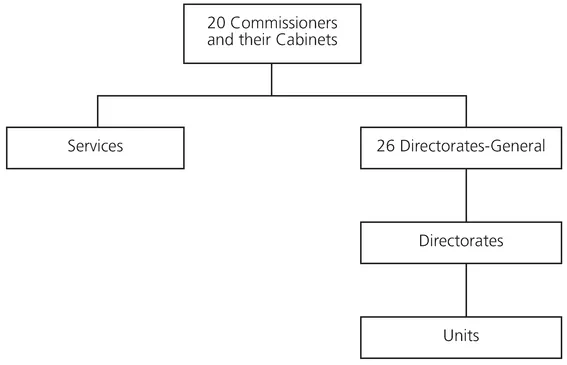
The European Commission (hereafter referred to as the ‘Commission’) is headed by 20 Commissioners (two each from France, Germany, Italy, Spain and the United Kingdom, one each from the other member states) who are appointed for five years. These Commissioners, nominated by the governments of the member states and subject to a vote of approval by the European Parliament, represent the interests of the Community and are completely independent of national governments. The Commissioners are collectively known as the ‘College of Commissioners’. Each Commissioner is responsible for one or more policy areas and, in carrying out these responsibilities, will be assisted by a small group of private staff – the so-called ‘Cabinet’. Heads of private staff (‘Chefs de Cabinets’) meet each week to prepare the weekly meetings of the Commissioners.
The Commission has a staff of approximately 15,000, most of whom are based in Brussels. It is divided into 26 directorates-general (DGs) and several other general services such as the legal service and secretariat-general. DG XI is responsible for environment, nuclear safety and civil protection. Other DGs which may be important in relation to environmental matters include DG III (industry), DG VI (agriculture), DG VII (transport), DG XIV (fisheries), DG
BOX 1.1 THE STRUCTURE OF THE EUROPEAN COMMISSION
XVII (energy) and DG XXIV (consumer policy). Details of the directorates-general and services in the Commission are set out in Part Five of this book.
Each directorate-general is subdivided into directorates which are further divided into units. The staff in these units will specialize in the particular policy area covered by the unit. The various directorates and units of DG XI (environment, nuclear safety and civil protection) are also outlined in Part Five.
What does the Commission do?
The Commission has several tasks which are relevant to environmental matters. Firstly, it makes proposals for new EC laws and guides these proposals through the Community’s legislative process (see Part Four). Secondly, it exercises certain implementing powers which allow it to make rules to flesh out policies laid down in Community law. These rule-making powers are only given to the Commission in limited circumstances, such as where a particular law needs to be adapted quickly to keep up with scientific progress. For example, the appendices to the directive on classification, packaging and labelling of dangerous substances, which regulates the marketing conditions of chemicals, have been adapted to technological progress by adopting at least 20 Commission directives. The Commission cannot act completely independently in making these rules and a variety of advisory, management and regulatory committees have been set up to involve the member states or the Council in adopting these implementing measures. These committees are made up of representatives from the member states and meetings are chaired by a Commission representative.
The Commission’s final task is to make sure that the member states comply with the EC environmental laws which are in force. In carrying out this task it can, if necessary, take a member state to the European Court of Justice if that state fails to comply with an EC law (see Chapter 13).
Council of the European Union
What is the Council and how is it organized?
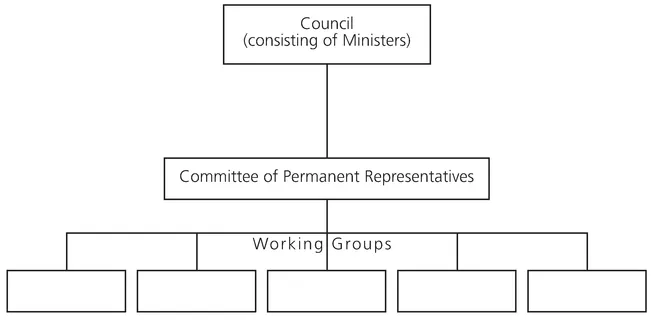
The Council of the European Union (‘Council’) is the EC institution in which the interests of the member states are represented. It is made up of one Minister for each member state and the Minister present will depend on the subject being discussed. Thus, for example, when the Council is discussing environmental matters it will be made up of the 15 Environment Ministers, while the ‘Agriculture Council’ will be made up of the Agriculture Ministers.
The Council’s secretariat is based in Brussels and Council meetings generally take place there. Meetings of the Council may also take place outside Brussels and, in particular, during the months of April, June and October, will be held in Luxembourg. The Presidency of the Council rotates amongst the member states every six months. The Presidency in the first half of 1999 will be held by Germany. The order after that is Finland (for the second half of 1999); Portugal, France (2000); Sweden, Belgium (2001); and Spain, Denmark (2002).
A Committee of Permanent Representatives (COREPER), consisting of the heads of each member state’s permanent national delegations to the EC in Brussels (known as the ‘permanent representations’), assists the Council in its work. When the Amsterdam Treaty comes into force, COREPER will be able to adopt ‘procedural decisions in cases provided for in the Council’s rules of procedure’.
A series of working parties or working groups help COREPER by carrying out vast amounts of preparatory, technical and detailed work. These working groups are composed of ‘experts’ and/or the desk officers from the permanent representations. The term ‘expert’ may include an official seconded by a ministry to the permanent national delegation or someone flown out from the member state for a particular meeting, such as a non-governmental scientist or technician. The Commission is represented at all levels of Council meetings.
BOX 1.2 THE STRUCTURE OF THE COUNCIL OF THE EUROPEAN UNION
What does it do?
The Council plays a decisive role in adopting new EC laws since it normally has the final say as to whether or not a particular EC law will be adopted. In some areas it now shares this power to adopt laws with the European Parliament (see Chapter 16).
European Parliament
What is the European Parliament and how is it organized?
The Members of the European Parliament (MEPs) represent the interests of the citizens of the European Union who elect them every five years. The European Parliament (‘Parliament’) has 626 members, the number of MEPs for a state depending roughly on its population. A lot of parliamentary work is carried out by 20 standing committees. The committee on environment, nuclear safety and civil protection is one of the most active committees. Other committees which may be useful in relation to environmental matters include the petitions committee, the committee on regional policy, the committee on transport and tourism, the committee on agriculture and rural development, the committee on legal affairs and citizen’s rights and the committee on fisheries.
MEPs are organized in several political groups which play an important role within the Parliament. The largest political groups within the current Parliament are the European Socialists and the European People’s party. Groups of MEPs from different political groups who share an interest in particular issues or themes have formed various ‘intergroups’ which also have an impact on the work of the Parliament. Existing intergroups include the Intergroup on the Welfare and Conservation of Animals and the Forest Intergroup.
The European Parliament carries out its work in several places. Meetings of its committees take place in Brussels; its secretariat is in Luxembourg and se...