The Sustainability Transformation is a must-read for anyone trying to make sense of what is happening to our world – and wanting to change it for the better.
Renowned consultant and communicator Alan AtKisson, author of the sustainability classic Believing Cassandra, cuts through the jargon and illuminates the essentials in this highly readable and motivational work. The Sustainability Transformation covers theory and practice, tools and strategies, the opportunities and the obstacles, illustrated with in-depth case studies and poignant personal anecdotes. AtKisson's aim is to empower the reader and to help grow a global 'army of change agents,' working effectively to overcome the great challenges of our times.
At the heart of the book is AtKisson's potent ISIS Method, used by business, governments, and organizations around the world. ISIS - Indicators, Systems, Innovation, Strategy - helps professionals, students, and amateurs alike to put sustainability to work and accelerate change, even when facing difficult circumstances. AtKisson also introduces the reader to many inspiring people, unsung heroes whose success stories provide a solid foundation for hope.
Previously published in hardcover as The ISIS Agreement.
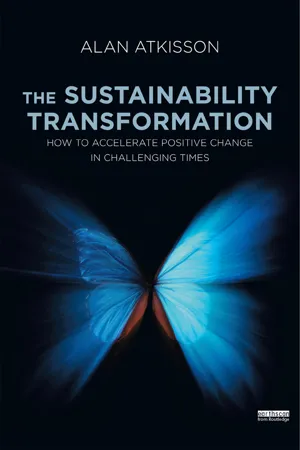
eBook - ePub
The Sustainability Transformation
How to Accelerate Positive Change in Challenging Times
- 344 pages
- English
- ePUB (mobile friendly)
- Available on iOS & Android
eBook - ePub
The Sustainability Transformation
How to Accelerate Positive Change in Challenging Times
About this book
1
The Hope Graph
Things are getting better and better, and worse and worse, faster and faster.
– Tom Atlee
Congratulations! You got the job. You start work immediately. You may already be hard at work, and if so, this is your renewal notice. And here is your assignment:
JOB DESCRIPTION
World development is making most people richer and healthier. It is creating enormous new opportunities for human learning and self-expression. But it is also creating a dangerous set of conditions and trends – climate change, a stark rich/poor divide, an erosion of community and social capital, depletion of both non-renewable and renewable resources, conflict over resources, degraded ecosystems, disappearing species, and many other problems – that are increasingly likely to cause collapses and catastrophes, small and large. These growing dangers are greatly diminishing the long-term prospects of both people and nature. Our current course is not sustainable.
Your job is to help change the world, by changing the systems in which you live and work. Your objective is to prevent collapse or catastrophe – in both human and natural systems – and to increase the prospects for a more sustainable and even beautiful future.
To assist you in accomplishing your assignment, you will be given access to current research about the trends shaping that future, as well as up-to-date news about important breakthroughs, tools, technologies and change processes. You will be linked up to other individuals and groups who have accepted the same job and who are spread out across the planet. This global ‘conspiracy of hope’, combined with the latest in communications technology, will make it possible to work in both physical and virtual teams, and to find help and support, almost anywhere.
Your prospects for success are better than they might appear, because slow changes can suddenly become very rapid, and because humanity has a long history of rising to overcome great challenges. But you face a number of daunting obstacles and limitations:
• You will be given minimal resources to pursue your mission – indeed, an extremely tiny amount when compared to the resources currently spent to fuel your community, company or government on its current course. You will have to find ways to create large-scale changes with small-scale budgets using high-leverage intervention strategies.
• You will be largely invisible to others, and it will sometimes be difficult to explain to other people what you are doing. Phrases like ‘sustainable development’, ‘global transformation’ or ‘a systems perspective’ still leave most people scratching their heads. You will have to communicate your intentions in ways that speak to people’s immediate and local needs while also convincing them to participate in longer-term, larger-scale changes to solve increasingly global problems. There is not enough time to wait for people to ‘wake up’ or ‘get it’ on a mass scale.
• You will have limited access to centres of power. If you achieve access, you will often discover that many people sitting in those centres of power feel surprisingly trapped by the system that they are supposedly controlling, and relatively powerless to make change. If you are not able to convince them otherwise, you will have to find other ‘leverage points’, other places to start change processes that can then spread through the system.
• Meanwhile, the momentum of change in the wrong direction will be immeasurably huge, and will probably continue to accelerate, in ways that seem unstoppable. It is imperative that you resist tendencies to despair and cynicism, in yourself and others, and that you find effective ways to spread a sense of hope and inspiration. For without hope – the belief that change is possible, that your vision of a sustainable world is attainable – your chances of success fall dramatically.
Good luck.
If you were interested enough to open this book, then you have already identified yourself as a candidate for the ‘job’ described above. Or you could be someone who has already held such a ‘position’, perhaps for many years. Whether newcomer or veteran, I hope you are inspired by the challenges of this historic period, and by the chance to play a role in addressing them.
On the other hand, you may not want the job. You might actually prefer to do something else with your life. But when one becomes aware that the world is genuinely headed for big trouble, and that changing course requires tremendous efforts, by as many people as possible, it is usually impossible to pretend that one does not have this rather important piece of information.
For most people, once they begin to grasp the gravity of our situation, not caring is not an option.
Fortunately, those of us who care are not alone. For a rapidly growing number of people, the ‘job description’ above is arriving in their lives suddenly, and through many channels. Perhaps a book or documentary film has convinced them of the dangers of climate change. Perhaps a trip to another country has awakened them to the reality of global poverty, as well as to the costs of rapid economic growth. Perhaps the seriousness and urgency of the world situation, after years of being either a nagging worry or dismissible exaggeration, has simply dawned upon them in an undeniable way, especially as political leaders, magazines and other previously sceptical public voices become not just convinced, but alarmed and actively engaged.
And sometimes people like you have received this job description at their actual job, from their actual boss. Perhaps you were reassigned from a job in public relations to the job of being a person who coordinates ‘sustainability programmes’ or ‘corporate responsibility’ – and realized that you have effectively been assigned to tackle the world’s greatest problems, on behalf of your company, city or government agency.
Indeed, tackling the world’s greatest problems has now become not just a movement, but a profession. And this profession, because it knits together people from nearly every discipline, is generally described not in terms of what people actually do, but in terms of the goal that they are trying to achieve: sustainability.
The word ‘sustainability’ simply refers to the ability of any system to keep going over time. It has historically been applied to everything from fish and forest management to the financial analysis of companies, to military logistics and the provision of armed forces with food, fuel and ammunition. ‘Sustainable development’, meanwhile, means change over time in the direction of sustainability. One needs the latter to achieve the former. (More on this in Chapter 5.)
‘Unsustainable’ systems collapse, by definition, while sustainable ones can keep doing what they are doing. A bewildering portion of systems in the world today – from agriculture to zoos – are unsustainable, because they depend on fossil energy sources, dirty and nature-destroying industrial processes, and/or social arrangements that simply cannot ‘keep doing what they are doing’ without wrecking the planet and creating the preconditions for armed conflict or worse.
That’s why we need sustainable development, as well as sustainable redevelopment.
And we need a lot more of both. And fast.
The fact that the world is increasingly caught up in a conversation about ‘global sustainability’ – that is, the ability of the entire world to keep doing what it is doing – is an utterly remarkable historical occurrence. Debates about the possibility of natural, economic and/or social collapse, spurred by catastrophic climate change and its harrowing web of interconnected global problems, have moved from the fringe cafés of pessimistic Greens to the centrepiece position on the international political table. Whether the increasingly real-looking collapse scenarios are truly ‘global’ or just huge enough to be global in their impact hardly matters. Whether the time horizon is 10 years or 50 may make a difference to economists who think in terms of future-discount rates, but it makes little difference to people worried about grandchildren and polar bears.
The fact that the global conversation about sustainability and sustainable development is increasingly becoming understood as a global struggle – a literal race against time, with life-and-death stakes for millions of people and other living species, both short and long term – is without a doubt the defining fact of our generation, and probably will be for several generations to come.
In the midst of this growing global clamour and chatter about our future, I take the emergence and the rapid increase in the number of ‘sustainability professionals’ – people whose jobs formally include sustainability or sustainable development issues, by whatever name – as both a troubling and a hopeful sign. It is troubling that such work is necessary, because where there is smoke there is fire. Where there is a rapidly growing fire brigade, fires are a rapidly growing problem.
But it gives me hope that the world is responding to the gathering storm of chronic problems and looming crises. People working on sustainability issues, at levels ranging from the very local to the very global, now number conservatively in the hundreds of thousands, very likely the millions, depending on how one defines the terms. The fact that every year marks the entry of many new people into this ‘global fire brigade’ is one of the most hopeful indicators I know.

During the last half-century, a growing chorus of scientists and researchers has been warning humanity that certain trends – global warming, growing population, increasing waste, a declining resource base, deteriorating natural systems – were heading us into danger, and that great efforts were required to avoid the worst. There have always been individuals, groups and organizations dedicated to raising awareness of the issues and taking practical and strategic action to make a difference. But these efforts have been small, putting it mildly, relative to the scale of the challenge. Great efforts require great numbers of people, a veritable army of people, working at all levels to create sustainability.
Finally, that army seems to be forming.
I received my own inescapable invitation to join the sustainability army in 1979, as a college student studying classic texts like The Limits to Growth (Meadows et al) and Population, Resources, Environment (Ehrlich, Ehrlich and Holdren). Since 1988, I have worked as a ‘sustainability professional’, someone whose job title has included the word ‘sustainability’ and whose job description, while not reading like the one above in any formal way, has certainly felt like that much of the time. Back in the late 1980s, we ‘professionals’ were a small and rather lonely bunch. Most of those formally engaged in sustainability work were scientists, grassroots activists, and United Nations-level policy thinkers and diplomats. (I started out as a journalist and wrote about them.) There were no ‘Vice Presidents for Sustainability’ in companies, no ‘Agenda 21 Coordinators’ for cities, no master’s degrees offered in ‘Business Administration with a Concentration in Sustainable Development’. Acronyms like ‘CSR’ had not yet been invented.
For me and for the few thousand people working globally on these issues back in the late 1980s, sustainability was a ‘field’ one learned by volunteerism, apprenticeship and learning-on-the-job. A great deal of what is now ‘standard practice’ was developed by people who just ‘made it up as they went along’. In our efforts to do something to ‘save the world’ – a phrase used with some combination of seriousness and self-deprecating irony – we were all amateurs.
These days, ‘saving the world’ is serious business, engaging major universities, large companies, and national and international agencies. But this is not a book just for the ‘pros’, or for professionals-in-training. This is also very much a book for ‘amateurs’ – remembering that the root of the word ‘amateur’ is amare, love. This is a book for all those who have dedicated some piece of their lives, professional or otherwise, indeed some piece of their hearts, to helping the human species make the greatest transition it has ever been challenged to make: the transition to a globally sustainable civilization.
New York City
May 1988
It’s amazing what junk some people will buy. To finance a move from New York to Seattle, for the past few weeks I have been a weekly fixture at this flea market in Brooklyn. I’m selling everything I can – clothes, books, records, furniture…even my underwear. Somebody just paid me 25 cents each for a bunch of old boxer shorts.
This cross-country move was originally motivated by a desire to get out of The City, and live somewhere with easier access ...
Table of contents
- Cover
- Title
- Copyright
- Dedication
- Contents
- List of figures
- Preface to the Paperback Edition
- Prologue: The Myth of Isis and Osiris
- A Letter to H.
- 1 The Hope Graph
- 2 The Meeting at Hotel Petrol
- 3 The Golden Coffin
- 4 Murder in The Big Easy
- 5 Solving a Very Big Problem
- 6 Make Money, Do Good…and Save the World
- 7 A Compass for the 21st Century
- 8 How to Build a Pyramid
- 9 Journey into the Amoeba
- 10 Playing with Power
- 11 An Army for Sustainability
- Coda
- Notes and References
- Appendix 1: Sustainability is Dead – Long Live Sustainability
- Appendix 2: The Earth Charter
- Index
Trusted by 375,005 students
Access to over 1.5 million titles for a fair monthly price.
Study more efficiently using our study tools.
Frequently asked questions
Yes, you can cancel anytime from the Subscription tab in your account settings on the Perlego website. Your subscription will stay active until the end of your current billing period. Learn how to cancel your subscription
No, books cannot be downloaded as external files, such as PDFs, for use outside of Perlego. However, you can download books within the Perlego app for offline reading on mobile or tablet. Learn how to download books offline
Perlego offers two plans: Essential and Complete
- Essential is ideal for learners and professionals who enjoy exploring a wide range of subjects. Access the Essential Library with 800,000+ trusted titles and best-sellers across business, personal growth, and the humanities. Includes unlimited reading time and Standard Read Aloud voice.
- Complete: Perfect for advanced learners and researchers needing full, unrestricted access. Unlock 1.5M+ books across hundreds of subjects, including academic and specialized titles. The Complete Plan also includes advanced features like Premium Read Aloud and Research Assistant.
We are an online textbook subscription service, where you can get access to an entire online library for less than the price of a single book per month. With over 1.5 million books across 990+ topics, we’ve got you covered! Learn about our mission
Look out for the read-aloud symbol on your next book to see if you can listen to it. The read-aloud tool reads text aloud for you, highlighting the text as it is being read. You can pause it, speed it up and slow it down. Learn more about Read Aloud
Yes! You can use the Perlego app on both iOS and Android devices to read anytime, anywhere — even offline. Perfect for commutes or when you’re on the go.
Please note we cannot support devices running on iOS 13 and Android 7 or earlier. Learn more about using the app
Please note we cannot support devices running on iOS 13 and Android 7 or earlier. Learn more about using the app
Yes, you can access The Sustainability Transformation by Alan AtKisson in PDF and/or ePUB format, as well as other popular books in Business & Business Strategy. We have over 1.5 million books available in our catalogue for you to explore.