eBook - ePub
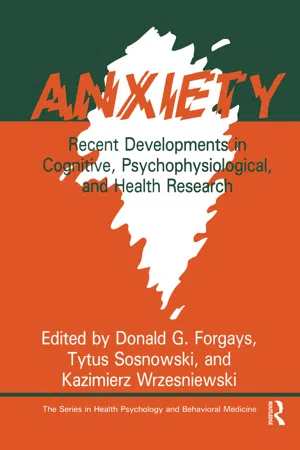
Anxiety
Recent Developments In Cognitive, Psychophysiological And Health Research
- 276 pages
- English
- ePUB (mobile friendly)
- Available on iOS & Android
eBook - ePub
Anxiety
Recent Developments In Cognitive, Psychophysiological And Health Research
About this book
Examines anxiety from both biological and behavioural points of view and combines three areas of anxiety - cognitive developments, psychophysiological developments and health development - normally examined independently.
Information
Publisher
Taylor & FrancisYear
2019Print ISBN
9781138963641
9781560322658
Edition
1eBook ISBN
9781317837138
1
Introduction: Current Studies on Anxiety from the Perspective of Research Conducted During the Last Three Decades
Jan Strelau
University of Warsaw, Poland
Anxiety is one of the few concepts in psychology that, at first glance, seems to be understood even by laymen. On the basis of their own experience, everyone knows what anxiety is, especially when they are in stressful situations. Anxiety is one of the crucial emotions that affects behavior not only in humans but also in animals and, from the evolutionary point of view, has important adaptive functions. This explains why psychologists pay so much attention to this phenomenon. Anxiety became a substantial concept in the psychoanalytic approach introduced by Freud and in most neo–psychoanalytic-oriented conceptualizations. It also was studied by Pavlov, who experimentally produced a state of anxiety in dogs by exposing them to conflict caused by ambiguous stimuli during the conditioning procedure of differentiation.
When considering the concept of anxiety from a scientific perspective, it is clear that its definition is much more equivocal than it seems to be in everyday life. In the second half of our century, many approaches and trends have developed in the field of anxiety and they have been pursued by researchers with increasing interest. For example, Spielberger (1966) stated that during the period of 1950 to 1963 there appeared 3,500 monographs and papers in which anxiety was used as one of the key words. About 20 years later, from 1974 to 1982, the number of publications with anxiety as a key word recorded in ‘Psychological Abstracts’ (Psych-Lit records) had grown to 6,800. In the past 9 years (1983–1991), this rate of increase has continued and the number of publications has grown to 13,023. The aspects of anxiety that have gained the most popularity in recent decades refer to social and health problems. Much less research has been conducted with the aim of studying the psychological and physiological mechanisms underlying the development of anxiety or of advancing our knowledge of the nature of anxiety.
Three Decades of Research on Anxiety
Looking at the psychological literature on anxiety from a perspective of the last three decades, different approaches and trends in this field of research can be observed. The drive-reflex-oriented concept of anxiety, also known as the conditioned reflex (CR) approach to anxiety, was developed by the Iowa School in the 1950s (Spence, 1956; Spence & Taylor, 1951). Although it is still present in current research, it has lost its popularity. This is mainly because the mechanistic approach, represented by the learning theories of anxiety (see Krohne, 1980), did not take into account the psychic states of the individual or the interaction between the individual and the situation in generating anxiety.
Drive-oriented research on anxiety, based on the conditioned reflex paradigm of K. W. Spence and Janet A. Taylor (1951), has, however, given rise to new approaches to anxiety that have not been appreciated by most investigators in the field of anxiety. Several issues are worth mentioning here.
1. The fact that individuals differ in the speed of conditioning to aversive stimuli (regarded as the measure of anxiety), explained by differences in the strength of drive evoked by these stimuli, has given way to the individual differences approach to anxiety. This approach has gained much popularity in recent decades.
2. To select a large number of individuals who can be characterized as having high or low levels of anxiety and to have a validity measure for experimentally assessed anxiety, Taylor (1953) developed the Manifest Anxiety Scale (MAS). This scale, mainly based on items from the MMPI, was and still is used to diagnose anxiety as understood as a trait. MAS serves also as one of the principal validity criteria for other trait anxiety inventories.
3. Spence and Taylor (1951) were the first researchers simultaneously to use physiological and psychometric measures for assessing anxiety. It has been shown recently that when psychometric and physiological data are compared, not only are different measures of anxiety used but also different kinds of anxieties are being compared (see Strelau, 1991).
4. By comparing MAS measures with speed of conditioning of the eyelid reflex and by showing that efficiency and speed of conditioning to unconditioned stimuli of different intensities depend on the level of anxiety, Spence and Taylor (1951) accomplished the first experiments on the relationship between anxiety and level of performance. Studies in which the interrelationships between anxiety and level of performance and/or achievement are investigated are currently among the most popular ones.
It has been shown in personality research (Mischel, 1968, 1977) and also in studies on anxiety (Endler, 1975) that the trait approach explains only about one third of the variance of anxiety measured under threatening situations. These kinds of findings resulted in the development of at least two new approaches in anxiety research.
The interactional approach to anxiety was the first to gain popularity (Endler, 1975; Endler & Hunt, 1966). The interactional paradigm made researchers aware of the fact that not only trait anxiety but also the situation and, in particular, the interaction between the individual’s anxiety trait and the situation contributes to the anxious behavior recorded in experimental and field studies. This kind of thinking about anxiety also has led to the development of situation-specific (S-R) types of inventories of anxiety (Endler, Hunt & Rosenstein, 1962; Endler & Okada, 1974). These latter measures, however, have not dominated the field of anxiety assessment because the amount of variance explained by such measures usually does not extend the variance explained by traditional anxiety inventories.
The fact that anxious behavior develops not only as a function of the tendency to react anxiously to aversive stimuli but also as a result of situation-specific conditions has led to the distinction between trait anxiety and state anxiety introduced by Cattell (Cattell & Scheier, 1958; Cattell, Shrader & Barton, 1974). This idea has been elaborated most fully by Spielberger (1966, 1972). According to him, trait anxiety refers to individual differences in anxiety proneness; the latter is regarded as a tendency to respond anxiously under stress. In turn, state anxiety consists of unpleasant feelings of tension and apprehension accompanied by arousal of the autonomic nervous system. The distinction between state anxiety and trait anxiety gained a good deal of popularity, especially after the State-Trait Anxiety Inventory (STAI) was developed by Spielberger, Gorsuch, and Lushene (1970). The STAI allows the separate measuring of anxiety as a state and of anxiety as a trait. Other inventories of this kind also have been developed (e.g., see Endler, Edwards, Vitelli & Parker, 1989).
Spielberger’s definition of state anxiety emphasizes the cognitive approach to anxiety in distinction to the conditioning paradigm of anxiety. This line of research developed under the influence of cognitive psychology. The studies and conceptualizations of McReynolds (1962), Lazarus (1966), Epstein (1967), Morris and Liebert (1973), and others have shown the importance of internal states such as cognitive incongruity, uncertainty, appraisal of threat, unexpectancy, helplessness, cognitive dissonance, and so forth as determinants of anxiety and also as states that are affected by anxiety.
These studies not only demonstrated the importance of cognitive functioning in generating anxiety but also introduced a cognitive component to the structure of anxiety. Liebert and Morris (1967) and Morris and Liebert (1970) have shown that anxiety consists of two components: arousal (the physiological component; also called emotionality) and worry (the cognitive component of anxiety). Worry has been defined as a primarily cognitive concern about the consequences of failure and includes negative self-evaluation (lack of confidence) and concerns about poor performance.
This approach to anxiety, which developed in studies in which levels of anxiety were related mainly to academic performance, has led to the development of a new direction known as test anxiety. The popularity of this kind of research is attested to by the establishment of an international association of test anxiety, Society for Test Anxiety Research, and the availability of the book series Advances in Test Anxiety Research since 1982.
The studies conducted on test anxiety also have shown that physical threat and psychological threat are qualitatively different sources of anxiety and that they probably refer to different kinds of anxiety. Psychological threat (the kinds of internal states mentioned previously) generates the cognitive component of anxiety, worry, whereas physical threat activates the arousal component of anxiety, emotionality (see Rost & Schermer, 1987; Schwarzer, Jerusalem & Lange, 1982). The fact that level of anxiety under physical threat does not permit us to predict level of anxiety under psychological threat also has been found in studies on trait and state anxiety (see Glanzmann & Laux, 1978; Kendall, 1978; Lamb, 1978).
Of special importance to the cognitive approach to anxiety is the research on stress done by Lazarus and his co-workers (Lazarus, 1966; Lazarus & Averill, 1972).Lazarus has demonstrated that anxiety develops when an individual appraises a situation as threatening. To be more specific, anxiety emerges when unsuccessful coping mechanisms have been developed or when the individual fails to cope with stress. Such a conceptualization of anxiety has led to the study of the relationship between anxiety and stress, and coping with stress has been regarded as a strategy for reducing anxiety (i.e., the state of appraising a situation as threatening). This field of research gained a considerable following in clinical and health psychology (e.g., see Janisse, 1988). To demonstrate the popularity of the studies aimed at solving theoretical and applied issues, it is worth noting that, between 1975 and 1991, 13 volumes have been published under the title Stress and Anxiety, edited by C. D. Spielberger, I. G. Sarason, and others. These are the proceedings of international symposia that have been organized every few years under the same label.
Important for a better understanding of the nature and determinants of state and trait anxiety is research aimed at comprehending the biological mechanisms underlying this phenomenon. This line of inquiry is not represented by as large a number of publications as are the other areas presented above.
Probably most influential with respect to the biological approach to anxiety is the research conducted since the early 1970s by J. A. Gray, a leading representative of the learning theoretical approach to appetitive and aversive motivational systems. Neuropsychological and neuropharmacological experiments conducted on rats led Gray (1972, 1976, 1982) to describe the hypothetical mechanisms underlying anxiety. According to him, the orbital frontal cortex, medial septal area, and hippocampus should be considered as the anatomical centers of anxiety. They constitute the behavioral inhibition system (BIS), which became a subject of study by several researchers (e.g., see Fowles, 1983, 1987; Sosnowski, Nurzynska & Polec, in press). The BIS is activated by conditioned aversive stimuli (signals of punishment, frustrative nonreward, and novel stimuli). However, the question as to what extent this biological mechanism of anxiety is generalizable to human beings remains open (e.g., see ‘Open Peer Commentary’ in Gray, 1982). Wilson, Barrett, and Gray (1989) tried without success to transfer Gray’s neuropsychological model of anxiety and impulsivity to human studies. The reason for failure may be because of this study’s use of psychometric measures of behavioral characteristics as expressions of anxiety and impulsivity.
In the domain of biological bases of anxiety, the most common approach consists of examining the physiological correlates of anxiety, which are then used as direct measures of anxiety or as indicators of the arousal component (emotionality) of this state/trait. The electrodermal system, regulated by the autonomic nervous system, is especially sensitive to stimuli-generating emotions, most importantly anxiety. Electrodermal activity (EDA) has been used since the beginning of this century (Veraguth, 1909) as the most popular indicator or correlate of anxiety (state and trait). Fowles (1983) treats EDA as a measure of the activity of BIS. During the last three decades, dozens of studies have been designed to compare levels of EDA (tonic, spontaneous, and phasic) with independent measures of state and trait anxiety. The results summarized by Naveteur and Freixa i Baque (1987;Chapter 10) are rather pessimistic (see also Stern & Janes, 1973). They demonstrate that in normal persons no prediction of state or trait anxiety can be made on the basis of EDA scores.
The lack of consistency between the EDA scores of the arousal component of anxiety and independent measures of this phenomenon, mostly provided by psychometric measures, is not surprising. First, it has been found in many experiments that different measures of the level of arousal (tonic and phasic) do not even correlate with each other (see Lacey, 1950, 1967; Venables, 1984). Second, studies in the domain of arousal-oriented personality/temperament dimensions (extraversion, neuroticism or emotionality, anxiety, sensation seeking, and strength of excitation) have shown that there is almost no agreement between psychometric measures and physiological correlates of these traits (see Amelang & Ullwer, 1991; Fahrenberg, 1986, 1987; Kohn, Cowles & Lafreniere, 1987; Stelmack, 1990; Strelau, 1983). The lack of relationship is found especially when tonic states of the physiological correlates are taken into account. In a recent article (Strelau, 1991), I have argued that there seem to be no grounds for expecting congruence between psychometric and physiological measures of arousal-oriented personality/temperament characteristics. Without going into detail, one may assume that on both levels (psychometric and physiological) different phenomena are not necessarily correlated with each other; this may also be true for anxiety....
Table of contents
- Cover
- Half Title
- The Series in Health Psychology and Behavioral Medicine
- Title Page
- Copyright Page
- Table of Contents
- Contributors
- Preface
- 1 Introduction: Current Studies on Anxiety from the Perspective of Research Conducted During the Last Three Decades
- I Cognitive Developments
- II Psychophysiological Developments
- III Health Developments
- Index
Trusted by 375,005 students
Access to over 1.5 million titles for a fair monthly price.
Study more efficiently using our study tools.
Frequently asked questions
Yes, you can cancel anytime from the Subscription tab in your account settings on the Perlego website. Your subscription will stay active until the end of your current billing period. Learn how to cancel your subscription
No, books cannot be downloaded as external files, such as PDFs, for use outside of Perlego. However, you can download books within the Perlego app for offline reading on mobile or tablet. Learn how to download books offline
Perlego offers two plans: Essential and Complete
- Essential is ideal for learners and professionals who enjoy exploring a wide range of subjects. Access the Essential Library with 800,000+ trusted titles and best-sellers across business, personal growth, and the humanities. Includes unlimited reading time and Standard Read Aloud voice.
- Complete: Perfect for advanced learners and researchers needing full, unrestricted access. Unlock 1.5M+ books across hundreds of subjects, including academic and specialized titles. The Complete Plan also includes advanced features like Premium Read Aloud and Research Assistant.
We are an online textbook subscription service, where you can get access to an entire online library for less than the price of a single book per month. With over 1.5 million books across 990+ topics, we’ve got you covered! Learn about our mission
Look out for the read-aloud symbol on your next book to see if you can listen to it. The read-aloud tool reads text aloud for you, highlighting the text as it is being read. You can pause it, speed it up and slow it down. Learn more about Read Aloud
Yes! You can use the Perlego app on both iOS and Android devices to read anytime, anywhere — even offline. Perfect for commutes or when you’re on the go.
Please note we cannot support devices running on iOS 13 and Android 7 or earlier. Learn more about using the app
Please note we cannot support devices running on iOS 13 and Android 7 or earlier. Learn more about using the app
Yes, you can access Anxiety by Donald G. Forgays, Tytus Sosnowski, Kazimierz Wrzesniewski, Donald G. Forgays,Tytus Sosnowski,Kazimierz Wrzesniewski in PDF and/or ePUB format, as well as other popular books in Psychology & Abnormal Psychology. We have over 1.5 million books available in our catalogue for you to explore.