Visit www.geraldlewis.com for more information.
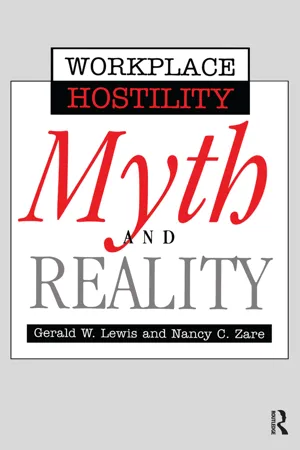
- 172 pages
- English
- ePUB (mobile friendly)
- Available on iOS & Android
eBook - ePub
About this book
Information
Publisher
Taylor & FrancisYear
2015Print ISBN
9781560325369
9781560325352
Edition
1eBook ISBN
9781317711377
Chapter 1
A BRIEF HISTORY OF SAFETY IN THE WORKPLACE
As we move toward the 21st century, there is an increasing effort to improve the physical and emotional health of the workplace. In order to appreciate these efforts, it may be helpful to compare the workplace of today to that of 100 to 150 years ago. During the 1800s, the workplace was involved primarily in manufacturing, and the goal was to improve production through industrial technology. Businesses tried develop faster methods of production at lower costs. The factory setting saw the increase of massproduced items through assembly lines and cookie-cutter technology. Most of the labor force was male, unskilled, with little education. Minimal concern was demonstrated for the welfare of the American worker.
It wasn’t until the mid 1800s that child labor laws began to appear. Other than that, the primary effort in U.S. industry was to deliver as much product as possible for the lowest cost, regardless of the physical or emotional impact on workers. It was commonplace for workers to be at the workplace 12 to 16 hours a day, six days a week. Working conditions often were close to intolerable, with limited light and ventilation. Safety was of little concern, and workers were subject to illness and injury on a regular basis. If a worker was injured or became ill, he was removed—with no benefits or compensation. Minimum wage standards were nonexistent, and many workers toiled under some form of indentured arrangement for subsistence survival. The benefits we take for granted—overtime, vacations, sick leave, federal and religious holidays, personal days, family leave, health and disability insurance, retirement plans, worker’s compensation, unemployment insurance, tuition reimbursement, COBRAs, and outplacement services—did not exist in the 1800s, even in the minds of the most forward-thinking employers.
It does not take much effort to imagine the workplace of yesteryear. Typically it was an evil-smelling, dirty, hazardous environment in which children and adults worked side by side, confronting the possibility of disabling injury and illness each day. In many cases, workers eked out their survival in factories, on farms, in mines, or in street markets fraught with violence and hostility that, in all likelihood, make our concerns of today pale by comparison.
The labor movement of the early 1900s did a great deal to change the look of the U.S. workplace. Child labor laws were written and enforced, and minimum wage standards and reasonable work hours became the focus of the labor movement. Eventually, employers—under pressure from labor unions to take better care of their employees—began to offer “benefits” to their workers. The majority of these benefits coincided with the initiation of the Social Security system and the return of young soldiers from World War II. The last 50 years have seen a dramatic improvement of conditions in the American workplace.
As the country moved into the postwar years, a shift began in the U.S. economy—a shift from manufacturing to service and information. Office buildings, shopping malls, and industrial parks began replacing factories, farms, and family businesses as primary employers.
In addition—and equally important—the emerging influence of psychology in the United States extended to the workplace, and its impact was felt on a number of levels. One significant concept that emerged from the marriage of industrial and behavioral psychology was that of individual reward and incentive. Citing studies of pigeons and laboratory rats, psychologists demonstrated to employers that the productivity of their workers could be increased through a system of planned rewards and incentives. This era saw the advent of incentive plans and improved working conditions. Commission-based salaries, bonuses, gifts, employee-of-the-month awards, favored parking places, promotions, and comp time were tied to employee performance in an ongoing effort to improve productivity.
Psychology departments at universities across the country received grants to conduct studies of the workplace: They were asked to determine what environments were most conducive to employee productivity, what schedules coincided with high-energy levels, even what colors helped workers feel more comfortable. By the 1970s, comfort was the operative word in most offices, as climate control, sound control, lighting, carpeting, artwork, and music were integrated into the workplace. By the 1990s, ergonomics (the applied science of equipment design, intended to maximize productivity by reducing operator fatigue and discomfort) emerged as a new field. It was no longer enough to make the environment look, sound, and smell good; in order for the individual worker to achieve his or her greatest potential (productivity), the employer had to provide equipment that assured the worker’s optimum level of physical comfort.
In 1970, the Environmental Protection Agency (EPA) took on the issue of environmental safety and wielded great power to influence the workplace with respect to safe disposal of harmful byproducts. In 1972, the Occupational Safety and Health Administration (OSHA) was established to ensure that U.S. workplaces maintained safety standards for employees. Time and money were spent on safety committees, educational programs, and management training, as physical safety became an all-important focus of the workplace.
Coincident with these changes in the physical environment at work was a growing commitment to making the emotional atmosphere safe and comfortable. As the waves of the civil rights movement washed across the country during the 1960s, the ripples certainly were felt in the workplace. Antidiscrimination policies, quotas, and affirmative action became common in the workplace. As women entered the workforce in greater numbers, policies against gender discrimination and harassment proliferated. Former bastions of male domination—such as fire protection, law enforcement, medicine, and the military—were forced to change in order to accommodate the influx of female applicants. At the same time, federal and state legislatures enacted laws dealing with age discrimination, sexual orientation, and workers with disabilities. In the past 50 years we have seen dramatic efforts to improve the physical safety, personal comfort, and emotional welfare of workers. The workplace of today is safer, more comfortable, and less hostile than at any time in recorded history.
However, we must continue our efforts in this country to increase safety and security in the workplace. The worker of today is under a different type of stress in a different type of work environment than in the past. Estimates are that today’s worker is doing one-third more work than he or she was a decade ago. Changes in technology, downsizing, mergers, layoffs, reorganizations, and the ever-present possibility of relocation put today’s workers in a near-constant state of apprehension and anxiety.
It is relationships in the workplace that lubricate the pistons of production. Without adequate interpersonal relations, a workplace may grind to a halt like a car with an oil leak. The transitions in the workplace over the last decade have caused a dramatic erosion in these relationships. The interpersonal comfort that enabled teams of personnel to produce at a high level of efficiency has been diminished. Old colleagues have been replaced with new employees or with temps, per diem workers, consultants, independent contractors, or other contingent employees. New department heads with no relationship to workers have been brought in to clean house, reorganize, or facilitate transitions.
Take the case of an advertising company that was in the process of transition. Each employee, including the CEO, had been with the company for more than a dozen years, and they had developed an effective team that produced top-quality work. The down side was that this highly paid team was aging, continuing to turn out the same kinds of advertising campaigns, showing little diversity and no response to changes in technology.The company grew, but after two failed attempts to “go public,” the board of directors made several significant changes within three months: First, they bought a small but highly advanced company that provided new technologies. Second, they removed the CEO and replaced him with a financial wizard, one who had helped other companies go public and then left after one or two years. The new CEO immediately laid off 20% of the staff and began using contract and freelance professionals who were hired on a project-by-project basis. Departments were shrunk, merged, disbanded, or relocated, and the benefit package was changed.These efforts succeeded in getting the company the financial backing to go public. However, the damage to the interpersonal infrastructure was overwhelming and resulted in turmoil and tension. Workers felt resentment, guilt, abandonment, and anger.
In his books Healing the Wounds and Breaking Free, David Noer noted that these are common reactions to such dramatic transitions. Sometimes, these reactions are so intense that employees begin to act out their feelings toward the organization. This behavior may take the form of organized slow-downs, sick outs, and strikes. Or it may be expressed in increased absenteeism and decreased levels of productivity. Underlying chronic tension and conflicts that have lain dormant for years may erupt with surprising fury in acts of extreme hostility and even violence against persons or property.
DEFINING HOSTILITY AND VIOLENCE
Hostility and violence can take many forms in the workplace, from sabotage and vandalism to rape and murder. Hostile and violent acts include any of the following:
• acts of racial, sexual, or age discrimination and harassment;
• tampering with data systems;
• vandalizing company property;
• threatening coworkers or a supervisor with assault;
• sending threatening letters, faxes, or voice mail messages;
• stalking coworkers or a supervisor;
• destroying another person’s property (e.g., slashing tires);
• assaulting coworkers or a supervisor;
• killing coworkers or a supervisor; or
• committing suicide on or near a company facility.
Because the definition of hostile and violent acts has changed in the last decade, record-keeping has been inconsistent and incomplete. Using the guidelines above, we can cite some recent figures, but inconsistencies remain, as these figures demonstrate.
• Between 1980 and 1989,111,000 incidents of hostile and violent acts in the workplace were reported.
• In the same time period, 7,581 work-related homicides were reported.
• One of every six deaths in the workplace is the result of violence.
• Each year in the U.S., 1,000 homicides are committed at work.
• Homicide accounts for 12% of job-related deaths.
Workplace Violence
One of the problems with any discussion of workplace violence is that the terminology is unclear and poorly defined. The Nova Scotia Occupational Health and Safety Advisory Council set up a working group to define workplace violence. In March 1995, the group arrived at a definition that included nonphysical as well as physical forms of behavior.
Workplace violence means the attempted, threatened, or actual conduct of a person that endangers or is likely to endanger the health and safety of a worker, including any threatening statement, harassment, or behavior that gives a worker reasonable cause to believe that the worker’s health and safety is at risk.
Workplace Harassment
The work group went on to define harassment as
any objectionable conduct, comment or display by a person that: 1) is directed at a worker; 2) endangers the health or safety of the worker; and 3) is made on the basis of race, creed, religion, color, sex, sexual orientation, marital status, family status, disability, physical size or weight, age, nationality, ancestry or place of origin.
This definition leads to some important questions: Is verbal harassment truly as damaging as a fist fight, rape, or murder? Is there a difference between verbal and physical gay bashing? How is it defined if two male workers get into a fight over a female employee? What about a fight over one employee getting a promotion over another?
Even in the case o...
Table of contents
- Cover
- Half Title
- Title Page
- Copyright Page
- Acknowledgments
- Table of Contents
- List of Tables and Figures
- Introduction
- Chapter 1 A Brief History of Safety in the Workplace
- Chapter 2 Profile of an At-Risk Employee
- Chapter 3 Conducting At-Risk Assessments
- Chapter 4 The At-Risk and the Toxic Workplace
- Chapter 5 Warning Signs
- Chapter 6 The Three Ps: Policies, Procedures, Programs
- Chapter 7 Management Training
- Chapter 8 Employee Education
- Chapter 9 Employee Assistance Services
- Chapter 10 Security Technology and Personal Safety
- Chapter 11 Crisis Response Teams
- Chapter 12 Organizational Health and Recovery
- Bibliography
- Index
- About the Authors
Trusted by 375,005 students
Access to over 1.5 million titles for a fair monthly price.
Study more efficiently using our study tools.
Frequently asked questions
Yes, you can cancel anytime from the Subscription tab in your account settings on the Perlego website. Your subscription will stay active until the end of your current billing period. Learn how to cancel your subscription
No, books cannot be downloaded as external files, such as PDFs, for use outside of Perlego. However, you can download books within the Perlego app for offline reading on mobile or tablet. Learn how to download books offline
Perlego offers two plans: Essential and Complete
- Essential is ideal for learners and professionals who enjoy exploring a wide range of subjects. Access the Essential Library with 800,000+ trusted titles and best-sellers across business, personal growth, and the humanities. Includes unlimited reading time and Standard Read Aloud voice.
- Complete: Perfect for advanced learners and researchers needing full, unrestricted access. Unlock 1.5M+ books across hundreds of subjects, including academic and specialized titles. The Complete Plan also includes advanced features like Premium Read Aloud and Research Assistant.
We are an online textbook subscription service, where you can get access to an entire online library for less than the price of a single book per month. With over 1.5 million books across 990+ topics, we’ve got you covered! Learn about our mission
Look out for the read-aloud symbol on your next book to see if you can listen to it. The read-aloud tool reads text aloud for you, highlighting the text as it is being read. You can pause it, speed it up and slow it down. Learn more about Read Aloud
Yes! You can use the Perlego app on both iOS and Android devices to read anytime, anywhere — even offline. Perfect for commutes or when you’re on the go.
Please note we cannot support devices running on iOS 13 and Android 7 or earlier. Learn more about using the app
Please note we cannot support devices running on iOS 13 and Android 7 or earlier. Learn more about using the app
Yes, you can access Violence In The Workplace by Gerald Lewis,Nancy Zare in PDF and/or ePUB format, as well as other popular books in Psychology & History & Theory in Psychology. We have over 1.5 million books available in our catalogue for you to explore.