This anthology brings together voices from industry and academia in a call for elevating the status, identity, value, and influence of technical communicators. Editors Barbara Mirel and Rachel Spilka assert that technical communicators must depart from their traditional roles, moving instead in a more influential and expansive direction. To help readers explore the possibilities, contributions from innovative thinkers and leaders in technical communication propose ways to redefine the field's identity and purposes and to expand the parameters of its work.
The chapters included here all point toward new directions for greater growth and influence of the field. Contributors depart from traditional ideas and solutions and discuss new and in some cases radical points, provoking further thought and discussion. Its exploration of fresh territory uncovers new research topics and directions, and provides an examination of both internal, industry-academia relationships and external relationships between technical communicators and other professionals. In its entirety, this collection represents an inclusive vision for the future, targeting such wide-ranging issues as creating effective professional organizations, disseminating research to diverse audiences, transitioning to more influential job roles, exerting leadership in usability, and creating hybrid identities and collaborative programs between industry and academic to support them.
The diverse voices from industry and academia will inspire readers to think differently about the discipline's identity and direction, and to build on the ideas they find herein to effect change within their own spheres. As required reading for academics and professionals in technical communication, this collection is a critical step in reshaping and reinvigorating the technical communication field to ensure its survival and growth in the 21st century.
eBook - ePub
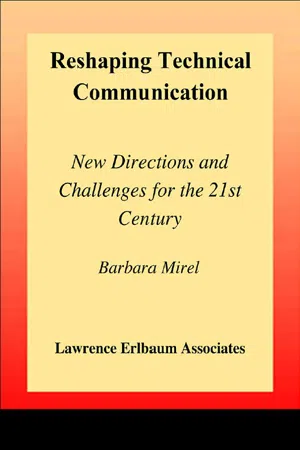
Reshaping Technical Communication
New Directions and Challenges for the 21st Century
- 234 pages
- English
- ePUB (mobile friendly)
- Available on iOS & Android
eBook - ePub
Reshaping Technical Communication
New Directions and Challenges for the 21st Century
About this book
Information
P A R T
I
REVISING INDUSTRY AND ACADEMIA:
CULTURES AND RELATIONSHIPS
As we look forward to the next few decades, the relationship between academic and industry specialists is just one of many ingredients of growth and development in technical communication. However, it is an important one because professionals from both worlds contribute to the substance and identity that technical communicators hold dear within the field and in the outside world. Part I reveals explicit or subtle ways in which the two worlds can earn each other’s respect and overcome cultural divisions in order to identify and accomplish shared goals.
In examining academic–industry relationships, the Part I contributors focus on complex differences and similarities. They argue that academic and industry specialists need to overcome serious barriers before agreeing on common goals and creating powerful allegiances. With this challenge in mind, the contributors explore such questions as these:
- What can be done to overcome cultural barriers between academic and industry worlds, and between the various worlds within industry?
- What might broad coalitions do to improve workplace practice from the technical communication perspective?
- How can academic and industry researchers ensure that empirical results from studies in both worlds will be relevant and of value to each world?
- How can academic and industry specialists reach a consensus perspective, and then strengthen their (united) voice in all stages of work life in workplace contexts?
Contrary to current threads of thought in the field, the Part I authors contend that professionals in academia and industry need to go beyond traditional solutions for easing tensions, improving dialogues, building bridges, and strengthening bonds between the two worlds. These solutions have included research projects, consulting, student and faculty internships, advisory boards, and service learning. In Part I, a strong theme is that strengthening the academic–industry relationship and elevating the status, influence, and value of the technical communication profession will require solutions that are more ambitious, broader in scope, and farther reaching. Toward that end, each contributor to Part I proposes conditions for accommodating more dynamic and flexible academic and industry contributions to training, research, and practice.
The first few Part I contributors expose prevalent stereotypes in the field about academics and practitioners. Stanley Dicks identifies primary cultural differences between the two worlds that have led to false, stereotypical impressions of each other. These differences, Dicks argues, have also had the unfortunate effect of discouraging or defeating many attempts at academic–practitioner collaboration. Dicks ties this absence or curtailment of collaboration to differences in the two worlds’ perceptions of information, language and discourse styles, views of collaborative versus individual efforts, assumptions about employment, and reward structures. Dicks hopes that once technical communicators become aware of potential cultural differences, they can use that knowledge to prevent or overcome breakdowns in communication, understanding, and collaboration.
For Dicks, the most effective kind of academic–industry collaboration is one that “transgresses fewer of the cultural divides.” For example, one reason that internships, usability testing, and industry visits to classrooms have been so successful is that these types of collaboration are short term, mutually beneficial, and do not challenge “either culture’s basic principles.” In contrast, lengthier projects that provide no short-term benefits and require more project management and communication are more challenging in terms of averting conflict. Dicks explains that for broad-scale types of academic-industry collaboration to succeed, it helps to define expectations and outcomes from the beginning, including which outcomes will be considered proprietary and which can be published, and to decide, right from the start, commitments of resources, people, time, and finances. By identifying, from the onset of joint projects, possible cultural impediments to successful collaboration, collaborators across worlds may develop strategies accordingly and increase the chances of a project’s success.
In contrast to Dicks’ emphasis on differences, the next two chapters focus on similarities and areas of overlap between academia and industry that offer benefits we often overlook. Deborah Bosley contends that dwelling on differences between academics and practitioners can thwart successful collaborations and partnerships between the worlds. From an academic point of view, Bosley worries that technical communication specialists in the university may hold traditional assumptions about differences that “in unproductive ways” keep them from disseminating their research to industry.
Bosley proposes that academics hoping to extend their influence beyond the university first identify common ground between academic and industry work environments, work practices, and writing habits and products. Then they need to make perceptual and behavioral changes in how they define themselves and do their work. For example, Bosley suggests that academics define themselves not just as teachers and researchers, but also as practitioners, as technical communicators who can work on documents and communication projects within both university and local communities. Doing so may increase the status and value of academics and help them earn the respect of practitioners. Bosley also urges a change in publication habits. She foreshadows Karen Schriver’s chapter in Part II by proposing a more expansive dissemination of research findings. Instead of reporting research findings primarily in academic journals, academics need to consider practical applications of their findings and disseminate those in publications that are accessible to a practitioner audience. Bosley concludes, “It is only through this kind of recognition—that each community has something to offer the other—that technical communicators will truly respect each other and want to collaborate and partner together for life-long learning.”
Continuing Bosley’s emphasis on similarities between academia and industry, Ann Blakeslee makes a case for shifting the focus of our research to the “overlapping space” between academia and industry. As Blakeslee puts it, this “overlapping” or “boundary space” between the two domains “suggests an area in which language, rhetorical aims, and work processes might be held in common.” In this space, dialogues between academics and practitioners may occur that generate richer and deeper understandings, leading to joint discoveries of shared goals and new means for mutually achieving them. Blakeslee urges a program of academic research to help the field identify, study, and understand the traits and workings of a “common ground” with this generative potential. She provides us with a look at what this kind of research might involve by describing projects that she conducted on classroom–industry collaborations at two universities. Blakeslee’s post hoc analysis of these projects reveals new approaches that researchers who study industry–academic collaborations can take in order to uncover subtle yet crucial new ground—overlapping spaces—for mutual support and advancement. These new approaches involve highlighting and negotiating the social and political dimensions of the communications and “deliverables” that are exchanged among students, teachers, and industry sponsors.
From her two case studies, Blakeslee illustrates ways in which nuanced differences between each world’s genres of project communications are likely to impede the two worlds from working together productively to create innovative products. To achieve project processes and dialogues that enhance joint goals and mutual support, Blakeslee recommends more research on classroom–industry projects directed toward discovering new knowledge of genres and toward mutually negotiating genres across worlds. What is gained from this kind of research is a richer appreciation of the subtleties and complexities of technical communication, including the social and political dynamics that play out and affect products.
In the next chapter, Anthony Paré illustrates how a participatory-action approach to research also has great promise in deepening the field’s understanding of writing in particular social contexts. Paré describes how, after 15 years of teaching, training, research, and consulting work, he discovered that he could claim just modest success in influencing workplace practice. As he puts it, “Nothing changed as a result of my work.” The reason was that his teaching or training was done at a distance from the social contexts that concerned his inquiry. Paré sought to “acknowledge the [social] embeddedness of workplace writing—indeed, to exploit it” by conducting participatory-action research, in which participants “set the research agenda, participate in data collection and analysis, and exercise control over the whole research process.” Paré describes one such project in which he asked Inuit social workers in northern Canada to define the problems of their field. According to Paré, this type of research, by allowing the social workers to create their own power, led to a far more complex and rich understanding of workplace writing than the social workers or researchers could have otherwise achieved. As he puts it, participatory-action research “made it possible for all of us as a group to negotiate a space between cultures, a space where teaching and learning were the natural outcomes of a common and collective need to know, and there the roles of teacher and student were constantly interchanged. In the process, we were all transformed.”
Just as Blakeslee and Paré propose new, more expansive types of research that aim, at least partly, to facilitate greater understanding between academics and practitioners, Stephen Bernhardt focuses his chapter on describing a more dynamic type of collaboration that has the potential to dramatically strengthen two-way bonds between academia and industry. Bernhardt echoes Dicks’s sensitivity to cultural differences between academics and practitioners. He sees valid reasons for the two worlds to remain separate in many goals and practices. Instead of achieving a complete unification of the two worlds, Bernhardt advocates what he calls “shared communities of practice involving frequent, active, project-based cooperation.” He argues that only by working together through project-based activities will academics and practitioners develop the knowledge and concern about each other necessary for successful collaborations toward shared goals. Bernhardt calls this active-practice, which he defines as the creation of productive tension between academia and industry. For example, while practitioners spend time on campus, teaching and working with students, faculty and students can spend time in workplace jobs. Together, practitioners and academics can combine their expertise as they collaborate on research projects. The result, according to Bernhardt, would be significant: “a tempering of distant, academic critical posturing and industry skepticism, together with a recovery of relevance and understanding across the divide.”
One concern surfaces from all chapters in Part I combined: What is the most inspiring metaphor for referring to goals that the profession needs to pursue regarding academic–industry relationships? Should it be “building bridges,” “narrowing gaps and differences,” “meeting in overlapping spaces,” or paradoxically, “finding unity in difference?” Contributors to Part I show that quick and easy answers to this issue do not exist, because academic–industry relationships are enormously complex.
Perhaps most centrally, Part I argues that whether the academic–industry relationship is a gap or not is less a concern than whether these two worlds can find ways to pull together toward the common goal of improving the field. According to Part I contributors, there is value in developing our knowledge of both differences and similarities between academia and industry, and then in using that knowledge to find more innovative, expansive ways to unite the two worlds. Doing so would help all technical communicators work together, as a unit, both toward internal goals such as improving research, theory, practice, and training, and toward external outreach efforts such as finding ways to increase their status, value, respect, and influence in workplace contexts. Consistent with a key purpose of the anthology as a whole, the Part I chapters aim to extend our thinking about the future of our field, and to develop a more expansive vision of how academics and industry specialists in our field might benefit from working together, instead of apart, to identify and then pursue goals that both worlds have in common.
CHAPTER
1
Cultural Impediments to Understanding:
Are They Surmountable?
R. STANLEY DICKS
North Carolina State University
Collaboration between academics and practitioners in technical communication is essential to both groups. Academic programs in technical communication came into existence because of the needs of business and government for competent communicators with the special knowledge and skill sets required to produce technical documents of high quality. Those programs, in a real sense, depend for their existence on continuing to meet the needs of the “work world.” To ensure that their programs continue to meet such needs, academics must continue to communicate with and collaborate with practitioners. In turn, business badly needs to hire technical communicators trained in the special requirements of audience-centered writing as opposed to the journalistic and expository writing instruction received in more traditional writing programs. Corporate and government entities, which face a constant shortage of qualified, competent communicators, must rely on academic programs to help supply enough such practitioners. In addition, to improve the quality of their work, practicing technical communicators need to interact continuously with academics to remain informed of the results of academic inquiry and research into appropriate principles and practices (Tebeaux, 1996).
Although both groups benefit greatly when they interact and collaborate effectively, many cultural differences between academia and business thwart collaboration efforts. From 13 years in academia and 16 years as a practicing technical communicator in industry, I have seen how those differences can discourage or defeat what would otherwise be mutually beneficial collaborations. I have seen groups decide not to collaborate because they could not agree on whether to publish the results. I have seen pote...
Table of contents
- COVER PAGE
- TITLE PAGE
- COPYRIGHT PAGE
- FOREWORD
- PREFACE
- INTRODUCTION
- PART I: REVISING INDUSTRY AND ACADEMIA: CULTURES AND RELATIONSHIPS
- PART II: RE-ENVISIONING THE PROFESSION
- APPENDIX: PROPOSED RESEARCH AGENDA FOR TECHNICAL COMMUNICATION
- ABOUT THE CONTRIBUTORS
Trusted by 375,005 students
Access to over 1.5 million titles for a fair monthly price.
Study more efficiently using our study tools.
Frequently asked questions
Yes, you can cancel anytime from the Subscription tab in your account settings on the Perlego website. Your subscription will stay active until the end of your current billing period. Learn how to cancel your subscription
No, books cannot be downloaded as external files, such as PDFs, for use outside of Perlego. However, you can download books within the Perlego app for offline reading on mobile or tablet. Learn how to download books offline
Perlego offers two plans: Essential and Complete
- Essential is ideal for learners and professionals who enjoy exploring a wide range of subjects. Access the Essential Library with 800,000+ trusted titles and best-sellers across business, personal growth, and the humanities. Includes unlimited reading time and Standard Read Aloud voice.
- Complete: Perfect for advanced learners and researchers needing full, unrestricted access. Unlock 1.5M+ books across hundreds of subjects, including academic and specialized titles. The Complete Plan also includes advanced features like Premium Read Aloud and Research Assistant.
We are an online textbook subscription service, where you can get access to an entire online library for less than the price of a single book per month. With over 1.5 million books across 990+ topics, we’ve got you covered! Learn about our mission
Look out for the read-aloud symbol on your next book to see if you can listen to it. The read-aloud tool reads text aloud for you, highlighting the text as it is being read. You can pause it, speed it up and slow it down. Learn more about Read Aloud
Yes! You can use the Perlego app on both iOS and Android devices to read anytime, anywhere — even offline. Perfect for commutes or when you’re on the go.
Please note we cannot support devices running on iOS 13 and Android 7 or earlier. Learn more about using the app
Please note we cannot support devices running on iOS 13 and Android 7 or earlier. Learn more about using the app
Yes, you can access Reshaping Technical Communication by Barbara Mirel, Rachel Spilka, Barbara Mirel,Rachel Spilka in PDF and/or ePUB format, as well as other popular books in Computer Science & Leadership. We have over 1.5 million books available in our catalogue for you to explore.