Although computational modeling is now a widespread technique in cognitive science and in psychology, relatively little work in developmental psychology has used this technique. The approach is not entirely new, as a small group of researchers has attempted to create computational accounts of cognitive developmental phenomena since the inception of the technique. It should seem obvious that transition mechanisms -- or how the system progresses from one level of competence to the next -- ought to be the central question for investigation in cognitive developmental psychology. Yet, if one scans the literature of modern developmental studies, it appears that the question has been all but ignored.
However, only recently have advances in computational technology enabled the researcher access to fully self-modifying computer languages capable of simulating cognitive change. By the beginning of the 1990s, increasing numbers of researchers in the cognitive sciences were of the opinion that the tools of mathematical modeling and computer simulation make theorizing about transition mechanisms both practical and beneficial -- by using both traditional symbolic computational systems and parallel distributed processing or connectionist approaches. Computational models make it possible to define the processes that lead to a system being transformed under environmental influence from one level of competence observed in children to the next most sophisticated level. By coding computational models into simulations of actual cognitive change, they become tangible entities that are accessible to systematic study.
Unfortunately, little of what has been produced has been published in journals or books where many professionals would easily find them. Feeling that developmental psychologists should be exposed to this relatively new approach, a symposium was organized at the biennial meeting of the Society for Research in Child Development. The "cost of entry" was that speakers had to have a running computational model of a documented cognitive transition. Inspired by that conference, this volume is the first collection where each content chapter presents a fully implemented, self-modifying simulation of some aspect of cognitive development. Previous collections have tended to discuss general approaches -- less than fully implemented models -- or non self-modifying models. Along with introductory and review chapters, this volume presents a set of truly "developmental" computational models -- a collection that can inform the interested researcher as well as form the basis for graduate-level courses.
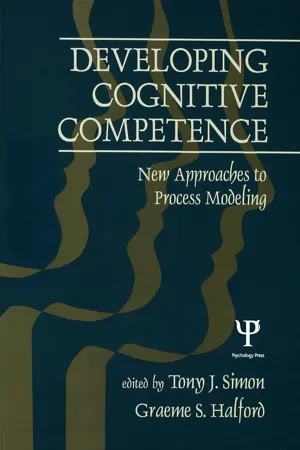
eBook - ePub
Developing Cognitive Competence
New Approaches To Process Modeling
- 408 pages
- English
- ePUB (mobile friendly)
- Available on iOS & Android
eBook - ePub
Developing Cognitive Competence
New Approaches To Process Modeling
About this book
Information
Publisher
Psychology PressYear
2015Print ISBN
9780805819984
9780805812893
Edition
1eBook ISBN
9781317717010
Table of contents
- Cover
- Title
- Copyright
- Dedication
- Contents
- Preface
- 1 Computational Models and Cognitive Change
- 2 Variation, Selection, and Cognitive Change
- 3 Modeling the Development of Reasoning Strategies: The Roles of Analogy, Knowledge, and Capacity
- 4 A Connectionist Perspective on Knowledge and Development
- 5 Modeling Cognitive Development With a Generative Connectionist Algorithm
- 6 Two Forces in the Development of Relational Similarity
- 7 A Computational Theory of Children's Learning About Number Conservation
- 8 Computational Models of Cognitive Change: The State of the Art
- Author Index
- Subject Index
Trusted by 375,005 students
Access to over 1.5 million titles for a fair monthly price.
Study more efficiently using our study tools.
Frequently asked questions
Yes, you can cancel anytime from the Subscription tab in your account settings on the Perlego website. Your subscription will stay active until the end of your current billing period. Learn how to cancel your subscription
No, books cannot be downloaded as external files, such as PDFs, for use outside of Perlego. However, you can download books within the Perlego app for offline reading on mobile or tablet. Learn how to download books offline
Perlego offers two plans: Essential and Complete
- Essential is ideal for learners and professionals who enjoy exploring a wide range of subjects. Access the Essential Library with 800,000+ trusted titles and best-sellers across business, personal growth, and the humanities. Includes unlimited reading time and Standard Read Aloud voice.
- Complete: Perfect for advanced learners and researchers needing full, unrestricted access. Unlock 1.5M+ books across hundreds of subjects, including academic and specialized titles. The Complete Plan also includes advanced features like Premium Read Aloud and Research Assistant.
We are an online textbook subscription service, where you can get access to an entire online library for less than the price of a single book per month. With over 1.5 million books across 990+ topics, we’ve got you covered! Learn about our mission
Look out for the read-aloud symbol on your next book to see if you can listen to it. The read-aloud tool reads text aloud for you, highlighting the text as it is being read. You can pause it, speed it up and slow it down. Learn more about Read Aloud
Yes! You can use the Perlego app on both iOS and Android devices to read anytime, anywhere — even offline. Perfect for commutes or when you’re on the go.
Please note we cannot support devices running on iOS 13 and Android 7 or earlier. Learn more about using the app
Please note we cannot support devices running on iOS 13 and Android 7 or earlier. Learn more about using the app
Yes, you can access Developing Cognitive Competence by Tony J. Simon, Graeme S. Halford, Tony J. Simon,Graeme S. Halford in PDF and/or ePUB format, as well as other popular books in Psychology & Developmental Psychology. We have over 1.5 million books available in our catalogue for you to explore.