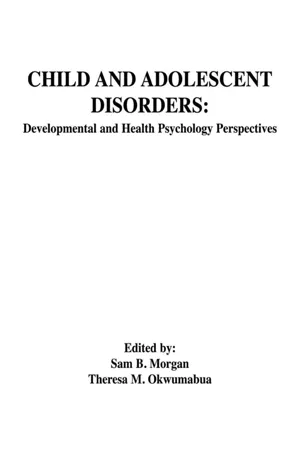
This book offers empirically based approaches to assessment, treatment, and prevention of certain childhood disorders encountered by psychologists and other practitioners in child clinical and pediatric psychology settings. In so doing, it views disorders from a developmental and health psychology perspective that emphasizes prevention of problems as well as positive coping strategies. Traditional topics such as autism and childhood depression are addressed, as are topics that have only recently emerged in the psychological literature. These include childhood diabetes, headaches, psychological aspects of teenage pregnancy, and early development of substance abuse.
eBook - ePub
Child and Adolescent Disorders
Developmental and Health Psychology Perspectives
- 476 pages
- English
- ePUB (mobile friendly)
- Available on iOS & Android
eBook - ePub
Child and Adolescent Disorders
Developmental and Health Psychology Perspectives
About this book
Information
Publisher
Psychology PressYear
2014Print ISBN
9781138970281
9780805805147
Edition
1eBook ISBN
9781317784302
I Behavioral and Developmental Disorders
This section considers child disorders that traditionally have been the concern of the child clinical psychologist but continue to evoke substantial clinical and research interest and controversy. Chapter 1 deals with childhood autism, which still is the most perplexing and developmentally complicated of all childhood disorders as well as perhaps the most frustrating to child clinicians in their treatment efforts. Although most evidence seems to favor biogenic over psychogenic hypotheses, the underlying causal mechanisms still remain a mystery. Despite the etiological uncertainty, much has been learned in recent years about the features and developmental course of the disorder. Moreover, although no cure has been found, certain interventions have been demonstrated to be more effective than others in enhancing the adaptation of the autistic individual to the world. Morgan reviews the changes in definitions of autism from Kanner’s original formulation to currently accepted developmental conceptions and also considers the topics of etiology, diagnostic assessment, intervention, and long-term adjustment of autistic individuals.
In Chapter 2, Houts and Abramson deal with functional childhood enuresis and encopresis, two disorders that traditionally have been treated by medical professionals. However, as these authors note, psychologists have developed some of the most promising treatments for these disorders, and further advances will require increased cooperation between psychologists and physicians. The authors provide a comprehensive review of enuresis and encopresis in terms of definition, epidemiology, etiology, assessment, and outcomes of different treatments. While offering an up-to-date evaluation of different enuresis treatments, including medical approaches, their chapter represents one of the first attempts to synthesize the results of research on encopresis treatments, which have just begun to receive the scientific scrutiny that enuresis treatments have undergone for a number of years.
Chapter 3, by Schleser, Armstrong, and Allen, considers a disorder that has engendered a voluminous research literature and still remains controversial with respect to etiology and treatment. After critically reviewing the literature on prevalence, etiological models, assessment strategies, and treatment approaches for Attention Deficit-Hyperactive Disorder (ADHD), these authors offer an innovative model for conceptualizing and treating ADHD. The model, which stresses the role of the ecological context in which children are labeled and treated, would lead to interventions that facilitate the natural development of adaptive behaviors in the ADHD child within everyday learning environments. As preliminary support for this model, the authors present results of their intervention research using classroom teachers as the primary treatment resource for the ADHD child.
The final chapter of this section deals with childhood depression, a disorder that was given scant attention in the clinical and research literature until the 1980s. Before the recent emergence of more developmental views of child and adolescent depression, many writers considered childhood depression to be virtually non-existent or to be an isomorphic, downward extension of adult depression. Finch, Casat, and Carey review traditional conceptions of child and adolescent depression as well as recently emerging developmental views that consider childhood depression to be distinct from adult depression. These authors discuss the inconsistent diagnostic criteria which, in turn, have led to problems in accurately estimating the incidence of childhood depression. After thoroughly evaluating the different methods used in assessment of child and adolescent depression, the chapter considers treatment approaches based on biological and psychosocial models.
1
Early Childhood Autism: Current Perspectives on Definition, Assessment, and Treatment
Memphis State University
In October 1938, the 5-year-old son of a lawyer from a small Mississippi town was brought to Leo Kanner, director of the Child Psychiatry Clinic at Johns Hopkins Hospital. The youngster, Donald, presented a paradoxical set of symptoms that Kanner had never seen before. He appeared to be in his own world and acted as if people did not exist. Although he demonstrated an amazing store of verbal knowledge, he could not carry on a normal conversation. From the time he was 2 1/2 years of age, he could accurately recite Psalm 23, the names of all presidents and vice-presidents of the United States, and the alphabet both forward and backward; he could hum or sing many tunes precisely. He showed a fascination with blocks, pans, and other round objects, spinning them deftly and preferring them to people. He revealed an uncanny memory in reproducing exact spatial arrangements of objects and was upset with minute changes in environmental stimuli or daily routine. He rarely spoke to anyone, but when he did, he referred to himself as “you” and to the person addressed as “I” (Kanner, 1943).
By 1943, Kanner had seen 10 more children who presented a behavioral pattern strikingly similar to that shown by Donald. That year he published his now-classic article that first described these children and proposed that their symptoms constituted a rare behavior disorder (Kanner, 1943); the following year he labeled the disorder early infantile autism (Kanner, 1944). He chose the term autism, derived from the Greek word meaning self, to denote the self-contained, or autistic existence of these children. He used the term early infantile because the disturbance seemed to exist from early infancy on. Since Kanner’s original article, there have been reports of children who do not clearly reveal signs of autism during infancy but later show all of the symptoms (Ornitz & Ritvo, 1976). For this reason, the term early childhood autism has emerged and is considered by some researchers to be more accurate than Kanner’s term.
Early childhood autism is not a prevalent disorder, although it is not as rare as it once was thought to be. Because definitions of the disorder have varied, estimates of incidence have also varied. If Kanner’s (1944) original definition is used, only about 1 child in 10,000 would meet the criteria; with more current definitions, such as those adopted by the National Society for Autistic Children (Ritvo & Freeman, 1977) and the American Psychiatric Association (1987), as many as 5 children in 10,000 may be called autistic. For reasons still unknown, autism afflicts about four times as many boys as girls (Rutter, 1985).
Since Kanner (1943, 1944) defined it as a unique disorder, autism has stirred an interest and controversy that is seemingly out of proportion to its somewhat low incidence in the population. Autistic children have been the subject of widespread study and debate in professional and scientific circles. In fact, a scientific journal, the Journal of Autism and Childhood Schizophrenia, was founded in 1971 primarily for the purpose of publishing articles and research on autism and related disorders. (In 1979 the name of this publication was changed to the Journal of Autism and Developmental Disorders.) The autistic child and adult have also caught the public eye through articles in the press and popular magazines, television documentaries and dramas, and the recent movie Rain Man starring Dustin Hoffman.
Why all this interest in this somewhat rare disorder? There are several reasons that may account for it. First, autistic children present an array of features that are naturally intriguing to both lay and professional observers. They show paradoxes in appearance and behavior that evoke curiosity and challenge understanding. They are usually attractive, well-formed children whose contemplative expressions often give the impression of intelligence or even precocity. Yet, in most cases, they are markedly impaired in social development and adaptive skills.
Second, autistic children present to parents and professionals urgent and disturbing problems in behavior and relationships. The child’s detached, disruptive, and inexplicable behavior is so much more demanding than that of the normal child, or even the retarded child, that it usually consumes the concentration and energy of his or her parents. Perhaps the most unsettling of these problems in the parents’ eyes is the child’s failure to form normal personal attachments and relationships. As a result of these special problems, an exceptionally large number of books have been written by parents of autistic children, such as Josh Greenfeld’s A Child Called Noah (1972) and A Place for Noah (1978), Barry Kaufman’s Sonrise (1976), and Clara Park’s The Siege (1967, 1982). Parents, led by Bernard Rimland, were also instrumental in founding in 1965 the National Society for Autistic Children (now called the Autism Society of America). This organization has brought autism to the public’s attention and has aggressively pursued educational and treatment programs designed specifically for autistic children.
A third reason for this great interest, a reason that transcends the intriguing and disturbing behavior of the autistic child, relates to the salient role that autism has played and continues to play in our theories and research in child development and psychopathology. Because autism represents the most severe social and behavioral disorder of childhood, it has assumed a pivotal role in the controversy over psychogenesis versus biogenesis in the etiology of childhood disorders (Bettelheim, 1967; Rimland, 1964). Moreover, because the social behaviors that develop so naturally in most children are missing in the autistic child, a better understanding of the mechanisms underlying the development of autism should, in turn, shed light on the mechanisms underlying normal social development.
Because of this broad interest in autism, the cumulative clinical and research literature on the topic has now reached massive proportions. Within the limited scope of this book chapter, I can only hope to provide a selective review of certain areas that I consider important to students and practitioners in the child clinical area. The specific topics that I address are (a) evolution of the definition of autism from Kanner’s original formulation to current conceptions, (b) cognitive impairment in autism, (c) etiology of autism, (d) diagnostic assessment of autistic children, (e) intervention with autistic children and their families, and (f) long-term adjustment of autistic individuals.
EVOLUTION OF THE DEFINITION OF AUTISM
Kanner’s Syndrome
From his observation of the 11 children on whom his original articles were based, Kanner (1943, 1944, 1949) outlined five major symptoms as composing the syndrome of early infantile autism. The first was the inability of these children to relate normally to people and situations from the start of life. The parents reported that, as infants, their children had failed to assume an anticipatory posture before being picked up and never cuddled as does the normal child. Throughout infancy and childhood they maintained what Kanner called “autistic aloneness,” forming no apparent attachments to people and seeming to live in their own world as if others did not exist.
Kanner’s second feature was described as “an anxiously obsessive desire for the maintenance of sameness” (1943, p. 245). The children seemed finely tuned to nuances of order in the environment and rigidly resisted the slightest changes in patterns and routines. For instance, a walk had to follow an identical course from day to day; bedtime had to comprise a particular set of rituals each night, and so on. The children absorbed themselves with repetitive activities such as spinning objects and turning light switches on and off. Interference with their ritualized patterns of life provoked anger or acute panic.
The third characteristic Kanner noted was these children’s failure to use language for purposes of communication. In 3 of the 11 cases, speech failed to develop altogether. The other 8 showed precocious development of speech, which combined with an exceptional rote memory to produce a repertoire of rhymes, catechisms, names, and numbers that were uttered with no apparent comprehension. The children spoke in mechanical fashion and appeared unable to convey meaning or feelings to others. Two prominent features of their speech were delayed echolalia (the repeating of stored phrases) and pronoun reversal, referring to themselves as “you” and “he or she” rather than “I” or “me.”
Kanner’s fourth characteristic was the child’s fascination with objects and an ability to handle them with dexterity. Especially preferred were objects that could be arranged in certain patterns and manipulated in sterotypic fashion. For example, a child might spend hours spinning jar lids or forming patterns with blocks. The fifth feature was the apparent “good cognitive potentialities” of these children as inferred from their isolated abilities. In the mute children, ability was discerned from their facility on performance tests such as the Seguin formboard. Among the speaking children, ability was inferred from their precocious, if bizarre, use of language and their unusual memory.
Although Kanner included all of these symptoms in the syndrome, he did not assign them equal significance for autism. He considered the social isolation and need for sameness as primary and the cognitive and motor features as secondary. He also assumed that autistic children were basically normal in intelligence and that their low adaptive functioning was secondary to the failure to form social relationships.
Recent Shifts in Conceptions of Autism
In the two decades or so following Kanner’s original formulation of the autistic syndrome, autism was regarded by many professionals as a psychogenic emotional disorder associated with secondary cognitive dysfunction (Bettelheim, 1967). During recent years, however, some substantial changes in thinking have emerged that cast a different light on the cause and basic nature of the disorder.
First, an accumulating body of evidence has supported autism more as a biogenic than psychogenic disorder, that is, autism has been found to be more consistently associated with organic than psychosocial variables (DeMyer, Hingtgen, & Jackson, 1981; Piggott, 1979; Rutter & Schopler, 1987). Second, autism is being viewed more as a developmental than an emotional disorder. In the most recent revisions of the Diagnostic and Statistical Manual of Mental Disorders (DSM-III) of the American Psychiatric Association (1980, 1987), autism is categorized as a pervasive developmental disorder, a term that replaces the previously used terms, childhood psychosis and childhood schizophrenia. As Rutter and Schopler (1987) have noted, the adoption of this term is significant because it highlights the developmental aspects of the anomalies in autism and separates it from mental illnesses of adult life. The adjective “pervasive” stresses the broad distortion of development in several areas, including cognition, socialization, and communication, as opposed to the restricted deficits found in specific developmental disorders (e. g., specific language disorder). Further, the U.S. Office of Special Education moved autism from the “severely emotionally disturbed” category to a separate category (National Society for Autistic Children, 1980). Also reflecting the growing developmental emphasis was the 1979 change in title of the Journal of Autism and Childhood Schizophrenia to the Journal of Autism and Developmental Disorders. Third, research findings have suggested more and more that cognitive impairment plays a central role in autism and may account for many of the social and emotional deficits (DeMyer et al., 1981; Morgan, 1984a).
Despite these recent changes in thinking about autism, Kanner’s original behavioral syndrome has survived in fairly intact form. The definitional changes that have evolved relate more to Kanner’s inferences about the disorder than to his actual description of behavior. The major modification, based on long-term research with ...
Table of contents
- Cover Page
- Half Title page
- Title Page
- Copyright Page
- Contents
- List of Contributors
- Preface
- I Behavioral and Developmental Disorders
- II Physical and Health-Related Disorders
- III Special Problems of Children and Adolescents
- Author Index
- Subject Index
Trusted by 375,005 students
Access to over 1.5 million titles for a fair monthly price.
Study more efficiently using our study tools.
Frequently asked questions
Yes, you can cancel anytime from the Subscription tab in your account settings on the Perlego website. Your subscription will stay active until the end of your current billing period. Learn how to cancel your subscription
No, books cannot be downloaded as external files, such as PDFs, for use outside of Perlego. However, you can download books within the Perlego app for offline reading on mobile or tablet. Learn how to download books offline
Perlego offers two plans: Essential and Complete
- Essential is ideal for learners and professionals who enjoy exploring a wide range of subjects. Access the Essential Library with 800,000+ trusted titles and best-sellers across business, personal growth, and the humanities. Includes unlimited reading time and Standard Read Aloud voice.
- Complete: Perfect for advanced learners and researchers needing full, unrestricted access. Unlock 1.5M+ books across hundreds of subjects, including academic and specialized titles. The Complete Plan also includes advanced features like Premium Read Aloud and Research Assistant.
We are an online textbook subscription service, where you can get access to an entire online library for less than the price of a single book per month. With over 1.5 million books across 990+ topics, we’ve got you covered! Learn about our mission
Look out for the read-aloud symbol on your next book to see if you can listen to it. The read-aloud tool reads text aloud for you, highlighting the text as it is being read. You can pause it, speed it up and slow it down. Learn more about Read Aloud
Yes! You can use the Perlego app on both iOS and Android devices to read anytime, anywhere — even offline. Perfect for commutes or when you’re on the go.
Please note we cannot support devices running on iOS 13 and Android 7 or earlier. Learn more about using the app
Please note we cannot support devices running on iOS 13 and Android 7 or earlier. Learn more about using the app
Yes, you can access Child and Adolescent Disorders by Sam B. Morgan,Theresa M. Okwumabua,Sam Morgan in PDF and/or ePUB format, as well as other popular books in Psychology & Developmental Psychology. We have over 1.5 million books available in our catalogue for you to explore.