- 288 pages
- English
- ePUB (mobile friendly)
- Available on iOS & Android
eBook - ePub
About this book
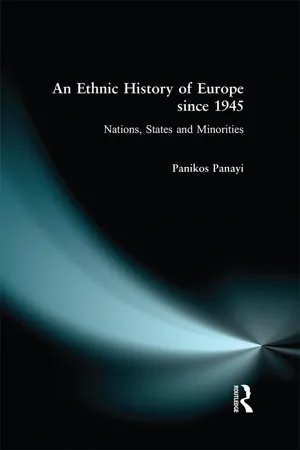
The first history of Europe since 1945 which examines the continent from a mainly ethnic perspective, Panikos Panayi has drawn on years of research to produce this comparative and exploratory account of the experience of ethnic minorities in post-war Europe. The coverage encompasses all categories of minorities including immigrants and refugees, localised ethnic groupings and dispersed peoples. Geographically, the scope of the book ranges from the Atlantic to the Urals and the Mediterranean to the Arctic, looking in particular at the Soviet Union, Britain, France, Germany, Romania, Cyprus and the former Yugoslavia.
Table 1
TABLE 1 CONTEMPORARY EUROPEAN STATES WITH THEIR SIGNIFICANT MINORITIES SINCE 1945


Section One
Introduction
Chapter 1
Minorities in European History
The Underlying Concepts
In 1945 Europe emerged torn apart by a war in which ethnic, national and racial differences had determined allies and enemies. Superficially, the following five decades of European history appear to represent an attempt to heal the wounds of centuries of conflict. In reality, ethnic differences have continued to perform a fundamental role in the development of all nation states and systems of government within Europe, in societies in which origin plays a central role in determining which individuals obtain economic and political rewards. Despite this, and despite the countless studies of countless minorities in numerous countries throughout Europe, no book by a single author has attempted to examine the European ethnic mosaic since the end of the Second World War. The present volume is therefore the first attempt by an individual author to rectify this situation. Its geographical scope ranges from Scandinavia to Turkey, and from Great Britain to the Soviet Union. The approach is thematic, with examples introduced to illustrate the areas covered by the three core sections of the book: it will not examine every minority in every nation state. Instead, it focuses upon those countries with the largest populations, including the Soviet Union, Britain, France and Germany, as well as those with the most obvious ethnic problems, which, in addition to the above, include Romania, Yugoslavia and Cyprus. However, hardly any country is ignored and the book is certainly not a study simply of those seven states. Attention will focus upon all categories of minorities including immigrants and refugees, localised ethnic groupings, and dispersed peoples.
The central theme of the book is the relationship between nation states and minorities which do not form part of the dominant ethnic grouping. All periods of human history have almost certainly witnessed intolerance by one group of people towards another, justified by the concept of superiority even in pre-literate cultures. The age of nationalism, both before and after the Second World War, fits into this historical pattern.
The present study will use throughout a series of terms which need defining at the outset. The most important of these words consist of: ethnicity, nation, nationalism, nation state and minority. Each of these terms has a very precise meaning, which have become confused in recent decades by over-use in the media and social science discourse.
Whether they like it or not, all individuals in Europe have some sort of ethnic identification. So what does 'ethnic' mean? The correct meaning is indicated by the origins of the term. It comes from the Greek word, ethnos, which simply means 'nation'. The full significance of this fact is that no difference exists between an ethnic group and a nation, in the true sense of the meaning of the latter word, applying to a group of people with shared characteristics. This relates equally to majorities and minorities.
The shared characteristics cover one or more of the following areas: appearance, language and religion. Appearance represents the most controversial signifier of difference, usually referring, at a fundamental level, to physiognomy or skin colour – although this does not mean, for instance, that all black or Asian people constitute the same ethnic group. Appearance of groups also manifests itself in other ways, notably dress, which especially distinguishes particular groups of post-War immigrants. Food, which can be regarded as another aspect of appearance, also differentiates one ethnic group from another. Appearance, encompassing dress and food, represents a basis for difference, but the last two are not built upon to any great extent by ethnic ideologues.
However, this cannot be said to hold true of language, perhaps the most important basis for the development of political ethnicity. Nevertheless, we need to recognise the fact that all modern literary languages are artificial constructs of modernity. Pre-literate societies communicate in dialects which thousands rather than millions of people speak. The act of creating a literary language in a particular area destroys the sum of its parts. Such an action represents a move towards a politically based ethnicity because no group can regard itself as a nation unless it possesses its own language.
While language is central to the claim of most ethnic groups which wish to describe themselves as distinct entities, religion is only slightly less important. Attending a religious service in many parts of Europe today is the most important way for members of some groups to display their difference from the dominant population in the state in which they live. Clearly, religion is just as important for majorities as minorities, with Eastern Orthodoxism, Roman Catholicism and various forms of Protestantism forming a basis of majority ethnicity throughout Europe.
The above differences merely form the basis of ethnicity, which becomes conscious when members of a particular minority face threats from an expanding state and its nationalist ideology. In this situation, leaders of a group of people develop a political consciousness, based upon a combination of the differences outlined above. In essence, ethnicity is a political ideology which revolves around one or more of the factors of appearance, language and religion.1
1 A fuller explanation of ethnicity can be found in Chapters 4 and 5.
Ethnicity is essentially a reaction against nationalism, but it also represents its basis. The latter ideology has evolved in Europe during the past two centuries. Before the nineteenth century political ideologies, revolving primarily around Christianity and kingship, acted as the basis for state authority. But, since the middle of the eighteenth century, nationalism has gradually evolved as the only legitimate form of political control. 'Received opinion holds that nationalism in the modern sense does not date back further than the revolutionary political turmoil that troubled the second half of the eighteenth century',2 meaning, of course, the American and French Revolutions.3 Nationalism has been like a Pandora's box: once opened, in 1776, the release of its US personification was followed, within the European continent – initially in the west and gradually moving eastward – by further spirits describing themselves as nationalities, so that there exist an endless number of groupings wishing to organise themselves as nation states.
2 Peter Alter, Nationalism, 2nd edn (London, 1994), p. 39.
3 But see Adrian Hastings, The Construction of Nationhood: Ethnicity, Religion and Nationalism (Cambridge, 1997), who writes of England as a nation state from the eleventh century at the latest.
Nationalism did not spring up overnight because it has ethnic origins.4 A political, social and economic transformation needs to take place in order for ethnicity to evolve into nationalism followed by a nation state. Nations and states differ and there is nothing inevitable in the existence of the nation state. In early modern Europe the main forms of political control included empires, notably the Habsburg and Ottoman, monarchical states, such as Sweden, France and England, and city states, especially in Germany and Italy. But none of these was actually a nation state. In the case of monarchical states, the monarch, rather than the people, represented the embodiment of nation and 'national historiography . . . extolled the nation in terms of its landscapes and resources rather than the character of its inhabitants'.5 Nationalism has essentially represented a transformation of the state since the eighteenth century to focus, in theory, upon the people who live within it.
4 See Anthony D. Smith, The Ethnic Origins of Nations (Oxford, 1986).
5 John Breuilly, Nationalism and the State (Manchester, 1982), p. 45.
At the end of the twentieth century the nation state 'is a construct which we now take for granted as a "natural" or eternal political state of affairs'.6 Nationalism seized control of Europe fairly rapidly so that by 1914 millions of people were prepared to die for their country. The reasons for these developments lie in a complex series of changes in Europe, affecting economy, society, politics and culture. The main social and economic change in European society during the past two centuries has clearly been the transformation of virtually the entire continent from one in which the agrarian means of production dominated to one in which industry has become central.
6 Gérard Chaliand, 'Minority Peoples in the Age of Nation States', in Chaliand (ed.), Minority Peoples in the Age of Nation States (London, 1989), p. 1.
Nationalism is usually regarded as the ideology of a growing bourgeoisie, used to di vide proletarians of one nation from those of another and therefo...
Table of contents
- Cover
- Half Title
- Title
- Copyright
- Contents
- Lists of Maps and Tables
- Acknowledgements
- Glossary and Abbreviations
- Table 1
- Section One: Introduction
- Select Bibliography
- Map 3
- Index
Trusted by 375,005 students
Access to over 1.5 million titles for a fair monthly price.
Study more efficiently using our study tools.
Frequently asked questions
Yes, you can cancel anytime from the Subscription tab in your account settings on the Perlego website. Your subscription will stay active until the end of your current billing period. Learn how to cancel your subscription
No, books cannot be downloaded as external files, such as PDFs, for use outside of Perlego. However, you can download books within the Perlego app for offline reading on mobile or tablet. Learn how to download books offline
Perlego offers two plans: Essential and Complete
- Essential is ideal for learners and professionals who enjoy exploring a wide range of subjects. Access the Essential Library with 800,000+ trusted titles and best-sellers across business, personal growth, and the humanities. Includes unlimited reading time and Standard Read Aloud voice.
- Complete: Perfect for advanced learners and researchers needing full, unrestricted access. Unlock 1.5M+ books across hundreds of subjects, including academic and specialized titles. The Complete Plan also includes advanced features like Premium Read Aloud and Research Assistant.
We are an online textbook subscription service, where you can get access to an entire online library for less than the price of a single book per month. With over 1.5 million books across 990+ topics, we’ve got you covered! Learn about our mission
Look out for the read-aloud symbol on your next book to see if you can listen to it. The read-aloud tool reads text aloud for you, highlighting the text as it is being read. You can pause it, speed it up and slow it down. Learn more about Read Aloud
Yes! You can use the Perlego app on both iOS and Android devices to read anytime, anywhere — even offline. Perfect for commutes or when you’re on the go.
Please note we cannot support devices running on iOS 13 and Android 7 or earlier. Learn more about using the app
Please note we cannot support devices running on iOS 13 and Android 7 or earlier. Learn more about using the app
Yes, you can access An Ethnic History of Europe since 1945 by Panikos Panayi in PDF and/or ePUB format, as well as other popular books in History & European History. We have over 1.5 million books available in our catalogue for you to explore.