- 616 pages
- English
- ePUB (mobile friendly)
- Available on iOS & Android
eBook - ePub
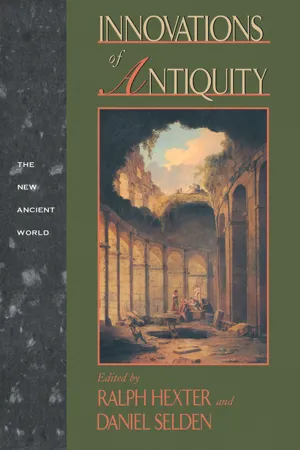
Innovations of Antiquity
About this book
A collection of essays representing the cutting edge of critical thinking in Greek and Roman literature in America today.
Information
Part One
Literariness
“The real subject of literary scholarship,” wrote Roman Jakobson in 1919, “is not literature in its totality, but literariness, in other words, that which makes a specific work a work of literature.” Aristotle was the first to distinguish poiêsis as a coherent field of investigation (peri poiêtikês autês te kai ton eidôn autês … legômen), though in his exposition literary composition takes its place as one of a number of different mimetic enterprises whose reproductions of phenomena converge jointly on the truth. These operations of resemblance, in which logos, mimesis, and alêtheia constitute one and the same possibility, are perceived by Aristotle to be proper to mankind: “imitation (to mimeisthai) is natural (sumphuton) to humans from their childhood and they differ from other living creatures in this, that man is the most mimetic (mimêtikôtaton).” If this establishes literary studies as a cornerstone of “humanism, “it also renders them ancillary to other sciences (biography, history, anthropology, metaphysics), and with rare exceptions—such as Dionysius of Halicarnassus’ On the Combination of Words—critical inquiry has preserved this hierarchy well into the modern era. Since the Enlightenment, however, and Kant in particular, aesthetic theory has begun to reclaim poetics as an autonomous discipline with methods and procedures of its own. The tendency is most explicit in the criticism of the Russian Formalists, who, at the beginning of this century, rejected the idea that literature is primarily a simulacrum of something else and turned their attention instead to those aspects of the literary text which make it different from nonliterary artifacts and other cultural phenomena. What this involved was not only a study of the linguistic and structural devices peculiar to literary compositions, but a reconceptualization of literature as a system and specific signifying practice. Mimesis no longer occupies the privileged position within literary criticism to which Aristotle had elevated it, but figures as one aspect of literariness among others which arises and develops under specific historical conditions. For the Formalists and their contemporary critical heirs, then, literary studies will no longer dovetail with history, philosophy, or the visual arts, but stand in dialectical relation to them.
The pair of essays included in this section both exemplify and complicate this turn to the distinctive features of literary texts as the proper focus of scholarship on literature. In John J. Winkler’s “Lollianos and the Desperadoes,” a debate over the interpretation of three newly discovered fragments of a hitherto unknown Greek narrative, Phoinikika, becomes an exemplary analysis of the problems of reading ancient fiction in relation to the realia of Hellenistic culture. Classical scholars have long regarded the so-called Greek “novel” or “romance” as a stepchild of the canon, or worse: a bastard or mongrel genre, vulgar, of uncertain parentage, but likely of Near Eastern origin. In the manner of the sacrificial ritual that Lollianos describes, three generations of critics have been only too happy to eviscerate these stories and, in an act of cultural haruspicy, examine their entrails for evidence of whatever social or historical material they might attest. What Winkler shows, however, is that if the rites in Lollianos’ text yield any information about ancient cult, they can do so only if rigorously analyzed as narratives. The origins of Lollianos’ scenes are to be sought not in liturgical practice or religious belief, but in popular entertainment and traveling stories whose narrative formulae and sequences were widely dispersed throughout the Mediterranean world and run through many different texts. Any reference to the codes of religion or history in the Phoinikika is not documentary, but strictly subordinate to the structure and requirements of its plot. In fact, far from providing a simple imitation or reflection of religious institutions, these literary topoi, Winkler argues, shaped not a few of the anecdotes of contemporary historians and, in a final mimetic twist, seem even to have inspired human agents to a historical enactment.
It is in large part the failure to appreciate the distinctive features of imaginative literature and to differentiate literary discourse from other modes of representation that has tended to hamstring critical understanding of the classics and allowed scholarship on ancient letters to lapse back into history, ethnography, psychology, or social science. In fact, it may well be that the principal function of literary texts is to put the relationship of language to the world of phenomena in question. This is a possibility that Anne Carson raises by returning to “Western culture’s original literary critic,” Simonides, and his efforts to define poetic composition by setting it in opposition to the mimetic achievements of the visual arts. Whereas the illusionism of fifth-century painting, celebrated by some contemporaries for its authenticity, denounced as sophistry by others, excelled at rendering the visible surface of the world (phainomena), and thereby achieved some measure of control over it, Simonides understood and practiced a literary craft that could depict the reality of imperception. As such, his poetry neither replaces nor negates appearances, but offers a counterpressure to the claims of the phenomenal by registering the lacunae and defects in our vision. It is no accident, then, that Simonides’ examples all have to do with a loss of consciousness: sleep, oblivion, incomprehension, death. Carson shows how the poet’s grammar is iconic of these gaps, and, as such, this reconfirms in an ironic mode the triadic connection of logos to mimêsis and alêtheia. For Simonides, however, truth does not stand in a transcendent relation to poetic speech, but is rather both always immanent and perpetually “needing to be uncovered” or “un-concealed.” In contradistinction, then, to the language of philosophy that would be instated by Plato and Aristotle in the next century, poetry, and by extension literature in general, finds its truth in the abrogation of perception, or, as Carson puts it, in the sensible experience of “not seeing what is there.”
1
Lollianos and the Desperadoes
“Without exaggeration and oversimplification little progress is made in most fields of humanistic investigation.” With this disarming quotation from A. D. Nock, Albert Henrichs begins his book-length interpretation of P. Colon. inv. 3328.1 In the same spirit of humanistic progress, I would like to reconsider some aspects of the text and to offer a different assessment of its place in the history of religion and literature.
The fragments are from three pages of a hitherto unknown Greek novel, Lollianos’ Phoinikika. Fragments A and B luckily include book ends, from whose subscriptions we know the author and title of the work. Fragment C is just scraps which yield no continuous sense. Fragment A brokenly and confusedly mentions youths, women dancing, something (perhaps furniture) being thrown off the roof, sobriety, kissing, and then, in a slightly more intelligible scene, the male narrator’s loss of virginity with a woman named Persis, her gift to him of a gold necklace which he refuses, the assistance of one Glauketes2 in taking the necklace elsewhere, and finally what seems to be a confrontation between Persis’ mother and the two lovers. This last is similar to Achilles Tatius, Leukippe and Kleitophon 2.23–25. Achilles Tatius also offers the closest parallel to fragment B, a ghastly description of human sacrifice and cannibalism. This scene is the focus of most of Henrichs’ interpretation and I will limit myself to it in the present article.
The central question raised by this new novel fragment is how to assess the relative importance of religious and literary parallels. Is the Phoinikika to be regarded as a document in religious or in literary history, or perhaps somewhere on the borderland of both? There has been a lively discussion in the last half century of the thesis that the ancient novels were written and read as religious documents, deriving their basic structure and many details from the myths and cults of particular religions. Henrichs devotes most of his book to arguing that the sacrifice scene in Lollianos is inspired by an actual rite, probably of a Dionysian character, and that the Phoinikika serves to illuminate a little-known corner of religious history. His views3 are based on an extensive collection of liturgical, mythical, and ethnological parallels concerning oath rituals, the sacrifice of children, cannibalism, and face painting. Of all the parallels cited, the two which are closest in every way to Lollianos are Achilles Tatius 3.15 and Cassius Dio, Roman History 71.4. On the strength of these Henrichs asserts that Lollianos’ description of a ritual murder represents, more or less directly, the cultic practice of the Egyptian Boukoloi. Without postulating a religious message for the Phoinikika as a whole, Henrichs does claim that this scene yields valuable information about the structure of ancient mystery rituals (78, n. 6) and that these new fragments support the methodological correctness of Kerenyi’s and Merkelbach’s approach to the ancient novels.4
A different approach to the interpretation of the ancient novels, which I will argue for, is that which traces the patterns of narrative, the basic plots and formulae of popular entertainment. In this view the motivation of narrative is fundamentally aesthetic rather than religious—a self-standing delight in stories themselves. Raconteurs will of course refer to gods and conventional rites and religious beliefs as they occur naturally in the texture of daily life—it would be impossible to avoid them—but without intending a religious message. The two scholars who have pioneered the study of the ancient novels as narrative structures formed from a long tradition of conventional motifs are S. Trenkner and F. Wehrli.5 They view the novels as part of a much larger field of narrative art whose standard plots are found in many genres—in epic, tragedy, comedy, fable, mythography, mime, and in folk narrative as recorded by historians and geographers.
Both approaches try to provide a sensible reconstruction of context for the surviving novels and both are conjecturing in the dark. The great silence of the ancient world which hampers research into mystery cults is also a barrier in the area of popular entertainment. For contrary reasons, both mysteries and popular literature are not well known to us in anything like the extent of their actual existence. The silence of serious reverence enshrined the one, the silence of critical disdain dismissed the other. It is important to emphasize at the outset that these tw...
Table of contents
- Cover Page
- Half Title page
- series
- Title Page
- Copyright Page
- Dedication
- Contents
- Introduction: More Difficult Reading
- Abbreviations
- Part One Literariness
- Part Two Figures
- Part Three Variance
- Part Four Gender
- Part Five Absence
- Part Six Context
- Part Seven Persuasion
- Part Eight Traditions
- List of Contributors
Trusted by 375,005 students
Access to over 1.5 million titles for a fair monthly price.
Study more efficiently using our study tools.
Frequently asked questions
Yes, you can cancel anytime from the Subscription tab in your account settings on the Perlego website. Your subscription will stay active until the end of your current billing period. Learn how to cancel your subscription
No, books cannot be downloaded as external files, such as PDFs, for use outside of Perlego. However, you can download books within the Perlego app for offline reading on mobile or tablet. Learn how to download books offline
Perlego offers two plans: Essential and Complete
- Essential is ideal for learners and professionals who enjoy exploring a wide range of subjects. Access the Essential Library with 800,000+ trusted titles and best-sellers across business, personal growth, and the humanities. Includes unlimited reading time and Standard Read Aloud voice.
- Complete: Perfect for advanced learners and researchers needing full, unrestricted access. Unlock 1.5M+ books across hundreds of subjects, including academic and specialized titles. The Complete Plan also includes advanced features like Premium Read Aloud and Research Assistant.
We are an online textbook subscription service, where you can get access to an entire online library for less than the price of a single book per month. With over 1.5 million books across 990+ topics, we’ve got you covered! Learn about our mission
Look out for the read-aloud symbol on your next book to see if you can listen to it. The read-aloud tool reads text aloud for you, highlighting the text as it is being read. You can pause it, speed it up and slow it down. Learn more about Read Aloud
Yes! You can use the Perlego app on both iOS and Android devices to read anytime, anywhere — even offline. Perfect for commutes or when you’re on the go.
Please note we cannot support devices running on iOS 13 and Android 7 or earlier. Learn more about using the app
Please note we cannot support devices running on iOS 13 and Android 7 or earlier. Learn more about using the app
Yes, you can access Innovations of Antiquity by Daniel L. Selden, Ralph Hexter, Daniel L. Selden,Ralph Hexter in PDF and/or ePUB format, as well as other popular books in Letteratura & Storia antica. We have over 1.5 million books available in our catalogue for you to explore.