- 315 pages
- English
- ePUB (mobile friendly)
- Available on iOS & Android
eBook - ePub
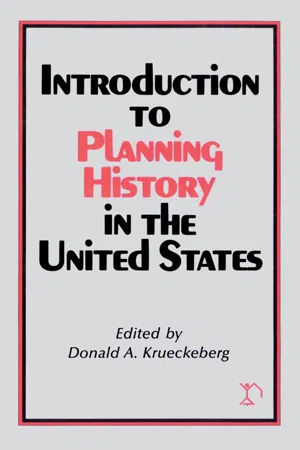
Introduction to Planning History in the United States
About this book
This book is an introduction to the history of the city planning profession in the United States, from its roots in the middle of the nineteenth century to the present day. The work examines important questions of American planning history. Why did city planning develop in the manner it did? What did it set out to achieve and how have those goals changed? Where did planning thrive and who were its leaders? What have been the most important ideas in planning and what is their relation to thought and social development?By answering these questions, this book provides a general understanding for further study of the extensive literature of planning and urban history.Donald A. Krueckeberg divides this work into three historical periods: an initial period of independent but gradually converging concepts of a planned city; a second period of national organization, experimentation, and development; and a third period of implementation of planning ideas in nearly all levels and areas of urban policymaking.Krueckeberg begins with revealing the origins of modern planning in the movements for sanitary reform, civic art and beautification, classical revival in civic design, and neighborhood settlements and housing reform. A second section covers the institutionalization of the profession; the rise of zoning and comprehensive planning; influential figures of the period; and the new communities program of the New Deal. The book contains case studies and focuses on the role of the planner and the effectiveness of the profession. Krueckeberg concludes with a bibliography of planning history in the United States.
Information
1
The Culture of Planning
Donald A. Krueckeberg
Considering the immense importance of a right location, and a right planning for cities, no step should ever be taken by the parties concerned, without employing some person who is qualified by a special culture, to assist and direct. Our engineers are trained for a very different kind of service, and are partly disqualified for this by the habit of a study more strictly linear, more rigidly scientific, and less artistic. The qualifications of surveyors are commonly more meagre still— Nothing is more to be regretted, in this view, than that the American nation, having a new world to make, and a clean map on which to place it, should be sacrificing their advantage so cheaply, in the extempore planning of towns and cities. The peoples of the old world have their cities built for times gone by, when railroads and gunpowder were unknown. We can have cities for the new age that has come, adapted to its better conditions of use and ornament. So great an advantage ought not to be thrown away. We want, therefore, a city planning profession .... 1
Horace Bushneil
“City Plans,” 1864
Introduction: Purpose, Scope, and Organization of the Book
The American professions began to multiply rapidly in the 1860s. The architects formed the American Institute of Architects in 1866. The engineering professions organized in 1871. Seventy-nine societies for professional service were chartered in the 1870s. In the next decade 121 more were established. Another forty-five were added in the 1890s.2 City planning was not one of these.
The city planning profession came later in this process of institutional development. The emergence of a “special culture,” a special knowledge and training for city planning, might be dated as early as 1893 with the opening of the World’s Columbian Exposition in Chicago and the model city it presented to the nation. Several significant beginning events coincided in 1909 with the publication of the famous Plan of Chicago, the first university course of instruction in city planning, at Harvard, and the first National Conference on City Planning. With the founding of the American City Planning Institute in 1917 the professional society was finally formed.
This book is an introduction to the history of the city planning profession in the United States, from its roots in the middle of the nineteenth century, through its emergence around the turn of the century, to the present day. Through a collection of papers by various authors, it introduces the reader to some of the important questions of American planning history. Why did city planning develop in the manner it did in the United States? What did it set out to achieve and how have those goals changed? Where did planning thrive and who were its leaders? What have been the most important ideas in planning and what is their relation to the major streams of American thought and social development? What has been the real impact of the planning movement on urban development in the United States? What have planners achieved? No single book could answer all of these questions. What this book provides is a general understanding upon which further study of the extensive literature of planning history, and of the broader field of urban history, can build.
The readings in this collection are divided into three historical periods: an initial period of independent but gradually converging concepts of a planned city; a second period of national organization, experimentation, and development; and a third period of implementation of planning ideas in nearly all levels and areas of urban policymaking. The first part of the book treats the period from 1840 to 1914. It includes four papers that reveal the origins of modern planning in the movements for sanitary reform, civic art and beautification, classical revival in civic design, and neighborhood settlements and housing reform. The second group of papers treats the period from 1914 to 1945. It covers the institutionalization of the profession; the rise of zoning and comprehensive planning; several influential figures of the period, including Robert Moses, Lewis Mumford, and Frank Lloyd Wright; and the new communities program of the New Deal. Also included in this period are the planned community of Radburn and its special influence on the planning movement, an account of the experiments in planning process and method conducted by the National Resource Planning Board, and an assessment of the alternative visions of the future held by planners at the end of World War II.
Part three contains case studies of planning since the war that focus on the role of the planner and the effectiveness of the profession. The first is a study of St. Paul, Minnesota in the 1950s, focusing on a highway location dispute and the planner’s relation to the community and the political decision process. The second case reveals the work of planners for the city of San Francisco, California in the 1960s, chronicled by the director of the planning commission. The final study is a retrospective view of a decade of planning in Cleveland, Ohio from 1969 to 1979, assessing the impacts of a highly regarded new model of planning for equity. Each of these scenarios of post-war planning has connections with the field’s deeper roots. The book concludes with a bibliography of planning history in the United States selected for further reading and reference.
The Origins of Urban Planning 1840-1914
The patterns of city development in the nineteenth century were overwhelmingly the result of free enterprise. Cities were laid out as often by real estate developers, engineers, surveyors, and even amateurs as government officials. The plan was most often a simple plotting of streets in a gridiron pattern and the subdivision of blocks into lots for sale. This atomistic system of city development was fed by rapidly changing technology and a swelling population, driven by great waves of immigration. The resulting basic and persistent American pattern of urbanization has been likened by William H. Wilson to vast “seas of unplanning.” On this map of entrepreneurial activity we see three independent ideas arise and gradually begin to converge toward the concept of city planning. Those ideas are “scientific efficiency,” “civic beauty,” and “social equity.”
Throughout the nineteenth century the railroad gradually tied the cities of the nation into a functional system of rapid transportation. The engineering of water and sanitary sewerage systems similarly came to join the elements of a single city into a centralized system based on two major scientific inventions responsive to the chaotic conditions of the nineteenth century. The first of these was the technical discovery in England in the 1840s that water flowing through a small-diameter pipe could function as the basis of a self-cleansing system of sewage removal that might service an entire city. Connected with the already feasible centralized supply of water, this new device of “water carriage sewerage” completed the urban water delivery-waste collection cycle and provided the technology to transform a city from an unsanitary aggregation of private lots, each with its own well and privy, to an integrated system of water and waste flows at higher (yet more sanitary) densities of development.
The second invention was a planning procedure that entailed the systematic mapping and recording of sanitary conditions on every parcel of land. The sanitary survey was devised to provide planning information for the treatment of cities under siege of epidemic yellow fever. It was among the first efforts to collect detailed data on an entire city for the purpose of formulating and implementing plans for the common good. In this case the common good was the most fundamental of all — human survival.
These new ways of portraying the city, as a system of interdependent parts and as an object of scientific survey, led to a new consciousness of city building, though not immediately to the concept of comprehensive city planning. This new “townsite consciousness” was most fully absorbed into the parks movement and particularly the work of the great landscape architect Frederick Law Olmsted. His work reflected the careful selection of sites and their painstaking development according to principles of good drainage, plentiful sunlight, pure water, clean air, and, of course, pleasing design. Many important contributions were made to the city planning movement by Olmsted, such as Central Park in New York and the suburb of Riverside, Illinois. These early planning concepts, participants, and activities are discussed by Jon A. Peterson in The Impact of Sanitary Reform upon American Urban Planning, 1840-1890, chapter 2.
The idea of the “City Beautiful” came on the heels of sanitary reform. It was not a simple social whim for cosmetic veneer, as it is often misrepresented, but a complex set of forces bidding to expand civic consciousness as well as raise standards of public design. There were four major branches of the city beautiful movement, three of which focused on either small public spaces or more comprehensively on medium and smaller sized cities. These were the movements to promote “municipal art,”“civic improvements,”and “outdoor art.” These are treated in chapter 3, The City Beautiful Movement: Forgotten Origins and Lost Meanings, also by Jon A. Peterson.
The idea of “municipal art” was to make the cities into patrons of the arts. This involved the promotion of decoration, sculpture, collaborative works for public display, the planting of street trees, the use of color in civic design, and campaigns against billboards and smoke. These causes were backed by municipal art commissions, and often incorporated into broader programs of city beautification and public housekeeping called “civic improvement” that sought to counterbalance the heavy hand of industrialization. Civic improvement societies sprang up in hundreds of small and medium-sized cities, spurred by the influential writings of Charles Mulford Robinson, pioneer planner and planning publicist. Frequently led by women, these local societies formed a national network of civic organizations. Much of the popular national support for the idea of planning, when it emerged as a profession, was to be found in this powerful national movement.
The third branch of the City Beautiful movement, “outdoor art,” was led by the American Park and Outdoor Art Association (APOAA) in which Frederick Law Olmsted was a major figure. In 1904 the civic improvement associations merged with the APOAA to form the American Civic Association, bringing into one organizational body programs of land planning that ranged from the promotion of a national park system in the wilderness toan agenda of city parks, planned urban development, better housing, civic art, sanitation, and traffic safety. By 1905 there were 2,426 affiliated civic improvement societies supporting the American planning movement.

1.1 Illustration from the Plan of Chicago, 1909, p. 117.
The fourth branch of the City Beautiful movement, “classical design,”came in its purest form in the attempt by architects to integrate traditional Grecian-Roman architectural themes into monumental city plans. Usage of grand design in the United States already had important precedents, especially in Pierre L’Enfant’s spiderweb streetplan for Washington, D.C. in the 1790s. Daniel Burnham of Chicago became the acknowledged leader of this movement a century later, and organizer of the design team for the Chicago Columbian Exposition in 1893. Design themes of grouped public buildings in the neoclassical style, great boulevards, and monuments anchoring grand perspectives were repeated throughout the following two decades, culminating in the 1909 Plan of Chicago which is presented in chapter 4, The Plan of Chicago, by Robert W. Wrigley, Jr. One can see from his portrayal that the plan was not only a great performance of the artistic process. It was also the beginning, in the promotional work of Walter D. Moody and others who tried to implement the plan, of a movement toward a governmental process that was regional in scope and participatory in style.
Upon these foundations of sanitary reform and civic beauty arose yet a third level of planning culture whose goals were neighborhood building and housing reform. Neighborhood settlement workers and housing reformers brought to the city planning movement humanitarian concerns for children, their schools and playgrounds, their home environments, sound housing, and a spirit of community life. They were devoted to the amelioration of slum tenements and their overcrowded and unsanitary conditions. This third level of planning interests is presented in chapter 5, Playgrounds, Housing, and City Planning, by Allen F. Davis.
Housing reform throughout most of the nineteenth century had been a wholly private-sector and largely unsuccessful effort. The problem was very challenging. Philanthropists and other idealists had been attempting to create good housing for the poor as a sound investment of private capital yielding a return. Toward the end of the century these efforts were largely supplanted by the promotion and adoption of various housing laws regulating minimum standards of space, light, air, and plumbing through controls on building design. As Davis suggests, however, many planners and housing reformers saw that these regulatory measures also were inadequate to produce sound housing in sufficient supply. By 1909, when the various strains of planning interest came together in the first National Conference on City Planning, it was clear that more direct governmental intervention would be required.
Thus we see on the 19th century landscape of individualism and industrial enterprise three converging ideas of urban planning: one of sanitation and scientific efficiency, a second of civic beauty and the building arts, and a third of social equity and charity. Enterprise alone bred chaos. Cooperation for efficient development was essential to the survival of city life. The City Beautiful movement implied, however, that even an efficient mode of enterprise was not enough. There were higher values than making money and being connected to the sewer system, valves such as art, community appearance, and nature. Humanitarian concerns for those whom Jacob Riis called, “the other half” completed the tripartite city planning concept.
The Growth of Planning between the Wars
William H. Wilson presents the achievements of planning between the wars as the product of two extremes, the down-to-earth realists and the high-flying idealists. These are his Moles and Skylarks of chapter 6. On the front of realism we find the formation of the professional organizations, schools of formal instruction, and the institutionalization of the planning function within local, and later, regional and national government. The tools of practice were developed and refined. Zoning and the master plan contributed to a new version of civic efficiency, aspiring to scientific city building. Wilson shows us, in the figure of Robert Moses of New York, an entrepreneur of the public dollar and builder of a civic empire.
The idealists built a city of Utopian concepts and values that left a permanent imprint on the development of planning thought. Lewis Mumford, one of America’s most eloquent critics of pragmatism and technology, developed a philosophy of city development for humanistic ends, in association with New York City area architects, housers, planners, and economists. Their collaboration led ultimately to one of the great symbols of the American planning movement — the town of Radburn. On other fronts, idealists such as Frank Lloyd Wright, the architect, and Rexford Tugwell, the economist, challenged America with their ideas of new towns for the prairie and new programs for the rural poor.
The design of Radburn, New Jersey, a “new town for the motor age” as it was called, was a major new synthesis of planning ideas. The historical impact of this phenomenon is analyzed by Eugenie Ladner Birch in chapter 7, Radburn and the American Planning Movement: The Persistence of an Idea. Many of the best minds in the field contributed to this plan as a...
Table of contents
- Cover
- Half Title Page
- Title Page
- Copyright Page
- Contents
- List of Plates
- Acknowledgements
- About the Contributors
- 1 The Culture of Planning.
- 2 The Impact of Sanitary Reform upon American Urban Planning, 1840-1890.
- 3 The City Beautiful Movement: Forgotten Origins and Lost Meanings.
- 4 The Plan of Chicago.
- 5 Playgrounds, Housing and City Planning.
- 6 Moles and Skylarks.
- 7 Radburn and the American Planning Movement: The Persistence of an Idea.
- 8 City Planning in World War II: The Experience of the National Resources Planning Board.
- 9 Visions of a Post-War City: A Perspective on Urban Planning in Philadelphia and the Nation, 1942-1945.
- 10 The Intercity Freeway.
- 11 1968: Getting Going, Staffing Up, Responding to Issues.
- 12 A Retrospective View of Equity Planning: Cleveland 1969-1979.
- Bibliography of Planning History in the United States.
- Index.
Trusted by 375,005 students
Access to over 1.5 million titles for a fair monthly price.
Study more efficiently using our study tools.
Frequently asked questions
Yes, you can cancel anytime from the Subscription tab in your account settings on the Perlego website. Your subscription will stay active until the end of your current billing period. Learn how to cancel your subscription
No, books cannot be downloaded as external files, such as PDFs, for use outside of Perlego. However, you can download books within the Perlego app for offline reading on mobile or tablet. Learn how to download books offline
Perlego offers two plans: Essential and Complete
- Essential is ideal for learners and professionals who enjoy exploring a wide range of subjects. Access the Essential Library with 800,000+ trusted titles and best-sellers across business, personal growth, and the humanities. Includes unlimited reading time and Standard Read Aloud voice.
- Complete: Perfect for advanced learners and researchers needing full, unrestricted access. Unlock 1.5M+ books across hundreds of subjects, including academic and specialized titles. The Complete Plan also includes advanced features like Premium Read Aloud and Research Assistant.
We are an online textbook subscription service, where you can get access to an entire online library for less than the price of a single book per month. With over 1.5 million books across 990+ topics, we’ve got you covered! Learn about our mission
Look out for the read-aloud symbol on your next book to see if you can listen to it. The read-aloud tool reads text aloud for you, highlighting the text as it is being read. You can pause it, speed it up and slow it down. Learn more about Read Aloud
Yes! You can use the Perlego app on both iOS and Android devices to read anytime, anywhere — even offline. Perfect for commutes or when you’re on the go.
Please note we cannot support devices running on iOS 13 and Android 7 or earlier. Learn more about using the app
Please note we cannot support devices running on iOS 13 and Android 7 or earlier. Learn more about using the app
Yes, you can access Introduction to Planning History in the United States by Donald A. Krueckeberg in PDF and/or ePUB format, as well as other popular books in Architecture & Urban Planning & Landscaping. We have over 1.5 million books available in our catalogue for you to explore.