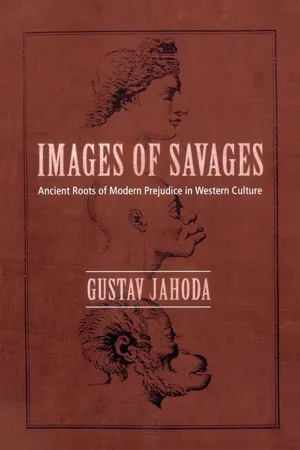
In Images of Savages, the distinguished psychologist Gustav Jahoda advances the provocative thesis that racism and the perpetual alienation of a racialized 'other' are a central leagacy of the Western tradition. Finding the roots of these demonizations deep in the myth and traditions of classical antiquity, he examines how the monstrous humanoid creatures of ancient myth and the fabulous "wild men" of the medieval European woods shaped early modern explorers' interpretations of the New World they encountered. Drawing on a global scale the schematic of the Western imagination of its "others," Jahoda locates the persistent identification of the racialized other with cannibalism, sexual abandon and animal drives. Turning to Europe's scientific tradition, Jahoda traces this imagery through the work of 18th century scientists on the relationship between humans and apes, the new racist biology of the 19th century studies of "savagery" as an arrested evolutionary state, and the assignment, especially of blacks, to a status intermediate between humans and animals, or that of children in need of paternal protection from Western masters. Finding in these traditional tropes a central influence upon the most current psychological theory, Jahoda presents a startling historical continuity of racial figuration that persists right up to the present day. Far from suggesting a program for the eradication of racial stereotypes, this remarkable effort nevertheless isolates the most significant barriers to equality buried deep within the Western tradition, and proposes a potentially redemptive self-awareness that will contribute to the gradual dismantling of racial injustice and alienation. Gustav Jahoda demonstrates how deeply rooted Western perceptions going back more than a thousand years are still feeding racial prejudice today.
This highly original socio-historical contextualisation will be invaluable to scholars of psychology, sociology and anthropology, and to all those interested in the sources of racial prejudice.
- 320 pages
- English
- ePUB (mobile friendly)
- Available on iOS & Android
eBook - ePub
About this book
Information
1
INTRODUCTION
Images of the Other, that strange, exotic, incomprehensible creature, feared, abhorred, and yet in some ways also envied, have run as a constant thread through the European past. The remote ancestry of the images dates back mainly to Greco-Roman and later Judaeo-Christian traditions. These were influential until the early modern period and, as will be shown in due course, there are writers who maintain that they remain so even at present. A psychological process will also be examined that helps to throw light on the manner in which these images affected the perception of savages.
The ‘monstrous’ or ‘Plinian’ races
A conspectus of these strange races was provided by Pliny the Elder in the first century AD. Drawn in the main from Greek sources, it listed a bewildering array of humanoid creatures, far richer in their variety than the rather stereotyped modern representations of ‘aliens’ in science fiction. They included people without mouths who lived on smells, headless ones with eyes in their shoulders, others with the heads of dogs, and a race with only one foot, so large that it was used as a sunshade. Some of them probably had a realistic basis, such as the ‘Bragmanni’, wise men who lived in caves, whose name is likely to be a corruption of ‘Brahman’. Similarly, ‘Pygmies’ had been reported in travel accounts by Herodotus. Of particular interest in the present context are the ‘anthropophagi’ or ‘man-eaters’, who in due course became known as ‘cannibals’. As will be shown in detail later (Chapter 8), ‘cannibalism’ always remained a key symbol of savagery.
The ‘monstrous races’ were invariably said to live in remote places, but remoteness in the psychological as much as in the geographical sense. While some sources referred them to Asia or ‘Ethiopia’ (a term then applied to Africa), others located them in more distant parts of what we now know as ‘Europe’. Thus in the 11th century a bishop, Adam of Bremen (?–1075), wrote an account of the inhabitants in his region and beyond (Adam of Bremen, trans. Tschan 1959). His characterizations of neighbouring peoples, although fanciful in parts, seem on the whole to be realistically based. Those living in the more northerly regions, however, were represented by Adam as ‘monstrous races’ (pp. 200–1):
In this sea there are also very many other islands, all infested by ferocious barbarians…. Likewise, round about the shore of the Baltic Sea, it is said, live the Amazons in what is now called the land of women. Some declare that these women conceive by sipping water. Some, too, assert that they are made pregnant by the merchants who pass that way, or by the men they hold captive in their midst, or by various monsters, which are not rare there…. And when these women come to give birth, if the offspring be of the male sex, they become Gynocephali; if of the feminine kind, they become most beautiful women. Living by themselves, the latter spurn consort with men and, if men come near, even drive them manfully away. The Cynocephali are men who have their heads on their breasts. They are often seen in Russia as captives and they voice their words in barks…. Palefaced, green, and macrobiotic, that is, long-lived men, called Husi, also live in those parts. Finally, there are those who are given the name of Anthropophagi and they feed on human flesh.
At that period there was as yet nothing like a ‘European’ identity, even in the weakest sense. The larger unit of which people felt themselves to be part was ‘Christendom’, as distinct from the infidel Muslims and the pagans; the latter included Scandinavians, Slavs, Magyars, and also the Celtic fringe of Welsh, Irish and Scots.
The following two centuries saw the beginnings of long-distance explorations, and the weird and wonderful beings allegedly encountered were described in terms of the Plinian races (see Figure 1.1). Among the travel reports which drew on that tradition, the best known was that of Sir John Mandeville.1 It appeared around the middle of the 14th century, was translated into several languages and went through numerous editions. The flavour of its content may be exemplified by the following extract:
And in those isles are many manners of folk of divers conditions. In one of them is a manner of folk of great stature, as they were giants, horrible and foul to the sight; and they have but one eye, and that is in the midst of the forehead. They eat raw flesh and raw fish. In another isle are foul men of figure without heads, and they have eyes in either shoulder one, and their mouths are round shaped like a horseshoe, y-midst their breasts. In another isle are men without heads; and their eyes and their mouths are behind in their shoulders.(Letts [1346?] 1953, Vol. 1, pp. 141/2)
It is believed that the above passage referred to the Andaman Islands, but the geography often remained somewhat nebulous. For instance, ‘Aethiopes’ (or ‘burnt faces’) were often indifferently located either in India or Africa.

Figure 1.1 Representations dating from the thirteenth century of some of the ‘monstrous races’
Source: Bodleian Library, Oxford, MS Douce 88, folios 69V–70R
The records of such early explorations underwent a series of transformations. The perceptions of the travellers themselves were bound to be selective, and they interpreted much of what they saw in terms of their preconceptions. Nonetheless, realities are likely to have imposed some constraints, even though that left plenty of room for fanciful embroidery. Pigafetta, who had sailed with Magellan’s first circumnavigation of the globe in the 15th century, returned from the Philippines after Magellan’s death there and wrote an account of their adventures. In it he mentioned East Indians who were some eighteen inches high and had ears so long that at night one was used as a mattress and the other as a blanket.
When it came to the chroniclers who collected travellers’ tales at second- or nth-hand, freedom to invent was extensive. As demonstrated in classical experiments by Bartlett (1932), culturally alien material comes to be assimilated in the process of transmission to the culturally familiar; and what was familiar at the time was the notion of ‘monstrous races’. This is a point that will be further expanded below.
Let me now briefly turn to another aspect of the Greek tradition, which concerns such beings as satyrs, fauns, nymphs and sileni (wood gods). These were characterized by their unrestrained licentiousness – White (1978, p. 170) described them graphically as ‘little more than ambulatory genitalia’. In the present context it is worth noting that there are strong indications of past confusions between the mythological satyr and a large monkey or gibbon, known to Pliny as ‘satyrus’. This was probably the species which gave rise to the following description by Pliny:
[T]he Choromandae are a savage and wild people; distinct voice and speech have they none, but in steed thereof, they keepe an horrible gnashing and hideous noise: rough they are and hairie all over their bodies, eies they have red like the houlets [owls] and toothed they be like dogs.(Plinius Secundus [AD 77] 1601, p. 156, cited in Dickason 1984, p. 73)
In 1699 Edward Tyson published his pioneering account of the dissection of a creature subsequently identified as a chimpanzee under the lengthy title: Orang-Outang, sive Homo Sylvestris: or: the ANATOMY of a PYGMIE compared with that of a Monkey, an Ape and a Man. To which is added A Philological Essay Concerning the Pygmies, the Cynocephali, the Satyrs and Sphinges of the Ancients. Wherein it will appear that they are all either Apes or Monkeys, and not Men, as formerly pretended. This was a significant event, to which I shall return below. Here it is necessary to note Tyson’s argument that beliefs in the monstrous races, satyrs and other hybrid monsters had in fact all been the result of misconstruing monkeys or apes; the same, he maintained, was true of homo sylvestris, the ‘Wild Man of the Woods’, whose rather different antecedents will now be outlined.
The ‘Wild Man of the Woods’
The Greeks in their myths conceived of indiscriminate interbreedings between gods, humans and animals, so that any resulting abnormal species would not have seemed upsetting or even unduly astonishing; nor did they necessarily ascribe any moral deficiencies to such imagined creatures. The opposite was true of the ancient Hebrews, for whom interbreeding of different natural kinds was abhorrent, since they believed that it produced a wild and evil race of giants. The manner in which these ideas became, fatefully, linked with the name of Ham has been described by White (1978, p. 161):
After the flood …evil and (therefore) wildness returned to the world, especially in the descendants of Noah’s youngest son, Ham, who was cursed for revealing his father’s nakedness. From Ham was descended …that breed of ‘wild men’ who combined Cain’s rebelliousness with the size of the primal giants. They must also have been black, since, through etymological conflation, the Hebrews ran together word roots used to indicate the color black, the land of Egypt (i.e of bondage), the land of Canaan (i.e of pagan idolatry), the condition of accursedness (and, ironically, apparently the notion of fertility), with the proper name of Ham and its adjectival variations.
Gervase of Tilbury wrote around 1212: ‘It is said that the “Aethiopians” descend from Cush, son of Ham, because the Hebraic word Cush is translated as “Aethiops” (cited in Medeiros 1985, p. 129). Much later the legend of Ham was seized upon as providing a biblical justification for the oppression of blacks. In early Christianity it led, probably through fusion with pre-Christian mythology, to the image of the ‘Wild Man of the Woods’ (see Figure 1.2). Saint Augustine identified Nimrod as a descendant of Ham and as responsible for the building of the tower of Babel and the subsequent fragmentation of humanity. Nimrod thus seems to have been one of the main sources of the myth of the Wild Man. This figure, also known as that of the ‘Hairy Wild Man’, gradually emerged in the literature and art of the Middle Ages and became common in European folklore by the end of the period. A savage creature of the woods, he was usually pictured with a body covered in hair excepting only his face, knees and elbows (the same applied to pictures of wild women, whose usually pendant breasts were also devoid of hair). The Wild Man was typically shown wielding a large stick or even a tree trunk, indicative of his brute strength (for descriptions of illustrations cf. Mason 1990). Living a solitary life apart from the company of bears and devils, he was devoid of speech and the use of reason. Knowing neither God nor morality he was a slave to his passions, and carried off women whom he not only raped but, according to Edmund Spenser’s Faerie Queene, subsequently ate. The females were said to have an irrepressible desire to copulate with ordinary men. Both sexes were conceived as being acquainted with nature’s secrets, close to but not quite animals.

Figure 1.2 Fifteenth-century representation of a ‘Wild Man’ and a ‘Wild Woman’
Source: Copyright © Fitzwilliam Museum, University of Cambridge.
These figures embodied some of the features of the Plinian races, but in other respects resembled the satyr of antiquity with its horned forehead, goat-like lower body and a disproportionately large phallus. The satyr shared with the Wild Man its semi-animality and, above all, an unrestrained sexual appetite. Bernheimer (1952), who wrote an authoritative account of the image of the Wild Man, suggested that it constituted a Freudian projection of prohibited libidinal impulses; the erotic colouring is certainly pronounced. Accordingly, during the Middle Ages the myth, frowned upon by the ecclesiastical authorities, remained largely an oral tradition at the popular level. A change occurred during the Renaissance with its return to classical values, when wildness was sometimes perceived as a release from the fetters of civilization, a duality one encounters again in the Enlightenment dichotomy of the ‘noble’ versus ‘ignoble’ savage. It was also during the Enlightenment that serious philosophical and scientific discussions began concerning the relationship between animals, notably apes, and humans. In view of the crucial role played by the concept of’animality’ from the initial contacts with savages onwards, a preliminary outline of the background will be useful.
‘Animality’ and the symbolism of ape and child
Europeans, taking their own physical appearance and mode of life as the criteria of full humanity, found the savages wanting. Their different pigmentation, their nakedness, the kinds of foods they consumed (often thought to include human flesh) and other negatively regarded characteristics attributed to them were taken as indications of their animality. Over the centuries, one of the most common epithets applied to them was that of the ‘beastly’ savage. This was not merely a matter of casual labelling, for profound issues of the nature of humanity came to be raised, and in the early 19th century the great naturalist Guvier was to provide scientific arguments for the greater animality of savages.
While savages were sometimes compared to several kinds of wild animals, for obvious reasons monkeys and apes greatly predominated. It should be mentioned at this point that long prevailing European ideas and feelings about animals are by no means universal. In many cultures, notably hunting-and-gathering ones, animals are believed to have souls and to be in close partnership with humans. Nor is this confined to non-literate cultures: in Japan it is precisely the monkey that is used ‘as a metaphor for humans in relation to animals and as a metaphor for the Japanese in relation to foreigners’ (Ohnuki-Tierny 1987, p. 7). In both European and Japanese cultures the monkey was situated at the borderline between humans and non-humans but was evaluated very differently, probably owing to contrasting religious traditions. In Japan the monkey was viewed historically as a shaman mediating between the Mountain Deity and humans, endowed with healing powers. In the Greco-Christian tradition the monkey was something of an anomaly, as will be documented later in more detail. Here it will be sufficient to mention that monkeys and apes resemble humans in many respects, yet are not humans, thereby occupying a marginal position between the two categories of humanity and animality.2 Anthropologists have shown that such anomalies are apt to evoke strong feelings. For instance, Leach (1964, p. 39), who discussed the kind of verbal abuse where humans are called animal names, stated that ‘it is the ambiguous categories that attract the maximum interest and the most intense feeling of taboo. The general theory is that taboo applies to categories which are anomalous with respect to clear-cut category oppositions’.
It may also be noted that there was support for the comparison of savages with monkeys and apes from popular folklore. In medieval illustrations the Wild Man of the Woods often looks very ape-like, and there is considerable overlap between the characteristics attributed to wild men and apes. The notions associated with the latter have been extensively documented by Janson (1952). From antiquity onwards, the similarity between humans and apes had not merely been recognized, but in the case of Aristotle and Galen even exaggerated. Aristotle’s description of intra-uterine development in De Animalibus referred to a progression ‘from sperm, to a fungus-like shape, to that of an unshaped animal, to the shape of an ape, and finally – one stage before the fully human configuration of the fetus – to the shape of a Pygmy’ (cited in Friedman 1981, p. 191). The Greeks, and subsequently the Romans, implicitly assumed the human-like nature of apes by attributing to them negative moral features (trickster, sycophant, hypocrite) and regarding them as physically repulsive and ugly – perhaps with a view to stressing the distinction between apes and humans in a context where they perceived close similarities. At any rate, given this image, and the uncertain categorization in classical literature of different species, it is not surprising that apes came to be associated with some of the mythical races, notably satyrs and cynocephali (‘dog-heads’). It is clear that already at that stage the image of the ape carried a heavy if somewhat var...
Table of contents
- Cover
- Haft Title
- Title Page
- Copyright Page
- Dedication
- Table of Contents
- List of illustrations
- Preface
- Acknowledgements
- 1 Introduction
- Part I From Renaissance to Enlightenment
- Part II Animality and beastly man-eating
- Part III The Image of the savage as child-like
- Part IV Perspectives and interpretations
- Postscript: The images as symptoms and supports of racism
- Notes
- Riferences and forther reading
- Author index
- Subject index
Trusted by 375,005 students
Access to over 1.5 million titles for a fair monthly price.
Study more efficiently using our study tools.
Frequently asked questions
Yes, you can cancel anytime from the Subscription tab in your account settings on the Perlego website. Your subscription will stay active until the end of your current billing period. Learn how to cancel your subscription
No, books cannot be downloaded as external files, such as PDFs, for use outside of Perlego. However, you can download books within the Perlego app for offline reading on mobile or tablet. Learn how to download books offline
Perlego offers two plans: Essential and Complete
- Essential is ideal for learners and professionals who enjoy exploring a wide range of subjects. Access the Essential Library with 800,000+ trusted titles and best-sellers across business, personal growth, and the humanities. Includes unlimited reading time and Standard Read Aloud voice.
- Complete: Perfect for advanced learners and researchers needing full, unrestricted access. Unlock 1.5M+ books across hundreds of subjects, including academic and specialized titles. The Complete Plan also includes advanced features like Premium Read Aloud and Research Assistant.
We are an online textbook subscription service, where you can get access to an entire online library for less than the price of a single book per month. With over 1.5 million books across 990+ topics, we’ve got you covered! Learn about our mission
Look out for the read-aloud symbol on your next book to see if you can listen to it. The read-aloud tool reads text aloud for you, highlighting the text as it is being read. You can pause it, speed it up and slow it down. Learn more about Read Aloud
Yes! You can use the Perlego app on both iOS and Android devices to read anytime, anywhere — even offline. Perfect for commutes or when you’re on the go.
Please note we cannot support devices running on iOS 13 and Android 7 or earlier. Learn more about using the app
Please note we cannot support devices running on iOS 13 and Android 7 or earlier. Learn more about using the app
Yes, you can access Images of Savages by Gustav Jahoda in PDF and/or ePUB format, as well as other popular books in Psychology & History & Theory in Psychology. We have over 1.5 million books available in our catalogue for you to explore.