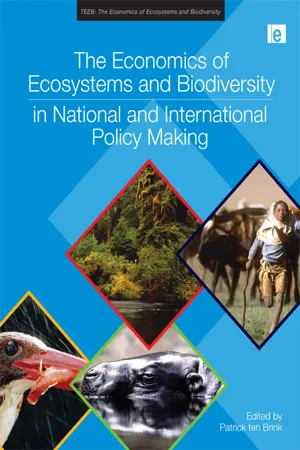
The Economics of Ecosystems and Biodiversity (TEEB) study is a major international initiative drawing attention to local, national and global economic benefits of biodiversity, to highlight the growing costs of biodiversity loss and ecosystem degradation, the benefits of investing in natural capital, and to draw together expertise from the fields of science, economics and policy to enable practical actions. Drawing on a team of more than one hundred authors and reviewers, this book demonstrates the value of ecosystems and biodiversity to the economy, society and individuals. It underlines the urgency of strategic policy making and action at national and international levels, and presents a rich evidence base of policies and instruments in use around the world and a wide range of innovative solutions.
It highlights the need for new public policy to reflect the appreciation that public goods and social benefits are often overlooked and that we need a transition to decision making which integrates the many values of nature across policy sectors. It explores the range of instruments to reward those offering ecosystem service benefits, such as water provision and climate regulation. It looks at fiscal and regulatory instruments to reduce the incentives of those running down our natural capital, and at reforming subsidies such that they respond to current and future priorities.
The authors also consider two major areas of investment in natural capital - protected areas and investment in restoration. Overall the book underlines the needs and ways to transform our approach to natural capital, and demonstrates how we can practically take into account the value of ecosystems and biodiversity in policy decisions - at national and international levels - to promote the protection of our environment and contribute to a sustainable economy and to the wellbeing of societies.
eBook - ePub
The Economics of Ecosystems and Biodiversity in National and International Policy Making
- 390 pages
- English
- ePUB (mobile friendly)
- Available on iOS & Android
eBook - ePub
The Economics of Ecosystems and Biodiversity in National and International Policy Making
About this book
Information
Part I
The Need for Action

Chapter 1
The Global Biodiversity Crisis and Related Policy Challenge
Coordinating lead author
Patrick ten Brink
Patrick ten Brink
Lead authors
Marianne Kettunen, Alexandra Vakrou, Heidi Wittmer
Marianne Kettunen, Alexandra Vakrou, Heidi Wittmer
Contributing authors
Jonathan Armstrong, Leonardo Mazza, Clare Shine, Matt Rayment, Alice Ruhweza, Ben ten Brink
Jonathan Armstrong, Leonardo Mazza, Clare Shine, Matt Rayment, Alice Ruhweza, Ben ten Brink
See end of chapter for acknowledgements for reviews and other contributions
Contents
Key messages
Summary
1 What is biodiversity and why does it matter?
2 The biodiversity crisis: Scale and causes
2.1 How much of our natural capital is being lost?
2.2 Global projections of future loss
2.3 What is driving these losses?
3 Economic dimensions of the biodiversity crisis
3.1 How do ecosystem services underpin the economy?
3.2 Understanding the value of ecosystem services
3.3 Using valuation to assess trade-offs, costs and benefits
4 Human dimensions of the biodiversity crisis
4.1 Ecosystem services: A lifeline for the poor, a necessity for everyone
4.2 Substitution potential: Limits and implications
4.3 Engaging communities to define policy solutions
Notes
Acknowledgements
References
Key messages
Ecosystems and their biodiversity underpin the global economy and human well-being, and need to be valued and protected. The world’s ‘natural capital’ is not a luxury for the rich but a necessity for all. The figures speak for themselves: over a billion people in developing countries rely on fish as a major source of food, around 1.1 billion people are dependent on forests for their livelihoods and over half of all commercial medicines derive from natural substances, mostly sourced in rainforests.
Damage to global ecosystem services and biodiversity is acute and accelerating. In the last century we have lost 35 per cent of mangroves, 40 per cent of forests and 50 per cent of wetlands. 60 per cent of ecosystem services have been degraded in 50 years. Species are being lost 100 to 1000 times faster than in geological times and this will get worse with climate change. 80 per cent of the world’s fisheries are fully or over-exploited. Critical thresholds are being passed and coral reefs risk collapse if CO2 emissions are not urgently reduced.
Ecosystem damage carries costs for business and society: the number of sectors benefiting from natural capital represents a far larger share of the economy than many policy makers appreciate. It is not just the agricultural, forestry and fisheries sectors, but also water, food and drink, pharmaceuticals, health, recreation and tourism. Failure to halt biodiversity loss on land will also lead to major losses from lost provisioning services (e.g. food, fuel, water), regulating services (e.g. lost carbon storage; air, water and waste purification; natural hazards management) and cultural services (e.g. recreation and tourism). At sea, for provision services alone, unsustainable fishing reduces potential fisheries output by an estimated $50 billion/year.
Growing demand from an expanding and wealthier global population is a key cause of biodiversity loss. At a deeper level, economic signals from policy and market prices fail to reflect the true value of biodiversity. Incentives are not in place to encourage sustainable practices or to distribute costs and benefits efficiently and fairly. The imbalance between private gain and public loss runs through most of today’s policy failures.
Understanding value is critical to inform trade-offs in decision making on land conversion and ecosystem management. When the true value of ecosystem services are included, traditional trade-offs may be revealed as unacceptable. The cost of acting to sustain biodiversity and ecosystem services can be significantly lower than the cost of inaction.
Policies that seek to integrate environmental, economic and social concerns need to recognize the limited substitution potential of ecosystem services and the sheer scale of the human impacts caused by loss or degradation of natural capital. Finding alternative sources – e.g. for water, fuelwood and food – or creating artificial substitutes – e.g. water purification – can strain poorer communities, increase costs and raise prices of the most basic commodities, putting them beyond the reach of some groups. In some cases (e.g. species extinction) there are no substitutes.
Maintaining and investing in natural capital not only makes economic sense but is also critical for meeting social objectives and fundamental to meeting the Millennium Development Goals. This book will describe the potential for win–win–win opportunities (biodiversity, economic and social) in responding to the biodiversity crisis.
Summary
In our every deliberation, we must consider the impact of our decisions on the next seven generations. (From The Great Law of the Iroquois Confederacy)
Chapter 1 provides an overview of key issues and priorities related to the global biodiversity crisis. Section 1 introduces policy makers to basic terms, concepts and the reasons for urgent concern at the highest levels. Section 2 highlights the seriousness of current biodiversity loss, backed by concrete examples, and analyses the causes of ongoing and future projected losses. Section 3 explains the critical importance of ecosystem services for economic prosperity and shows how valuation can support informed and cost-effective policy trade-offs and investments. Section 4 emphasizes the scale of human dependence on ecosystem services and biodiversity, particularly for the poor with limited access to alternatives, and the need to engage communities in developing and implementing policy solutions.
1 What is biodiversity and why does it matter?
‘Biodiversity’ is an umbrella term that covers all life on the planet, from the genetic level up to species to habitats and ecosystems on land and in water. It underpins our global economy as well as human well-being. Biodiversity offers essential benefits to people and contributes to society as a whole by providing knowledge, protection, medicine and community identity. Ecosystems in their turn provide a range of vital services, including regulation of nutrient and carbon cycles (see Box 1.1 for key terms).
Despite its benefits for society, damage to global biodiversity is acute and accelerating. Before we even consider future predictions (see Section 2), alarming statistics already highlight the scale of past losses. Species are going extinct 100 to 1000 times faster than in geological times (Pimm et al, 1995). During the last century, the planet lost 50 per cent of its wetlands, 40 per cent of its forests and 35 per cent of its mangroves. Around 60 per cent of global ecosystem services have been degraded in just 50 years (MA, 2005a).
These losses harm the economy (see Section 3) and human well-being (see Section 4). Unfortunately, we usually appreciate what we have lost too late and/or where there are no available substitutes. The poorest people and developing countries are hit hardest but richer nations are not immune. For example, the loss of bees has sparked worldwide concern because it directly affects natural pollination capacity. We know that over half of the world’s fish stocks are already fully exploited and another quarter over-exploited or depleted (FAO, 2009a). This decline affects us all but especially the one billion or more people in developing countries who rely on fish for their main source of protein.
The relationship between biodiversity, ecosystems and their ability to deliver vital services is complex and variable. Ecosystems are components of biodiversity, and species are essential components within those ecosystems. The loss of any components of biodiversity will trigger a change in services provided by the ecosystem concerned. Depending on the circumstances, such changes can (initially) be subtle or make ecosystems less stable and more vulnerable to collapse. If an entire ecosystem is lost, this will have a significant structural impact with direct human, social and economic costs.
Box 1.1 Key definitions: Biodiversity, ecosystems and ecosystem services
Biological diversity means ‘the variability among living organisms from all sources, including terrestrial, marine and other aquatic ecosystems and the ecological complexes of which they are part; this includes diversity within species, between species and of ecosystems’ (UN, 1993). The term covers every form of life on Earth (plants, animals, fungi and micro-organisms), the diversity of communities that they form and the habitats in which they live. It encompasses three levels: ecosystem diversity (i.e. variety of ecosystems); species diversity (i.e. variety of different species); and genetic diversity (i.e. variety of genes within species).
Ecosystem means ‘a dynamic complex of plant, animal and micro-organism communities and their non-living environment interacting as a functional unit’ (UN, 1993). Every ecosystem is characterized by complex relationships between living (biotic) and non-living (abiotic) components (resources), sunlight, air, water, minerals and nutrients: the quantity (e.g. biomass, productivity), quality and diversity of species (e.g. richness, rarity) all play an important role. The functioning of an ecosystem often hinges on certain species or groups of species that perform key functions e.g. pollination, grazing, predation, nitrogen fixing.
Ecosystem services refer to the flow of benefits1 that people obtain from ecosystems (MA, 2005a). These include:
• provisioning services (e.g. food, fibre, fuel, water);
• regulating services (benefits from ecosystem processes that regulate e.g. climate, floods, disease, waste and water quality);
• cultural services (e.g. recreation, tourism, and aesthetic, spiritual and ethical values);
• supporting services necessary for the production of all other ecosystem services (e.g. soil formation, photosynthesis, nutrient cycling).
‘Habitat services’ is also a separate classification to highlight the importance of ecosystems to provide habitats for migratory species (e.g. as nurseries) and as gene pool ‘protectors’ (maintain gene pool diversity and vitality) (see TEEB Foundations, 2010).
Ecosystem services flow from the ‘natural capital stocks’, like interest or dividends from the stock (also sometimes termed ‘natural assets’). ‘Natural capital’ is an ‘economic metaphor for the limited stocks of physical and biological resources found on earth’ (MA, 2005a). See Section ...
Table of contents
- Cover
- Halftitle
- Title
- Copyright
- Dedication
- Contents
- List of Figures, Tables and Boxes
- List of Contributors
- Acknowledgements
- Foreword
- Preface
- List of Acronyms and Abbreviations
- Introduction
- Part I — The Need for Action
- Part II — Measuring What We Manage: Information Tools for Decision Makers
- Part III — Available Solutions: Instruments for Better Stewardship of Natural Capital
- Part IV — The Road Ahead
- Index
Trusted by 375,005 students
Access to over 1.5 million titles for a fair monthly price.
Study more efficiently using our study tools.
Frequently asked questions
Yes, you can cancel anytime from the Subscription tab in your account settings on the Perlego website. Your subscription will stay active until the end of your current billing period. Learn how to cancel your subscription
No, books cannot be downloaded as external files, such as PDFs, for use outside of Perlego. However, you can download books within the Perlego app for offline reading on mobile or tablet. Learn how to download books offline
Perlego offers two plans: Essential and Complete
- Essential is ideal for learners and professionals who enjoy exploring a wide range of subjects. Access the Essential Library with 800,000+ trusted titles and best-sellers across business, personal growth, and the humanities. Includes unlimited reading time and Standard Read Aloud voice.
- Complete: Perfect for advanced learners and researchers needing full, unrestricted access. Unlock 1.5M+ books across hundreds of subjects, including academic and specialized titles. The Complete Plan also includes advanced features like Premium Read Aloud and Research Assistant.
We are an online textbook subscription service, where you can get access to an entire online library for less than the price of a single book per month. With over 1.5 million books across 990+ topics, we’ve got you covered! Learn about our mission
Look out for the read-aloud symbol on your next book to see if you can listen to it. The read-aloud tool reads text aloud for you, highlighting the text as it is being read. You can pause it, speed it up and slow it down. Learn more about Read Aloud
Yes! You can use the Perlego app on both iOS and Android devices to read anytime, anywhere — even offline. Perfect for commutes or when you’re on the go.
Please note we cannot support devices running on iOS 13 and Android 7 or earlier. Learn more about using the app
Please note we cannot support devices running on iOS 13 and Android 7 or earlier. Learn more about using the app
Yes, you can access The Economics of Ecosystems and Biodiversity in National and International Policy Making by Patrick ten Brink in PDF and/or ePUB format, as well as other popular books in Economia & Economia ambientale. We have over 1.5 million books available in our catalogue for you to explore.