![]()
1
Introduction
Stewart Maginnis, Jennifer Rietbergen-McCracken
and William Jackson
What is FLR?
The term ‘forest landscape restoration’ was first coined in 2001 by a group of forest restoration experts who met in Segovia, Spain, defining it as ‘a process that aims to regain ecological integrity and enhance human well-being in deforested or degraded forest landscapes’.
The FLR concept is still being refined and redefined to accommodate new perspectives and ideas on what it entails and what sets it apart from more conventional approaches to putting trees back into the landscape. Indeed, the process of compiling The Forest Landscape Restoration Handbook, which involved discussions with a range of individuals and institutions, has itself brought increased clarity to the concept.
While the overall conceptual framework of FLR is new, virtually all the principles and techniques behind the approach have been around for some time and will already be familiar to many forestry practitioners. In essence, FLR is an approach to managing the dynamic and often complex interactions between the people, natural resources and land uses that comprise a landscape. It makes use of collaborative approaches to harmonize the many land-use decisions of stakeholders with the aims of restoring ecological integrity and enhancing the development of local communities and national economies. In many ways, it is an alternative to top-down, expert-driven land-use planning, providing a means to reflect societal choice through applying the principles of an ecosystem-management approach.
Thus, FLR differs from conventional restoration approaches in several ways:
• It takes a landscape-level view. This does not mean that every FLR initiative must be large-scale or expensive; rather that site-level restoration decisions need to accommodate landscape-level objectives and take into account likely landscape-level impacts.
• It operates on the ‘double filter’ condition: restoration efforts need to result in both improved ecological integrity and enhanced human well-being at the landscape level (the double filter is discussed in more detail later in this chapter).
• It is a collaborative process involving a wide range of stakeholder groups collectively deciding on the most technically appropriate and socioeconomically acceptable options for restoration.
• It does not necessarily aim to return forest landscapes to their original state, but rather is a forward-looking approach that aims to strengthen the resilience of forest landscapes and keep future options open for optimizing the delivery of forest-related goods and services at the landscape level.
• It can be applied not only to primary forests but also to secondary forests, forest lands and even agricultural land.
The specific activities of any FLR initiative could include one or more of the following:
• rehabilitation and management of degraded primary forest;
• management of secondary forest;
• restoration of primary forest-related functions in degraded forest lands;
• promotion of natural regeneration on degraded lands and marginal agricultural sites;
• ecological restoration;
• plantations and planted forest; and
• agroforestry and other configurations of on-farm trees.
From policy to practice
The main aim of The Forest Landscape Restoration Handbook is to help forest restoration practitioners to understand FLR, appreciate its benefits and start to implement it. Thus, while the ITTO Guidelines for the Restoration, Management and Rehabilitation of Degraded and Secondary Tropical Forests (ITTO, 2002) are aimed primarily at policy-makers, this book targets field-level forest managers working in degraded forests and forest lands. These forest managers may include forest department staff, local communities or NGO staff involved in joint forest management, private sector timber company staff, or local government planning officers. FLR is still unknown to many of these groups, although they might already have adopted some of its principles in innovative forest restoration activities.1
One of the key messages in the book is that the technical knowledge is available to start FLR now, based on a wide range of proven restoration techniques. The limiting factors are most likely a lack of understanding of the landscape-level approach, the other land-use policies outside the forest sector that can have a major influence on landscape-level dynamics, and, in particular, the landscape-level impacts of site-level land uses. In addressing this last issue, the book highlights the double filter criterion of FLR, which states that the enhancement of human well-being and the restoration of ecological integrity cannot be traded off at the landscape level. This means that while specialization is inevitable and trade-offs unavoidable at the site level, the landscape-level sum of all site-level actions should attempt to balance the two objectives of enhanced human well-being and restored ecological integrity.2
This book has been compiled as a series of ‘essential reading’ chapters on the key principles and techniques of FLR and will serve as a bridge between the policy-level guidance provided by the ITTO guidelines and the context-specific field guides that it is hoped will be developed following the national-level FLR workshops to be held during 2005 and 2006. Though not a field guide, the book will still provide practical guidance on implementing FLR, including how to:
• use an adaptive management approach in planning and implementing an FLR initiative and support this approach through comprehensive monitoring and evaluation;
• understand and analyse the dynamics operating within a forest landscape;
• work with multiple stakeholder groups and address different, sometimes conflicting, interests;
• construct FLR scenario models to help make explicit the choices and trade-offs inherent in FLR planning and facilitate collaborative learning with stakeholder groups on which technical options to pursue; and
• evaluate the technical options available at the site level and take into account the biophysical and socio-economic factors that will influence the likely success of an FLR initiative.
The book draws on numerous case studies in which FLR has been applied in practice (sometimes before the term FLR actually existed), and uses these to illustrate the main learning points on FLR. The book also provides references for further reading and more detailed guidance.
Notes
1 See, for example, the case study from the Shinyanga region of Tanzania in Chapter 2.
2 See Chapter 3 for more on the double filter of FLR.
Reference
ITTO (2002) ITTO Guidelines for the Restoration, Management and Rehabilitation of Degraded and Secondary Tropical Forests, ITTO Policy Development Series No 13, ITTO, Yokohama, Japan
![]()
2
What Is FLR and How Does It
Differ from Current Approaches?
Stewart Maginnis and William Jackson
This chapter provides a brief overview of what FLR means in practice and what makes it fundamentally different from more conventional approaches to putting trees back into the landscape. The chapter highlights the following points:
• by itself, restoration through site-based interventions (such as afforestation schemes) is not capable of delivering the full range of forest goods and services that society and local communities require;
• the aim of FLR is not to recreate the past but rather to keep future options open, both in terms of human well-being and ecosystem functionality (including biodiversity conservation);
• land use and ecosystems change over time, so adaptability and, by extension, adaptive management lie at the heart of FLR; and
• delivering meaningful results at the landscape level will require more than just technically competent interventions; it will also require a good understanding of how land-use policies and people's livelihood needs influence the overall quality and availability of forest goods and services in the landscape.
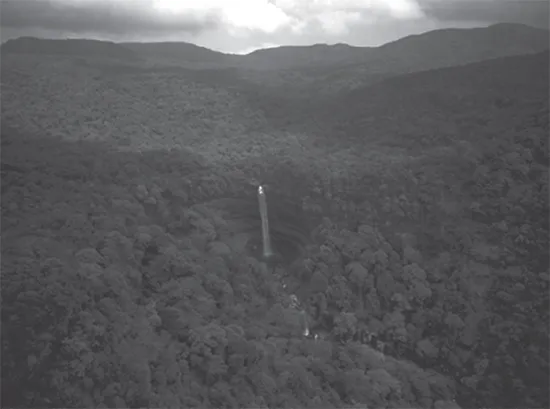
To many foresters, the idea of a ‘forest landscape’ invokes an ideal image of continuous forest cover stretching uninterrupted towards the horizon, as illustrated in Figure 2.1. Under this scenario, the forest tends to be both well-managed and protected, delivering not only nationally and locally important products such as timber, rattan, fuelwood and rubber, but also maintaining important ecological services such as slope stabilization, hydrological regulation and carbon sequestration. In practice, however, the situation can be quite different.
Figure 2.1 The ‘classic’ forest landscape: Lao PDR
Source: Stuart Chape
Deforestation and forest degradation have altered many of the world's tropical forest landscapes to such a degree that, at the very most, only 42 per cent of remaining forest cover (or 18 per cent of original forest cover) in the tropics is still found in large, contiguous tracts. The forest estate of eight ITTO producer countries (and most ITTO consumer countries) now exists only as fragmented, mostly modified and sometimes degraded blocks. This means that at least 830 million hectares of tropical forest are confined to fragmented blocks, of which perhaps 500 million hectares are either degraded primary or secondary tropical forest and can be considered part of modified forest landscapes (Figures 2.2 and 2.3).
In addition to the large area of fragmented tropical forest, another 350 million hectares of former forest land can no longer be classified as forest because of the extent to which it has been degraded by fire, land clearance and destructive harvesting practices. Such areas, illustrated in Figure 2.4, often remain in a state of arrested succession because the conditions do not exist to support secondary forest regeneration or conversion to another productive land use. These areas lack nearly all forest-related attributes (structure, function, productivity, composition) and constitute the gre...