![]()
Part I
Design of Electrical Installation Systems
![]()
Chapter 1
Regulations Governing Electrical Installations
Whatever type of electrical equipment is installed, it has to be connected by means of cables and other types of conductors, and controlled by suitable switchgear. This is the work which is undertaken by the installation engineer, and no equipment, however simple or elaborate, can be used with safety unless the installation has been planned, correctly designed and the installation work has been carried out correctly.
1.1 PLANNING OF INSTALLATION WORK
Like fire, electricity is a very good servant, but if not properly controlled and used it can prove to be a very dangerous master. The need for planned methods of wiring and installation work has long been recognised and all kinds of regulations, requirements, recommendations, codes of practice and so on have been issued. Some are mandatory and can be enforced by law, whilst others are recommendations.
This book deals with the work of the electrical designer and installation engineer and an attempt will be made to present, as clearly as possible, a general outline of the basis of good installation work, including design, planning and execution. References will be made to the various rules and regulations, and copies of these must be obtained and studied.
From what has already been said it should be clear to everyone who intends to undertake any electrical installation work that they must be conversant with all of the recognised standards and practices.
If an uninstructed amateur attempts to paint his house, at the very worst he can make an unsightly mess, but if he decides to install a few additional ‘points’ in his house, his workmanship might become a positive danger to himself and his family.
When planning an installation there are many things which must be taken into account: the correct size of cables, suitable switchgear, current rating of overcurrent devices, the number of outlets which may be connected to a circuit and so on. These and other matters are explained in the various chapters of this book.
The regulations governing electrical design and installation work can be divided into two categories: statutory regulations and non-statutory regulations (Fig. 1.1).
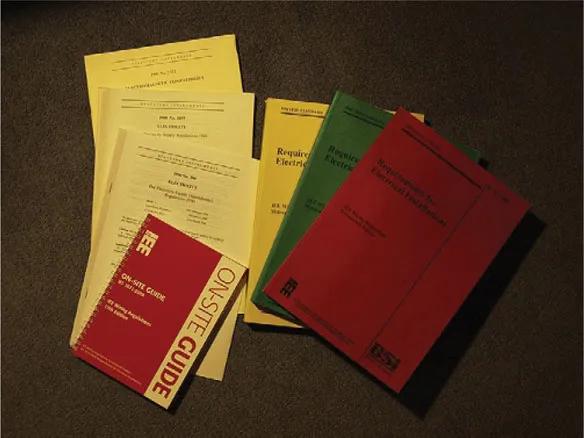
Figure 1.1 Regulations. It is essential before designing or installing electrical equipment to obtain and study copies of the relevant British Standards, Regulations and other guidance documents. A selection of these is illustrated here.
Statutory regulations include:
Type of installation/
activity |
Regulation |
Administered by |
| Installations in general (with certain exceptions) | Electricity Safety, Quality and Continuity Regulations 2002 and amendments | Secretary of State |
| All installations in the workplace including factories and offices | Electricity at Work Regulations 1989 and amendments | Health and Safety Executive |
| Management and design of installations | Construction (Design and management) Regulations 2007 | Secretary of State |
| Installation practice | Work at Height Regulations 2005 | Secretary of State |
| Electrical equipment | The Low Voltage Equipment (Safety) Regulations 1989 | Secretary of State |
| Buildings in general with certain exceptions (Separate Regulations apply in Scotland and N Ireland) | Building Regulations 2000 and amendments | Department for Communities and Local Government |
Non-statutory regulations include:
| Type of installation | Regulation | Published by |
| Installations in general (with certain exceptions) | Requirements for Electrical Installations. IEE Wiring Regulations Seventeenth Edition BS 7671: 2008 | British Standards Institution and the Institution of Engineering and Technology |
| Installations on construction sites | BS 7375: 1996 | British Standards Institution |
| Conduit systems | BS EN 61386: 2004 | British Standards Institution |
| Trunking and ducting systems | BS EN 50085 | British Standards Institution |
| Accommodation of building services in ducts | BS 8313: 1997 | British Standards Institution |
| Installations in explosive atmospheres | BS EN 60079: 2003 | British Standards Institution |
| Emergency lighting of premises (other than cinemas and similar premises) | BS 5266: 1999 | British Standards Institution |
| Fire detection and alarm systems in buildings | BS 5839: 2002 | British Standards Institution |
| Protection of structures against lightning | BS EN 62305: 2006 | British Standards Institution |
| Industrial plugs, sockets and couplers | BS EN 60309: 1999 | British Standards Institution |
| Uninterruptible power supplies | BS EN 62040 | British Standards Institution |
| Earthing | BS 7430: 1998 | British Standards Institution |
1.2 THE ELECTRICITY SAFETY, QUALITY AND CONTINUITY REGULATIONS 2002
The Electricity Safety, Quality and Continuity Regulations 2002 came into effect on 31 January 2003 and were drawn up with the object of securing a proper supply of electrical energy and the safety of the public. An amendment, effective from October 2006, introduced a number of changes. The regulations replace The Electricity Supply Regulations 1988 and subsequent amendments up to and including those issued in 1998.
The Regulations apply to all ‘duty holders’ concerned with the supply and use of electrical energy and these include generators, distributors, transmitters, meter operators and others supplying electricity to consumers. They also apply to the agents, contractors and subcontractors of any duty holders.
As with the earlier regulations, parts of the 2002 regulations apply to the supply of electricity to consumer’s installations (Regulations 23–29 inclusive) and give the electricity distributor powers to require certain standards of installation before giving or maintaining a supply to the consumer. Regulation 25(2) states that ‘A distributor shall not give his consent to the making or altering of the connection where he has reasonable grounds for believing that the consumer’s installation fails to comply with British Standard Requirements.’
If any installation is not up to the standard, the distributor may issue a notice in writing to the consumer requiring remedial works to be carried out within a reasonable period. The period required must be stated in the notice. If remedial works are not carried out by the end of the period specified, the distributor may disconnect (or refuse to connect) the supply and, in the event of such disconnection must set out the reasons in a further written notice.
A distributor may also disconnect a supply without giving notice, if such disconnection can be justified on the grounds of safety. In this event the distributor must give notice in writing as soon as reasonably practicable, giving reasons and details of remedial measures required. The distributor shall restore the supply when the stipulated remedial measures have been taken.
If there is a dispute between the distributor and consumer over the disconnection or refusal to connect, which cannot be resolved between them, the matter may be referred to the Secretary of State who shall appoint a suitably qualified person to determine the dispute. Following the determination, the distributor shall maintain, connect, restore or may disconnect the supply as appropriate, subject to any conditions specified in the determination.
1.3 IEE WIRING REGULATIONS – BS 7671
The full title is ‘Requirements for electrical installations – The IEE Wiring Regulations – Seventeenth Edition. BS 7671: 2008, and is based upon CENELEC (The European Committee for Electrotechnical Standardisation) Harmonisation Documents formed from IEC (International Electrotechnical Commission) standards. The requirements and some of the actual wordings are therefore similar to IEC standards.
The IEE Regulations are divided into the following parts:
Part 1 Scope, object and fundamental principles
Part 2 Definitions
Part 3 Assessment of general characteristics
Part 4 Protection for safety
Part 5 Selection and erection of equipment
Part 6 Inspection and testing
Part 7 Special installations or locations
There are also 15 appendices, and these are:
| Appendix 1 | British standards to which reference is made in the Regulations |
| Appendix 2 | Statutory regulations and associated memoranda |
| Appendix 3 | Time/current characteristics of overcurrent protective devices and residual current devices (RCDs) |
| Appendix 4 | Current-carrying capacity and voltage drop for cables and flexible cords. Tables are included for cables with copper or aluminium conductors |
| Appendix 5 | Classification of external influences |
| Appendix 6 | Model forms for certification and reporting |
| Appendix 7 | Harmonised cable core colours |
| Appendix 8 | Current-carrying capacity and voltage drop for busbar trunking and powertrack systems |
| Appendix 9 | Definitions – multiple source, d.c. and other systems |
| Appendix 10 | Protection of conductors in parallel against overcurrent |
| Appendix 11 | Effect of harmonic currents on balanced 3-phase systems |
| Appendix 12 | Voltage drop in consumers’ installations |
| Appendix 13 | Methods for measuring the insulation resistance/impedance of floors and walls to Earth or to the protective conductor system |
| Appendix 14 | Measurement of earth fault loop impedance: consideration of the increase of the resistance of conductors with increase of temperature |
| Appendix 15 | Ring and radial final circuit arrangements, Regulation 433.1 |
In addition to the Regulations themselves, the IEE also publish books of Guidance Notes and these include on-site and design guides.
The guides provide much additional useful information over and above that contained in the 17th edition of the Wiring Regulations themselves.
This present book is based upon the requirements of the 17th edition of the IEE Regulations, and the following comments on each part are offer...