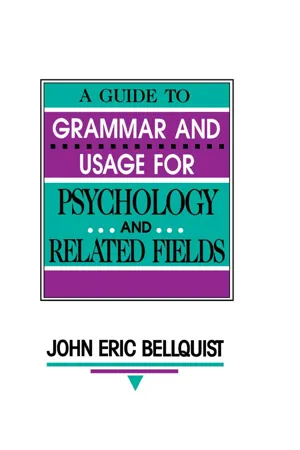
Why another book on this topic? The author's experience editing leading journals in psychology suggests that publication manuals and books on writing about experimentation in psychology do not adequately address grammatical usage and style. Much of the advice published for scientific writers reads as if it had been written either by English teachers for writers who do not publish in scientific fields, or by scientific writers who think that the information already available in countless handbooks on grammar and style for student writers in English classes is enough. Unfortunately, such traditional handbooks do not offer the particular sorts of commentary that scientific writers need.
This book offers specific advice on a host of issues ranging from the appropriate use of abbreviations to wordiness -- and how to avoid it. Dr. Bellquist's expertise in both the English language and the language of scientific writing ideally positions him to offer guidelines on the use of the passive, the best wording for statistical presentations, and just how to describe experimental procedures, among many other topics. Complete with examples and principles to guide writing decisions, this book will assist both students and seasoned professionals in presenting their work clearly for maximum impact. This book is intended as a guide to grammar and usage for writers in scientific fields -- particularly in experimental psychology and all fields related to experimental psychology. Features of the book include:
* alphabetical entries and numerous cross references on grammar, usage, and style;
* numerous examples taken from scientific papers or based on actual cases;
* discussions of semantic problems of grammar such as modification, predication, and statement;
* and discussions of usage specific to experimental psychology, statistics, and related fields.
- 216 pages
- English
- ePUB (mobile friendly)
- Available on iOS & Android
eBook - ePub
A Guide To Grammar and Usage for Psychology and Related Fields
About this book
Information
Publisher
Psychology PressYear
2014Print ISBN
9780805813531
9780805813944
Edition
1eBook ISBN
9781317781189
A
a, an. A and an are the two forms of the indefinite article in English. A is used before words that begin with consonants: a lexical decision task. An is used before words that begin with vowels: an effect. When a word begins with the voiced “h” in English, the word is construed as beginning with a consonant: a hit, a high-frequency tone. When a word begins with a silent “h,”, however, the word is construed as if it begins with a vowel: an honor, an honest person. (This silent “h” is a trace of the original pronunciation in French, where the initial “h” is always silent: honneur, honnête.) Despite what one occasionally sees in print or hears on the radio, the expression a history is therefore correct; the hypercorrected form an history is wrong. Another word that sometimes erroneously attracts an is hypothesis, which comes from Greek; but in both Greek and English, the initial “h” in this word is voiced: a hypothesis.
abbreviations, Latin. The discussion of scientific experiments includes the specification of problems, procedures, results, and their implications; it also includes the comparison of present effects or results, as well as of present research and its historical antecedents. The following abbreviations of Latin terms are often used to express such relationships.
Comparison
| cf. | confer, compare |
| vs. | versus, against |
Specification
| e.g. | exempli gratia, for example |
| etc. | et cetera, and so forth (literally: and other things) |
| i.e. | id est, that is |
| viz. | videlicet, namely |
These abbreviations do not need to be italicized to signify their foreign origin; they have long been English expressions in their own right. Note, too, that the punctuation does not necessarily reflect whether the respective abbreviation stands for one or two words in the Latin. Et cetera is two words, but it takes one period in its abbreviated form. It is therefore best to learn the conventional punctuation for each case separately.
The APA manual counsels that one use the preceding abbreviations within parentheses only; outside parentheses, they are to be spelled out, and their appropriate English counterparts should be used whenever common ones are available. Thus, for et cetera, one might use and so forth or and so on; and for id est, one should use that is; but versus has itself become an ordinary English word, so no counterpart for it is necessary.
Of the many other Latin abbreviations that may at times be useful, special attention should be paid to et al. (et alii, and others) and ad lib (ad libitum, in accordance with desire). Et al. is ordinarily used in APA style for citations of texts by three or more authors after their first mention, and for citations of texts by six or more authors always. It is never italicized or spelled out, and never translated. Note that al. is followed by a period. Ad lib is hyphenated when it is used as an adjective before the noun; otherwise it is not: ad-lib feeding, but the rats were fed ad lib. Ad lib, unlike et al., does not take the period, even though logic would suggest that it should.
For additional comments, especially with respect to semantic problems sometimes associated with the use of such abbreviations, see CF., E.G., I.E., SEE, VIZ., and VERSUS.
abbreviations of measurement. In general, one should follow the APA manual in abbreviating units of measurement; when this does not suffice, one should follow the guidelines provided by professional societies or organizations in other fields, and particularly those found in the publication manual of the American Institute of Physics. Yet there will always be some units of measurement that one cannot seem to find anywhere, and journals do differ: The journals of the Psychonomie Society, for example, do not follow the APA's guidelines in all respects. In fact, anyone who reads much in the field of experimental psychology will discover variation even within single journals, usually owing to editors' having followed the practice of particular authors, but sometimes owing to editorial inconsistency. The APA's own journals are no exception to this observation.
Here is a brief selection of common abbreviations of measurement; those with asterisks should be defined within parentheses on first use:1
| cd | candle(s), candela(s) |
| cm | centimeter(s) |
| cpd* | cycles per degree |
| cpm* | cycles per minute |
| cps* | cycles per second |
| deg,° | degree(s) |
| deg/s, deg/sec; °/s,°/sec | degree(s) per second (cf. dps) |
| dpi* | dot(s) per inch |
| dps* | degree(s) per second (cf. deg/s) |
| fc | foot-candle(s) |
| fL | foot-lambert(s) |
| ft | foot (feet) |
| g | gram(s) |
| hr,h | hour(s) |
| Hz | hertz |
| in. | inch(es); note the period |
| k | kilo-, except in kilobytes |
| K | kilobyte(s) |
| kc | kilocycle(s) |
| kg | kilogram(s) |
| kHz | kilohertz |
| kΩ | kilohm(s) |
| L | lambert(s) |
| m | meter(s) |
| M | molar concentration |
| MB | megabyte(s) |
| mg | milligram(s) |
| mHz | megahertz |
| min | minute(s) (time) |
| ' | minute(s) (plane angle) |
| mm | millimeter(s) |
| ms, msec | millisecond(s) |
| μs, μsec | microsecond(s) |
| N | newton(s) |
| Ω | ohm(s) |
| rpm | revolution(s) per minute |
| s, sec | second(s) (time) |
| ” | second(s) (plane angle) |
| V | volt(s) |
| W | watt(s) |
Note that of these abbreviations, only the one for inches takes the period, to avoid confusion with the word in: The circles were 2 in. in diameter.
As for the hyphenation of such abbreviations, consider the following examples (again, practice will sometimes vary):
a 5-s interval (a 5-sec interval)
an interval of 5 s (an interval of 5 sec)
a 3-min test
a test 3 min long
a 1- to 5-s interval (a 1- to 5-sec interval)
2-, 5-, and 10-s exposures (2-, 5-, and 10-sec exposures)
a 25-cm-diam platter
a platter 25 cm in diameter
a 12:12-hr lightidark cycle (a 12:12-h lightidark cycle)
5×7in. cards
a 25×25 cm box
an interval of 1-5 days
from 1 to 5 days
a temperature of 22-24° C
temperature from 22° to 24° C
Note that in general, the numeral and the abbreviation take the hyphen when they act together as a compound adjective before the noun, as in the first six examples just given; but when the adjectival construction becomes too complex, as in the example 5×7 in. cards, a 25 × 25 cm box, the hyphen is omitted.2
abbreviations, statistical. Among the many abbreviations of statistical or mathematical terms, the following are common:
...Table of contents
- Cover
- Half Title
- Title Page
- Copyright Page
- List of Entries
- Preface
- A
- B
- C
- D
- E
- F
- G
- H
- I
- J, L
- M
- N
- O
- P, Q
- R
- S
- T
- U, V
- W
- Endnotes
- Selected Bibliography
Trusted by 375,005 students
Access to over 1.5 million titles for a fair monthly price.
Study more efficiently using our study tools.
Frequently asked questions
Yes, you can cancel anytime from the Subscription tab in your account settings on the Perlego website. Your subscription will stay active until the end of your current billing period. Learn how to cancel your subscription
No, books cannot be downloaded as external files, such as PDFs, for use outside of Perlego. However, you can download books within the Perlego app for offline reading on mobile or tablet. Learn how to download books offline
Perlego offers two plans: Essential and Complete
- Essential is ideal for learners and professionals who enjoy exploring a wide range of subjects. Access the Essential Library with 800,000+ trusted titles and best-sellers across business, personal growth, and the humanities. Includes unlimited reading time and Standard Read Aloud voice.
- Complete: Perfect for advanced learners and researchers needing full, unrestricted access. Unlock 1.5M+ books across hundreds of subjects, including academic and specialized titles. The Complete Plan also includes advanced features like Premium Read Aloud and Research Assistant.
We are an online textbook subscription service, where you can get access to an entire online library for less than the price of a single book per month. With over 1.5 million books across 990+ topics, we’ve got you covered! Learn about our mission
Look out for the read-aloud symbol on your next book to see if you can listen to it. The read-aloud tool reads text aloud for you, highlighting the text as it is being read. You can pause it, speed it up and slow it down. Learn more about Read Aloud
Yes! You can use the Perlego app on both iOS and Android devices to read anytime, anywhere — even offline. Perfect for commutes or when you’re on the go.
Please note we cannot support devices running on iOS 13 and Android 7 or earlier. Learn more about using the app
Please note we cannot support devices running on iOS 13 and Android 7 or earlier. Learn more about using the app
Yes, you can access A Guide To Grammar and Usage for Psychology and Related Fields by John Eric Bellquist in PDF and/or ePUB format, as well as other popular books in Psychology & Education in Psychology. We have over 1.5 million books available in our catalogue for you to explore.