Providing role models of excellence for contemporary women and men and contributing to the understanding of the educational and career development of high achieving women, these autobiographical essays of seventeen women and their achievements generate a deeper appreciation of the vital role of women in the development of contemporary psychology.
eBook - ePub
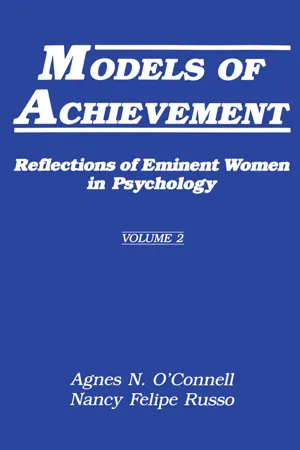
Models of Achievement
Reflections of Eminent Women in Psychology, Volume 2
- 400 pages
- English
- ePUB (mobile friendly)
- Available on iOS & Android
eBook - ePub
Models of Achievement
Reflections of Eminent Women in Psychology, Volume 2
About this book
Information
Publisher
Psychology PressYear
2014Print ISBN
9780805803228
9780805800838
Edition
1eBook ISBN
9781317785897
PART I
GENERAL INTRODUCTION
CHAPTER 1
A New Vision of Women in Psychology
The purpose of these volumes is to present a new way of looking at women in psychology and in society. One way this new vision can be brought into sharp focus is by preserving and making visible the often unrecognized and undervalued accomplishments of women in the field. Women have made significant contributions to the cornerstones of thinking in psychology since its inception, but appropriate acknowledgment has not yet been made. These autobiographies respond to the historical neglect of women’s roles and contributions and give these remarkable women the opportunity to define and interpret their experiences in their own words. From these autobiographies and accomplishments, a new vision of women in psychology begins to emerge.
An outcome of this new vision is the illumination of women as role models. Role models are needed to aid in the acculturation of women into psychology. The professional advantages of same-sex role models in the lives of prominent women have been well documented (e.g., Almquist & Angrist, 1975; Goldstein, 1979), and these advantages also apply to reading about distinguished women (Walum, cited in Douvan, 1974). Although the number of women psychologists is increasing, there are still too few to fill the need for role models. In 1984, women earned 50.1% of the doctorates awarded in psychology (APA [American Psychological Association] Committee on Women in Psychology, 1986). The majority of psychology students in graduate schools are women (all subfields combined). Yet ironically, only one in four full-time faculty members is a woman, and the role models available in graduate departments continue to be predominantly men. For women to see the realization of their own aspirations in the lives of other women is a crucial source of support and inspiration during difficult times (Douvan, 1974). Much wisdom and inspiration are to be gained from the varied combinations of perseverance, determination, dedication, humility, humor, and achievement contained in the lives of these eminent women.
In this volume, the new vision is shaped by the lives of women who are more contemporary than those whose autobiographies are contained in our earlier work. The inclusion of younger eminent women reflects the response to requests from colleagues and students as well as our own interest in examining the historical evolution of the lives and achievements of women in psychology. Thirteen of the 17 women in the first volume were born between 1897 and 1913 and earned their doctorates between 1927 and 1939. In contrast, 12 of the 17 women in this volume were born between 1915 and 1936 and earned their doctorates between 1942 and 1967.
The criteria for choosing the women in this volume include a sustained record of achievement over a significant period of time; achievement that has withstood the clarifying filter of time; being a pioneer; being a leader or expert. These women represent a wide range of subdisciplines, remarkable accomplishments, and varying life styles. They are women of great creative achievements whose lives do not follow the beaten path. They are women whose indomitable spirit make the pursuit of challenge and achievement possible in the face of discrimination, humiliation, trivialization, and other barriers.
Some come from professional families; some from poor and disadvantaged backgrounds. They have experienced sexism, racism, anti-Semitism, and issues of acculturation in their educational and professional pursuits and in their daily lives. They have overcome these barriers with courage and grace. Despite obstacles, they have made extraordinary contributions to psychology in academe, industry, and government. Their work reaches the highest standards of excellence—whether it is in theoretical or applied or in traditional or emerging areas. Their personal lives represent a cross-section of the life styles available to women in the 20th century. They are single, married and childless, married with children, single parents, and grandmothers.
Our invitation to participate in the celebration of eminent women and their work by contributing an autobiography to these volumes generated a variety of responses—from gracious acceptance to strong resistance. Despite their undeniable accomplishments, several of the women perceived their leadership and contributions to psychology as “serendipitous,” the result of “chance encounters,” “luck,” or the “interaction of time, place, people, and circumstances” and expressed feelings of embarrassment or surprise at our invitation. These disclaimers of ability reflect humility and an attributional style that did not exclude these women from high achievement. “Luck” requires being prepared to respond to opportunity’s knock, is difficult to separate from strategy, and may very well be the residue of skill.
Close examination of their autobiographies reveals that these women are in charge of their lives. Each is unique in her definition of fulfillment and the specific configuration of her choices, but they all possess the remarkable strength, talent, resiliency, and flexibility to influence as well as be influenced by their surroundings.
Historical events shaped the nature and number of opportunities open to these women. The affluence and optimism following World War I gave way to hard times during the depression of the 1930s. World War II brought educational and employment opportunities for women, but its aftermath brought retrenchment. It was not until the women’s movement of the 1960s and 1970s that new gains were made, and women in psychology played a role in forging those gains.
Since the 1970s, five women have achieved the distinction of serving as president of APA: Anne Anastasi (1972), Leona E. Tyler (1973), Florence L. Denmark (1980), Janet Taylor Spence (1984), and Bonnie R. Strickland (1987). Their autobiographies are contained in this volume. Only two other women, Mary Whiton Calkins (1905) and Margaret Floy Washburn (1921), have achieved that distinction since APA was founded in 1892. Their biographies are contained in a special issue of Psychology of Women Quarterly (O’Connell & Russo, 1980).
The impact of the gains of the 1960s and the 1970s is evident in many of the autobiographies presented here. Yet, decades after the resurgence of the women’s movement, equality is yet to be fully realized. What is required is a revolution of vision, a new way of perceiving women. What is required is the perception of women as exemplars, as fully functioning, competent, capable contributors to psychology and to society—without the covert reservations of societal or cultural stereotypes. It will take wisdom, dedication, and energy to ensure a future marked by excellence, progress, and opportunity.
The lessons contained in these autobiographies provide a foundation for achieving this new vision and these goals. To clarify the lessons to be learned, this book considers the contributions of women in psychology from three levels of analysis. Nancy Felipe Russo presents the universal level in a chapter on the social and historical context. Agnes N. O’Connell presents the group level in a chapter on the similarities and differences in the lives of these eminent women. The distinguished women themselves present the individual level in their autobiographies.
We hope that the lessons contained in the lives of these distinguished women will be learned wisely and well by both women and men. We also hope that these volumes will be the catalyst for a rippling revolution of vision, a new way of looking at women in psychology and in society, a new vision of women as exemplars and major contributors across time.
REFERENCES
Almquist, E. M., & Angrist, S. S. (1985). Careers and contingencies. Amherst: University of Massachusetts Press.
APA Committee on Women in Psychology. (1986). Report on women in psychology. Washington, DC: American Psychological Association.
Douvan, E. (1974). The role of models in women’s professional development. Psychology of Women Quarterly, 1, 5–20.
Goldstein, E. (1979). Effect of same-sex and cross-sex role models on the subsequent academic productivity of scholars. American Psychologist, 34 (5), 407–410.
O’Connell, A. N., Russo, N. F. (Eds.). (1980). Eminent women in psychology: Models of achievement [Special issue]. Psychology of Women Quarterly, 5(1).
PART II
HISTORICAL PERSPECTIVES
CHAPTER 2
Women’s Participation in Psychology: Reflecting and Shaping the Social Context
Women’s entry into and participation in psychology are integrally linked with a myriad of overlapping and interweaving social and economic factors that have shaped America culture in the 20th century. These factors include women’s struggle for sufferage, reform movements (including the progressive education and child welfare movements), the expansion of higher education, the trend toward professionalism, World War I, the Great Depression, World War II and its social and economic aftermath, the civil rights movement, and the resurgence of the women’s movement in the 1960s and 1970s.
Psychology in the United States began its growth at the end of the 19th century, at a time of great economic and social change, when belief in women’s innate altruism and moral superiority was used to justify women’s participation in public life and societal reform (Hymowitz & Weissman, 1978). The early feminists who organized the 1848 Seneca Falls Convention wanted sufferage as a means to ensure equality for women. But political realities led them to exploit (and thus reinforce) the rhetoric of the reform movements. It was argued that the vote was needed so that “women could ‘stand maternal watch for the nation’s children’ at the ballot box” (Ryan, 1983, p. 214). Women’s access to higher education, better conditions of employment, and equal political rights were all justified as means to expand the maternal domain and enable women to “clean up” society (Klein, 1984; Ryan, 1983).
The increased emphasis on child welfare was accompanied by a societal trend toward professionalism in the 20th century. A belief in a “professional approach to child care” emerged, and science was used to argue for women’s greater access to higher education. The role of “mother” became viewed as “a scientific vocation that required intelligence and training” in order to produce vigorous, healthy male citizens to serve in the nation’s armed forces in World War I (Filene, 1975). The goal of melding science and motherhood in the service of child welfare provided a rationale for women’s higher education and legitimized women’s participation in the world of work.
THE EMERGENCE OF APPLIED PSYCHOLOGY
What women were doing in applied settings was considered to be secondary to the “real” psychology that was developing in academic settings in which women were more likely to be excluded from regular faculty appointments. Yet, as described by Russo (1983), during the first three decades of the 20th century, society’s interest in progressive education and in child welfare stimulated psychological research on child development, mental retardation, and mental testing. Women found opportunities for education and employment in these areas of applied psychology, which were considered congruent with women’s special talents, interests, and abilities.
The psychological clinics and child guidance and child welfare institutes that emerged from these movements provided supportive work environments for women. The first psychological clinic, established by Lightner Witmer at the University of Pennsylvania in 1896, was founded “for the study and treatment of children who were mentally or morally retarded and of those who had physical defects that slowed development or progress” (French, 1984, p. 976). In 1900, Anna McKeag became the first person to receive a PhD from the clinic. Eight of Witmer’s first 25 doctoral students were women (French, 1984). Women became pioneers in the development and application of psychological tests and have continued to make major contributions to tests and measurements in psychology (Denmark, 1980; Russo & Denmark, 1987; Russo & O’Connell, 1980; Sexton, 1969, 1973–1974). In this volume are Anne Anastasi, Marie Skodak Crissey, Erika Fromm, Olga E. deCillis Engelhardt, Jane Loevinger, Patricia Cain Smith, Frances K. Graham, Martha T. Mednick, Janet Taylor Spence, Bonnie R. Strickland, and Leona E. Tyler—all have made contributions to tests and measurements in psychology. Crissey’s autobiography, in particular, discusses the evolution of research with intelligence tests in the 1930s.
In 1909, the Juvenile Psychopathic Institute, considered to be the first mental health clinic, was established in Chicago by psychiatrist William Healy and psychologists Augusta F. Bronner and Grace Fernald. Child guidance clinics spread in the 1920s; in 1924, child guidance clinicians founded the American Orthopsychiatric Association. In 1931, Bronner became its president (Reisman, 1976).
The institutes for child study that spread during the 1920s enabled women to pursue scientific research in child development. Such institutes created a source of employment for women who were typically denied access to regular faculty positions in academe (outside the women’s colleges), giving them access to stimulating colleagues and research facilities. The list of women associated with these institutes reads like a Who’s Who of women psychologists and includes Lois Hayden Meek Stolz, Tyler, Crissey, and Dorothy Hansen Eichorn, who are included in this volume.
Thus, the progressive education and child welfare movements provided educational and employment opportunities for women while shaping their aspirations and interests as well. Further, these movements led to the establishment of institutional structures encouraging sex segregation in psychology that was not to be challenged effectively until the women’s movement reemerged in the 1960s and 1970s. Their impact can be seen in the higher proportions of doctorates awarded to women from 1920 to 1974 in sub-fields specializing in knowledge related to these movements: developmental (48%), school (32%), education (25%), clinical (24%), and counseling and guidance (24%). In contrast, 6% of the PhDs in industrial-organizational psychology went to women (Russo, 1984).
WOMEN AND SCIENTIFIC PSYCHOLOGY
As higher education expanded in the 1920s and 1930s, so too did opportunities for women’s education. Women began to trickle into all fields of science but particularly into those congruent with society’s conceptions of women’s abilities—psychology, sociology, economics, and applied chemistry in home economics (Rossiter, 1974; Solomon, 1985). As we have seen, the demand for applied psychological knowledge related to topics considered to be in women’s traditional domain created applied subfields that provided a place for women psychologists to pursue research in areas congruent with society’s gender stereotypes, and female scientists have continued to choose psychology in greater proportions than male scientists. In the years between 1920 and 1974, before the major impact of the women’s movement on science, 5.7% of the PhDs awarded to men were in psychology compared to 15.2% of PhDs awarded to women. In 1983, 1 in 4 female doctoral scientists were in psychology compared to 1 in 10 male doctoral scientists (National Science Foundation [NSF], 1986).
The disadvantaged status of women in academe has affected women’s ability to fulfill their scientific potential in psychology. In 1984, 50.1% of PhD recipients in psychology were women, but only 22% of the full-time positions in psychology departments were occupied by women—a proportion unchanged from the 194...
Table of contents
- Cover
- Half Title
- Title Page
- Copyright Page
- Table of Contents
- Foreword
- Preface
- PART I General Introduction
- PART II Historical Perspectives
- PART III Personal Perspectives: Autobiographical Sketches
- PART IV Perspectives on Patterns of Achievement
- Index
Trusted by 375,005 students
Access to over 1.5 million titles for a fair monthly price.
Study more efficiently using our study tools.
Frequently asked questions
Yes, you can cancel anytime from the Subscription tab in your account settings on the Perlego website. Your subscription will stay active until the end of your current billing period. Learn how to cancel your subscription
No, books cannot be downloaded as external files, such as PDFs, for use outside of Perlego. However, you can download books within the Perlego app for offline reading on mobile or tablet. Learn how to download books offline
Perlego offers two plans: Essential and Complete
- Essential is ideal for learners and professionals who enjoy exploring a wide range of subjects. Access the Essential Library with 800,000+ trusted titles and best-sellers across business, personal growth, and the humanities. Includes unlimited reading time and Standard Read Aloud voice.
- Complete: Perfect for advanced learners and researchers needing full, unrestricted access. Unlock 1.5M+ books across hundreds of subjects, including academic and specialized titles. The Complete Plan also includes advanced features like Premium Read Aloud and Research Assistant.
We are an online textbook subscription service, where you can get access to an entire online library for less than the price of a single book per month. With over 1.5 million books across 990+ topics, we’ve got you covered! Learn about our mission
Look out for the read-aloud symbol on your next book to see if you can listen to it. The read-aloud tool reads text aloud for you, highlighting the text as it is being read. You can pause it, speed it up and slow it down. Learn more about Read Aloud
Yes! You can use the Perlego app on both iOS and Android devices to read anytime, anywhere — even offline. Perfect for commutes or when you’re on the go.
Please note we cannot support devices running on iOS 13 and Android 7 or earlier. Learn more about using the app
Please note we cannot support devices running on iOS 13 and Android 7 or earlier. Learn more about using the app
Yes, you can access Models of Achievement by Agnes N. O'Connell,Nancy Felipe Russo in PDF and/or ePUB format, as well as other popular books in Psychology & History & Theory in Psychology. We have over 1.5 million books available in our catalogue for you to explore.