- 222 pages
- English
- ePUB (mobile friendly)
- Available on iOS & Android
eBook - ePub
About this book
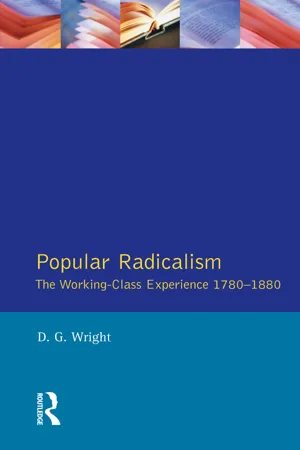
This well-argued and richly-detailed book concludes that the working-class radical movement was never able to prove a serious challenge to the stability of the British state; and, in fact, achieved very little in these years, except when operating in conjunction with the political movements and organizations of the middle class.
Chapter 1
Introduction: Class and Class Consciousness
In his Progress in Pudsey, published in 1887, Joseph Lawson, a sixtyfive-year-old former woollen manufacturer and Chartist, complained that ‘one serious fault in most of the histories we read when young, and which deeply impressed us at the time, was the everlasting scribble about the kings and queens, nobles and dukes, generals and their feats in various battles, and the consequent wholesale suffering, murder and death. There was very little about the large masses of the people – what they were thinking, doing and suffering’. Were Lawson writing a century later, he could make the same complaint, for it is really only during the last thirty years that there has appeared a daunting, if extremely stimulating, amount of research and writing on ‘the large masses of the people’. Nowadays there is as much, if not more, research concerned with ‘history from below’ as with ‘history from above’, especially with the emergence of social history as a distinct discipline, rather than being the subordinate of economic history.
The history of the English working class since the eighteenth century does, however, pose a number of difficulties for students. One is the sheer amount of published material and the complexity of the vigorous historical debates which it has prompted. Another is that the topic has, since the 1930s when Marxism first made a significant impact on British intellectuals, been something of an ideological battleground, with historians frequently seeking to employ history as a weapon in present politics. Political axes have been well ground before being wielded in fierce historical disputes on the question of working-class living standards during the industrial revolution, the extent of revolutionary class consciousness during the early nineteenth century, and the alleged embourgeoisement of many skilled workers after 1850.
Such controversies remain alive. Even the old ‘standard of living’ debate, which dates back to the revisionary writings of the ‘optimist’ Sir John Clapham from the late 1920s, remains far from concluded. Reassessments of the rate of economic growth before 1830 suggest that optimistic assumptions by scholars like T. S. Ashton and R. M. Hartwell of population growth being consistently outpaced by the expansion of the national product rest upon presuming too rapid a rate of economic growth. Hence there is still much to be said for the ‘pessimistic’ arguments of the Webbs, Hammonds, E. J. Hobsbawm and E. P. Thompson (Rule 1986: 27–43; 379–82). It is therefore not easy to reach anything approaching a detached and balanced view on such contentious issues. Perhaps attempts to do so are misguided. As Margaret Cole once recalled of her childhood: ‘Our household was non-political. That is to say, Tory.’
For the historian of popular radicalism, a fundamental historical controversy is that concerned with the existence of a working class; not so much in the sense of large numbers of men and women who owned virtually nothing but their labour power, but of a working class conscious of possessing an identity and interests separate from, and often antagonistic towards, those of the propertied classes. The use of the word ‘class’ to describe social groups became common only in the early nineteeth century. Although eighteenth-century society was a profoundly unequal one, social cleavages did not yet run along the lines of the more horizontal class divisions discernible by the 1830s and 1840s. When they referred to the major divisions in society, eighteenth-century observers like Archdeacon Paley or Edmund Burke tended to employ the language of ‘ranks’ and ‘orders’, as in ‘middle ranks’ or ‘lower orders’. This terminology was deemed appropriate for a hierarchial society of ascending ranks and degrees, held together by bonds of patronage firmly in the hands of those high in the social scale and by ties of dependence which bound those lower down the social scale to those above them: the tenant to his landlord, the labourer to his employer.
This concept of a community of shared interests in agrarian England has also been applied to manufacturing, where a ‘vertical’ consciousness of ‘the trade’ bound masters and men, capital and labour, together in a context of shared mutual interests. Although such consciousness did not prevent considerable conflict between capital and labour taking place, such disputes proved short-lived within the parameters of a perceived common interest. Such a view can be taken too far, given the frequency of food riots, turnpike riots and industrial strikes. Alongside the eighteenth-century language of ranks and orders existed another which expressed unambiguous fear of ‘the mob’. Nevertheless, it remains true that articulation of a separate labour interest was usually temporary. As Dr Rule points out: ‘Bitter exchanges, sometimes violent strikes and sharply articulated hostility often gave way after settlement to an expressed preference for an ordered world in which masters and men both knew their place and the duties that went with it’ (Morris 1979:18; Rule 1986: 384).
After 1780 the language of ranks and orders slowly began to be replaced by the language of class, so that by mid-ninteenth century the old terminology, though still in use, was being substituted by the categorizations ‘working classes’, ‘middle classes’ and ‘aristocracy’, or, even more precisely, ‘working class’ and ‘middle class’. Such a change in linguistic usage implicitly recognized that social conflict had become focused on the clash of interests arising from the distribution of wealth, income and power (Rose 1981: 255; Morris 1979: 9).
The Creation of the English Working Class
No serious historian, including those most impressed by the gradations and divisions among the working class, denies that a working class, as a descriptive category for people who existed by selling their labour power, came into existence during the late eighteenth and early nineteenth centuries. From about the middle of the eighteenth century, English society was increasingly transformed by a series of virtually simultaneous revolutions: demographic, transport, agrarian and industrial. A sustained increase in population began around 1740, whereby the 5 million people in England and Wales in 1700 rose to 71/2 million in 1780, 9 million in 1801, 18 million in 1851 and 26 million in 1881. Such unprecedented growth involved a massive increase in the supply of labour; during the first half of the nineteenth century the labour force more than doubled. It also meant a vastly increased number of people to feed, clothe and house. While it is true that the various revolutions interacted to produce, over the period as a whole, an output of goods and services which outpaced the increase in population, growth took place at an uneven rate and imposed much deprivation and suffering on substantial groups of labouring people. It is important to bear in mind that a good deal of economic growth occurred before the advent of the factory system on any scale. Factories only became dominant in the second half of the nineteenth century. Indeed, the initial impact of the industrial revolution, with only limited application of steam power, was to expand both the numbers and the output of hand-workers in the domestic and small workshop system, workers who continued to outnumber factory operatives until at least 1851.
Between 1700 and 1880 the most significant change in the structure and scale of the labour force was the shift away from agriculture into manufacturing. In 1700 perhaps between a quarter and a half of the occupied population were engaged in manufacture and mining; fifty years later trade and manufacturing together probably employed more workers than agriculture. By 1801 it looks as though over 40 per cent were involved in manufacture and trade, as against 36 per cent primarily engaged in agriculture, although it is difficult to be precise because of the haphazard nature of the occupational censuses and the lack of a clear definition of the ‘working population’. There is the further problem of the many people who worked simultaneously in industry and agriculture. According to the 1851 census, 43 per cent of the occupied population were in manufacture and mining. Thereafter the proportion rose only slightly, as the continuous decline in agricultural employment was balanced by an increase in tertiary, rather than manufacturing, occupations, although agriculture, with 1,790,000 workers, was still the largest single occupation in 1851.
In many sectors of the capital goods industry, the expansion of the labour force was accompanied by an increase in the unit of production and the number of workers on each site: in shipyards, mines, quarries, ropeworks, glassworks and brickyards. Technological innovation in these sectors was limited. There was none, for example, in the hewing of coal, yet the number of miners rose from about 50,000 in 1800 to 219,000 in 1851, while the pits themselves employed greater numbers. So far as consumer goods industries were concerned, the bulk of the workforce remained outside the factory system, which as late as the mid-nineteenth century predominated only in the manufacture of cotton and worsted cloth. The 650,000 workforce in East Midlands stocking-knitting and lace-making, as well as 14,000 in the Sheffield cutlery trades, were largely untouched by the factory system. In Birmingham, as in Sheffield, small-scale artisan production persisted in metal goods manufacture, despite the existence of a few large enterprises. The garment industry, including tailors, seamstresses, milliners and glovers, with a total workforce of well over 600,000 in 1851, was small-scale and unmechanized, as was shoemaking with 243,000. Small masters also predominated in the building industry (600,000) and also, to a slightly lesser extent, in pottery manufacture.
Machine-operatives in factories were therefore only a relatively small minority of the total workforce as late as 1851. The census of that year revealed that there were only 1,750,000 workers in mechanized industry, employing steam-driven machinery, and 5,500,000 in non-mechanized industry. Mechanized industry therefore employed less than a quarter of the industrial workforce even when mining, rather misleading, was classified as mechanized. As in the eighteenth century, industrial production involved the employment of a great deal of female and child labour, with women concentrated in the lighter branches of industry and excluded from the workshop craft trades. On the other hand, it is doubtful whether the industrial revolution meant any significant increase in the female proportion of the workforce, given the ubiquity of women workers in the pre-1780 economy. Child labour is more problematic. Dr Hunt, for example, argues that it was in decline even before 1850 and was probably less extensive than before 1780. But the 1851 census figure of about a third of children aged under fifteen engaged in paid employment is probably a considerable underestimate, omitting the many children who assisted adult workers or were employed in household production.
Industrialization in Britain took place alongside a process of very rapid urbanization. Only London had a population over 50,000 in 1750; but by 1851 there were 29 towns over 50,000 and 9 with over 100,000, while London’s population had increased to 21/2 million. Between 1801 and 1851, for example, the population of Birmingham rose from 71,000 to 233,000, Manchester 75,000 to 303,000, Sheffield from 46,000 to 135,000 and Bradford from 13,000 to 104,000. A large proportion of the working population had to adjust not only to industrialization, but also to the manifold problems of urban existence, including intense overcrowding and horrific sanitary conditions. The increasing concentration of the workforce in urban areas obviously acted as a stimulant to working-class radicalism; Marx himself argued that urban proximity of work and residence was a major precondition for the emergence of a self-conscious and militant working class.
As it was, changes in the structure and scale of both industry and agriculture involved inexorable proletarianization for a large proportion of the workforce. If hand technology and much small-scale production persisted in industry, then the workers involved were often subject to significant changes, as many of them found it increasingly difficult to maintain their privileges if they were skilled men, as well as to retain control over the labour process or to resist intensification of the pace of work and even wage reductions. The decline of textile handloom weavers and Nottingham and Leicester framework stocking knitters are but two outstanding examples of extreme deprivation and suffering under the impact of plummeting living standards during the first half of the nineteenth century. Occupations like tailoring and shoemaking were subject to ‘sweating’ as mass-production methods developed, employing cheap labour to produce lower-priced but inferior goods. Capitalist exploitation was not confined to the factory system, since many trades which remained immune to factory production were structurally transformed with the expansion of merchant capitalism and the ‘putting out’ system. Over many key sectors of industry, workers ceased to own the materials on which they worked or the finished products of their labour, being reduced merely to selling their labour power. At the same time, those brought into the factory system lost control over the pace of the labour process as they became subject to the programmed rhythms of machine industry, to the clock and the factory hooter and no more ‘Saint Monday’.
In fact proletarianization, in the sense of people who were obliged to earn their living by selling their labour power, had already made substantial progress as early as 1750, when a substantial proportion of England’s population already depended on wages. The crude occupational census of 1811 showed that manual workers of all kinds accounted for four-fifths of the entire population. Wage labour was therefore widespread before the industrial revolution, with groups like East Midlands framework knitters and West Country weavers entirely dependent on work put out by capitalist weavers and clothiers, who collected and marketed the product, paying wages in the form of piecerate ‘prices’. Southern agriculture, rural cloth and metal working, as well as urban printing, tailoring and hat-making depended on a class of wage-earning journeyman labourers. Much domestic and workshop labour involved unremitting toil in wretched conditions by modern standards, although the intensity of labour varied with the amount of work in hand.
It therefore makes sense, as Dr Rule has argued, to speak of the existence of a ‘proletariat’ by the end of the eighteenth century, even if it were not as yet a self-conscious proletariat capable of mass action on a major scale, given the persistence of multifarious gradations and divisions among the workers. The chances of a journeyman who had served a full apprenticeship being able to set up as a small independent master became progressively reduced. Resentment on the part of skilled artisans at the erosion of their traditions and customary expectations, together with their desire to preserve the privileges and skilled status they were still able to retain, was to place them in the vanguard of both the trade unionism which pre-dated the classic industrial revolution period and the working-class radical movements which coincided with it (Stedman Jones: 1975; Hunt 1981:7–31; Rule 1986:1–2, 7–21; Hopkins 1979: 2–16).
Theories of Class
A major debate in modern social history focuses on the legitimacy of class terminology and, more specifically, whether the concept of a ‘working class’ serves as a useful category of historical explanation. Certainly use of the term ‘working class’ is fraught with historiographical, ideological and semantic difficulties. Even the most committed anti-Marxist historians employ the phrase adjectivally, as in ‘workingclass housing’, ‘working-class protest’ and so on. The debate itself is complicated by a lack of agreement on what exactly is meant by ‘class’. Some historians, like Hobsbawm and Foster, see class as tangible; measurable in terms of income, occupation, relationship to the means of production, area of residence and marriage patterns. Others, including Asa Briggs and E. P. Thompson, put the emphasis on awareness of class and habits of class; with class as the embodiment of common traditions, experiences and values, rather than as an economically homogeneous layer of social stratification.
Any debate on class necessarily has to confront the writings of Marx and ideological differences are at their sharpest over whether a Marxist-Leninist conception of the working class bears any close relationship to historical reality. There are those historians, themselves often left-wing political activists, for whom the Marxist-Leninist conception of class ‘forms the adored central mystery of a quasi-religious cult’ (McCord 1985). Conservative historians tend to doubt whether the employment of social categories like ‘working class’ and ‘middle class’ can be anything other than a handy, if essentially misleading, form of social shorthand, and question whether it is possible to refer in any precise way to a significantly, different middle and working class situated on either side of a discernibly sharp discontinuity in the social spectrum. There has therefore been considerable scepticism expressed about the extent to which class consciousness existed in the early nineteenth century, in terms of a recognition of conflicting interests binding together the disparate elements of a particular class in inexorable struggle against other classes. For such sceptics, words like ‘bourgeoisie’ and ‘proletariat’ are anathema, to be banished into limbo along with the ghosts of Marx and Lenin.
Such views, of course, represent an extreme case, as does the opposite view that a fully-fledged revolutionary proletariat had emerged in England by mid-nineteenth century. There are more moderate historians who accept readily enough the existence of a working class as a descriptive category for people who were engaged in manual wage labour and had similar lifestyles and material rewards, while at the same time denying the existence of widespread class conflict or the impossibility of collaboration between middle-class and working-class radicalism. There are also those who accept the development of a working-class consciousness in the sense of an awareness of a distinct class identity, while rejecting that this consciousness was ‘revolutionary’: aiming to overthrow the capitalist system rather than making reformist and opportunist gains within the system.
Marx and Lenin argued that an individual’s class was determined by the role he or she played in the production process; the fundamental distinction being between those who owned the means of production and those who owned only their labour power. Marx believed that the emergence of a new mode of production, based on steam power and large-scale capitalism, during the later eighteenth century led to the formation of new class relationships, with a wage-earning and propertyless working class confronting those capitalists who controlled the means of industrial productivity. A characteristic feature of the new mode of production was that workers became subordinated to the monotonous pace of power-driven machines in increasingly large factories, initially concentrated in the textile industry. A growing factory proletariat produced more and more, yet received minimal – even decreasing – wages in return for its labour. The result was surplus value and expanding profits for the capitalist factory owners and a profound sense of alienation for the proletariat. Factory workers became alienated not only from the goods they produced, but also from nature and from themselves.
Marx claimed that the working-class nucleus continued to expand after the beginnings of large-scale industrialization, assisted by the successive proletarianization and alienation of shopkeepers, artisans and peasants. Just as capitalism would absorb an already profitconscious aristocracy, so the myriad distinctions of skill and status within the ranks of labour would be rendered down to produce a proletariat united against its oppressors. Simultaneously, Marx described what he saw as having happened since the advent of industrialization, and predicted what would continue to occur until the final and inevitable collapse of the capitalist system, doomed by its own internal contradictions.
In other words Marx, not altogether consistently, depicted the working class suddenly emerging with the appearance of the factory mode of production in the 1760s, but also as slowly evolving towards maturity as it came to incorporate other alienated groups. Class conflict and class consciousness necessarily accompanied class formation, though tending to develop rather more slowly. Early attempts to destroy factories and machinery which competed with workers’ labour were succeeded by strategies for maintaining and advancing wage levels by means of national trade unions and political campaigns. However, Marx believed that even by the mid-nineteenth century the English working class had failed to reac...
Table of contents
- Cover
- Half Title
- Title Page
- Copyright Page
- Table of Contents
- Preface
- 1. Introduction: class and class consciousness
- 2. Origins 1770–89
- 3. Artisans and Jacobins 1789–1815
- 4. Radicals and Reformers 1815–30
- 5. Reform and Conflict 1830–8
- 6. The Chartist Challenge 1838–48
- 7. The Mid-Victorian Consensus 1850–80
- 8. Conclusion
- Bibliography
- Index
Trusted by 375,005 students
Access to over 1.5 million titles for a fair monthly price.
Study more efficiently using our study tools.
Frequently asked questions
Yes, you can cancel anytime from the Subscription tab in your account settings on the Perlego website. Your subscription will stay active until the end of your current billing period. Learn how to cancel your subscription
No, books cannot be downloaded as external files, such as PDFs, for use outside of Perlego. However, you can download books within the Perlego app for offline reading on mobile or tablet. Learn how to download books offline
Perlego offers two plans: Essential and Complete
- Essential is ideal for learners and professionals who enjoy exploring a wide range of subjects. Access the Essential Library with 800,000+ trusted titles and best-sellers across business, personal growth, and the humanities. Includes unlimited reading time and Standard Read Aloud voice.
- Complete: Perfect for advanced learners and researchers needing full, unrestricted access. Unlock 1.5M+ books across hundreds of subjects, including academic and specialized titles. The Complete Plan also includes advanced features like Premium Read Aloud and Research Assistant.
We are an online textbook subscription service, where you can get access to an entire online library for less than the price of a single book per month. With over 1.5 million books across 990+ topics, we’ve got you covered! Learn about our mission
Look out for the read-aloud symbol on your next book to see if you can listen to it. The read-aloud tool reads text aloud for you, highlighting the text as it is being read. You can pause it, speed it up and slow it down. Learn more about Read Aloud
Yes! You can use the Perlego app on both iOS and Android devices to read anytime, anywhere — even offline. Perfect for commutes or when you’re on the go.
Please note we cannot support devices running on iOS 13 and Android 7 or earlier. Learn more about using the app
Please note we cannot support devices running on iOS 13 and Android 7 or earlier. Learn more about using the app
Yes, you can access Popular Radicalism by D. G. Wright in PDF and/or ePUB format, as well as other popular books in History & Early Modern History. We have over 1.5 million books available in our catalogue for you to explore.