![]()
PART I
An overview of human development
Biology has no story to tell that is more fascinating than that of human development. A tiny fragment of matter, in the appropriate environmental context, is able to develop into a human baby. Birth, like the reality of stars in the heavens, is so common that we almost take it for granted. Yet for this event to occur, 266 days of cellular activity must pass with a precision that would impress the most critical of engineers.
To read and understand this text properly, the knowledge of basic terms, concepts, and anatomic landmarks is needed (Chapter 1). And to understand development, it is necessary to know something about cells, the interacting entities that result in development (Chapter 2) and genetics (Chapter 4). Two types of cell division (Chapter 3) are necessary for reproduction (Chapter 5) and development to occur. In addition to cell division, cells must also differentiate and become specialized members of the cellular society that is the human body. All of cell differentiation is fascinating, but none more so than gametogenesis (Chapter 6), the process by which seemingly ordinary cells give rise to the tiny motile sperm and the large expecting egg.
An enormous amount of human activity is concerned with fertilization—how to encourage it, how to prevent it, and humankind’s preoccupation with sexual behavior, originally designed to culminate in fertilization (Chapter 7). Fertilization launches human development.
In addition to continuing cell division and cell differentiation during embryogenesis (Chapter 8) and development of the fetus (Chapter 9), we see a third dramatic component of development, morphogenesis—the origin of form. Human development does not involve the growth of preformed parts but, rather, the gradual emergence of eyes and ears and arms and legs.
Development would not progress beyond the first week if it were not for the placenta, the most unique of human organs, and the umbilical cord (Chapter 10), through which the developing human communicates with the placenta. As the embryo and fetus grow, they need this life-support system. When studying the development of the baby, one must be mindful of the context in which this development occurs—the pregnant woman (Chapter 11). Then comes the day we celebrate annually for the rest of our lives, our “birth” day. We have no direct recollection of this event, but it is life-altering not only for us, but especially for our parents. Moreover, as dramatic as birth is, humankind, at least until the advent of fertility drugs, has been particularly enthralled by multiple births.
![]()
Chapter One
Before you begin
Chapter objectives
After studying this chapter, you should be able to:
1.Correctly use and interpret the following anatomic landmarks and terms: anatomic position, superior, inferior, cephalic, caudal, rostral, medial, lateral, proximal, distal, dorsum, dorsal, venter, ventral.
2.Understand symmetry and explain the difference between radial symmetry and bilateral symmetry.
3.Distinguish between planes and sections, and explain how the sagittal, frontal, and transverse planes divide the human body.
4.Explain the differences between the developmental timelines used by obstetricians and embryologists.
Before beginning our discussion of human development in the ensuing chapters, we need to learn some basic concepts that will guide the more detailed descriptions that follow later in the book. Our discussion will take place in this order.
•First, we will take up the “geographic” descriptions essential to any study of anatomy—adult or developmental.
•We will move to the fourth dimension—time—and briefly discuss the terminology used to discuss the progression of pregnancy.
•Finally, we will talk about comparative embryology. Although this book is primarily concerned with human development, many aspects of human development are particularly interesting when compared with that of other animals.
Anatomic descriptions
A large part of the content of human developmental biology is developmental anatomy. Anatomy is never static, but it is especially dynamic before birth. When you study the development of the human face during the second half of the embryonic period (the fourth through eighth weeks), you will be especially impressed by dynamic anatomy (morphogenesis).
To communicate about anatomy, it is necessary to have a common vocabulary shared by teacher and student; otherwise, the information transferred is not precise. This is especially true when the anatomy described is constantly changing. The terms explained here are frequently used in the descriptions in this text.
Anatomic landmarks
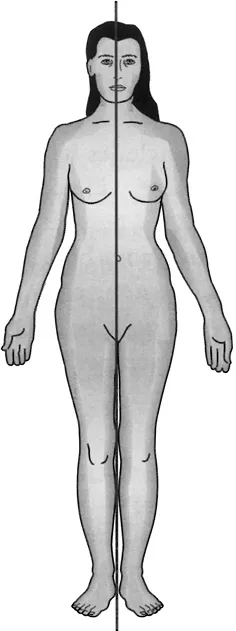
The anatomic position for a human is standing straight and upright, with arms at the sides and palms facing forward (Figure 1.1). The head is at the superior (top) end of the body, and other parts of the body are relatively inferior (below) to it. Because a dog walks on four legs, its head is anterior (front), and its tail is posterior (back). To avoid the confusion caused by four-legged and two-legged animals, we will use the term cephalic to refer to the head and the term caudal to refer to the tail of both. If we use these terms as adverbs rather than adjectives, they become cephalad (toward the head end) and caudad (toward the tail end). We may even refer to something on the head that is closer to the very end of the head than to some other reference point as rostral.
Figure 1.1Anatomic position and bilateral symmetry. The body is erect, the arms are at the sides of the b...