- 280 pages
- English
- ePUB (mobile friendly)
- Available on iOS & Android
eBook - ePub
About this book
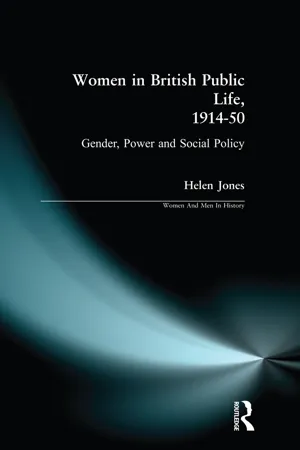
An examination of the ways in which women challenged the British educational, employment and welfare systems after the franchise. Helen Jones explores how women adapted their strategies to confront the system from within, and what constraints were imposed on them. She also examines the active role that British women played in Continental Europe, and an important comparative chapter looks at the experience of women in France, Germany, Italy, Australia and the USA.
Information
CHAPTER ONE
Introduction
The current position of women in politics
Twenty years after Britain’s first woman Prime Minister took office senior women politicians are still hot news. In the mid-1990s women’s role in national politics was again thrust centre stage with the controversy over women-only short lists for constituencies to select Labour Party candidates. Following the 1997 general election women MPs remained in the limelight. There were 120 women MPs elected of whom 101 were Labour, 14 Conservative and 6 from other parties. Women now comprised 18 per cent of MPs, a big leap up from the previous parliament. The dramatic increase in women MPs came largely on the Labour benches, due to Labour’s women-only short lists, already outlawed by the time of the election, coupled with Labour’s landslide victory.
As well as more women MPs, the number of women in government was greater than in the past, but not impressive. Tony Blair, the Prime Minister, appointed 5 women to his Cabinet; this figure, although not all the faces, remained unchanged after his first Cabinet reshuffle a year later. The arrival of increasing numbers of women in top jobs can be seen in many sections of society. In the professions women are catching up with men numerically but the more prestigious professions – and top positions within all professions – are systematically, although not exclusively, filled with men.
Following the 1997 general election serious analysis of Westminster gender politics was camouflaged under the popular press’s image of ‘Blair’s babes’. There has been a mushrooming of press coverage of women in politics, but little reflective analysis. Newspaper articles in the broadsheets on women in politics still refer to the women’s clothes and hair. The focus of media attention has been on the impact of more women MPs on the working of the House of Commons, and whether the structures are being put in place for more women-friendly policies to emerge across government. When in opposition, Labour had promised a Minister for Women with a seat in the Cabinet. In office, Blair tacked the responsibility on to another portfolio; it was an appendage to Harriet Harman’s role as Secretary of State for Social Security, 1997–98, and then, after her sacking, to that of Baroness Jay, Leader of the House of Lords, who eschews the label ‘feminist’. Blair also created a Women’s Unit, serviced by a small team of civil servants, to coordinate and promote women-friendly policies across Whitehall. All policy proposals should now carry an explanation of their implications for women. The Women’s Unit’s launch and now its workings are much more low-key than the Social Exclusion Unit, established on the same principles.
Harriet Harman, in her first major speech after the 1997 general election, claimed that it had been a turning point in women’s history. She went on to say that one of her principal concerns was to make sure that public policy recognised women’s changing roles and particularly their need to combine work and home responsibilities. Later, in February 1998, while still in the Cabinet, she claimed that the government was committed to ‘building and sustaining a new habit of governance that has women’s voices and women’s interests at its very heart’. A number of commentators have, however, asserted that gender politics are not fashionable under New Labour and that the coterie of ministers and advisors at the heart of government have created a ‘laddish’ culture. As a result of women’s campaigns many women’s issues have become mainstream, but in the process they have lost their radical edge and have been incorporated into a non-feminist agenda.
The question has been raised as to whether women MPs pursue women-friendly policies, as distinct from demanding more convenient working conditions for themselves. While the press has judged back-bench women largely by their commitment to women’s issues, they judge women Cabinet ministers more on perceptions of their general competence. It is too soon to make assessments of the current clutch of women politicians, and generalisations about them and policies for women are fraught with difficulties. Clear differences between women MPs are obvious. Not only do policy differences and strategies vary between women in the different parties, but there are also differences between the attitudes and policies of backbenchers and ministers, and long-serving MPs and new ones. It is difficult, too, to demarcate particular policies as being ‘women’s policies’; what may be ‘woman-friendly’ for one woman or group of women, may not be so for other women.
These debates over women’s role in national politics and policy making continue despite more than 70 years of women’s enfranchisement, entry into Parliament and presence in the civil service. Overcoming the enfranchisement hurdle (in part in 1918 and in full in 1928) was a huge achievement, but barriers to women’s full and equal participation in national politics and policy making remained in place. The extent of their entrenchment is evidenced by women’s continuing struggles at the turn of the twenty-first century. The main aim of this book is to examine women’s social policy priorities and strategies in the first flush of enfranchisement and in a period of extensive restructuring and extension of state welfare. It analyses the role of women in policy making and the mechanisms of discrimination which operated against them. It is a study of gender, power and social policy making.
Definitions of gender, power and social policy making
Gender refers to the social construction of differences between women and men. As it is socially created it is possible to change it, and for it to change over time, both between and within societies.
Political scientists argue at length over definitions of power. In the context of social policy making it is the ability to make appointments and to determine aspects of policy. It involves having the right, and the resources, to take advantage of opportunities to participate in full in the decision-making process. Ham and Hill have emphasised the dynamic nature of decision making for policies. Thus, they have argued that policy making involves a course of action, or a web of decisions, rather than one single decision at one particular time. They argue that a decision network of great complexity may be involved over a long period. Policies can, of course, be as much about resisting as facilitating change.1 As policy making is a process, often long-drawn-out, it was (and still is) important for women to be a part of the on-going process. It was (and is) not enough to offer opinions which may or may not be taken into account, or to be consulted on an arbitrary basis. It is important to be a consistent part, by right, of the policy process. One of the issues, therefore, with which this book is concerned is the role of women in policy making as politicians, civil servants or as experts in the fields of health and education.
It cannot be assumed that a member of any group, whether it be ‘women’ or civil servants, has a pre-determined set of attitudes and assumptions which is brought to bear on policy making. It is necessary to tease these out. The methodology for investigating the ideas behind policies is not straightforward. This book draws on written sources, both unpublished and published. There is always a problem of how far those committing their views to paper are willing, or indeed able, to express them in writing, and how far the process of committing thoughts to paper actually changes them. Civil servants may be working in a shared political and cultural environment where it is not considered necessary or desirable to state explicitly their assumptions; thoughts committed to paper may be only the tip of the ideological iceberg, or expressed in a culturally coded language.
The debate
Historians’ interest in governance during the period from 1914 to 1950 has focused on the way in which trade unions and employers’ organisations arguably became part of the central government decision-making machinery. This shared decision making grew, according to Middlemas, from access for consultation during the First World War to full-blown shared responsibility for policy making in the Second World War.2 Both Middlemas and his critics argue about the nature, speed and consistency of the process which he has identified. They do not attack the study for its lack of a gender analysis of policy making. Yet, employers’ organisations and the labour movement were both male-dominated and largely reflected an industrial male power base. At a time when there was increased, albeit uneven, male pressure group influence on government, women’s pressure group influence and role in policy making remained marginal.
Koven and Michel have shown how women, in a number of western countries, focused on influencing governments’ maternal and child welfare policies. They rightly argue that maternalist policies were not only concerned with the welfare and rights of women and children, but also with critiquing the wider state and society. They claim that women transformed motherhood from women’s primary private responsibility into public policy. While Koven and Michel maintain that women were a powerful influence in defining the needs of mothers and children, and in shaping institutions to meet these needs, a number of the chapters in their book consider the constraints on women in shaping policies and institutions. Although it is true, as Koven and Michel assert, that male bureaucracies, politicians and propaganda often encouraged women in their welfare work, nevertheless, they discouraged them when the women appeared to challenge either government policies or the processes and institutions which maintained male authority.3
A number of historians, who have looked at the influence of women on the emerging system of state welfare, have focused on the late nineteenth and early twentieth centuries. They argue that women had substantial influence on the development of the welfare state through voluntary organisations. Koven and Michel, Thane, Skocpol and Rutter, look at the late nineteenth and early twentieth centuries, yet it was in the 1940s that the main increases in state welfare took place.4
Here the focus is on the years of both world wars (1914–18 and 1939–45) and the years leading up to (1920s and 1930s), and including, the main period (1940s) of increased state welfare and restructuring of welfare provision. The aim is to provide an analysis of British women’s direct role in central government social policy making in an era of major social upheaval and restructuring of welfare provision.
Themes and arguments
During the Victorian and Edwardian years women had challenged the educational, employment and welfare systems. They had operated, for the most part, around the periphery of state power. Women had exercised considerable power in local charitable work and in local government. Developments in welfare provision then shifted from the local to the national stage, and for this reason the focus here is on national politics.
As the new century dawned women had successfully opened up for themselves a role in public life and had organised numerous pressure groups which lobbied governments for change. For a number of years governments had offered women ad hoc appointments as civil servants or places on government enquiries. The limitations of a temporary, outsider’s role in policy making have already been mentioned. This book looks at the opportunities for, and barriers to, women taking a full role in policy making at a time when Britain was moving towards greater political rights through enfranchisement and more social rights through a state welfare system. It will be explained how and why, despite these developments, and women’s manifest expertise and interest in social welfare, in areas such as health and education, women as a group were systematically discriminated against and excluded from the policy-making process. Women did not have the insiders’ ability to network informally but had to rely on more cumbersome, formal and less effective lobbying. Women’s role in policy making continued to be primarily as campaigners, not policy makers. Women’s campaigns often ran counter to government economic policy and entrenched attitudes, hostile both to policies advocated by women’s groups and to the women’s groups themselves.
Women campaigners attempted to stamp their ideas on domestic social policy making and to inject a social policy dimension into international affairs. They tried to play a part in the policy-making process through the civil service; through Parliament; through lobbying government; through teaching, nursing, medicine and social work, and through promoting charitable services, which it was hoped government would imitate.
Government departments’ targeting of resources and prioritising services often worked against women’s demands. Women’s whole approach was often more integrated and less compartmentalised than government organisation and attitudes could, or would, accommodate. Despite divisions between women, all the major welfare campaigns of the period recognised the unequal distribution of resources in families. The priority of women campaigners was poor working-class women and children in Britain, and middle-class women and children fallen on hard times on the Continent. From the First World War, British women were involved to an unprecedented extent with the welfare of continental Europeans. The gendered impact of poverty was the intellectual tree from which their campaigns and policies sprouted. The unemployment and fascism of the 1930s did not eclipse a gendered analysis of poverty, but contributed to one and gave it an added urgency.
The ability of women to contribute to policy in both world wars was strictly limited, even though they undertook responsible work in, and for, the government. Women were, for the most part, implementing decisions already taken. In both wars women were brought into government after certain key decisions affecting women had been reached. Women’s role was, nevertheless, greater in war than in peace, and greater in the Second World War than in the First World War. Both wars created opportunities for women, but fewer for them than for men. In the Second World War, especially, the close relationship between women’s organisations and government was vital to the effective pursuit of the war on the home front.
In both war and peace, few women played a direct part in policy making, and because there were so few women their work had no trickle-down effect on the power of women in general. There were too few well-placed women to create a network which could effectively challenge and dislodge structures and cultures which operated to women’s disadvantage. In Parliament there were never more than 15 women at any one time, there were no women in the House of Lords and only a handful in the administrative grade of the civil service. Men, not women, had the power of appointment and promotion. Individual women exercised power, but not groups of women. As the numbers of women were small they were unrepresentative of the vast array of interests and circumstances of women, and this again limited the collective and feminist powers of women. Those women with influence, moreover, did not necessarily use it to enhance other women’s policy-making powers.
Among women politicians, civil servants and women employed in health and education, their ability to exercise power related to the extent of the hierarchy in which they operated, the degree of flexibility and discipline, the homogeneity of the environment and the extent of an established male culture. Although there were women mounting attacks on governments across a range of domestic and foreign policy issues, and often linking the two through their analysis of welfare, there is little evidence that women in health and education, despite their expertise and experience, were able to contribute directly to decision making for welfare policies.
The most radical campaigns of women were not, moreover, wholeheartedly pursued by women through the political parties, which all sidelined women’s issues. Women politicians displayed a mixed attitude towards women’s specific needs. Not all women MPs believed in speaking on women’s issues. They were, in any case, greatly constrained by the culture and practices of Parlia...
Table of contents
- Cover
- Half Title
- Title Page
- Copyright Page
- Table of Contents
- Acknowledgements
- Publisher’s Acknowledgements
- List of Abbreviations
- 1. Introduction
- 2. First World War
- 3. Working in Education, Health and Welfare
- 4. Campaigning against the Gendered Impact of Poverty
- 5. The European Stage
- 6. Westminster and Whitehall between the Wars
- 7. British Women’s Experiences Compared
- 8. Woman Power in the Second World War
- 9. Post-war Reconstruction
- Select Bibliography
- Index
Trusted by 375,005 students
Access to over 1.5 million titles for a fair monthly price.
Study more efficiently using our study tools.
Frequently asked questions
Yes, you can cancel anytime from the Subscription tab in your account settings on the Perlego website. Your subscription will stay active until the end of your current billing period. Learn how to cancel your subscription
No, books cannot be downloaded as external files, such as PDFs, for use outside of Perlego. However, you can download books within the Perlego app for offline reading on mobile or tablet. Learn how to download books offline
Perlego offers two plans: Essential and Complete
- Essential is ideal for learners and professionals who enjoy exploring a wide range of subjects. Access the Essential Library with 800,000+ trusted titles and best-sellers across business, personal growth, and the humanities. Includes unlimited reading time and Standard Read Aloud voice.
- Complete: Perfect for advanced learners and researchers needing full, unrestricted access. Unlock 1.5M+ books across hundreds of subjects, including academic and specialized titles. The Complete Plan also includes advanced features like Premium Read Aloud and Research Assistant.
We are an online textbook subscription service, where you can get access to an entire online library for less than the price of a single book per month. With over 1.5 million books across 990+ topics, we’ve got you covered! Learn about our mission
Look out for the read-aloud symbol on your next book to see if you can listen to it. The read-aloud tool reads text aloud for you, highlighting the text as it is being read. You can pause it, speed it up and slow it down. Learn more about Read Aloud
Yes! You can use the Perlego app on both iOS and Android devices to read anytime, anywhere — even offline. Perfect for commutes or when you’re on the go.
Please note we cannot support devices running on iOS 13 and Android 7 or earlier. Learn more about using the app
Please note we cannot support devices running on iOS 13 and Android 7 or earlier. Learn more about using the app
Yes, you can access Women in British Public Life, 1914 - 50 by Helen Jones in PDF and/or ePUB format, as well as other popular books in Storia & Storia del XX secolo. We have over 1.5 million books available in our catalogue for you to explore.