Human Rights
eBook - ePub

Human Rights

  1. 256 pages
  2. English
  3. ePUB (mobile friendly)
  4. Available on iOS & Android
eBook - ePub

Human Rights

About this book

Key Facts Key Cases: Human Rights will ensure you grasp the main concepts of your Human Rights module with ease. This book explains the facts and associated case law for:


  • What human rights apply in the United Kingdom, Europe and other parts of the world
  • The European Convention on Human Rights and the Human Rights Act
  • How the various rights, freedoms and prohibitions which now pervade English law operate
  • How rights affect important issues including discrimination, public order, police powers and terrorism
  • How human rights operate in the global and other continental regional contexts

Key Facts Key Cases is the essential series for anyone studying law at LLB, postgraduate and conversion courses. The series provides the simplest and most effective way to absorb and retain all of the material essential for passing your exams. Each chapter includes:


  • diagrams at the start of chapters to summarise key points
  • structured headings and numbered points to allow for clear recall of the essential points
  • charts and tables to break down more complex information

Chapters are also supported by a Key Cases section which provides the simplest and most effective way to absorb and memorise essential cases needed for exam success.


  • Essential and leading cases are explained
  • The style, layout and explanations are user friendly
  • Cases are broken down into key components by use of a clear system of symbols for quick and easy visual recognition

Trusted by 375,005 students

Access to over 1 million titles for a fair monthly price.

Study more efficiently using our study tools.

Information

Publisher
Routledge
Year
2013
eBook ISBN
9781134686650
Edition
1
Topic
Jura
1
Introduction
1.1 Topics
1.1.1 Contents
1 The book contains 15 chapters including this introduction.
2 Chapter 2 provides an overview of the Convention for the Protection of Human Rights and Fundamental Freedoms (1950), commonly referred to as the European Convention on Human Rights, and for convenience referred to hereafter simply as ‘the Convention’ or ‘the ECnHR’, depending on the context.
3 Chapter 3 provides an equivalent overview of the Human Rights Act 1998, and may be referred to as ‘the HRA’.
4 Chapters 412 address either specific articles of the Convention as in chapters 4, 5, 7, 9, 10 and 12, or themes that involve other substantive articles but may tend to have wider scope such as chapters 6 and 11.
5 The final three chapters address human property rights in chapter 13; themes, issues and the future in chapter 14; and global and non-European regional rights and regimes in the final chapter.
6 In the Key Facts sections of the book, the full case names are usually given so that it will be easy to access electronic databases to read the original law reports.
7 In the Key Cases sections, full citations are also provided.
8 It is important to read this chapter first (or be aware of its contents) as it contains information indicating a little historical and theoretical background but also provides a table of acronyms, a glossary of words and phrases, and a timeline.
1.1.2 What are human rights?
1 There are many theories and ideas as to what is meant by human rights, and for English law they are a development of what traditionally were called civil liberties, which are founded on the wider and less concrete bases of the rule of law, the doctrine of separation of powers, equity and other principles.
2 Modern parliamentary democracy started to grow out of the English Civil War in the 1640s and later through the Bill of Rights (1689), by which the protestant monarchs William and Mary were invited to take the Crown on condition that they accepted reduced royal powers and increased parliamentary government.
3 In the following century, the growth of natural or civil rights was strongly advanced by the American War of Independence from Britain in the 1770s and the French Revolution in the 1790s.
4 English common law over the centuries developed laws that provided protection for ordinary people, such as jury trial and habeas corpus, equitable remedies and, in the latter part of the twentieth century, judicial review.
5 During the Second World War, horrendous atrocities were committed and, in the aftermath, European states were persuaded to sign up to a new set of rules with the drafting of the Convention, so modern human rights began, initially very slowly, in 1950; the ECnHR was heavily influenced by the UN Declaration of Human Rights (1948).
6 Since the beginning of the twenty-first century with the introduction of a revitalised European Court of Human Rights to replace the previous Commission and Court, and with the expansion of membership of the Council of Europe following the end of the Cold War in 1989, growth has been exponential, powered in the UK by the HRA.
7 Examination of the substantive articles shows that the main focus of the Convention is on individual civil and political rights, with some more limited social and property rights, rather than wider collective rights, perhaps better described as ‘third-world aspirations’ such as the right to self-determination or economic development.
1.1.3 Characteristics of human rights
1 Western ideas of human rights are overwhelmingly based on the idea of universalism, so they are:
rights available everywhere;
rights simply by virtue of being human;
inalienable rights and so cannot be taken or given away (e.g. you cannot agree to become a slave);
egalitarian, meaning the same for everyone on the planet.
2 They may exist as:
a) natural rights not based or relying on legal systems but stemming from a higher mor...
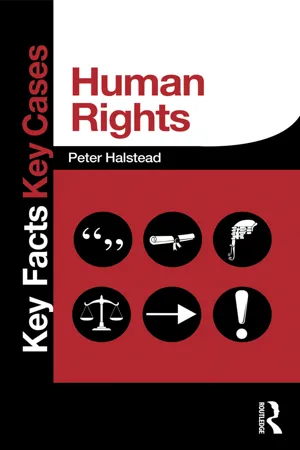
Table of contents

  1. Cover
  2. Half Title
  3. Title Page
  4. Copyright Page
  5. Table of Contents
  6. Preface
  7. Table of Cases
  8. Chapter 1. Introduction
  9. Chapter 2. European Convention on Human Rights
  10. Chapter 3. The Human Rights Act
  11. Chapter 4. The Right to Life
  12. Chapter 5. Torture, Inhuman or Degrading Treatment or Punishment
  13. Chapter 6. Public Order, Police Powers and Freedom of Assembly
  14. Chapter 7. Rights to Liberty, Security and Fair Trial
  15. Chapter 8. Freedom of Expression
  16. Chapter 9. Privacy, Family Life and Marriage
  17. Chapter 10. Discrimination
  18. Chapter 11. Terrorism and Counter-Terrorism Measures
  19. Chapter 12. Freedom of Thought, Conscience and Religion
  20. Chapter 13. Human Property Rights
  21. Chapter 14. Themes, Issues and the Future
  22. Chapter 15. Global and Regional Human Rights
  23. Index

Frequently asked questions

Yes, you can cancel anytime from the Subscription tab in your account settings on the Perlego website. Your subscription will stay active until the end of your current billing period. Learn how to cancel your subscription
No, books cannot be downloaded as external files, such as PDFs, for use outside of Perlego. However, you can download books within the Perlego app for offline reading on mobile or tablet. Learn how to download books offline
Perlego offers two plans: Essential and Complete
  • Essential is ideal for learners and professionals who enjoy exploring a wide range of subjects. Access the Essential Library with 800,000+ trusted titles and best-sellers across business, personal growth, and the humanities. Includes unlimited reading time and Standard Read Aloud voice.
  • Complete: Perfect for advanced learners and researchers needing full, unrestricted access. Unlock 1.4M+ books across hundreds of subjects, including academic and specialized titles. The Complete Plan also includes advanced features like Premium Read Aloud and Research Assistant.
Both plans are available with monthly, semester, or annual billing cycles.
We are an online textbook subscription service, where you can get access to an entire online library for less than the price of a single book per month. With over 1 million books across 990+ topics, we’ve got you covered! Learn about our mission
Look out for the read-aloud symbol on your next book to see if you can listen to it. The read-aloud tool reads text aloud for you, highlighting the text as it is being read. You can pause it, speed it up and slow it down. Learn more about Read Aloud
Yes! You can use the Perlego app on both iOS and Android devices to read anytime, anywhere — even offline. Perfect for commutes or when you’re on the go.
Please note we cannot support devices running on iOS 13 and Android 7 or earlier. Learn more about using the app
Yes, you can access Human Rights by Peter Halstead in PDF and/or ePUB format, as well as other popular books in Jura & Rechtstheorie & -praxis. We have over one million books available in our catalogue for you to explore.